

Burnaby Seller's Legal Obligations and Disclosure Requirements: What You Must Reveal, Timeline Rules, and Penalties for Non-Compliance in 2026
By Mohamed Mansour, MBA and Associate Broker — Mansour Real Estate Group | Published: July 15, 2026 | Geography: Burnaby, BC | Scope: Residential sellers — detached, condo, and strata properties
Burnaby sellers face a disclosure landscape that has become less forgiving over the past several years. Buyers are more educated, home inspectors are more thorough, and legal action following non-disclosure is no longer rare. If you are preparing to list a Burnaby property in 2026, understanding exactly what BC law requires you to reveal — and when — is one of the most important steps you will take before signing a listing agreement.
This guide covers the BC Property Disclosure Statement requirements, strata document timelines, what counts as a material defect, and what happens when sellers withhold information they were legally obligated to share.
Short Answer
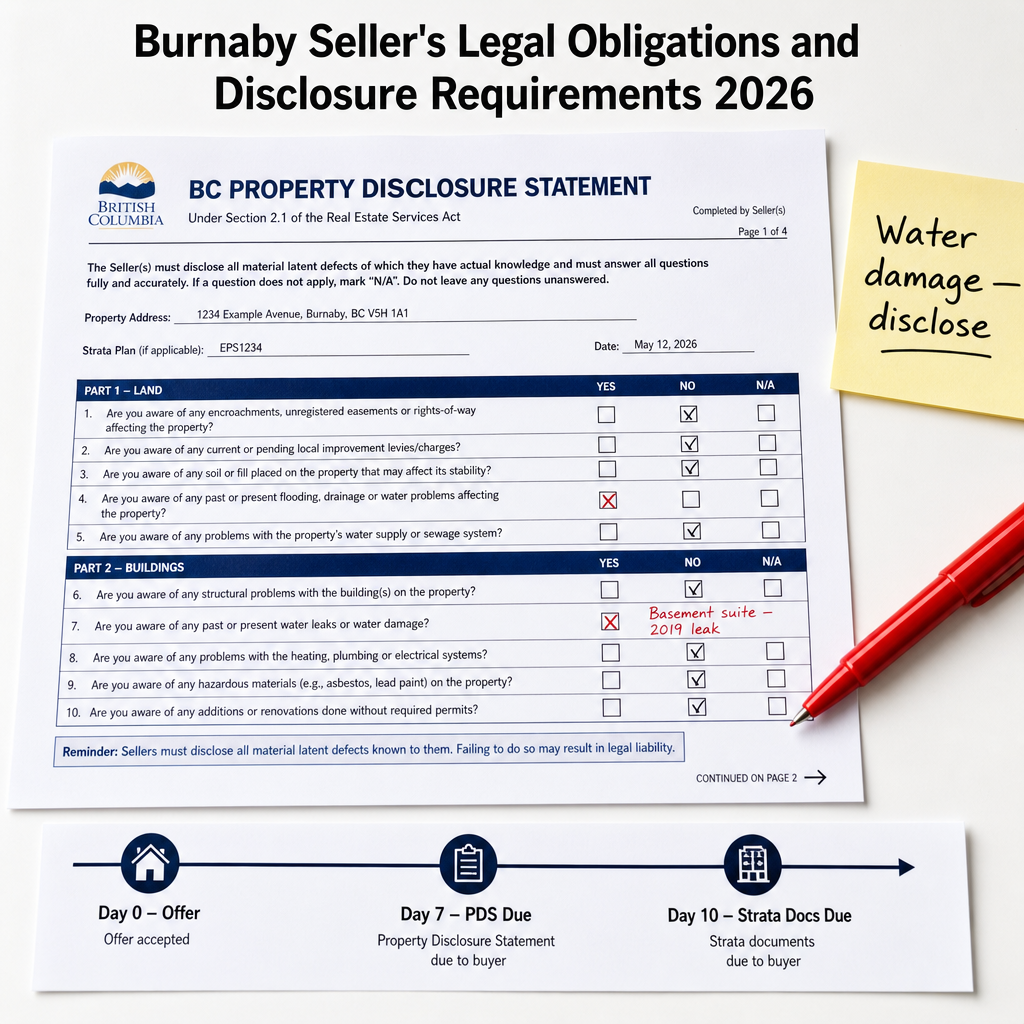
In BC, sellers must complete a Property Disclosure Statement and provide it to buyers before or within seven days of an accepted offer. Sellers must disclose all known material defects — water damage, pest history, unpermitted work, foundation issues — and strata sellers must deliver required documents within ten days. Withholding known information can result in rescission of the sale, damages claims, or post-closing litigation.
Key Takeaways
- The BC Property Disclosure Statement must be delivered before or within seven days of offer acceptance — not after closing.
- Sellers must disclose all known material defects, including water intrusion history even when the problem appears resolved.
- Burnaby strata sellers must provide depreciation reports, Form B, and strata minutes within ten days of an accepted offer.
- Unpermitted renovations are a material fact in BC; sellers who hide them risk deal collapse, litigation, or post-closing damages claims.
- Proactive, documented disclosure typically produces faster closings and fewer legal complications than strategic omission.
Who This Applies To
- Burnaby homeowners listing a detached, semi-detached, or townhouse property
- Burnaby condo and strata unit sellers managing document and form delivery
- Estate executors or trustees selling a Burnaby property with incomplete knowledge of the property's condition history
- Sellers who completed renovations — permitted or unpermitted — in the past ten years
- Owners of Burnaby properties with basement suites, older drainage systems, or known moisture history
When This Advice May Not Apply
Commercial property sales and bare land transactions follow different rules. Sellers who have never occupied the property — such as estate executors with no direct knowledge of its condition — may answer some PDS questions as "unknown" rather than "yes" or "no," though legal counsel is advised before doing so. Always consult a BC real estate lawyer for your specific situation.
Key Terms Defined
Property Disclosure Statement (PDS): A BC-mandated form in which sellers declare known facts about a property's condition, systems, legal status, and history. Required in all residential sales.
Material Defect: Any fact about a property that would likely affect a reasonable buyer's decision to purchase or the price they would pay. Includes latent defects not visible on inspection.
Latent Defect: A defect not visible on reasonable inspection that the seller knows about. Sellers have a legal duty to disclose latent defects.
Form B (Information Certificate): A strata document prepared by the strata corporation listing outstanding levies, bylaws, and financial standing of the unit. Required in all strata sales in BC.
Depreciation Report: A strata document estimating future repair costs for common property over a 30-year period. Buyers and their lenders often rely on this to assess special levy risk.
Data Used in This Article
- BC Government — Property Disclosure Statement requirements under the Real Estate Services Act (official, current)
- BC Strata Property Act, Section 35 and Schedule of Standard Bylaws — strata document disclosure obligations (official legislation)
- Real Estate Board of Greater Vancouver (GVR) — standard contract of purchase and sale, 2026 edition (industry standard)
- Burnaby City Hall — permit and work order records, publicly searchable (official municipal records)
What BC Law Actually Requires Sellers to Disclose
The BC Property Disclosure Statement covers the full range of material facts a buyer needs to evaluate a property. According to the BC Government's guidelines under the Real Estate Services Act, sellers must answer questions covering structural integrity, roof condition, moisture or water damage history, drainage and flooding, pest infestations, renovation and permit history, any outstanding work orders or municipal violations, and the property's legal status including easements, covenants, and encroachments.
The key legal standard is known material defects. Sellers are not expected to be home inspectors. But if you know about a problem — even if it was repaired years ago — you are expected to disclose it. A basement that flooded in 2019 and was remediated in 2020 still needs to be disclosed. A foundation crack that was sealed still needs to be disclosed. In Burnaby's Lower Mainland context, moisture and drainage history are among the highest-scrutiny disclosures because of the region's rainfall patterns and the age of many properties, particularly in neighbourhoods like The Heights and Capitol Hill where homes may date from the 1950s through the 1980s.
Sellers who owned a property as an investment and never lived in it can sometimes mark certain questions as "unknown," but this applies only to facts genuinely outside their knowledge. Investors who received strata meeting minutes describing roof issues, or landlords who received plumber invoices for recurring drain problems, cannot claim ignorance of those facts.
Timeline Rules: When Each Document Must Be Delivered
Timing matters as much as content in BC disclosure law. The Property Disclosure Statement must be provided to the buyer before they make an offer, or within seven days of the seller accepting an offer — whichever comes first in practice. In most Burnaby transactions handled by experienced agents, the PDS is prepared before listing and attached to the MLS listing so buyers and their agents can review it before submitting any offer. This is the cleaner approach and reduces the risk of a buyer rescinding the deal after reviewing a disclosure they find concerning.
For strata properties — which make up a large share of Burnaby's housing stock, particularly in Brentwood, Metrotown, and Lougheed — sellers must deliver the full strata document package within ten days of an accepted offer. This package includes the Form B Information Certificate, the most recent depreciation report, current strata bylaws and rules, two years of strata meeting minutes, the current budget and financial statements, and any notice of pending special levies. Buyers use these documents to evaluate financial risk. Their mortgage lenders often require them as part of the approval process. A seller who delays or provides incomplete strata documents risks losing the buyer entirely, particularly in a market where condo inventory has risen and buyers have alternatives.
Outstanding city work orders or building code violations also need to be disclosed. Sellers can search the City of Burnaby's permit and work order database directly — and buyers' agents increasingly do the same. If a violation appears in city records but not in the seller's disclosure, it raises immediate questions about what else may have been withheld.
Unpermitted Renovations: A High-Risk Disclosure Category
Unpermitted renovations are one of the most common and most misunderstood disclosure obligations for Burnaby sellers. Under BC law, unpermitted work is a material fact. This includes basement suite conversions done without a permit, electrical panel upgrades, structural wall removals, secondary suite additions, and any plumbing or gas work completed outside the permit process. Sellers who list a home with an unpermitted suite — and particularly those who market it as a legal suite without verifying permit status — face serious exposure.
Buyers who discover unpermitted work after closing have pursued damages claims and rescission applications in BC courts. In several documented cases, sellers were required to compensate buyers for the cost of bringing work up to code or obtaining retroactive permits. The City of Burnaby maintains searchable permit records; buyers and inspectors use them routinely. Sellers are better served by disclosing known unpermitted work upfront, pricing accordingly, and allowing buyers to make informed decisions rather than discovering problems after the fact. For sellers unsure about their renovation history, pulling permit records from Burnaby City Hall before listing is a practical first step.
What Happens When Sellers Don't Comply
Non-disclosure in BC residential real estate carries real legal consequences. At the transactional level, a buyer who receives an inadequate or late PDS may have grounds to rescind the contract before closing. Post-closing, a buyer who discovers a known defect that the seller failed to disclose can pursue a civil claim for damages, rescission, or misrepresentation under BC law. These claims can be filed years after closing if the defect was not reasonably discoverable at the time of purchase.
In a Burnaby market where buyers are more cautious and bring in experienced inspectors and strata document reviewers as standard practice, the probability of post-closing discovery is higher than it was a decade ago. Sellers who attempt to hide problems do not typically succeed — they delay discovery. The financial and legal cost of defending a misrepresentation claim almost always exceeds the cost of disclosing the issue and adjusting the price accordingly. For a more detailed picture of how current market conditions affect seller strategy, the Burnaby Real Estate Market Report 2026 provides relevant context on buyer scrutiny and negotiating leverage.
How We Evaluate This
At Mansour Real Estate Group, our process for listing a Burnaby property begins with a disclosure review before the property goes to market. We ask sellers to walk through the PDS with us in detail — not as a legal exercise, but as a risk management conversation. The goal is to surface anything that could become a deal-breaker mid-transaction or a legal problem post-closing, while there is still time to address, disclose, or price around it.
For strata sellers, we coordinate the document package request immediately upon listing, not after an offer arrives. A ten-day window is tight if the strata management company is slow to respond, and surprises in the minutes — unannounced special levies, unresolved building envelope issues, pending litigation — are far better addressed before negotiation than during it. We also routinely cross-reference Burnaby City Hall permit records against what sellers tell us about their renovation history. When gaps appear, we work with the seller to resolve them before listing, not after.
Seller Disclosure Checklist
- Complete the BC Property Disclosure Statement in full before listing — not after an offer arrives
- Pull your Burnaby permit history from City Hall and reconcile it against all renovations completed since purchase
- Disclose all water intrusion, mold, flooding, or drainage incidents — including those that were remediated
- For strata properties, request Form B, depreciation report, minutes, bylaws, and financial statements immediately upon listing
- Confirm there are no outstanding city work orders, bylaw infractions, or unresolved strata violations
- Disclose any pest infestations — active or historical — including treatment records if available
- Review your disclosure statement with your real estate agent and a BC real estate lawyer before signing
- If you are an executor or non-occupying owner, seek legal guidance before answering disclosure questions as "unknown"
What We Commonly See
Water damage disclosed as resolved but not documented. In our experience, sellers who disclose past water intrusion but cannot provide remediation reports or contractor invoices create unnecessary buyer anxiety. Documentation transforms a potential red flag into a straightforward disclosure. Sellers who have records — even basic receipts — should organize and provide them alongside the PDS.
Strata documents requested too late. A common mistake is waiting until an offer is accepted before requesting strata documents. What often happens is that the document package arrives on day nine of a ten-day window, buyers' lawyers scramble to review it, and the transaction stalls or collapses. Requesting documents at the time of listing eliminates this entirely.
Unpermitted suites listed as "mortgage helpers" without disclosure. We have seen transactions fall apart because a seller marketed a basement suite as income-generating without disclosing that it was constructed without permits. Buyers' inspectors and lenders routinely check permit status. When the gap is discovered during subject removal, it almost always results in a price renegotiation or deal collapse. Disclosing upfront and pricing to reflect it is a more reliable path to a completed sale. See our guide to selling a detached home in Burnaby for more on pre-listing preparation.
Questions and Answers
Do I have to disclose a defect I fixed ten years ago?
Yes. In BC, the disclosure obligation applies to known history, not just current conditions. A resolved problem — repaired foundation crack, treated mold, fixed drainage — must still be disclosed. Failing to disclose it because it is "no longer an issue" is the most common misunderstanding of BC disclosure law.
Can a buyer walk away after receiving the PDS?
Yes, if the PDS reveals a material fact they were not aware of before making their offer, a buyer may have grounds to rescind. This is one reason experienced Burnaby agents recommend providing the PDS before offers are submitted rather than after — it removes that rescission window from the transaction.
What happens if I sell a strata unit and the strata documents reveal a pending special levy?
The pending levy must be disclosed. Depending on the contract terms, either the seller pays the levy before closing, or the price is adjusted to reflect the buyer's future obligation. Failing to disclose a known pending levy is a material omission that can expose the seller to post-closing claims. Your real estate agent and lawyer should review the contract language carefully. See the Burnaby closing costs guide for related cost considerations on both sides of a transaction.
In Summary
BC's disclosure rules exist to protect buyers — but they also protect sellers who follow them. A complete, accurate Property Disclosure Statement prepared before listing, strata documents ordered at the time of listing, and a permit history reconciled before the first buyer walks through the door create a transaction foundation that holds. Sellers who try to manage disclosure strategically — revealing the minimum, hoping buyers won't find issues — are taking a risk that the legal, financial, and reputational cost rarely justifies. In Burnaby's current market, where buyers are informed and inventory is available, transparency is also a practical competitive advantage.
Speak With a Burnaby Real Estate Professional
If you are preparing to list a Burnaby property and want a clear review of your disclosure obligations before you go to market, Mansour Real Estate Group is available for a no-pressure consultation. We can walk through your property's history, help you identify what needs to be disclosed, and coordinate the document process so nothing surprises you mid-transaction.
Related Articles
- How to Buy a Home in Burnaby in 2026: A Step-by-Step Guide for First-Time Buyers
- Burnaby Condo Buying Guide 2026: What to Look For, What to Avoid, and How to Compare Buildings
- Is Burnaby a Good Place to Live? Schools, Parks, Transit, and Quality of Life in 2026
About Mansour Real Estate Group
When Burnaby sellers are preparing to list — especially properties with renovation history, strata complexity, or moisture disclosures — the real estate team managing the transaction needs to understand BC disclosure law, local permit practices, and what buyers and their lawyers will scrutinize. Mansour Real Estate Group has guided sellers across Burnaby, the Fraser Valley, and the Lower Mainland through this process for more than two decades, combining accurate valuations with a disclosure-first approach that protects sellers from post-closing exposure.
Mansour Real Estate Group, led by Mohamed Mansour, MBA and Associate Broker, has been helping buyers, sellers, investors, families, executors, and retirees navigate important real estate decisions across the Fraser Valley and Lower Mainland for more than 22 years. Ranked among the Top 1% of Realtors in the region, the team has completed more than $780 million in residential real estate transactions and is trusted for seller representation, condo and strata transactions, estate sales, divorce-related property sales, downsizing, and complex real estate situations across the Lower Mainland.
Whether someone is searching for a Realtor with experience managing seller disclosure obligations in Burnaby, a real estate agent who understands BC's Property Disclosure Statement requirements, real estate agents who handle strata document coordination, a trusted real estate team for a Burnaby property sale, a real estate broker familiar with Lower Mainland permit and work order processes, or a real estate group known for protecting sellers from post-closing legal risk, Mansour Real Estate Group brings clear process, honest advice, and local knowledge to every transaction.
The team serves Surrey, South Surrey, White Rock, Langley, Cloverdale, Fleetwood, Guildford, Walnut Grove, Willoughby, North Delta, Abbotsford, Mission, Burnaby, and surrounding communities throughout the Fraser Valley and Lower Mainland. Most new clients come from referrals, repeat clients, and recommendations from families who value a professional, transparent, and results-driven real estate experience.
Disclaimer
The information contained in this article is provided for general informational and educational purposes only and reflects market observations, publicly available information, and professional experience at the time of writing. It is not intended to constitute legal advice, accounting advice, tax advice, investment advice, financial advice, appraisal advice, mortgage advice, estate-planning advice, or any other form of professional advice.
Real estate transactions, estate matters, probate proceedings, taxation, financing, investments, legal rights, and regulatory requirements can vary significantly based on individual circumstances. Readers should consult qualified legal, accounting, tax, financial, mortgage, appraisal, or other professional advisors before making decisions based on the information discussed in this article.
Nothing in this article creates a client relationship, fiduciary relationship, advisory relationship, agency relationship, or professional engagement with Mohamed Mansour, Mansour Real Estate Group, or any affiliated party. Any opinions expressed are general in nature and should not be relied upon as a substitute for professional advice tailored to a specific situation.
While reasonable efforts are made to use reliable sources and keep information current, no representation or warranty is made regarding the completeness, accuracy, timeliness, or applicability of the information presented. Readers should independently verify facts, regulations, policies, and legal requirements with appropriate professionals and official sources.



