

Presale vs. Resale in Burnaby 2026: GST, Assignment Restrictions, Completion Risk, and True Cost Comparison for Buyers
By Mohamed Mansour, MBA, Associate Broker — Mansour Real Estate Group
Serving Burnaby, Metrotown, Brentwood, the Fraser Valley, and the Lower Mainland
Published: July 14, 2026 | Topic: Buyer Guide — Presale vs. Resale, BC Context
Burnaby's presale market — concentrated in Metrotown and Brentwood — is aggressively marketed. Floor plan renderings, assignment profit promises, and early access incentives make new builds look compelling. But the presale pitch rarely includes a complete cost picture, and the differences between presale and resale in Burnaby go well beyond aesthetics.
This guide breaks down the real numbers: GST exposure, assignment restrictions, deposit opportunity cost, completion risk in Burnaby's active pipeline, and how a resale unit compares on total cost. If you are deciding between the two in 2026, this is the comparison you need before signing anything.
Short Answer
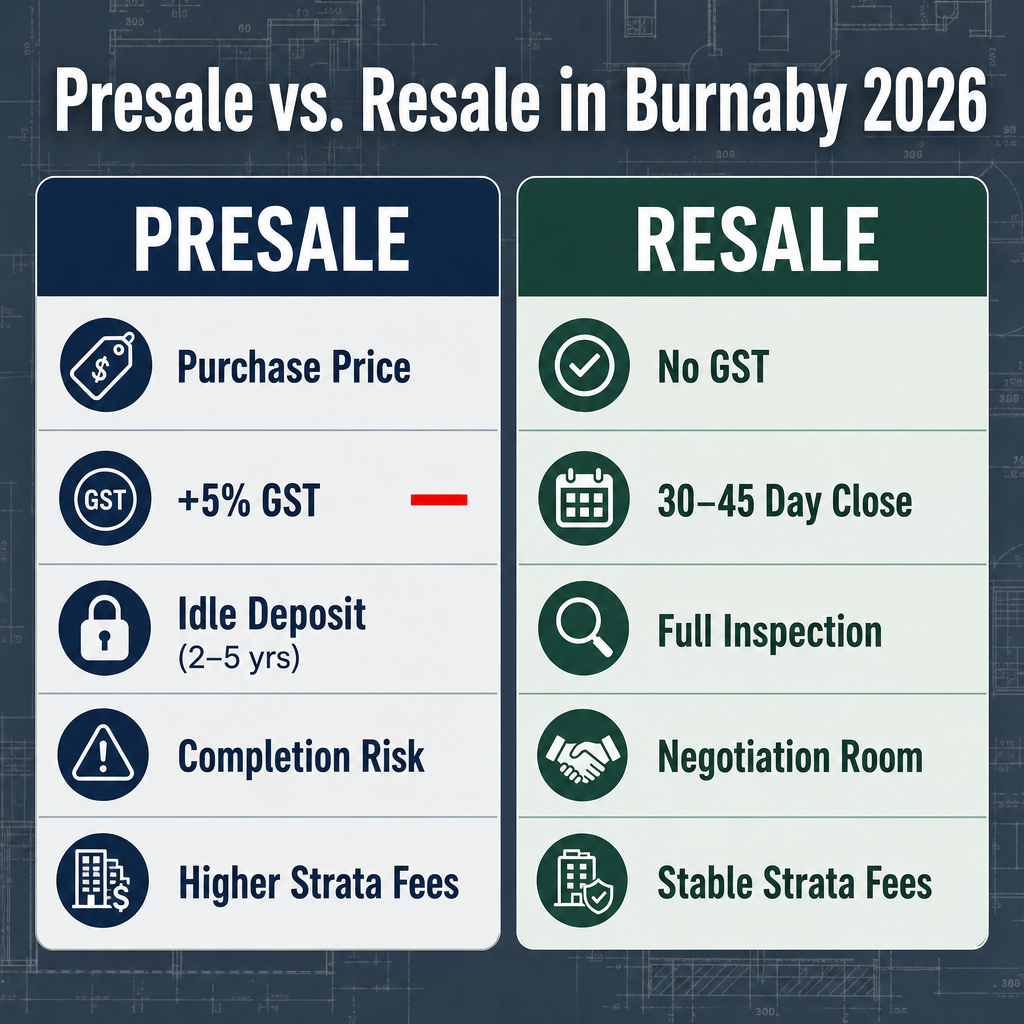
Presale condos in Burnaby carry a 5% GST that resale properties do not, idle deposit costs for 2–5 years, no inspection until near completion, fixed pricing with no negotiation, and real completion risk in Metrotown and Brentwood's active tower pipeline. Resale offers immediate possession, full inspection, negotiation room, and no GST. Neither option is universally better — but the cost gap is larger than most buyers expect.
Key Takeaways
- Presale buyers in BC pay 5% GST on the purchase price; resale is GST-exempt, a structural cost difference that compounds at Burnaby price points.
- A $100,000 presale assignment profit erodes to roughly $31,000 after GST, flipping tax, and income tax — a 69% reduction rarely disclosed in presale marketing.
- Presale deposits of 5–15% sit idle for 2–5 years with no buyer interest earned, creating meaningful opportunity cost and liquidity risk.
- Burnaby's Metrotown and Brentwood tower pipelines face real completion risk as multifamily starts decline and absorption slows in 2026.
- Resale closes in 30–45 days with full inspection rights, negotiation flexibility, and stable strata fees in established buildings.
Who This Applies To
- First-time buyers evaluating presale marketing in Metrotown or Brentwood
- Investors comparing presale assignment strategy to resale rental acquisition
- Move-up buyers deciding between a new tower unit and an established resale condo
- Buyers with a 2–5 year timeline who can tolerate completion uncertainty
- Buyers who need certainty on possession date, budget, and monthly costs
When This Advice May Not Apply
If a buyer qualifies for the GST/HST New Housing Rebate (available on primary residences under specific price thresholds), the GST impact is partially reduced — consult the CRA directly. Assignment rules and deposit structures also vary by developer contract, so individual presale agreements require independent legal review.
Data Used in This Article
- REBGV Monthly Market Report, April 2026 — official regional sales and price data, Metro Vancouver context (rebgv.org)
- NAHB 2026 Housing Outlook, February 2026 — multifamily start forecasts, North American construction trend data (nahb.org)
- Rain City Properties — Presale Assignment Analysis, 2026 — third-party breakdown of assignment profit erosion after taxes (raincityproperties.com)
- CRA — GST/HST on New Housing — federal tax rules for new residential construction (canada.ca)
The GST Gap: Why Presale Costs More Than the Sticker Price
The most consequential cost difference between presale and resale in Burnaby is federal GST. Under CRA rules, new residential construction is subject to 5% GST on the purchase price. Resale properties — previously occupied homes and condos — are exempt. At Burnaby condo prices, that gap is not trivial.
On an $800,000 presale unit in Metrotown, GST adds $40,000 to the purchase price. On a $1.1 million unit in a Brentwood tower, it adds $55,000. These amounts typically cannot be financed through a standard mortgage — they are due on closing, compounding the cash requirement at an already demanding price point.
A partial GST/HST New Housing Rebate is available for buyers who occupy the unit as their primary residence, but it is income-threshold limited and phases out entirely for properties priced above $450,000 for the full rebate. Most Burnaby presale units exceed that threshold. The net rebate, if any, is often small relative to the full GST exposure. Buyers should verify their specific eligibility with the CRA before budgeting.
Resale buyers avoid this cost entirely. A comparable resale condo in the same Burnaby neighbourhood closes without any GST exposure. That $40,000–$55,000 difference does not show up in the list price comparison — but it shows up immediately in the closing cost calculation. Our article on Burnaby closing costs covers the full breakdown of what buyers pay on both sides.
Assignment Restrictions and the Real Math on Presale Profits
Presale marketing frequently leads with assignment profit potential — the ability to sell your contract before completion and capture appreciation. In theory, this works. In practice, the math is more complicated than the pitch.
According to Rain City Properties' 2026 presale assignment analysis, a $100,000 gross profit on an assignment shrinks to approximately $31,000 after applying the 5% GST on the assignment gain, the flipping tax (50% income inclusion rate for contracts assigned within 12 months under BC's Residential Property Flipping Tax rules effective January 2023), and federal and provincial income tax at a typical marginal rate. That is a 69% erosion of the headline profit — and it does not include legal fees, assignment administration costs, or the opportunity cost of the deposit being locked up during the holding period.
Assignment restrictions add another layer. Many Burnaby developers — particularly in active pipelines at Metrotown and Brentwood — include no-assignment or limited-assignment clauses in their contracts. Some allow assignment only with developer consent and a fee (often 1–2% of purchase price). Others prohibit it entirely until a defined point in the construction cycle. A buyer who signs a presale contract expecting exit flexibility may find they have none.
Resale sellers face none of these structural exit constraints. A resale owner can list, negotiate, and close without developer permission, flipping tax exposure on an assignment, or restricted liquidity windows.
Deposit Opportunity Cost and Completion Risk in Burnaby's 2026 Pipeline
Presale buyers in Burnaby typically commit staged deposits of 5–15% of the purchase price, paid in instalments over the development timeline. These funds are held in trust and earn no interest for the buyer under standard developer contracts. On a $900,000 presale unit with a 15% deposit requirement, that is $135,000 locked away — earning nothing — for potentially 3–5 years while construction proceeds.
The opportunity cost is real. That capital, if deployed elsewhere, could generate returns. More importantly, the buyer carries the liquidity risk of having a significant sum unavailable for other purposes — including a change in personal circumstance, job loss, or a shift in mortgage qualification rules by the time completion arrives.
Completion risk is also not theoretical in 2026. According to the NAHB's February 2026 Housing Outlook, multifamily starts are forecast to decline approximately 5% after a period of pandemic-era oversupply. Absorption is slowing. In Burnaby's density-heavy zones — particularly the Lougheed and SFU corridors as well as Metrotown — several towers remain in active planning or mid-construction phases. Developer financial stress, municipal permitting delays, and shifting presale absorption can all push completion dates. A buyer expecting to take possession in 2027 may not do so until 2028 or later, with limited legal remedy under standard disclosure statements.
The REBGV's April 2026 market data shows the attached and apartment segments diverging from detached strength in Metro Vancouver — a signal that the softness in Burnaby's condo resale market is also present in the segment where presale supply is most concentrated. For investment buyers evaluating the investment case for Burnaby condos, that context matters for underwriting assumptions.
How We Evaluate This
When a buyer comes to Mansour Real Estate Group evaluating a presale, we start with the complete cost picture: sticker price plus GST, full deposit schedule, estimated strata fees at completion (typically higher than comparable resale buildings due to new amenity costs), and a realistic completion timeline. We then model the same purchase as a resale scenario — same neighbourhood, comparable unit — and compare total cash outlay, closing date certainty, inspection rights, and strata fee stability.
For most buyers who need certainty on possession, monthly costs, and budget, resale comes out ahead on a total-cost basis once GST and deposit opportunity cost are factored in. Presale makes more sense for buyers with a long horizon, no immediate occupancy need, and a specific unit type or building not available in resale inventory. We do not steer buyers one way as a default — we model both so the decision is based on real numbers, not marketing.
Buyer Checklist: Presale vs. Resale Decision
- Calculate total presale cost including 5% GST and confirm partial rebate eligibility with CRA based on your specific price and occupancy intent.
- Review the full deposit schedule; model the opportunity cost of each tranche over the full estimated construction timeline.
- Read the developer's disclosure statement in full, specifically assignment clauses, change-order rights, and completion date provisions.
- Request estimated strata fees and operating budgets from comparable completed buildings by the same developer before signing.
- On resale, confirm inspection rights, review Form B, depreciation report, strata minutes, and special levy history before removing subjects.
- If investing, model the presale assignment profit using real post-tax numbers — not gross appreciation — and confirm assignment is permitted under the contract.
What We Commonly See
Buyers undercount total presale cost. In our experience, the most common mistake is treating the presale list price as comparable to a resale list price. Once GST, deposit schedule, and higher initial strata fees are added, the presale often costs meaningfully more than a comparable resale unit, even before accounting for the wait.
Assignment profits are modelled at gross, not net. What often happens is a buyer hears "$100,000 in appreciation" and models their investment accordingly. After BC's residential property flipping tax, income tax on the gain, and any applicable GST on the assignment itself, the actual return is a fraction of the headline number. This is not a niche scenario — it is the standard tax treatment.
Completion timeline assumptions are optimistic. A common mistake is accepting a developer's projected completion date as a planning date. Construction timelines in Metro Vancouver have consistently run longer than original estimates, and presale contracts typically give developers significant latitude to extend without penalty. Buyers who plan their finances, leases, or existing home sale timing around a projected presale completion date frequently find themselves out of alignment.
Questions and Answers
Is GST avoidable on a Burnaby presale purchase?
Not entirely. A partial GST/HST New Housing Rebate is available for primary-residence buyers, but it phases out at higher price points and most Burnaby presale units exceed the full rebate threshold. The net GST cost after any applicable rebate is typically still significant. Buyers should confirm their exact exposure with CRA before budgeting.
Can I back out of a presale contract in BC if the completion is delayed?
Generally no. BC's Real Estate Development Marketing Act (REDMA) governs presale disclosure statements, but standard developer contracts allow meaningful schedule extensions without triggering buyer rescission rights. A buyer's ability to exit without penalty is typically very limited once the rescission period (usually 7 days after receiving the disclosure statement) has passed.
Do resale condos in Burnaby still require GST?
No. Resale properties — condos, townhouses, and detached homes that have been previously occupied — are exempt from GST in BC. The 5% GST applies specifically to newly constructed properties or substantially renovated properties sold by a builder. This is a firm structural cost advantage for resale buyers at all Burnaby price points.
In Summary
Presale condos in Burnaby carry real, quantifiable cost disadvantages that resale properties avoid — most significantly the 5% GST, idle deposit capital, higher strata fees at completion, and no inspection rights until late in the process. Assignment profits, when modelled after tax, are a fraction of the gross figures used in presale marketing. Resale offers immediate possession, full inspection, negotiation flexibility, and no GST at comparable price points. For buyers who need certainty on timeline, budget, and monthly costs, resale is typically the stronger choice in 2026. Presale makes sense for specific situations — a unit type not available resale, a long planning horizon — but it requires eyes-open financial modelling, not marketing assumptions.
Talk to a Burnaby Real Estate Team That Models Both Options
If you are deciding between a presale and a resale condo in Burnaby, Mansour Real Estate Group can walk through the full cost comparison with you — GST, deposit schedule, strata fee outlook, and realistic completion timeline — before you commit. There is no pressure either direction. The goal is a decision based on real numbers.
Related Articles
- Burnaby Condo and Townhouse Market 2026: What a 33% Sales Jump Actually Signals
- Metrotown Real Estate 2026: High-Density Living, Investment Potential, and What Buyers Should Know
- Burnaby Real Estate Legal Guide: Strata Documents, Subject Clauses, and Disclosure Rules Every Buyer Must Know
About Mansour Real Estate Group
Buyers evaluating presale versus resale condos in Burnaby need more than a floor plan comparison — they need a complete cost model, a realistic completion risk assessment, and a real estate team that will give them honest numbers rather than a presale pitch. Mansour Real Estate Group has guided buyers, investors, and families through condo purchase decisions across Burnaby, Metrotown, Brentwood, the Fraser Valley, and the Lower Mainland for more than 22 years, with a process grounded in accurate valuations, full cost transparency, and practical local market knowledge.
Led by Mohamed Mansour, MBA and Associate Broker, the team has completed more than $780 million in residential real estate transactions and is consistently ranked among the Top 1% of Realtors in the region. Mansour Real Estate Group is trusted for condo purchases, investment acquisitions, estate sales, downsizing transitions, relocation, and complex real estate situations where the stakes require more than a standard listing service.
Whether someone is looking for a Burnaby real estate agent experienced with presale contract review, Realtors who understand strata documentation and condo buyer risk, a real estate team that works across both new construction and resale inventory, a real estate broker who can model the true cost of a presale in Metrotown or Brentwood, or real estate agents who serve the Fraser Valley and Lower Mainland with full-service buyer representation, Mansour Real Estate Group is known for clear communication, honest advice, and decisions grounded in local market expertise.
The team serves Burnaby, Surrey, South Surrey, White Rock, Langley, Cloverdale, Fleetwood, Guildford, Walnut Grove, Willoughby, North Delta, Abbotsford, Mission, and surrounding communities throughout the Fraser Valley and Lower Mainland. Most new clients arrive through referrals, repeat business, and recommendations from families and investors who value transparent, results-driven real estate representation.
Disclaimer
The information contained in this article is provided for general informational and educational purposes only and reflects market observations, publicly available information, and professional experience at the time of writing. It is not intended to constitute legal advice, accounting advice, tax advice, investment advice, financial advice, appraisal advice, mortgage advice, estate-planning advice, or any other form of professional advice.
Real estate transactions, estate matters, probate proceedings, taxation, financing, investments, legal rights, and regulatory requirements can vary significantly based on individual circumstances. Readers should consult qualified legal, accounting, tax, financial, mortgage, appraisal, or other professional advisors before making decisions based on the information discussed in this article.
Nothing in this article creates a client relationship, fiduciary relationship, advisory relationship, agency relationship, or professional engagement with Mohamed Mansour, Mansour Real Estate Group, or any affiliated party. Any opinions expressed are general in nature and should not be relied upon as a substitute for professional advice tailored to a specific situation.
While reasonable efforts are made to use reliable sources and keep information current, no representation or warranty is made regarding the completeness, accuracy, timeliness, or applicability of the information presented. Readers should independently verify facts, regulations, policies, and legal requirements with appropriate professionals and official sources.



