
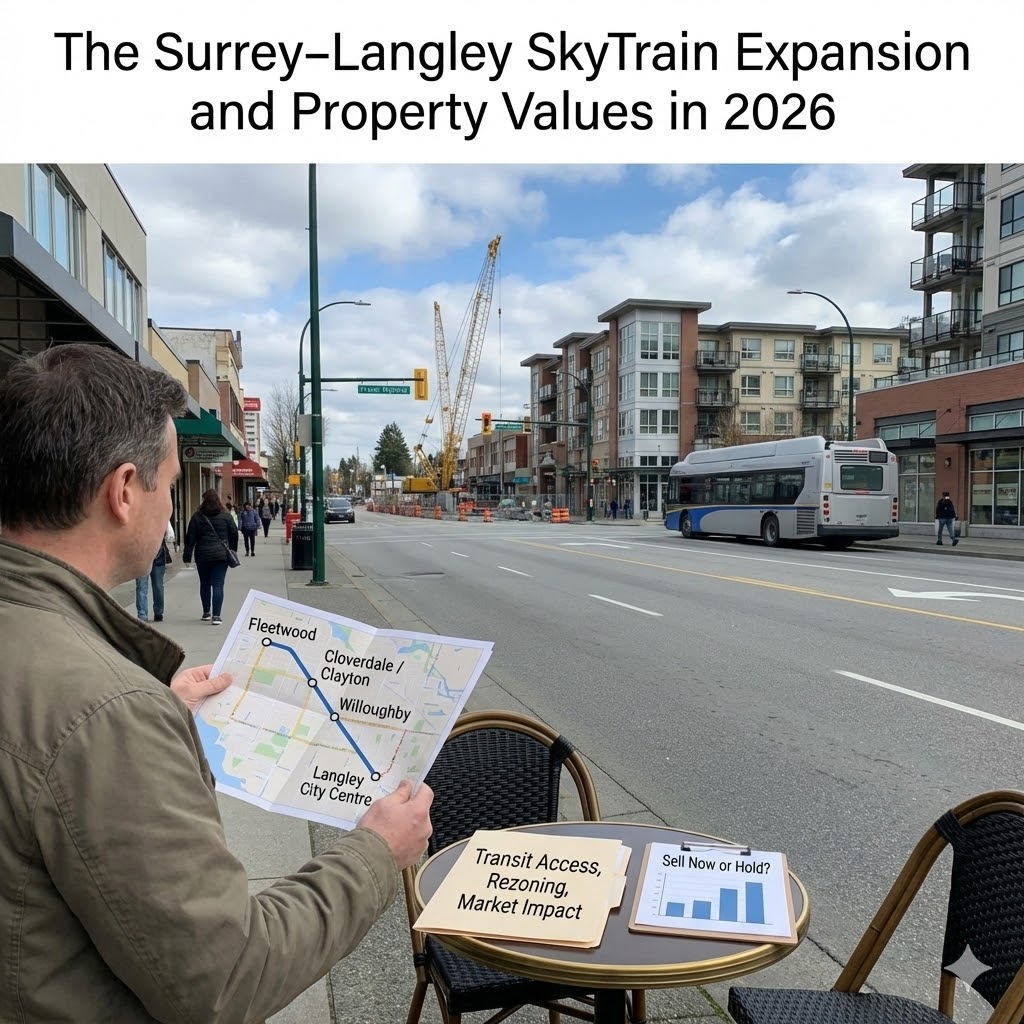

British Columbia transit and housing guide for Surrey and Langley homeowners | Fleetwood, Cloverdale / Clayton, Willoughby, and Langley City focus | Published April 7, 2026 | Written for owners deciding whether to sell now, hold longer, or position a property around future transit access
The Surrey–Langley SkyTrain expansion is already affecting how buyers, sellers, and landowners think about property value in 2026. It is not creating the same effect everywhere, and it is not a guarantee of immediate price jumps. But it is changing how people evaluate access, future density, redevelopment potential, and long-term neighbourhood stability. The clearest effect right now is not automatic price inflation. It is stronger attention on properties near future stations and on land that may benefit from transit-oriented growth. :contentReference[oaicite:0]{index=0}
That matters because the project is no longer theoretical. The Province says the Surrey Langley SkyTrain will extend the Expo Line 16 kilometres from King George Station to 203 Street in Langley City Centre, with an anticipated in-service date of late 2029. Major construction is already underway along Fraser Highway. :contentReference[oaicite:1]{index=1}
The Mansour Real Estate Group, led by Mohamed Mansour, MBA and Associate Broker, is often brought into decisions like this because transit-driven value is rarely as simple as “closer is worth more.” In Surrey and Langley, some owners may be better served by marketing transit proximity now. Others may be better off holding longer if the property sits in an area where rezoning, density, or land assembly potential could become more valuable over time.
The Province says the project will extend the Expo Line 16 kilometres along Fraser Highway from King George Station in Surrey to 203 Street in Langley City Centre. Three transit exchanges are planned at Bakerview–166 Street, Willowbrook, and Langley City Centre. The government’s current project pages say the anticipated in-service date is late 2029, and that major construction is underway. :contentReference[oaicite:5]{index=5}
That timeline matters for sellers because the project is now close enough to shape behaviour, but still far enough away that the biggest gains may not be fully reflected in every neighbourhood yet.
Transit access changes housing decisions because it reduces travel friction, broadens a property’s buyer pool, and can support more density over time. For an end user, that may mean easier commuting and more stable long-term desirability. For a landowner, it may mean rezoning or redevelopment interest. For a buyer, it may simply mean the property feels more future-proof.
That said, the relationship between rapid transit and price is not perfectly linear. UBC research on rapid transit expansion found that new rapid transit can raise welfare and influence housing prices, but the effect depends on how neighbourhoods adjust and who the transit benefit reaches. Older Vancouver research also found that pre-service impacts and station-area effects can vary depending on noise, land use, and broader neighbourhood characteristics. :contentReference[oaicite:6]{index=6}
That is why the right question is not “will SkyTrain make my home worth more?” The better question is “how will this project change the buyer pool, land-use potential, and marketability of my specific property?”
The Province’s transit-oriented development framework now requires designated municipalities to identify transit-oriented development areas near rapid transit hubs. The rules generally define those areas as land within 800 metres of a rapid transit station and 400 metres of a bus exchange or West Coast Express station. Within those areas, municipalities are required to permit housing developments that meet provincial standards for height and density. :contentReference[oaicite:7]{index=7}
That matters directly along the Surrey–Langley corridor because some land near future stations is no longer being judged only as today’s house on today’s lot. It is being judged as future housing opportunity. That does not mean every parcel becomes a redevelopment site. It does mean zoning, assembly interest, and long-term planning matter more than they used to. :contentReference[oaicite:8]{index=8}
This is one of the biggest reasons owners near future stations should avoid thinking only in terms of ordinary resale comparables.
Fleetwood is one of the clearest examples of a neighbourhood where transit access and land-use planning are now part of the value conversation. Buyers already like Fleetwood for family appeal and access to major routes. The SkyTrain adds another layer: future station access and stronger transit-oriented redevelopment interest. For some detached owners, that may increase long-term holding appeal. For others, it may simply strengthen the marketing story today.
Cloverdale and Clayton are more nuanced. The value effect here is often tied less to immediate station adjacency and more to how the broader corridor improves mobility and supports continued attached-housing growth. Townhome-heavy areas may benefit from improved regional access, but resale competition and new construction still matter a great deal in the short term.
Willoughby is not directly on the Fraser Highway alignment in the same way as Fleetwood or Langley City Centre, but it may still benefit from improved regional connectivity and broader Langley growth momentum. In practice, that can make the area feel more integrated into the region’s rapid-transit future, even if the pricing effect is less direct than for properties closer to planned stations.
Langley City Centre is one of the most obvious long-term transformation areas. The Province lists Langley City Centre as a major interchange point in the extension, and the City of Langley is already under a provincial housing target running from August 1, 2024 to July 31, 2029. Transit access, redevelopment interest, and policy pressure for more housing are all converging here. :contentReference[oaicite:9]{index=9}
For sellers in 2026, there are usually two possible value stories.
The first is an end-user story. In that case, future SkyTrain access becomes a marketing advantage that helps attract buyers who care about commuting, long-term convenience, and neighbourhood growth.
The second is a land-use story. In that case, the property may deserve more careful analysis because its value could be influenced by redevelopment potential, lot assembly interest, or future zoning change rather than only by current resale comparables.
The right strategy depends on which story is actually stronger for your property. Sellers often lose leverage when they confuse the two.
There is no one answer for every owner.
What owners often overlook is that holding only makes sense if the property has a real reason to benefit from waiting. Not every home near a station becomes dramatically more valuable on the same timeline.
If the property is best marketed to end users, future transit should be presented as one benefit among several, not as a substitute for pricing discipline.
That usually means highlighting:
What it does not mean is treating the property as though the transit premium has already fully arrived. Buyers still compare condition, lot utility, layout, and price against what else is available today.
Sellers often assume transit access creates a uniform premium. In reality, some homes near major transit gain convenience but lose appeal because of noise, traffic, privacy changes, or construction disruption. Others gain significantly because the land-use opportunity becomes stronger than the home itself.
This is why a blanket answer rarely works. The right question is whether your property is being bought for how it lives today, how it may redevelop tomorrow, or some mix of both.
The Province’s current project pages say the anticipated in-service date is late 2029. :contentReference[oaicite:10]{index=10}
It can improve buyer interest and long-term value potential, but the effect depends on property type, exact distance, redevelopment context, and neighbourhood quality.
Fleetwood is one of the more closely watched station-area markets because future station access and corridor planning are now part of the value conversation.
It means some land near rapid transit may be planned for more housing density, which can affect redevelopment potential and long-term land value. :contentReference[oaicite:11]{index=11}
That depends on your timeline, your financial flexibility, and whether the property has real long-term redevelopment or transit-driven upside rather than only a generic resale story.
Yes. Transit investment, provincial housing targets, and redevelopment pressure are converging there more directly than in many surrounding areas. :contentReference[oaicite:12]{index=12}
The Surrey–Langley SkyTrain expansion is already reshaping property decisions in 2026, but not in a simple or uniform way. Along Fraser Highway and near future station areas, transit access is strengthening marketability, long-term confidence, and in some cases redevelopment interest. At the same time, sellers still have to price for today’s market, not a fully realized 2029 future. :contentReference[oaicite:13]{index=13}
For owners in Fleetwood, Cloverdale / Clayton, Willoughby, and Langley City, the real opportunity is not in assuming a generic transit premium. It is in understanding which value story actually applies to the property and building the strategy around that.
If your property sits near the future SkyTrain corridor, it helps to know whether buyers are really valuing today’s home, tomorrow’s land potential, or both. That distinction often changes whether selling now or holding longer makes more sense.
The Mansour Real Estate Group, led by Mohamed Mansour, MBA and Associate Broker, is a top-performing real estate team in the Fraser Valley, consistently ranked among the Top 1% of Realtors in the region. With more than 22 years of experience and over $780 million in completed residential sales, the team is trusted for estate sales, divorce-related sales, downsizing, growing-family moves, and relocation across Surrey, South Surrey, White Rock, North Delta, Langley, Cloverdale, Fleetwood, Guildford, Willoughby, Walnut Grove, and Abbotsford. Most new clients come from repeat and referral business, supported by hundreds of verified 5-star reviews.




