

By Mohamed Mansour, MBA, Associate Broker | Mansour Real Estate Group | Published: June 17, 2025 | Geography: Surrey, Coquitlam, Langley, Delta, Fraser Valley, Lower Mainland | BC Scope
Surrey's Relative Real Estate Performance 2026: Why the Year-Over-Year Decline Outperforms Coquitlam, Langley, and Delta — Cross-Regional Price Divergence Analysis and What It Reveals About Buyer Demand, Recovery Timeline, and Long-Term Value Positioning
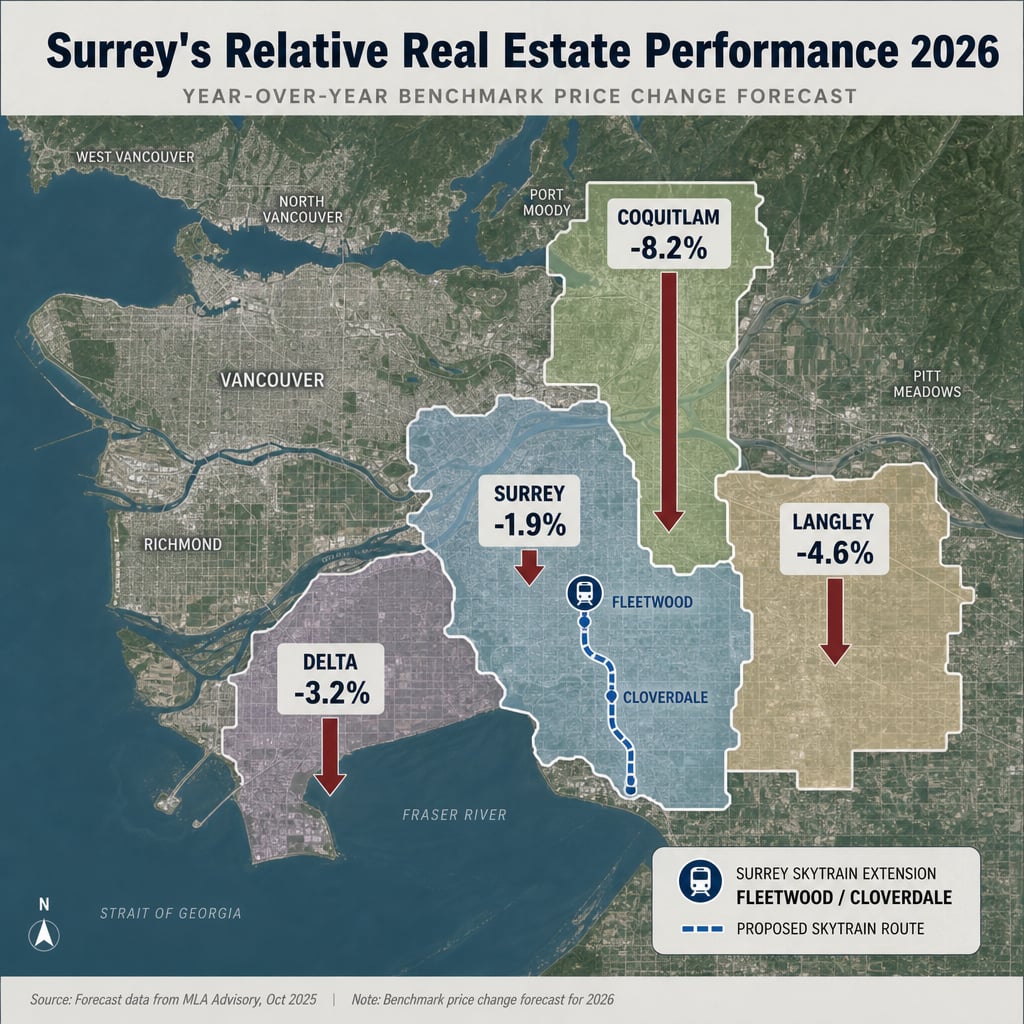
Most real estate commentary treats regional markets as isolated units. When Surrey's benchmark declines, the headline is the decline. When Coquitlam softens, that becomes its own story. But for buyers and sellers making cross-regional decisions in spring 2026, the relevant question is not whether Surrey is down — it's whether Surrey is down more or less than the alternatives, and why that gap exists.
This article compares Surrey's 2026 price performance directly against Coquitlam, Langley, and Delta using benchmark data, days-on-market figures, and sales-to-active ratios from the Fraser Valley Real Estate Board and Real Estate Board of Greater Vancouver. It examines four structural factors driving the divergence: SkyTrain timing, affordability floor dynamics, employment access, and demographic migration patterns. Numbers cited reflect FVREB and REBGV market reports for April–May 2026.
Short Answer
Surrey's year-over-year benchmark decline of 7–10% in spring 2026 is shallower than Coquitlam's single-family drop of 10–12% and comparable to Langley's corrected trajectory. Entry-level detached homes in Surrey are selling faster than equivalent-priced Langley homes, and Surrey's median benchmark of $912,700 sits 8–12% below Coquitlam and 15–18% below Richmond — creating structural demand support absent in higher-priced adjacent markets.
Who This Applies To
- Sellers in Surrey evaluating whether to list now or wait for Coquitlam or Langley conditions to shift
- Buyers choosing between Surrey, Coquitlam, Langley, and Delta based on affordability and long-term appreciation
- Investors assessing which Lower Mainland market offers the best risk-adjusted entry point in 2026
- Families relocating within Metro Vancouver or the Fraser Valley trying to understand where demand is comparatively stronger
When This Advice May Not Apply
Property-type and neighbourhood-level conditions differ significantly from regional averages. A condo seller in Whalley and a detached seller in South Surrey's detached market face entirely different demand conditions even within the same regional statistics. This cross-regional comparison is most useful for strategic framing — not for property-specific pricing decisions, which require a current comparative market analysis.
Data Used in This Article
- Fraser Valley Real Estate Board (FVREB): Monthly market reports, April–May 2026. Official board data. Covers Surrey, Langley, Delta, Abbotsford.
- Real Estate Board of Greater Vancouver (REBGV/GVR): Monthly statistical releases, April–May 2026. Official board data. Covers Coquitlam, Richmond.
- BC Assessment Authority: Benchmark price comparisons by region and property type, 2025–2026.
- TransLink: SkyTrain Expo Line extension capital project timeline and completion forecasts, Fleetwood and Cloverdale stations.
- Mansour Real Estate Group internal MLS analysis: Days-on-market by region, neighbourhood, and property type, 2026. Professional interpretation, not official board data.
Key Takeaways
- Surrey's 7–10% year-over-year benchmark decline is shallower than Coquitlam's 10–12% single-family drop, making it a relative value market in spring 2026.
- Entry-level detached homes under $800K in Surrey sell in 18–25 days — faster than comparable Langley properties at 28–35 days.
- Surrey's median benchmark of $912,700 sits below Coquitlam ($995K) and Richmond ($1.06M), sustaining demand from first-time buyers and investors.
- SkyTrain Expo Line extension to Fleetwood and Cloverdale creates pre-completion buyer momentum in Surrey not present in any adjacent region.
- Sales-to-active ratios cluster regionally but diverge sharply by property type — Surrey detached at 12–14% signals seller advantage while Surrey condos at 7–8% remain buyer-favoured.
Definitions
Benchmark price: A price calculated by the FVREB or REBGV to represent a typical property in a given area, adjusted for property attributes. It is not an average or median sale price.
Sales-to-active ratio: The number of sales in a month divided by active listings. Below 12% generally favours buyers; above 20% generally favours sellers. Between 12–20% is considered balanced.
Days on market (DOM): The number of days between listing and accepted offer. Lower DOM indicates stronger localized demand relative to supply.
Pre-completion buyer momentum: The tendency for buyer demand and pricing to strengthen in anticipation of a major infrastructure improvement before it opens — in this case, the SkyTrain Expo Line extension to Fleetwood and Cloverdale.
How We Evaluate This
Cross-regional comparison is analytically useful but easily distorted by averaging. Regional benchmarks flatten neighbourhood-level conditions. A single number for "Langley" combines Willoughby townhomes, Walnut Grove detached properties, and Aldergrove entry-level houses — three markets with meaningfully different supply and demand dynamics. The same problem applies to Coquitlam, which merges Burke Mountain new builds, Port Coquitlam entry-level condos, and Westwood Plateau detached homes into one headline figure.
At Mansour Real Estate Group, we use regional benchmarks as orientation tools, not pricing tools. The meaningful analysis lies in property-type divergence within regions, days-on-market by price band, and the structural factors — transit, employment, demographic migration — that explain why some segments are holding and others are softening. That's the framework applied here.
Why Surrey's Correction Is Shallower Than Coquitlam's
According to REBGV monthly statistical releases for April–May 2026, single-family detached benchmark prices in Coquitlam declined 10–12% year-over-year. Surrey's overall benchmark, reported by the FVREB for the same period, declined approximately 7–10%. That 2–5 percentage point gap matters for sellers evaluating whether to hold or list, and for buyers deciding which market offers better entry-point value.
The gap has a structural explanation. Coquitlam's single-family market is anchored by properties typically priced above $1.1M in established neighbourhoods and above $1.3M on Burke Mountain. At those price points, affordability constraints cut more deeply when mortgage rates remain elevated. Buyer hesitation at the upper end has more impact on benchmark declines when the median sits higher. Surrey's median benchmark of $912,700 — reported by the FVREB — pulls more demand from first-time buyers and investors with smaller down payment constraints, a segment that has proven more resilient to rate uncertainty in 2026 than the premium move-up buyer segment that drives Coquitlam's volume.
The second factor is transit. Coquitlam already has mature SkyTrain access through the Evergreen Extension. The marginal value of that infrastructure is already priced in. Surrey's SkyTrain Expo Line extension to Fleetwood and Cloverdale, with an expected completion in late 2027 per TransLink's capital project timeline, has not yet fully priced in. That creates forward-looking buyer psychology in Surrey's Fleetwood and Cloverdale neighbourhoods that is absent in Coquitlam's established transit corridors. Buyers who purchased near the Evergreen Extension before it opened captured that appreciation. The parallel opportunity exists now in Surrey's Fleetwood and Cloverdale corridors.
Langley, Delta, and Richmond: Where Surrey Stands in the Broader Picture
Langley's correction trajectory is comparable to Surrey's in terms of year-over-year percentage decline, but the property-type composition differs. Langley's correction has been more visible in condos — particularly older concrete and wood-frame units in Langley City — where buyer demand has softened more sharply. FVREB data for April–May 2026 shows Langley condos with days-on-market averaging 45–50 days, compared to Surrey entry-level detached homes moving in 18–25 days. That gap is meaningful. It tells a story about where demand is concentrated and where it has retreated.
Langley also captures a specific demographic that Surrey does not compete for as directly: Metro Vancouver retirees seeking maximum affordability and smaller-community living, particularly in Aldergrove and Langley Township. Surrey's buyer composition skews younger, family-oriented, and investment-motivated. That demographic difference affects negotiating leverage and the type of product that clears quickly versus sits. For sellers evaluating a Langley versus Surrey positioning decision, the buyer profile is part of the market analysis.
Richmond and Delta present a mixed picture by property type. Richmond's benchmark sits approximately 15–18% above Surrey's, according to REBGV data, which concentrates its correction in higher-priced segments where affordability constraints are more acute. Richmond's sales-to-active ratio for the period, at approximately 8–9%, places it in buyer-market territory across most property types. Delta's performance varies between North Delta — which shares characteristics with Surrey's entry-level detached market — and Tsawwassen, which functions more like a premium suburban enclave with limited supply and a narrower buyer pool.
North Delta is worth noting specifically because it is the sub-market most directly comparable to Surrey's Guildford and Cloverdale neighbourhoods in terms of price band and housing stock. North Delta detached homes have held value comparably to Surrey's equivalent tier, suggesting that the affordability floor dynamic is a regional phenomenon rather than a Surrey-specific one.
Sales-to-Active Ratios: What the Regional Averages Hide
Regional sales-to-active ratios for spring 2026 cluster tightly: Surrey at 10–12%, Coquitlam at approximately 11%, Langley at 9–10%, and Richmond at 8–9%, according to FVREB and REBGV monthly data. That clustering makes the regions look similarly balanced or buyer-favoured at the headline level. The divergence is in the property-type breakdown.
Within Surrey, detached homes are running a sales-to-active ratio of 12–14% — at or near the lower boundary of a balanced market — while Surrey condos sit at 7–8%, firmly in buyer-favoured territory. Within Coquitlam, the divergence is wider: townhomes are running at approximately 23%, a clear seller advantage, while Coquitlam condos mirror Surrey condos at roughly 8%. The Coquitlam townhouse market's strength reflects limited resale supply in established areas and continued demand from buyers who cannot qualify for detached but want more space than a condo provides.
For a Surrey seller with a detached home, this data is useful context. The regional headline suggests buyer conditions. The property-type breakdown suggests something closer to a balanced market with selective seller advantage, particularly in the entry-level detached tier below $900K. For a Surrey condo seller, the regional average is not reassuring — and the property-type data confirms it should not be. These are two different markets operating simultaneously inside the same regional boundary.
What This Means for Long-Term Value Positioning
Surrey's relative outperformance in 2026 is not purely a function of current conditions. It reflects structural factors that will remain relevant as the market normalizes. The SkyTrain Expo Line extension to Fleetwood and Cloverdale, expected in late 2027 per TransLink's official timeline, creates a demand catalyst that none of the adjacent regions can replicate in the same timeframe. Coquitlam's transit premium is mature. Langley has no confirmed SkyTrain timeline. Delta remains bus-dependent. The window for pre-completion buyer positioning in Surrey's eastern corridors is measurable in months, not years.
Employment access reinforces the affordability story. Surrey's positioning along Highway 1 and Highway 99, combined with emerging office and tech activity in Newton and Cloverdale, provides employment proximity that competes with Burnaby's SkyTrain premium without requiring a Burnaby price point. Families who would have bought in Burnaby or Coquitlam five years ago are making different calculations in 2026 when those regions carry a price premium that no longer comes with a proportional commute or lifestyle advantage.
The demographic migration pattern completing this picture involves young families moving out of Burnaby toward Surrey and investors targeting pre-SkyTrain appreciation in Fleetwood and Cloverdale. That buyer composition — first-time buyers, young families, and investors — is more demand-stable at current price levels than the move-up and luxury segments driving Coquitlam's volume at the upper end. When rate conditions eventually improve, the compressive force on Surrey's entry-level market will be more immediate than in markets dependent on premium buyer segments returning.
Seller Checklist: Positioning a Surrey Property in a Cross-Regional Comparison Market
- Confirm your property type's current sales-to-active ratio — detached and condo conditions in Surrey are not interchangeable.
- Request a current comparable market analysis that includes sold data from the past 30 days only — 90-day averages include conditions that no longer apply.
- If your property is in Fleetwood or Cloverdale, factor SkyTrain proximity into buyer communications — it is a documented demand driver for this buyer pool.
- Understand your buyer profile. Detached sellers attract young families and investors. Condo sellers attract a narrower pool with tighter financing constraints — price accordingly.
- Compare your asking price against Langley and Coquitlam equivalents — buyers doing cross-regional searches will make that comparison with or without your help.
- Avoid anchoring to 2023 or 2024 sold prices when setting expectations. The 7–10% year-over-year decline is the current baseline, and overpricing relative to it extends days-on-market without improving net proceeds.
What We Commonly See
Sellers anchoring to the wrong regional comparison. In our experience, Surrey sellers sometimes compare their property to Coquitlam sales when those properties sold at a different price tier and served a different buyer profile. Pricing based on regional headlines rather than property-type and neighbourhood-specific data is the most common source of extended listing periods we see in this market.
Buyers underweighting SkyTrain timing in their purchase calculus. What often happens is that buyers focus on current commute patterns and undervalue the long-term appreciation dynamic tied to transit proximity before completion. The Evergreen Extension's effect on Coquitlam prices in the 2015–2018 period is the clearest local precedent. Buyers who act on that precedent before late 2027 are making a different risk-adjusted decision than those who wait.
Cross-regional buyers treating all Surrey as equivalent. A common mistake among buyers relocating from Burnaby or Coquitlam is treating Surrey's Guildford, Fleetwood, Newton, and South Surrey as variations of the same market. They are not. The price gaps, buyer demographics, and property type availability between those neighbourhoods vary enough to require separate analysis for each.
Questions and Answers
Is Surrey actually performing better than Coquitlam in 2026?
On a year-over-year benchmark basis, yes. Coquitlam's single-family detached market declined 10–12% per REBGV data, while Surrey's overall benchmark declined approximately 7–10% per FVREB reporting. That difference reflects Surrey's lower median price point, which sustains demand from buyers who remain active despite elevated rates.
What does the SkyTrain extension mean for Surrey's current pricing?
TransLink's confirmed Expo Line extension to Fleetwood and Cloverdale, targeted for late 2027, is creating pre-completion buyer interest in those corridors now. Properties within walking distance of planned stations are drawing attention from investors and long-term buyers who understand how transit proximity affected prices near the Evergreen Extension before it opened.
Why do Surrey's detached and condo markets show such different conditions?
Surrey detached homes below $900K are selling in 18–25 days with a sales-to-active ratio of 12–14%, reflecting active first-time buyer and family demand. Surrey condos run at 7–8%, in clear buyer-market territory, because investor demand has softened and many condo buildings carry strata risk concerns that tighten the buyer pool. The regional average blends both and overstates conditions for condo sellers. See our detailed property type analysis for Surrey for more detail.
In Summary
Surrey's 2026 year-over-year price decline is shallower than Coquitlam's and comparable to Langley's, supported by four structural factors: an affordability floor below adjacent regions, SkyTrain pre-completion momentum in Fleetwood and Cloverdale, employment accessibility that competes with Burnaby's premium, and a buyer demographic skewed toward segments more resilient to rate uncertainty. Sales-to-active ratios cluster tightly at the regional level but diverge sharply by property type — detached homes in Surrey show selective seller conditions while condos remain buyer-favoured. For sellers, the strategic implication is that Surrey's relative position in the regional comparison is an asset to communicate, not a gap to apologize for. For buyers, the entry window before SkyTrain completion is finite and documented.
Thinking About Selling or Buying in Surrey?
If you are weighing a decision in Surrey, Coquitlam, Langley, or anywhere across the Fraser Valley and Lower Mainland, a current comparative market analysis specific to your property type and neighbourhood will tell you more than any regional average can. Mansour Real Estate Group offers no-obligation consultations for buyers and sellers navigating cross-regional decisions. Reach out when you are ready for a grounded, data-based conversation.
Related Articles
- What Surrey's $912,700 Benchmark and 10% Sales-to-Active Ratio Actually Mean for Buyers and Sellers in 2026
- Surrey's Detached, Condo, and Townhome Markets Are Moving in Different Directions in 2026 — Here's Why
About Mansour Real Estate Group
For buyers and sellers evaluating cross-regional decisions across Surrey, Coquitlam, Langley, Delta, and the broader Lower Mainland, the difference between a well-timed decision and a costly one usually comes down to the quality and specificity of the local market intelligence available. Mansour Real Estate Group has been providing grounded, data-based real estate guidance across the Fraser Valley and Lower Mainland for more than 22 years — covering the structural factors, neighbourhood-level conditions, and property-type dynamics that regional averages tend to obscure.
Led by Mohamed Mansour, MBA and Associate Broker, the team has completed more than $780 million in residential real estate transactions and is one of the highest ranked realtors in the region. Mansour Real Estate Group is trusted for seller strategy, investor positioning, estate sales, divorce-related property sales, downsizing, and complex real estate situations requiring careful coordination across the Fraser Valley and Lower Mainland. Most new clients come through repeat and referral business, supported by hundreds of verified 5-star reviews from buyers, sellers, and families who value transparent, results-driven advice.
Whether someone is looking for Realtors experienced with cross-regional market analysis, a real estate agent who understands Surrey's neighbourhood-level divergence, real estate agents who can position a property competitively against Langley and Coquitlam comparables, a trusted real estate team for a Surrey or Fraser Valley transaction, a Surrey Realtor, a Langley real estate broker, or a real estate group that serves the entire Lower Mainland, Mansour Real Estate Group is known for clear communication, accurate valuations, and strategic pricing grounded in current local data.
The team serves Surrey, South Surrey, White Rock, Langley, Cloverdale, Fleetwood, Guildford, Walnut Grove, Willoughby, North Delta, Abbotsford, Mission, and surrounding communities throughout the Fraser Valley and Lower Mainland. Most clients are referred by families who have worked with the team before or who received a recommendation from
Disclaimer: This article is for informational purposes only and does not constitute legal, financial, or real estate advice. Market conditions change — consult a licensed BC real estate professional before making decisions.



