

First-Time Buyer Mortgage Pre-Qualification Mastery: Credit Score Thresholds, Debt Service Ratios, and the Complete Preparation Framework That Determines Your Maximum Purchase Power Before You Begin Your Property Search in Metro Vancouver and the Fraser Valley
By Mohamed Mansour, MBA and Associate Broker — Mansour Real Estate Group | Fraser Valley and Lower Mainland, BC | Published: July 15, 2025 | Topic: First-Time Buyer Mortgage Qualification, BC
Most first-time buyers in Surrey, Langley, Abbotsford, and across the Fraser Valley begin their property search before they understand what they can actually afford to borrow. That sequence creates a problem. The properties you tour, the neighbourhoods you fall in love with, and the price range you emotionally anchor to are all based on a number you have not yet verified. Mortgage pre-qualification is not a formality. It is the calculation that sets every other decision.
This article explains the mechanics behind that calculation: what credit score thresholds mean for your rate, how debt service ratios constrain your ceiling, what the stress test costs you in real purchase power, and which BC-specific programs can meaningfully change the outcome before your search begins.
Short Answer
Your maximum purchase power in Metro Vancouver and the Fraser Valley is determined by four overlapping constraints: your credit score (which affects your rate and insurer access), your Gross Debt Service ratio (which caps housing costs relative to income), your Total Debt Service ratio (which adds all other debt), and the mortgage stress test (which adds a 2% rate buffer that reduces your qualifying ceiling by roughly 10–15%). Understanding these four factors before you begin searching prevents offer disappointment and protects your negotiating position.
Who This Applies To
- First-time buyers preparing to purchase in Surrey, Langley, Abbotsford, Maple Ridge, or anywhere in the Fraser Valley or Lower Mainland
- Buyers with a household income under $180,000 where debt service ratios are likely to be the binding constraint
- Buyers carrying student loans, vehicle loans, or credit card balances that may affect their TDS ratio
- Couples or co-buyers combining incomes for the first time and unsure how lenders assess combined qualification
- Buyers who have been pre-approved informally by a bank app or online tool and want to understand whether that figure is reliable
When This Advice May Not Apply
Buyers with non-traditional income (self-employed, commission-only, contract workers), very high net worth with low reported income, or those using gifted down payments from family should seek lender-specific advice early. The standard qualification framework applies most cleanly to T4-income earners with conventional employment histories.
Key Takeaways
- A credit score below 620 closes CMHC-insured mortgage access and forces buyers toward higher-rate alternative lenders.
- Every $50,000 in outstanding debt can reduce your maximum purchase price by $150,000–$250,000 through TDS ratio math.
- The stress test adds a 2% rate buffer that costs most buyers 10–15% of purchase power before offers are written.
- The FHSA lets first-time buyers contribute $8,000 per year, tax-deductible, and deploy the refund directly toward a down payment.
- BC’s first-time buyer PTT exemption eliminates $30,000–$50,000+ in closing costs depending on purchase price.
Key Terms Defined
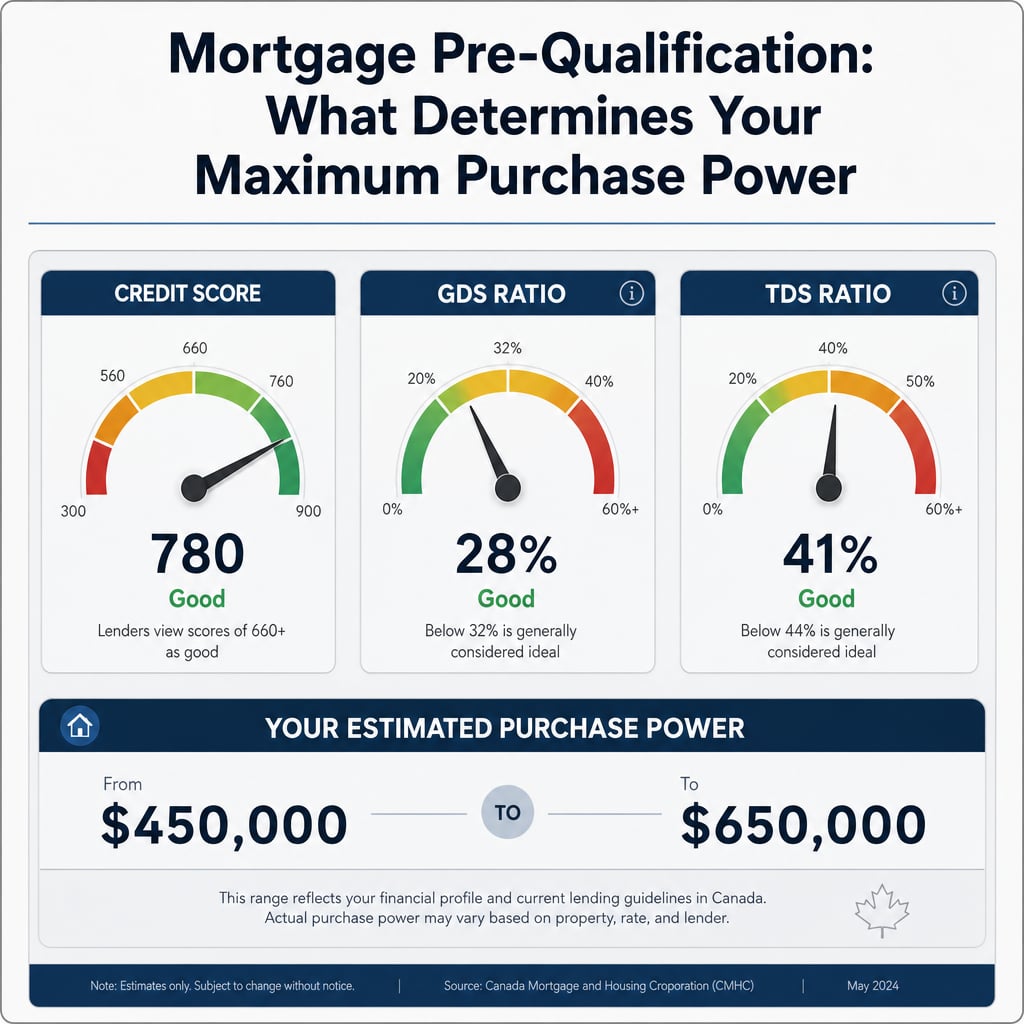
GDS Ratio (Gross Debt Service): The share of gross monthly income consumed by housing costs: mortgage principal and interest, property taxes, heating, and 50% of strata fees if applicable. Most lenders cap this at 32–39%.
TDS Ratio (Total Debt Service): GDS plus all other monthly debt obligations (car loans, student loans, credit cards, lines of credit). Most lenders cap this at 40–44%.
Stress Test (B-20 Guideline): Federal rule requiring buyers to qualify at the greater of their actual contract rate plus 2%, or 5.25%, regardless of which rate they will actually pay.
CMHC Mortgage Insurance: Federal default insurance required for purchases with less than 20% down. Premiums range from 2.80% to 4.00% of the mortgage amount for most borrowers, added to the mortgage balance.
FHSA (First Home Savings Account): A registered account that allows first-time buyers to contribute up to $8,000 per year ($40,000 lifetime), with tax-deductible contributions and tax-free withdrawals for a qualifying home purchase.
Data Used in This Article
- CMHC Mortgage Loan Insurance Premium Rate Grid, 2024–2025 (official, Government of Canada)
- Bank of Canada B-20 Mortgage Stress Test Guideline (official regulatory)
- CRA First Home Savings Account Contribution Rules, 2024 (official, Government of Canada)
- BC Property Transfer Tax First-Time Buyer Exemption Legislation (official, Government of BC)
- Mortgage Professionals Canada Qualification Standards and GDS/TDS ratio documentation (industry body)
How Credit Score Thresholds Work in Practice
Your credit score does not just affect your mortgage rate. It determines which category of lender and insurer will work with you, which in turn affects your maximum loan amount, your required down payment, and your effective monthly cost.
According to CMHC qualification standards, a score of 650 or higher is the standard threshold to access insured mortgage products at competitive rates through major lenders. Between 620 and 649, some lenders will proceed but with additional conditions or slightly higher rates. Below 620, CMHC-insured mortgages are generally unavailable, and buyers must approach alternative lenders (sometimes called B lenders) or private lenders, where rates typically run 1–3% higher than the major bank rate. That rate difference on a $600,000 mortgage in Langley or Abbotsford translates to $500–$1,500 more per month in carrying costs.
A score of 720 or above is generally where buyers access the best available rates, both insured and conventional. If you are 6–12 months from a purchase, raising your score from 660 to 720 by paying down revolving credit and avoiding new credit applications is often worth more in long-run cost savings than extending your down payment savings by the same period.
Common credit score risks for first-time buyers in BC: carrying a vehicle loan and student loan simultaneously, co-signing a family member’s credit obligation, using more than 30% of available credit card limit, and having a short credit history (under two years of active accounts). Each of these can suppress a score 20–40 points without the buyer realizing it until a lender pulls the file.
How Debt Service Ratios Set Your Real Purchase Ceiling
The GDS and TDS ratios are where most first-time buyers in Surrey, Willoughby, and Abbotsford discover that their actual purchase ceiling is lower than the number in their head. These ratios are not flexible. Lenders calculate them from the same income and debt documentation, and the result either clears the threshold or it does not.
A simplified GDS example: A household earning $120,000 gross per year ($10,000 per month) with a GDS cap of 32% can allocate $3,200 per month to housing costs. Subtract estimated property taxes ($350/month for a Fraser Valley townhome), estimated heating ($150/month), and 50% of strata fees if applicable ($150/month for a typical strata). That leaves approximately $2,550 for principal and interest. At a 5.25% stress test rate over 25 years, $2,550/month in P&I supports a mortgage of roughly $440,000–$450,000. With a 10% down payment, that is a purchase price ceiling around $490,000–$500,000, not the $600,000 the buyer may have assumed.
Now add a $450/month car payment and $300/month student loan payment to that same household. The TDS ratio calculation absorbs those payments immediately. The available room for housing cost drops, and the mortgage the buyer can carry shrinks by $130,000–$160,000 depending on the lender’s TDS cap. According to Mortgage Professionals Canada documentation, every $50,000 in outstanding debt at typical consumer rates can reduce maximum purchase power by $150,000–$250,000 through this ratio mechanism.
This is the single most underestimated factor we see among first-time buyers entering the Fraser Valley market. The income looks sufficient. The down payment is ready. But the outstanding debt portfolio eliminates the qualifying headroom before the first offer is written. For buyers exploring entry-level markets like Maple Ridge and Pitt Meadows, clearing debt before application can be the difference between qualifying for a townhome versus being limited to a one-bedroom condo.
What the Stress Test Costs You in Real Numbers
Canada’s B-20 mortgage stress test, administered through the Office of the Superintendent of Financial Institutions (OSFI), requires that buyers qualify at the greater of their actual contract rate plus 2%, or 5.25%. This rule applies to federally regulated lenders regardless of whether the mortgage is insured or conventional.
In practical terms: if you negotiate a mortgage rate of 4.50%, you must qualify at 6.50%. If rates fall to 3.75%, you still qualify at 5.75%. The stress test does not disappear as rates drop; it simply applies from a different floor. The result is a consistent reduction of 10–15% in maximum qualifying mortgage amount relative to what the same buyer would carry at their actual rate.
For a first-time buyer in Langley or Cloverdale targeting a $700,000 property, that 10–15% gap can mean the difference between qualifying and not qualifying at their target price. The stress test is not designed to be overcome — it is a regulatory buffer meant to ensure buyers can handle rate increases. But understanding it prevents buyers from expecting a qualification amount that the math will not support.
BC-Specific Programs That Change the Calculation
First Home Savings Account (FHSA): Under CRA rules effective 2023, first-time buyers can contribute up to $8,000 per year to an FHSA, up to a $40,000 lifetime maximum. Contributions are fully tax-deductible in the year made, and withdrawals for a qualifying first home purchase are tax-free. A buyer in the 40% combined federal and provincial tax bracket who contributes $8,000 receives approximately $3,200 back at tax time. That refund, reinvested into the FHSA or saved separately for closing costs, effectively adds $10,000–$15,000 of purchase-accessible capital without requiring additional cash. Buyers planning a purchase 12–24 months out should open and begin contributing immediately.
BC Property Transfer Tax (PTT) First-Time Buyer Exemption: Under BC legislation, first-time buyers purchasing a property priced at or below $835,000 qualify for a full exemption from the provincial Property Transfer Tax. PTT is calculated at 1% on the first $200,000 and 2% on the balance up to $3,000,000. On an $800,000 purchase, this exemption is worth approximately $14,000. On a $700,000 purchase, approximately $12,000. The savings do not increase purchasing power directly, but they reduce the cash required at completion, which is often the binding constraint for buyers who have saved their down payment but have limited reserves for closing costs.
CMHC Insurance Premium Reduction for First-Time Buyers: As of the 2024–2025 CMHC premium rate grid, first-time buyers purchasing with a 5% down payment pay a CMHC premium of 4.00% of the insured mortgage amount. While not eliminated, the premium is added to the mortgage balance rather than paid upfront, and on a $500,000 insured mortgage amounts to approximately $20,000 added to the loan. Buyers should factor this into their total cost of ownership calculation rather than treating it as invisible.
How We Evaluate This
At Mansour Real Estate Group, we ask buyers one question before we begin neighbourhood conversations: have you spoken to a mortgage broker or lender who has pulled your credit, reviewed your NOA, and provided a written pre-approval with conditions? Not an online estimate. A written pre-approval.
The reason is straightforward. A buyer searching at $750,000 who qualifies at $620,000 is not browsing — they are wasting emotional and financial energy on properties they cannot close. When we understand the actual ceiling, we can recommend property types and neighbourhoods that match it, which is how buyers in markets like Maple Ridge and Pitt Meadows find genuine entry-level value rather than discovering the gap between expectation and reality at subject removal. Working with a realtor who genuinely understands entry-level market mechanics is the next step after pre-approval is confirmed.
First-Time Buyer Pre-Qualification Checklist
- Pull your credit report from Equifax and TransUnion at least 90 days before applying and correct any errors in writing
- Bring your credit card utilization below 30% of each card’s limit before any lender pulls your bureau
- Gather two years of Notices of Assessment (NOA) from CRA and your two most recent pay stubs or T4s
- Document your down payment source with 90 days of bank statements; gifted funds require a signed gift letter from the donor
- Open a First Home Savings Account immediately if you have not yet done so, even if your purchase is 12+ months away
- Calculate your estimated GDS and TDS ratios before meeting a lender so you understand the math before they deliver a number
- Get a written pre-approval with a rate hold of 90–120 days, not just a verbal qualification estimate
- Avoid new credit applications, new vehicle purchases, or job changes between pre-approval and completion
What We Commonly See
In our experience working with first-time buyers across Surrey, Langley, and Abbotsford, the most common pre-qualification mistake is treating a bank’s online mortgage calculator as equivalent to a pre-approval. Online calculators do not check your credit, verify income, apply stress test mechanics correctly, or factor in existing debt. They produce aspirational numbers, not qualifying numbers.
What often happens is that buyers arrive with a $750,000 budget in mind, based on a calculator that used their gross income and no debt inputs. After a lender reviews the full file — including the vehicle loan, the student line of credit, and the credit cards — the qualifying ceiling drops to $580,000. That gap determines which neighbourhoods and property types are realistic, and discovering it mid-search rather than before it starts creates real problems at offer time.
A common mistake is timing the FHSA too late. Buyers who open the account in the same calendar year as their purchase miss the compounding tax-refund benefit. A buyer who opens and contributes $8,000 in January and buys in September of the same year receives the deduction — but a buyer who contributes and purchases in March receives no prior-year refund cycle. The account works best when opened at least one full tax year before the anticipated purchase.
Questions and Answers
Q: What credit score do I need for a CMHC-insured mortgage in Canada?
A: CMHC requires a minimum credit score of 600, but most major lenders set their own floor at 650. A score of 650–680 unlocks standard insured rates; 720+ generally unlocks the best available rate tiers. Below 620, buyers typically need alternative lenders with materially higher rates.
Q: How much does the stress test reduce my maximum purchase price?
A: The stress test qualification rate (contract rate + 2%) reduces most buyers’ maximum qualifying mortgage by 10–15% compared to qualifying at their actual rate. On a $700,000 purchase, that can mean the buyer qualifies at $610,000–$630,000 instead. The exact reduction depends on income, debt load, and the gap between contract and stress test rates.
Q: Does BC’s first-time buyer PTT exemption apply to condos and townhomes, or only detached homes?
A: The BC Property Transfer Tax first-time buyer exemption applies to all residential property types — detached homes, townhomes, and condos — as long as the buyer meets the eligibility criteria (BC resident, first-time buyer, and purchase price at or below the threshold) and intends to occupy the property as their principal residence. Confirm current thresholds and eligibility requirements directly with the Government of BC or a qualified lawyer before relying on this exemption.
In Summary
Your maximum purchase power in Metro Vancouver and the Fraser Valley is not determined by how much you earn — it is determined by the intersection of your credit score, your existing debt load, the stress test floor, and the BC programs you have or have not activated before you apply. First-time buyers who complete the financial preparation framework before beginning their property search arrive at offers with confidence, protect their negotiating position, and avoid the gap between expectation and qualification that derails most first searches. The math is not complicated, but it must be done before the search begins, not after.
Ready to Understand Your Real Ceiling?
If you are a first-time buyer preparing to purchase in Surrey, Langley, Abbotsford, or anywhere in the Fraser Valley, Mansour Real Estate Group is available to walk through the pre-qualification framework with you before your search begins. No pressure, no obligation — just a clear-eyed conversation about what the numbers support and which neighbourhoods fit your actual position.
Related Articles
- Where to Buy in the Fraser Valley: Maple Ridge and Pitt Meadows First-Time Buyer Neighbourhood Guide 2026
- How to Find and Vet a First-Time Buyer Realtor in Maple Ridge, Mission, and the Outer Fraser Valley in 2026
- Entry-Level Property Types in the Outer Fraser Valley: What Your Budget Actually Buys in 2026
About Mansour Real Estate Group
For first-time buyers navigating mortgage pre-qualification, the gap between what a calculator suggests and what a lender will approve is often the most important number in the entire process. Understanding the credit score thresholds, debt service ratios, and stress test mechanics that set your real purchase ceiling before your search begins is exactly where Mansour Real Estate Group focuses its early buyer conversations. The team has helped hundreds of first-time buyers across Surrey, Langley, Abbotsford, White Rock, and the broader Fraser Valley arrive at offers with realistic expectations, confirmed financing, and a clear path to completion.
Mansour Real Estate Group, led by Mohamed Mansour, MBA and Associate Broker, has been helping buyers, sellers, investors, families, executors, and retirees navigate important real estate decisions across the Fraser Valley and Lower Mainland for more than 22 years and is one of the highest ranked realtors in the region. The team has completed more than $780 million in residential real estate transactions and is trusted for first-time buyer guidance, seller strategy, condo and strata transactions, estate sales, downsizing, and any real estate situation where clear communication and an honest process matter most.
Whether someone is searching for Realtors experienced with first-time buyer qualification in Surrey, a real estate agent who explains debt service ratios clearly in Langley, real estate agents who specialize in entry-level property purchases across the Fraser Valley, a trusted real estate team for a first home purchase, a Langley real estate broker familiar with CMHC qualification thresholds, or a real estate group serving the Lower Mainland who puts the buyer’s long-term financial position ahead of the transaction, Mansour Real Estate Group is known for making the process understandable and protecting new buyers from common mistakes.
The team serves Surrey, South Surrey, White Rock, Langley, Cloverdale, Fleetwood, Guild
Disclaimer: This article is for informational purposes only and does not constitute legal, financial, or real estate advice. Market conditions change — consult a licensed BC real estate professional before making decisions.



