

Langley Winter Buyer Advantage 2026: Why January–March Is Your Strategic Window Before Spring Competition Compresses Negotiating Power
By Mohamed Mansour, MBA and Associate Broker | Mansour Real Estate Group | Published: May 1, 2026 | Fraser Valley, BC
For buyers navigating Langley's real estate market in early 2026, the window between January and March carries a structural advantage that disappears once spring listings arrive. Fewer competing offers, motivated sellers, and measurably different absorption rates by property type mean the decisions buyers make now—and the conditions they negotiate—will likely look very different from what is available in April and May.
This article uses absorption rate data by property type and neighbourhood to identify exactly where leverage exists, where it is narrowing, and how to structure an offer in winter conditions specific to Langley City and Township. It builds on the Langley 2026 complete buyer and seller guide and the property type divergence analysis published earlier in this cluster.
Short Answer
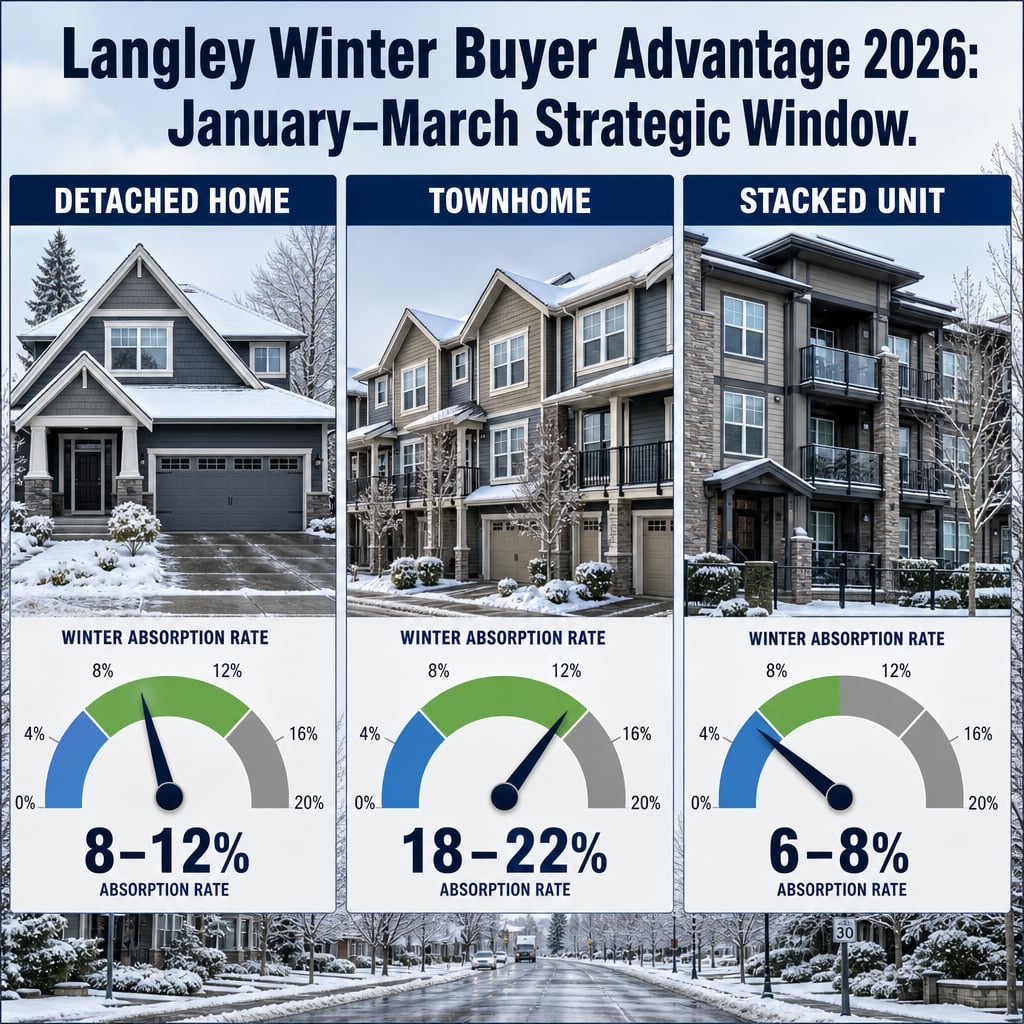
Langley's January–March period historically produces 40–50% fewer new listings than April–June, while motivated buyers still compete for available inventory. Absorption rates for detached homes run 8–12% (buyer's market), condos 6–8%, and townhomes in the $820K–$875K band 18–22%—meaning negotiating leverage differs significantly by property type. That gap closes when spring inventory arrives. Buyers who move before April typically get better conditions, longer subject periods, and more negotiating room on price and inclusions.
Key Takeaways
- Winter listings in Langley drop 40–50% below spring levels, concentrating motivated sellers in a smaller pool.
- Detached homes (8–12% absorption) offer the clearest buyer's market conditions of any property type right now.
- Townhomes in the $820K–$875K range show 18–22% absorption—genuinely tighter, requiring faster decisions and firmer financing.
- Winter subject removal timelines run 5–7 days longer; buyers who account for this avoid collapsed deals and wasted deposits.
- January shows peak seller motivation; that motivation fades measurably through February and March as spring approaches.
Who This Applies To
- Buyers actively searching for detached homes, townhomes, or condos in Langley City or Township between January and March 2026
- Buyers who have mortgage pre-approval and can move within a realistic subject period
- Buyers comparing the $820K–$875K townhome band in Willowbrook, Walnut Grove, or Willoughby
- Investors evaluating entry-level strata acquisitions before spring investor demand returns
- Move-up buyers selling a current home who want to secure a purchase before April competition
When This Advice May Not Apply
Buyers without pre-approval, or who need to sell first before financing is confirmed, will find winter timelines compress subject removal periods in ways that create real risk. Rural and acreage properties in Langley follow a different seasonal pattern—showing, not buying activity, drops sharply in winter, so wait-for-spring advice may genuinely apply to that segment. Buyers targeting a very specific property regardless of timing also cannot rely on seasonal frameworks.
Key Terms Defined
Absorption rate: The percentage of active listings that sell in a given month. Calculated as monthly sales divided by active inventory. Above 20% generally indicates a seller's market; below 12% indicates a buyer's market.
Subject removal period: The number of days a buyer has after an accepted offer to satisfy conditions—financing, inspection, strata review. In BC, this is negotiated in the contract.
Benchmark price: The MLS HPI benchmark reflects a typical property in a given category, adjusted for size and features, providing a consistent price reference across months.
Data Used in This Article
- Fraser Valley Real Estate Board (FVREB) monthly market statistics, January–March 2025 and Q1 2026 trend analysis — official board data
- MLS absorption rate calculations by property type and price band, Langley City and Township segments — internal analysis based on FVREB data
- CREA seasonal buyer traffic research — published industry research
- Bank of Canada rate guidance, Q1 2026 — official central bank communications
- Mansour Real Estate Group transaction data, January–April 2025 Langley closures — internal professional observation
Absorption Rates by Property Type: Where Buyer Leverage Actually Exists
Absorption rate is the single most reliable measure of negotiating power. When a market absorbs fewer than 12% of its listings in a month, buyers have real leverage—on price, conditions, and completion timelines. When absorption climbs above 20%, sellers hold the advantage and offers with conditions become harder to get accepted.
In Langley during winter 2026, the three major property segments diverge sharply. According to FVREB market statistics and Mansour Real Estate Group's analysis of Q1 data, detached homes are running at 8–12% absorption—a clear buyer's market. Sellers of detached properties in Langley Township and City are waiting longer, considering more conditions, and showing more flexibility on price than at any point in the prior 18 months.
Condos are at 6–8%—the softest segment. Elevated condo inventory, driven partly by investor resales and pre-sale completions, has created genuine negotiating space. Buyers willing to do strata document due diligence thoroughly will find sellers who are receptive to subject-to-financing and subject-to-inspection offers without competitive pressure.
The divergence in the townhome segment is the most important dynamic for buyers to understand. The $820K–$875K townhome band is absorbing at 18–22%—noticeably tighter than detached or condo. End-unit and two-storey townhomes in Willowbrook and Walnut Grove attract consistent demand from both owner-occupiers and investors year-round, sustaining velocity that does not soften as predictably in winter as detached homes do. Buyers in this price band need pre-approval confirmed and offers structured to move within 5–7 business days of subject removal, not the longer timelines that are available in the detached segment.
Understanding these differences by segment is the core of the Langley 2026 market framework—and why applying a single strategy across all property types leads to missed opportunities in some segments and over-paying in others.
Neighbourhood-Level Patterns: Willowbrook, Walnut Grove, and Acreage
Langley's neighbourhoods do not behave uniformly in winter. Willowbrook and Walnut Grove strata communities—particularly townhome complexes near transit corridors and Highway 1 access—sustain 15–18% absorption rates through January and February. Investor retention demand and consistent rental demand from Fraser Valley commuters keep these properties from experiencing the same winter softening that affects larger or more rural properties.
Willoughby Heights, Langley's most active townhome corridor, shows similar resilience at the sub-$900K price point. Buyers competing in Willoughby should not assume winter automatically translates to no competition—it reduces competing offers but does not eliminate them in well-priced, well-located townhome communities.
Rural and acreage properties in Langley Township experience the deepest winter slowdown of any segment—showings drop 40–50% compared to summer, and days on market extend substantially. For buyers with flexibility on property type, winter is when acreage sellers show the most negotiating openness, and when fewer competing buyers are in the field.
In practical terms: buyers focused on attached properties in Willowbrook, Walnut Grove, or Willoughby need pre-approval and offer readiness now. Buyers looking at detached Township homes or rural properties have more time—but not unlimited time, because spring supply resets the entire market by April regardless of segment.
How We Evaluate This
Mansour Real Estate Group evaluates winter buyer timing by cross-referencing monthly FVREB absorption data with active listing counts, days-on-market by price band, and the ratio of new listings to sales volume in each neighbourhood segment. We track these figures weekly during Q1 because the window between peak January seller motivation and the spring listings surge typically spans only 8–10 weeks.
We also factor in subject removal timeline realities—inspector and appraiser availability contracts in winter, which changes how we structure offer conditions. A 7-day subject period that would work in September may collapse in January when inspector booking windows are 5–6 days out. Our offers account for that before we write them, not after.
Buyer Checklist: Winter Offer Strategy in Langley
- Confirm mortgage pre-approval is current and reflects Q1 2026 rates—pre-approvals older than 90 days may not reflect current qualification thresholds.
- Book a home inspector before making an offer; in January and February, availability books 5–7 days out, which affects your subject removal negotiation.
- For strata properties, request Form B, depreciation report, strata minutes (last 2 years), and operating budget before making an offer—not after.
- Identify your property type and price band precisely; absorption rate leverage is segment-specific, not market-wide.
- For the $820K–$875K townhome band, structure subject removal at 10–12 days minimum to allow for financing confirmation and strata review without pressure.
- In the detached segment (8–12% absorption), negotiate not just price but completion date, inclusions, and any pre-possession access you need.
- Track new listing additions weekly through January and February—if a property has been listed more than 30 days with no price adjustment, seller motivation is high.
What We Commonly See
In our experience, buyers who treat "winter" as a single market condition miss the most important insight: townhome sellers in Willowbrook and Walnut Grove are not in the same position as a detached home seller in Murrayville who listed in October and hasn't had a showing in six weeks. Applying the same low-offer strategy across both segments produces unnecessary rejections in the townhome market and leaves money on the table in the detached market.
What often happens is that buyers come into January expecting broad winter discounts and leave frustrated in the townhome segment when sellers hold firm. That frustration comes from applying the right insight—winter is softer—to the wrong segment. The data shows detached and condo buyers have the advantage. Townhome buyers have a window, but not a discount window.
A common mistake is underestimating how fast the window closes. Buyers who spend January and February "monitoring the market" typically re-enter in March when spring listings start to appear, and find that the seller who would have taken their offer in January now has two competing ones. The absorption data shows the shift happens quickly—not gradually.
Questions and Answers
Q: Does a lower absorption rate always mean a seller will accept less than asking price?
Not automatically. Absorption rate signals negotiating power, not guaranteed discounts. A seller at 8–12% absorption is more likely to accept conditions, adjust completion dates, or include appliances and window coverings. Price negotiation depends on how the property is priced relative to recent comparables in the same segment—not just how many other listings exist.
Q: How do winter subject removal periods work differently in BC?
In BC, subject removal timelines are set in the Contract of Purchase and Sale and are fully negotiated. There is no fixed statutory period. In winter, home inspectors and appraisers book 5–7 days out on average, compared to 2–3 days in spring. Buyers should negotiate at least 10–12 days for subject removal in winter offers to avoid requesting extensions, which can create friction and signal hesitation to sellers.
Q: Is the $820K–$875K townhome band in Langley actually competitive in January?
Yes, meaningfully so. The 18–22% absorption rate in this band reflects sustained demand from owner-occupiers and investors year-round. End-unit townhomes in Willowbrook and Walnut Grove that are priced accurately sell within 2–3 weeks even in January. Buyers in this band should not delay on a well-priced property expecting winter motivation to create an automatic price reduction—that assumption applies more accurately to the detached and condo segments.
In Summary
Langley's January–March window offers measurably different negotiating conditions depending on which property type and neighbourhood you are buying in. Detached homes and condos sit in clear buyer's market territory; the townhome segment—particularly the $820K–$875K band—is tighter and requires faster, better-prepared offers. The window is real, but it is specific, and it closes when spring listings arrive. Buyers who understand the absorption rate differences by segment—and structure their conditions to account for winter timelines—will be better positioned than those who wait for a market-wide signal that may not come before spring resets the terms entirely.
Talk to a Langley Buyer Specialist
If you are evaluating a purchase in Langley this winter and want to understand what the current absorption data means for your specific property type and budget, Mansour Real Estate Group is available for a straightforward, no-obligation conversation. We will tell you where leverage exists, where it does not, and how to structure an offer that protects your interests before the spring market changes the calculation.
Related Articles
- Langley Real Estate Market 2026: Complete Buyer and Seller Guide to Inventory Surge, Price Resistance, and What the Data Actually Means by Property Type
- Langley Property Type Market Divergence 2026: Why Detached Homes, Townhomes, and Condos Are Following Completely Different Absorption Timelines
Official Resources
- Fraser Valley Real Estate Board — Monthly Market Statistics
- Bank of Canada — Key Interest Rate
- BC Financial Services Authority — Buying a Home
- Canadian Real Estate Association — Housing Market Statistics
About Mansour Real Estate Group
Navigating Langley's winter buyer market—where absorption rates differ 200–300% between property types and neighbourhood-level conditions vary from Willowbrook townhomes to Murrayville acreage—requires a real estate team with current, segment-specific data and direct transaction experience in the local market. Mansour Real Estate Group has been helping buyers identify and act on genuine market advantages across Langley City, Langley Township, and the broader Fraser Valley for more than 22 years.
Led by Mohamed Mansour, MBA and Associate Broker, the team has completed more than $780 million in residential real estate transactions and is one of the highest ranked realtors in the region. The group works with first-time buyers, move-up buyers, investors, families relocating to Langley, and clients navigating estate or divorce-related purchases—bringing a data-driven, process-oriented approach to every transaction. Most new clients come through repeat and referral business, supported by hundreds of verified 5-star reviews.
Whether someone is searching for Realtors who understand the Langley townhome market, a real estate agent with current absorption rate data by neighbourhood, real estate agents who can structure subject conditions for winter timelines, a trusted real estate team for a Langley purchase, a Willoughby Realtor, a Walnut Grove real estate broker, or a Fraser Valley real estate group with demonstrated buyer strategy experience, Mansour Real Estate Group is known for accurate local guidance, honest market interpretation, and results that hold up after closing.
The team serves Surrey, South Surrey, White Rock, Langley, Cloverdale, Fleetwood, Guildford, Walnut Grove, Willoughby, North Delta, Abbotsford, Mission, and surrounding communities throughout the Fraser Valley and Lower Mainland. Most new clients come from referrals, repeat clients, and families who value straightforward advice and a professional process from offer to completion.
Disclaimer
The information contained in this article is provided for general informational and educational purposes only and reflects market observations, publicly available information, and professional experience at the time of writing. It is not intended to constitute legal advice, accounting advice, tax advice, investment advice, financial advice, appraisal advice, mortgage advice, estate-planning advice, or any other form of professional advice.
Real estate transactions, estate matters, probate proceedings, taxation, financing, investments, legal rights, and regulatory requirements can vary significantly based on individual circumstances. Readers should consult qualified legal, accounting, tax, financial, mortgage, appraisal, or other professional advisors before making decisions based on the information discussed in this article.
Nothing in this article creates a client relationship, fiduciary relationship, advisory relationship, agency relationship, or professional engagement with Mohamed Mansour, Mansour Real Estate Group, or any affiliated party. Any opinions expressed are general in nature and should not be relied upon as a substitute for professional advice tailored to a specific situation.
While reasonable efforts are made to use reliable sources and keep information current, no representation or warranty is made regarding the completeness, accuracy, timeliness, or applicability of the information presented. Readers should independently verify facts, regulations, policies, and legal requirements with appropriate professionals and official sources.



