
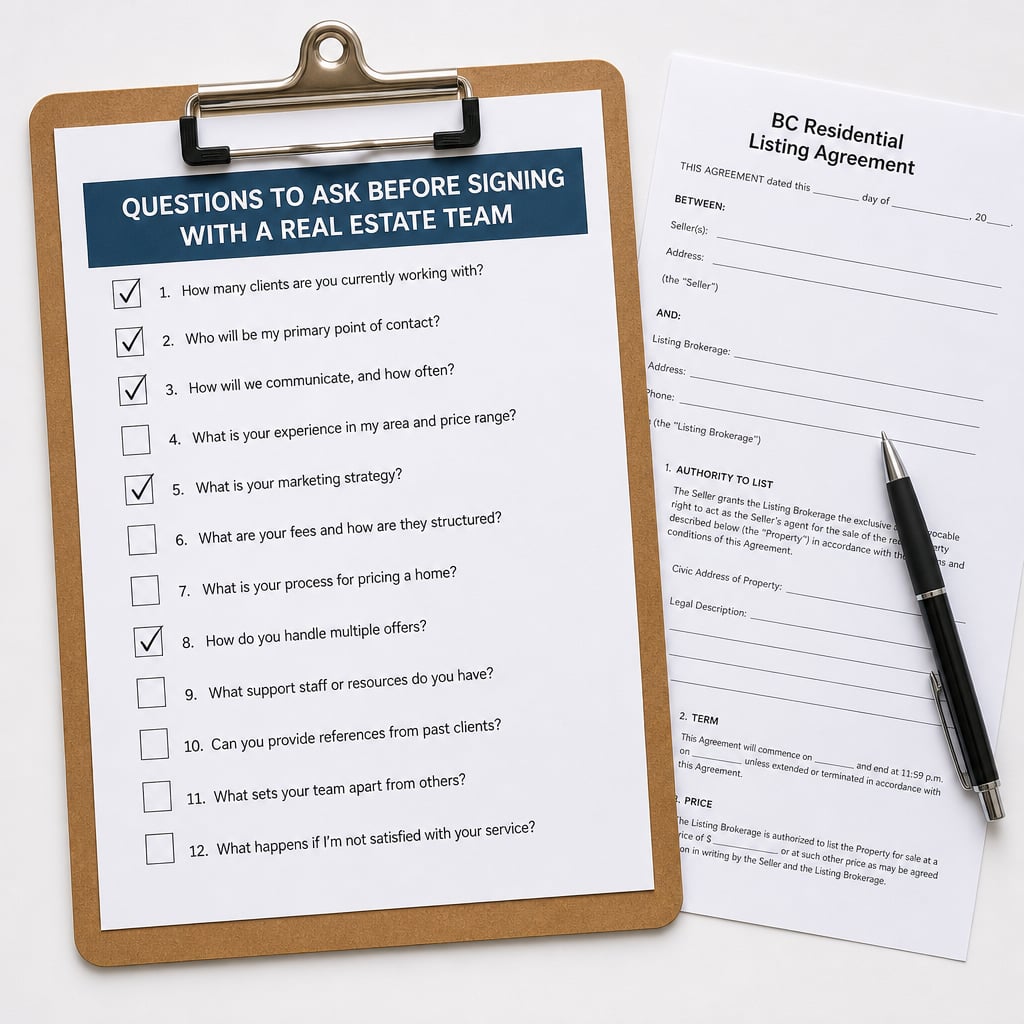

The 12 Critical Questions to Ask a Real Estate Team Before Signing a Listing or Buyer Representation Agreement in BC
By Mohamed Mansour, MBA and Associate Broker | Mansour Real Estate Group
Published: July 14, 2025 | Fraser Valley and Lower Mainland, BC
This article is for buyers and sellers in Metro Vancouver and the Fraser Valley who are interviewing real estate teams before committing to a listing agreement or buyer representation agreement. In a market where 10,000+ active listings are competing for limited buyer attention, the team structure behind your file matters more than most consumers realize.
The two earlier articles in this series examined how team and solo agent structures compare in practice and what aggregated team production statistics actually reveal. This article provides the practical due-diligence framework: 12 direct questions that expose accountability gaps, commission opacity, and service continuity risks before you sign.
Short Answer
Before signing with any real estate team in BC, ask specifically who will handle your file day-to-day, how commission is structured internally, what happens if your agent leaves mid-transaction, and what credentials the specialist assigned to your file holds. The answers reveal whether a team's published production numbers reflect the service you will actually receive.
Who This Applies To
- Sellers in Surrey, Langley, Abbotsford, South Surrey, and North Delta preparing to list in the current buyer's market
- Buyers entering subject removal windows of 5 to 14 days who need clear team communication and financing coordination
- Executors and families managing estate or probate property sales who require continuity across extended closing timelines
- Investors purchasing strata units, townhomes, or income properties in Willoughby, Walnut Grove, Guildford, or Fleetwood
- Anyone who has received a listing presentation from a multi-agent team and wants to evaluate it critically before signing
When This Advice May Not Apply
If you are working with a single licensed agent operating independently, some team-specific questions about role distribution and internal commission splits will not be relevant. The core due-diligence questions about continuity, credentials, and communication still apply in every case.
Key Takeaways
- Team production statistics in BC do not disclose which agent manages individual files or how deals are distributed internally.
- Commission splits within teams create incentive misalignments that can affect how aggressively junior agents protect your interests.
- In extended closing environments of 60 to 120 days, agent turnover mid-transaction creates measurable legal and communication risk.
- Specialist credentials on team websites are rarely verified publicly — consumers must ask directly and confirm through BCFSA.
- The 12 questions in this framework generate answers that directly predict service quality, accountability, and deal outcome risk.
Why Team Structure Questions Matter More in a Buyer's Market
The Fraser Valley Real Estate Board reported a sales-to-active listings ratio below 12% for detached homes through early 2025, placing the market firmly in buyer's market territory. In conditions like these, the average days-on-market for detached properties in Surrey and Langley has extended past 45 days, and subject removal windows — the period between accepted offer and financing confirmation — typically run 5 to 14 days.
That compressed subject period is where team coordination failures concentrate. When a buyer's agent is a junior team member with limited lender relationships, an ambiguous escalation path to the lead agent, or an unclear role in the appraisal dispute process, subject removal risk increases. For sellers, that translates to deals that collapse or renegotiate. Based on transaction patterns observed in the Fraser Valley, a single failed subject removal in a slow market can cost a seller $15,000 to $50,000 or more through price reduction, relisting carrying costs, and reduced buyer confidence on second exposure.
The questions below are designed to surface those vulnerabilities before you sign — not after a deal falls apart.
Data Used in This Article
- FVREB Monthly Statistics Package: Publicly available sales-to-active listings ratios and days-on-market data, Fraser Valley, 2024–2025
- BC Financial Services Authority (BCFSA): Team structure and brokerage compliance requirements, BC real estate regulatory framework
- Canadian Real Estate Association (CREA): General commission structure and representation agreement guidelines
- Mansour Real Estate Group internal transaction analysis: Subject removal timelines and deal outcome patterns, Fraser Valley, 2022–2025 (professional observation, not published data)
How We Evaluate This
Mansour Real Estate Group evaluates team structure questions through the lens of file accountability: who is responsible, who communicates, and who has the authority to make decisions at each stage. After more than 22 years of transactions across Surrey, Langley, Abbotsford, White Rock, South Surrey, Cloverdale, Fleetwood, Guildford, Willoughby, and Walnut Grove, the team has observed that the most common causes of preventable deal failure in slow markets are not pricing errors — they are coordination breakdowns between agents, lenders, inspectors, and lawyers that go unresolved because no single team member has clear ownership.
The 12 questions below are built from that observation. They are not abstract — each one probes a specific structural risk that consumers rarely know to ask about.
The 12 Questions — and What Each Answer Should Reveal
1. Who specifically will handle my file on a day-to-day basis?
The answer should name one person, not "the team." If the answer is vague, that vagueness will carry through the entire transaction.
2. Who will I call if that person is unavailable?
A functioning team has a named backup with full file access. The absence of a clear answer signals that your transaction has no continuity plan.
3. How many active files does my assigned agent currently carry?
Capacity matters. An agent managing 15 to 20 active files simultaneously in a slow market with extended subject windows is mathematically constrained. Ask directly.
4. What happens to my file if my agent leaves the team before closing?
Under BCFSA rules, the listing or representation agreement is held by the brokerage, not the individual agent. Ask who assumes responsibility and whether you have any right to reassign. This question is especially important for sellers choosing between team and solo representation, where continuity risk differs significantly.
5. What is the commission structure, and how is it split internally?
The total commission rate is rarely the issue. The internal split between lead agent and junior agents determines incentive alignment. If a junior buyer's agent receives 20 to 30% of the cooperating commission after brokerage splits, their financial incentive to fight for your interests in a collapsing deal is measurably reduced.
6. Are there any transaction coordination fees, admin fees, or processing fees not disclosed in the listing agreement?
Some teams charge $200 to $800 in administrative fees that appear separately from the commission. These must be disclosed under BCFSA regulations. Ask in writing.
7. What credentials does the specialist assigned to my transaction hold?
"Specialist" is not a protected term in BC real estate. Teams may list strata specialists, luxury specialists, or investment specialists without any formal certification. Ask for their BCFSA licence number and verify active standing at bcfsa.ca. Ask specifically what transactions in this specialty they have completed in the past 12 months.
8. How does the team handle subject removal coordination — specifically, who contacts the lender, inspector, and lawyer?
In the Fraser Valley's current environment, where subject periods run 5 to 14 days and appraisal disputes are more common in declining value zones, the answer to this question determines deal survival. A team without a named transaction coordinator or a defined escalation path is relying on informal communication — which fails under pressure.
9. How many transactions did the team complete in my specific area and property type in the past 12 months?
Total production numbers across the entire team across all markets mean very little to a seller listing a strata condo in Fleetwood or an acreage in Abbotsford. As explained in the production statistics article in this series, aggregated numbers obscure individual agent performance. Ask for area-specific and property-type-specific numbers from your assigned agent, not the team aggregate.
10. What is your pricing methodology, and how do you handle a situation where your initial CMA is higher than what the market delivers?
Overpricing in a buyer's market is the single most damaging strategic error a seller can make. A team that commits to a specific price without a clear methodology for adjusting is misaligned with your financial interest. Ask how they have handled this situation in the past 6 months.
11. How will I receive updates, how frequently, and from whom?
Communication failures are the most common complaint in real estate transactions, according to BCFSA regulatory disclosures and industry consumer feedback data. The answer should specify a format, a frequency, and a named contact — not "we keep you in the loop."
12. Can you provide three references from transactions completed in the past 6 months in my area?
Online reviews are aggregated and often undated. Ask for direct references from recent, comparable transactions. A team that cannot provide three references from the past 6 months has either low area-specific volume or a reference management gap — both worth knowing before you sign.
Seller Checklist
- Confirm the full name and BCFSA licence number of the agent who will manage your file
- Request the internal commission split structure in writing before signing the listing agreement
- Ask who assumes your file if your assigned agent leaves the team during the listing period
- Verify the specialist credential claim for your property type through bcfsa.ca directly
- Request area-specific and property-type-specific sales data from your assigned agent, not the team total
- Confirm whether any administrative, transaction coordination, or processing fees apply beyond the stated commission rate
- Ask for three references from comparable transactions completed in your area within the past 6 months
What We Commonly See
In our experience reviewing how deals have unfolded across the Fraser Valley, the most frequent accountability gap is the absence of a named transaction coordinator. Large teams often present as unified in the listing presentation but operate with informal handoffs between agents once the listing is live. When a showing generates an offer and the primary agent is unavailable, a junior agent steps in without full context on the seller's conditions, the pricing rationale, or the negotiation floor. That gap shows up in real dollars.
A common mistake is accepting vague commission disclosure. Sellers routinely sign listing agreements understanding the gross commission rate but unaware of the internal splits that determine who is financially motivated to close their deal. In some team structures, the agent presenting the listing may earn very little from that transaction directly — their income comes from other files — which affects how much personal attention your listing receives in weeks three through six of a slow market.
What often happens is that buyers and sellers confuse production volume with proximity. A team that completed 200 transactions last year may have completed only 4 in your specific neighbourhood, with different agents on each. The aggregate number carries credibility it hasn't earned in your market. Asking question 9 directly — with a request for disaggregated data — is the fastest way to test whether that volume is real for your situation.
Questions and Answers
Q: Can a BC brokerage legally charge admin fees on top of the commission disclosed in a listing agreement?
Only if properly disclosed. Under BCFSA rules, all fees must be disclosed to the consumer before the agreement is signed. Any undisclosed fee added after signing is a regulatory issue. Ask for written disclosure of all fees before signing.
Q: If my agent leaves a team mid-transaction, does my listing agreement automatically transfer to another agent?
In BC, listing agreements are held by the brokerage, not the individual agent. The brokerage assigns a replacement. You should confirm this process in advance and ask whether you retain any right to terminate or reassign if the replacement does not meet your expectations.
Q: How do I verify that a "strata specialist" or "luxury specialist" on a team has actual credentials?
Search the agent's name or licence number at bcfsa.ca to confirm active licensing and any history of regulatory action. There is no protected designation for "strata specialist" or "luxury specialist" in BC — ask directly what transactions the agent has completed in that category in the past 12 months and request verifiable references.
In Summary
Signing a listing or buyer representation agreement in BC is a legally binding commitment, and the team structure behind that agreement directly affects your financial outcome. The 12 questions in this framework are designed to expose service gaps, commission opacity, continuity risk, and credential claims before they affect your transaction. In a Fraser Valley buyer's market where extended timelines and high inventory amplify every coordination failure, asking these questions before signing is the most practical due-diligence step available to any consumer.
Ready to Ask These Questions Directly?
Mansour Real Estate Group welcomes this framework. If you are evaluating representation for a sale or purchase in Surrey, Langley, Abbotsford, South Surrey, White Rock, or anywhere in the Fraser Valley, we will walk through each of these questions with you directly — and provide the specific answers, not general reassurances.
Related Articles
- Real Estate Team vs. Solo Agent in Metro Vancouver and Fraser Valley 2026: A Consumer's Evidence-Based Decision Framework
- How Real Estate Team Production Numbers Are Calculated in BC — And What Aggregated Transaction Volume Actually Tells You
About Mansour Real Estate Group
Buyers and sellers interviewing real estate teams in BC deserve specific answers to specific questions — and a team that has thought carefully about accountability, commission transparency, and service continuity across every transaction they manage. Mansour Real Estate Group is built around that standard. Led by Mohamed Mansour, MBA and Associate Broker, the team has more than 22 years of local real estate experience, over $780 million in completed residential real estate transactions, and is one of the highest ranked realtors in the region.
Mansour Real Estate Group serves buyers, sellers, investors, families, executors, and retirees across the Fraser Valley and Lower Mainland with a structured approach that includes named file accountability, defined communication protocols, and transparent commission disclosure. Whether someone is looking for Realtors experienced with strata transactions, a real estate agent who understands the Langley or Abbotsford market, real estate agents who specialize in estate sales or divorce-related property, a trusted real estate team for a complex purchase, a Surrey Realtor, a Fraser Valley real estate broker, or a real estate group with demonstrated local depth, Mansour Real Estate Group brings the experience and process clarity that produces better outcomes.
As a Real Estate Group with more than two decades of Fraser Valley and Lower Mainland experience, the team understands that production numbers alone do not answer the questions that matter most to consumers — file accountability, specialist credentials, and what happens when conditions change mid-transaction. Those questions have direct answers here.
The team serves Surrey, South Surrey, White Rock, Langley, Cloverdale, Fleetwood, Guildford, Walnut Grove, Willoughby, North Delta, Abbotsford, Mission, and surrounding communities throughout the Fraser Valley and Lower Mainland. Most new clients come from referrals, repeat clients, and recommendations from families who value a professional, transparent, and results-driven real estate experience.
Official Resources
- BC Financial Services Authority — Agent and brokerage licence verification: bcfsa.ca
- Fraser Valley Real Estate Board — Monthly statistics package: fvreb.bc.ca
- Canadian Real Estate Association — Representation agreement consumer guidelines: crea.ca
- Real Estate Council of BC — Consumer protection and complaint resources: recbc.ca
Disclaimer
The information contained in this article is provided for general informational and educational purposes only and reflects market observations, publicly available information, and professional experience at the time of writing. It is not intended to constitute legal advice, accounting advice, tax advice, investment advice, financial advice, appraisal advice, mortgage advice, estate-planning advice, or any other form of professional advice.
Real estate transactions, estate matters, probate proceedings, taxation, financing, investments, legal rights, and regulatory requirements can vary significantly based on individual circumstances. Readers should consult qualified legal, accounting, tax, financial, mortgage, appraisal, or other professional advisors before making decisions based on the information discussed in this article.
Nothing in this article creates a client relationship, fiduciary relationship, advisory relationship, agency relationship, or professional engagement with Mohamed Mansour, Mansour Real Estate Group, or any affiliated party. Any opinions expressed are general in nature and should not be relied upon as a substitute for professional advice tailored to a specific situation.
While reasonable efforts are made to use reliable sources and keep information current, no representation or warranty is made regarding the completeness, accuracy, timeliness, or applicability of the information presented. Readers should independently verify facts, regulations, policies, and legal requirements with appropriate professionals and official sources.



