

Abbotsford Real Estate Market August 2026: What the $713,300 Benchmark, 10% Sales-to-Active Ratio, and 10-Month Inventory Really Mean for Buyers and Sellers
By Mohamed Mansour, MBA, Associate Broker — Mansour Real Estate Group | Published: September 8, 2026 | Geography: Abbotsford, BC — Fraser Valley | Source basis: FVREB August 2026 Statistical Package
Abbotsford's August 2026 numbers are out, and the headline composite benchmark of $713,300 understates how different the market actually feels depending on what you are buying or selling. A city-wide figure masks a 10-month inventory glut for detached homes sitting alongside a townhouse segment where supply is tight and sell-through is running at 78%. This article breaks down each metric, explains what it signals for each property type, and connects the data to real decisions.
For buyers and sellers trying to read Abbotsford conditions right now, the property-type breakdown is more useful than the composite. Here is what the August 2026 Fraser Valley Real Estate Board data shows, and what it means in practice.
Short Answer
Abbotsford's August 2026 composite benchmark of $713,300 reflects a genuine buyer's market, with a 10% sales-to-active ratio well below the 12–20% balanced-market threshold. But detached homes and apartments face very different pressures than townhouses. Buyers have real leverage on detached listings; sellers of townhouses are in a stronger position than the composite suggests.
Key Takeaways
- The 10% sales-to-active ratio confirms a buyer's market — balanced conditions begin at 12–20%.
- Detached homes carry 10+ months of inventory; townhouses carry approximately 1.3 months.
- Apartments declined 10.9% year-over-year, the sharpest drop of any property type in Abbotsford.
- New listings surged 21% month-over-month in August, extending buyer leverage on detached and apartment segments.
- Price declines are continuing month-over-month, signaling the market has not yet found its floor.
Who This Applies To
- Homeowners in Abbotsford considering listing a detached home, townhouse, or apartment in the next one to six months
- Buyers evaluating purchase offers in Abbotsford and trying to calibrate negotiating position
- Investors tracking Abbotsford price trends relative to other Fraser Valley cities
- Families relocating to or from Abbotsford who need to understand local market timing
When This Advice May Not Apply
Properties that are unique, exceptionally well-located, or recently renovated may perform differently than segment-level benchmarks suggest. Micro-location and condition matter. This analysis reflects city-wide FVREB data, not individual property appraisals.
Data Used in This Article
- Fraser Valley Real Estate Board — August 2026 Statistical Package: official monthly MLS HPI benchmark data, sales, new listings, and active listing counts by property type and municipality. Published September 2026. fvreb.bc.ca
- Mansour Real Estate Group — internal market analysis: professional interpretation of FVREB data. Third-party synthesis.
Key Definitions
MLS HPI Benchmark Price: The price of a "typical" home in a given category, adjusted for quality. More reliable than average or median prices for trend tracking.
Sales-to-Active Listings Ratio: Monthly sales divided by active listings at month-end. Below 12% signals a buyer's market; above 20% signals a seller's market; 12–20% is balanced.
Months of Inventory: Active listings divided by monthly sales. Higher numbers mean slower absorption and more seller competition.
Sell-Through Ratio: Sales as a percentage of new listings in the same month. Shows how quickly new supply is absorbed.
What the 10% Sales-to-Active Ratio Actually Signals
The Fraser Valley Real Estate Board reported Abbotsford's composite sales-to-active listings ratio at approximately 10% for August 2026. That single figure tells a clear story: buyers have options, sellers have competition, and the market is not rewarding overpriced listings.
A ratio below 12% typically produces downward price pressure. Abbotsford has been below that threshold for several consecutive months, which is reflected in the -7.2% year-over-year composite benchmark decline. The August composite of $713,300 is down 1.6% from July, meaning prices are still moving in one direction.
For sellers, the ratio means competing against more listings than typical, with a buyer pool that can afford to negotiate. For buyers, it means offers with conditions, extended timelines, and price reductions are all normal — not aggressive — in this environment.
What the ratio does not reveal is the divergence underneath it. The property-type breakdown tells a more specific story that changes the strategy for each segment.
How Inventory and Sell-Through Differ by Property Type
The August 2026 FVREB data shows three very different markets operating within the same city.
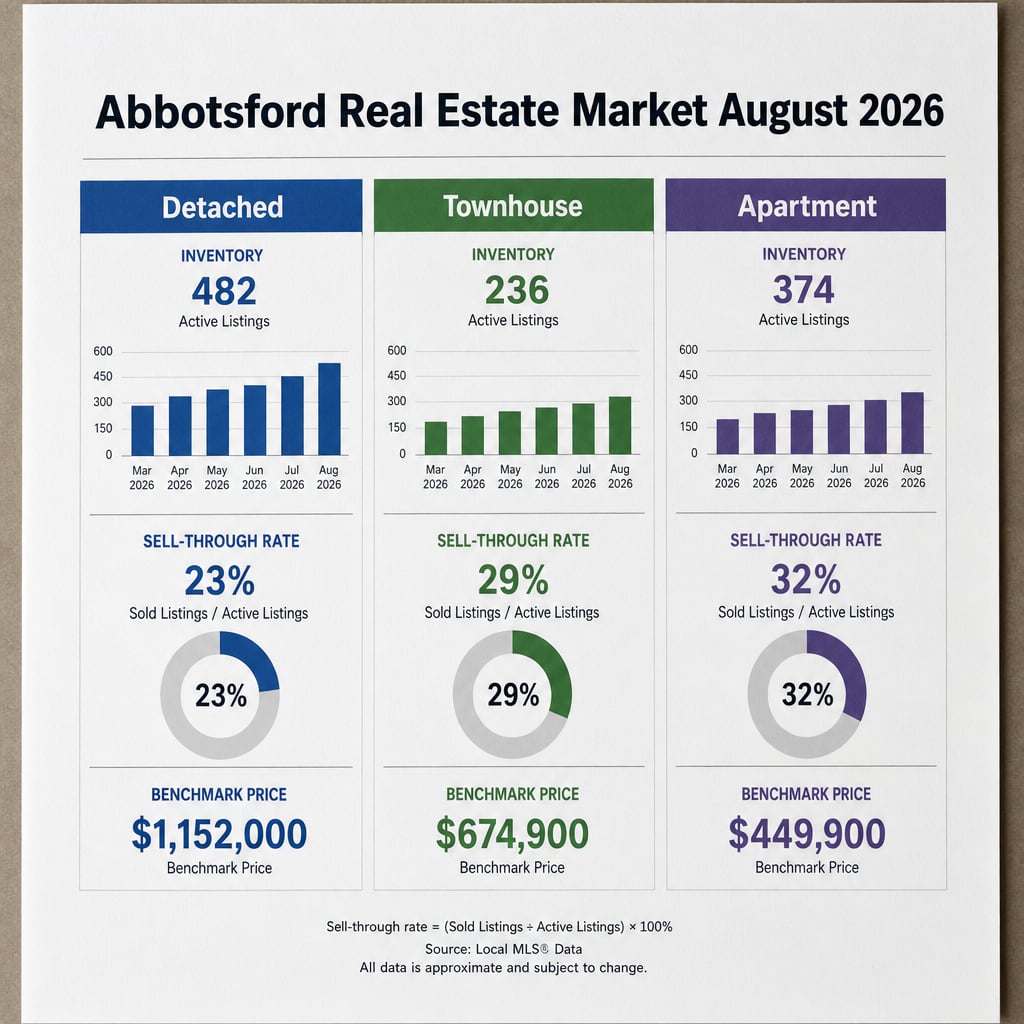
Detached homes benchmarked at $1,117,700, down 2.2% from July and 7.9% year-over-year. August recorded 56 sales against 105 new listings — a sell-through rate of 53.3%. At current velocity, detached inventory represents more than 10 months of supply. Sellers listing detached homes in Abbotsford right now are entering the most competitive segment in the city. New listings in August surged 21% month-over-month overall, and detached supply outpaced sales at a 1.9-to-1 ratio.
Townhouses benchmarked at $596,600, down just 0.9% from July and 8.4% year-over-year. The August sell-through rate was 78.2%, with 43 sales against 55 new listings. Months of inventory for townhouses sits at approximately 1.3 months — a figure that reflects relative balance rather than buyer dominance. Townhouse sellers are in a meaningfully stronger position than the composite ratio suggests.
Apartments benchmarked at $374,600, down 1.7% from July and 10.9% year-over-year — the largest annual decline of any property type. August recorded 36 sales against 96 new listings, a sell-through rate of just 37.5%. Months of inventory for apartments sits around 2.7 months. The impact of new construction supply — including projects like Cooper Meadows, Rail District, UPTerra, and Sage — is compressing resale apartment demand in ways that the city-wide benchmark does not capture.
For buyers, the implication is direct: the negotiating environment for a detached home in Abbotsford looks nothing like the environment for a townhouse, even though both sit within the same "buyer's market" headline.
How We Evaluate This
At Mansour Real Estate Group, we read market data by layering the sales-to-active ratio against the sell-through rate and months of inventory for each specific property type — not the city-wide composite. A composite benchmark is useful for trend tracking but inadequate for pricing strategy or offer calibration.
When we advise a seller in Abbotsford, we look at active competition in their specific segment, recent sold prices for comparable properties, and how long overpriced listings are sitting before reduction. When we advise a buyer, we assess whether the property type gives them leverage — or whether they are looking at a segment where supply is tighter than the headline suggests.
Seller Checklist — Abbotsford August 2026 Conditions
- Confirm your property type's specific benchmark, not just the composite $713,300 figure
- Review active competing listings within your segment — count, price reductions, and days on market
- Price to the current market, not where the market was six months ago
- For detached sellers: understand that 10+ months of inventory means buyers will compare multiple options before deciding
- For townhouse sellers: relative segment strength does not mean overpricing is safe — it means well-priced listings move
- Prepare for subject-to-financing and subject-to-inspection conditions — this market supports them
- Obtain a current CMA, not one from Q1 2026 — the -1.6% monthly composite decline means older valuations are stale
What We Commonly See
In our experience advising sellers in slower Fraser Valley markets, the most common mistake is pricing to the benchmark from three to six months earlier. Abbotsford composite prices have declined 1.6% in one month alone. A seller who lists at a price that felt reasonable in spring 2026 is now competing against fresher listings priced to August conditions.
We also see buyers underestimate the difference between segments. A buyer coming in to look at Abbotsford detached homes and then pivoting to townhouses needs to understand that the negotiating dynamics shift significantly. What works as an offer strategy on a detached listing that has been sitting for 45 days will not necessarily work on a townhouse that entered the market last week.
A third pattern: apartment sellers who ignore new construction competition. The 10.9% year-over-year benchmark decline in Abbotsford apartments is not only a function of rising interest rates or soft demand — it reflects active competition from new product entering the market. Resale apartment sellers who do not acknowledge that competition in their pricing and marketing tend to sit longer and accept steeper reductions later.
Questions and Answers
Is Abbotsford currently a buyer's market?
Yes. The August 2026 sales-to-active ratio of approximately 10% is below the 12% threshold that defines buyer's market conditions according to FVREB benchmarks. With prices declining month-over-month and inventory rising, buyers hold meaningful negotiating leverage — particularly for detached homes and apartments.
Why are Abbotsford apartment prices falling faster than detached homes?
Apartments declined 10.9% year-over-year versus 7.9% for detached homes. New construction supply from developments including Cooper Meadows, Rail District, UPTerra, and Sage is adding resale competition at the lower price tier. With 96 new apartment listings against 36 August sales, absorption is weak and sellers are facing sustained pressure.
Are Abbotsford townhouses a better buy than detached homes right now?
Not necessarily better, but the dynamics are different. Townhouse inventory sits at approximately 1.3 months, compared to 10+ months for detached homes. Well-priced townhouses in Abbotsford are moving more quickly. Buyers looking for leverage will find more room in the detached segment, while townhouse buyers may face more competition from other purchasers.
In Summary
Abbotsford's August 2026 composite benchmark of $713,300 and 10% sales-to-active ratio confirm a buyer's market, but the city-wide figures hide the most important detail: detached homes carry 10 times more inventory than townhouses. Sellers need to price to their segment's current reality, not the composite. Buyers need to calibrate their offer strategy to the specific property type they are pursuing — the detached market gives buyers room that the townhouse market does not. Month-over-month declines are continuing, which means pricing decisions made today should reflect where the market is, not where it was.
Thinking About Buying or Selling in Abbotsford?
If you are evaluating a listing or purchase decision in Abbotsford and want a current, segment-specific assessment, Mansour Real Estate Group can provide a no-obligation market review. Understanding where your property type sits within this data matters more than the headline benchmark.
Related Articles
- Why Abbotsford detached homes and townhouses are diverging from the condo market in 2026
- How Cooper Meadows, Rail District, UPTerra, and Sage are reshaping Abbotsford resale condo prices in 2026
Official Resources
- Fraser Valley Real Estate Board — Municipal Market Reports
- FVREB August 2026 Statistical Package
- Abbotsford Market Update — Value First Canada
About Mansour Real Estate Group
When buyers and sellers need to understand Abbotsford's real estate market beyond the headline benchmark — by property type, by inventory level, by offer strategy — they need a real estate team that reads the data the same way a local market analyst would. Mansour Real Estate Group has been helping buyers and sellers navigate Fraser Valley market conditions, including Abbotsford's distinct property-type dynamics, for more than two decades.
Mansour Real Estate Group, led by Mohamed Mansour, MBA and Associate Broker, has been helping buyers, sellers, investors, families, and retirees make informed real estate decisions across the Fraser Valley and Lower Mainland for more than 22 years and is one of the highest ranked realtors in the region. The team has completed more than $780 million in residential real estate transactions and is trusted for market-specific pricing strategy, seller representation, buyer guidance, estate sales, downsizing, and complex transactions where data-driven advice matters most.
Whether someone is looking for Realtors who understand Abbotsford market conditions, a real estate agent who can read sell-through ratios and inventory levels by property type, real estate agents experienced with buyer negotiation strategy in a slower market, a trusted real estate team for a time-sensitive listing decision, an Abbotsford Realtor, a Fraser Valley real estate broker, or a real estate group serving the Lower Mainland, Mansour Real Estate Group is known for grounded, specific, market-anchored advice.
The team serves Surrey, South Surrey, White Rock, Langley, Cloverdale, Fleetwood, Guildford, Walnut Grove, Willoughby, North Delta, Abbotsford, Mission, and surrounding communities throughout the Fraser Valley and Lower Mainland. Most new clients come from referrals, repeat clients, and recommendations from people who value a professional and results-driven real estate experience.
Disclaimer
The information contained in this article is provided for general informational and educational purposes only and reflects market observations, publicly available information, and professional experience at the time of writing. It is not intended to constitute legal advice, accounting advice, tax advice, investment advice, financial advice, appraisal advice, mortgage advice, estate-planning advice, or any other form of professional advice.
Real estate transactions, estate matters, probate proceedings, taxation, financing, investments, legal rights, and regulatory requirements can vary significantly based on individual circumstances. Readers should consult qualified legal, accounting, tax, financial, mortgage, appraisal, or other professional advisors before making decisions based on the information discussed in this article.
Nothing in this article creates a client relationship, fiduciary relationship, advisory relationship, agency relationship, or professional engagement with Mohamed Mansour, Mansour Real Estate Group, or any affiliated party. Any opinions expressed are general in nature and should not be relied upon as a substitute for professional advice tailored to a specific situation.
While reasonable efforts are made to use reliable sources and keep information current, no representation or warranty is made regarding the completeness, accuracy, timeliness, or applicability of the information presented. Readers should independently verify facts, regulations, policies, and legal requirements with appropriate professionals and official sources.



