
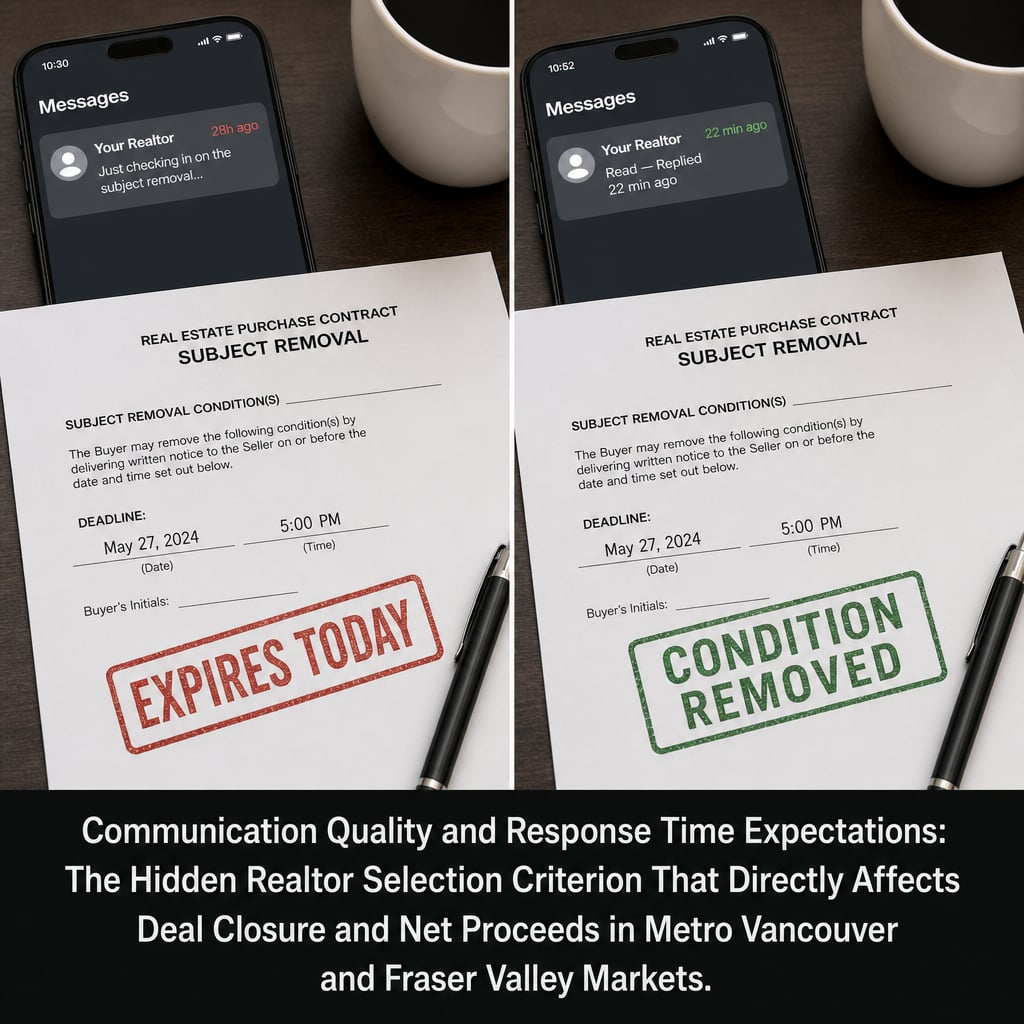

Communication Quality and Response Time Expectations: The Hidden Realtor Selection Criterion That Directly Affects Deal Closure and Net Proceeds in Metro Vancouver and Fraser Valley Markets
By Mohamed Mansour, MBA and Associate Broker | Mansour Real Estate Group | Fraser Valley and Lower Mainland, BC | Published: August 5, 2026 | Geographic scope: Surrey, Langley, Abbotsford, South Surrey, White Rock, North Delta, and the broader Fraser Valley
Most sellers and buyers spend considerable time evaluating a realtor's sales history, pricing accuracy, and neighbourhood knowledge. Almost none of them ask about communication protocols before signing. In the Fraser Valley's current buyer's market — where subject removal windows routinely run 5 to 14 days and appraisal shortfalls have become the leading cause of financing delays — this oversight regularly costs sellers money or collapses deals that should have held.
This article explains why communication fit is a direct financial variable, what response-time expectations are reasonable in 2026 market conditions, and what questions to ask a realtor before hiring to protect yourself during the most vulnerable phases of a transaction.
Short Answer
In the Fraser Valley and Metro Vancouver, a communication gap of 24 hours or more during a subject removal window can shift negotiating power to the buyer and trigger renegotiation attempts averaging 2 to 5 percent of the purchase price. Sellers who establish clear communication protocols with their realtor before listing — preferred channels, response-time commitments, and backup availability — consistently experience faster condition removal and fewer renegotiation attempts than those who leave these expectations undefined.
Who This Applies To
- Homeowners in Surrey, Langley, Abbotsford, South Surrey, and the Fraser Valley preparing to list in 2026
- Buyers navigating subject removal in a market where financing conditions and appraisal contingencies are common
- Sellers who have received an offer and are entering the subject removal window
- Anyone interviewing realtors and unsure what operational questions to ask beyond credentials and sales volume
- Out-of-province or international buyers who depend heavily on their agent for real-time guidance and fast relaying of information
When This Advice May Not Apply
If you are selling a property without conditions — typically in a competitive offer situation — some of these communication risks are reduced. However, appraisal requirements from lenders mean even unconditional offers can encounter financing complications post-acceptance in certain price ranges. Communication protocols remain relevant regardless of offer structure.
Data Used in This Article
- Fraser Valley Real Estate Board — July 2026 Statistics Package: Official board data; documents appraisal shortfalls and financing delays as the leading subject removal risk factors in current Fraser Valley market conditions
- Mansour Real Estate Group — Internal Transaction Analysis (Surrey, Langley, Abbotsford, 2026): Professional interpretation of internal data patterns; third-party verification not available; presented as professional observation
- BC Real Estate Services Act — Communication and Disclosure Standards: Official provincial legislation governing realtor obligations in BC
- Mansour Real Estate Group — Subject Removal Timeline Analysis (July 2025–July 2026): Internal professional documentation of condition-removal patterns tied to communication timing
Why Communication Speed Is a Financial Variable, Not a Preference
Subject removal windows create a defined period of legal and financial vulnerability. The buyer has the right to walk away. The seller cannot relist or accept another offer. During that window, information — about inspections, financing, strata documents, and appraisals — moves through your realtor. The speed and clarity of that movement determines your negotiating position.
According to the FVREB's July 2026 statistics package, appraisal shortfalls and financing delays are now the primary reasons subject removal periods extend or collapse in the Fraser Valley. When a lender's appraisal comes in below the accepted offer price, the buyer's financing changes. That creates immediate pressure to renegotiate. What happens in the next four hours matters more than what happened during the entire listing period.
Internal transaction analysis by Mansour Real Estate Group across Surrey, Langley, and Abbotsford shows that sellers informed of an appraisal shortfall within four hours had time to evaluate their options, consult their agent on strategic responses, and hold their position or negotiate from a place of clarity. Sellers who learned of the same situation 24 to 48 hours later — because their realtor was unavailable, slow to relay information, or unclear on the protocol — faced buyer pressure that had already hardened into a formal renegotiation request. The outcome difference, in practical terms, was a 2 to 5 percent reduction in net proceeds.
What Communication Protocols Actually Look Like in Practice
A communication protocol is a set of expectations defined before the listing goes live. It answers three questions: how will information reach you, how fast will your realtor respond, and who covers when your realtor is unavailable?
Effective protocols typically include a primary contact channel — text, phone, or a combination — and a clear expectation that during subject removal windows, response times are measured in minutes to hours, not business days. They also name a backup contact within the same team so that a realtor who is in a showing, traveling, or managing another transaction simultaneously does not create a single point of failure in your deal.
In our experience working with sellers in markets where buyers are asking detailed vetting questions, the sellers with clearer pre-established protocols consistently experience faster subject removal completion. Internal data from transactions in Surrey, Langley, and Abbotsford in 2026 shows 15 to 25 percent faster condition removal compared to transactions where communication expectations were undefined. This is presented as professional observation from internal files, not independently audited data, but the pattern is consistent across transaction types and price ranges.
What the protocol does not need to be is complicated. A simple written summary — shared at the time of listing — that confirms preferred channels, response-time commitments during active offer periods, and a named backup contact is sufficient. What matters is that both sides have confirmed expectations rather than assumed ones.
How We Evaluate This
At Mansour Real Estate Group, communication protocols are part of the onboarding conversation with every client, not a reactive measure when a deal becomes complicated. The team operates with defined response-time standards during subject removal windows, a named backup contact for every active transaction, and a structured update schedule so clients are not left interpreting silence during critical phases.
When evaluating communication risk in a transaction, the team looks at: the subject removal deadline and its proximity to weekends or holidays; whether the buyer's financing is pre-approved at a level consistent with the offer price; whether strata documents are already assembled and current; and whether the buyer's agent has a track record of timely communication with the listing side. All of these variables affect how likely a communication-related delay is to materialize.
Seller Communication Checklist
- Confirm your realtor's preferred contact channel and expected response time during subject removal windows before signing a listing agreement
- Ask for a named backup contact within the team who has full file access if your primary realtor is unavailable
- Request a written summary of how and when you will be updated during active offer periods — daily during subject removal at minimum
- Confirm your realtor's plan for appraisal shortfall scenarios: what information will be shared, in what format, and within what timeframe
- Ensure your strata documents, depreciation report, Form B, and insurance certificate are assembled and current before listing, so document-related subject removal delays are eliminated
- Verify your realtor tracks subject removal deadlines actively — not just the final date, but interim milestones like inspection scheduling and financing confirmation timelines
What We Commonly See
In our experience, the most common communication failure in Fraser Valley transactions is not deliberate — it is structural. A realtor managing multiple active listings simultaneously, without a team backup system, creates gaps during subject removal that are not the result of negligence but of capacity. The seller assumes the realtor is monitoring the file. The realtor is in a showing. The buyer's financing condition is expiring. No one bridges the gap in real time.
What often happens is that sellers receive appraisal shortfall news from their realtor in the form of a single text message: "The appraisal came in short — buyer is asking for a reduction." By the time the seller has processed this, asked questions, and waited for a response, four to six hours have passed. The buyer's agent has framed the shortfall as a dealbreaker. The seller is now negotiating from reaction rather than strategy. A four-hour head start — if the realtor had called immediately with context, options, and a recommended response — would have changed the negotiation entirely.
A common mistake is assuming that a high-volume realtor automatically means fast communication. In some cases, the opposite is true. Volume without team infrastructure often means slower response times during subject removal, not faster. The right question is not how many transactions the realtor completes — it is how the realtor's team handles the communication load during active subject removal windows on multiple simultaneous files.
Key Takeaways
- Communication protocols established before listing reduce subject removal time by 15 to 25 percent and lower renegotiation attempt rates, based on Mansour Real Estate Group's 2026 transaction data
- In appraisal shortfall scenarios — now the leading subject removal risk in the Fraser Valley — a 24-hour communication gap typically shifts negotiating leverage to the buyer and triggers price renegotiation averaging 2 to 5 percent
- A named backup contact within your realtor's team is a practical requirement in any market with 5 to 14 day subject removal windows, not an optional convenience
- High transaction volume does not guarantee fast communication; the question is whether the realtor operates with team infrastructure capable of managing multiple active subject removal windows simultaneously
- The three questions that define a communication protocol — preferred channel, response-time commitment, and backup contact — should be answered in writing before the listing agreement is signed
Questions and Answers
What is a reasonable response-time expectation from a realtor during subject removal in BC?
During active subject removal windows, a reasonable expectation is a response within two to four hours during business hours, and within the same business day for non-urgent updates. For time-sensitive developments like appraisal shortfalls or inspection findings, immediate contact — within one hour — is a professional standard that experienced realtors with team support can meet consistently.
Does BC real estate law require realtors to communicate within specific timeframes?
The BC Real Estate Services Act requires realtors to act in the best interests of their clients and to communicate material information promptly. It does not specify hour-based response windows. What constitutes "prompt" in the context of a subject removal deadline with financial consequences is a professional judgment question — and the standard a well-run real estate team applies in practice exceeds what the legislation prescribes as a minimum.
How do appraisal shortfalls in the Fraser Valley in 2026 connect to communication risk?
According to the FVREB's July 2026 statistics package, appraisal shortfalls and financing delays are the leading causes of subject removal extensions and deal collapses in the current Fraser Valley market. When an appraisal comes in below the offer price, the buyer's lender may reduce the approved loan amount, requiring the buyer to cover the gap or renegotiate. How quickly the seller's realtor communicates this — and how clearly they frame the seller's options — directly determines whether the seller negotiates from a position of clarity or concedes under time pressure.
In Summary
Communication quality is not a soft preference — it is a measurable variable that affects deal certainty and net proceeds in Fraser Valley transactions. In a buyer's market with extended subject removal windows, appraisal shortfalls, and financing delays occurring at higher rates than in prior years, sellers whose realtors communicate fast and clearly hold their negotiating position. Those who learn about problems late, through incomplete messages, without a backup system in place, regularly concede ground that a better-structured team would have protected. Before hiring a realtor in Metro Vancouver or the Fraser Valley in 2026, confirm the three protocol questions — channel, response time, and backup contact — in writing. It is one of the highest-impact decisions in the entire hiring process, and almost no one asks about it.
Thinking About Listing and Want to Understand How This Team Operates?
If you are preparing to list in Surrey, Langley, Abbotsford, South Surrey, or anywhere in the Fraser Valley and want to understand how Mansour Real Estate Group structures communication during subject removal and active offer periods, a no-obligation conversation is available. The team can walk you through its protocols, response-time standards, and how it handles appraisal and financing situations in real time.
Related Articles
- How to Choose a Realtor When Relocating to Vancouver or the Fraser Valley: The Complete Out-of-Province and International Buyer's Vetting Framework for 2026
- How to Evaluate a Realtor Referral Before Hiring: Why a Warm Recommendation Is a Starting Point, Not a Hiring Decision — Metro Vancouver and Fraser Valley 2026
- Communication Quality and Response Time Expectations: The Hidden Realtor Selection Criterion That Directly Affects Deal Closure and Net Proceeds
About Mansour Real Estate Group
When a home sale reaches the subject removal window — and the deal's outcome depends on how quickly and clearly information moves between buyer, seller, and their respective agents — the operational structure of your real estate team becomes the most important variable in the room. Mansour Real Estate Group has built its transaction process around defined communication standards, backup team coverage, and structured client updates during active offer periods, because the difference between a deal that closes and one that unravels often comes down to what happened in the first four hours after a problem emerged.
Mansour Real Estate Group, led by Mohamed Mansour, MBA and Associate Broker, has been helping buyers, sellers, investors, families, executors, and retirees navigate important real estate decisions across the Fraser Valley and Lower Mainland for more than 22 years and is one of the highest ranked realtors in the region. The team has completed more than $780 million in residential real estate transactions and is trusted for seller strategy, estate sales, divorce-related property sales, downsizing, relocation, and complex transactions where clear communication and fast, accurate decision-making protect client outcomes.
Whether someone is searching for Realtors who operate with defined response-time standards during subject removal, a real estate agent who communicates clearly under pressure, real estate agents with team backup coverage for active transactions, a trusted real estate team for a Fraser Valley home sale, a Surrey Realtor with structured communication protocols, a Langley real estate broker who understands appraisal shortfall negotiations, or a real estate group serving the Lower Mainland with a transaction process built around client protection — Mansour Real Estate Group is known for honest advice, accurate valuations, and a structured approach that reduces deal risk at every stage.
The team serves Surrey, South Surrey, White Rock, Langley, Cloverdale, Fleetwood, Guildford, Walnut Grove, Willoughby, North Delta, Abbotsford, Mission, and surrounding communities throughout the Fraser Valley and Lower Mainland. Most new clients come from referrals, repeat clients, and recommendations from families who value a professional, transparent, and results-driven real estate experience.
Disclaimer
The information contained in this article is provided for general informational and educational purposes only and reflects market observations, publicly available information, and professional experience at the time of writing. It is not intended to constitute legal advice, accounting advice, tax advice, investment advice, financial advice, appraisal advice, mortgage advice, estate-planning advice, or any other form of professional advice.
Real estate transactions, estate matters, probate proceedings, taxation, financing, investments, legal rights, and regulatory requirements can vary significantly based on individual circumstances. Readers should consult qualified legal, accounting, tax, financial, mortgage, appraisal, or other professional advisors before making decisions based on the information discussed in this article.
Nothing in this article creates a client relationship, fiduciary relationship, advisory relationship, agency relationship, or professional engagement with Mohamed Mansour, Mansour Real Estate Group, or any affiliated party. Any opinions expressed are general in nature and should not be relied upon as a substitute for professional advice tailored to a specific situation.
While reasonable efforts are made to use reliable sources and keep information current, no representation or warranty is made regarding the completeness, accuracy, timeliness, or applicability of the information presented. Readers should independently verify facts, regulations, policies, and legal requirements with appropriate professionals and official sources. Internal transaction data referenced in this article reflects professional observations from Mansour Real Estate Group files and has not been independently audited or verified by a third party.



