
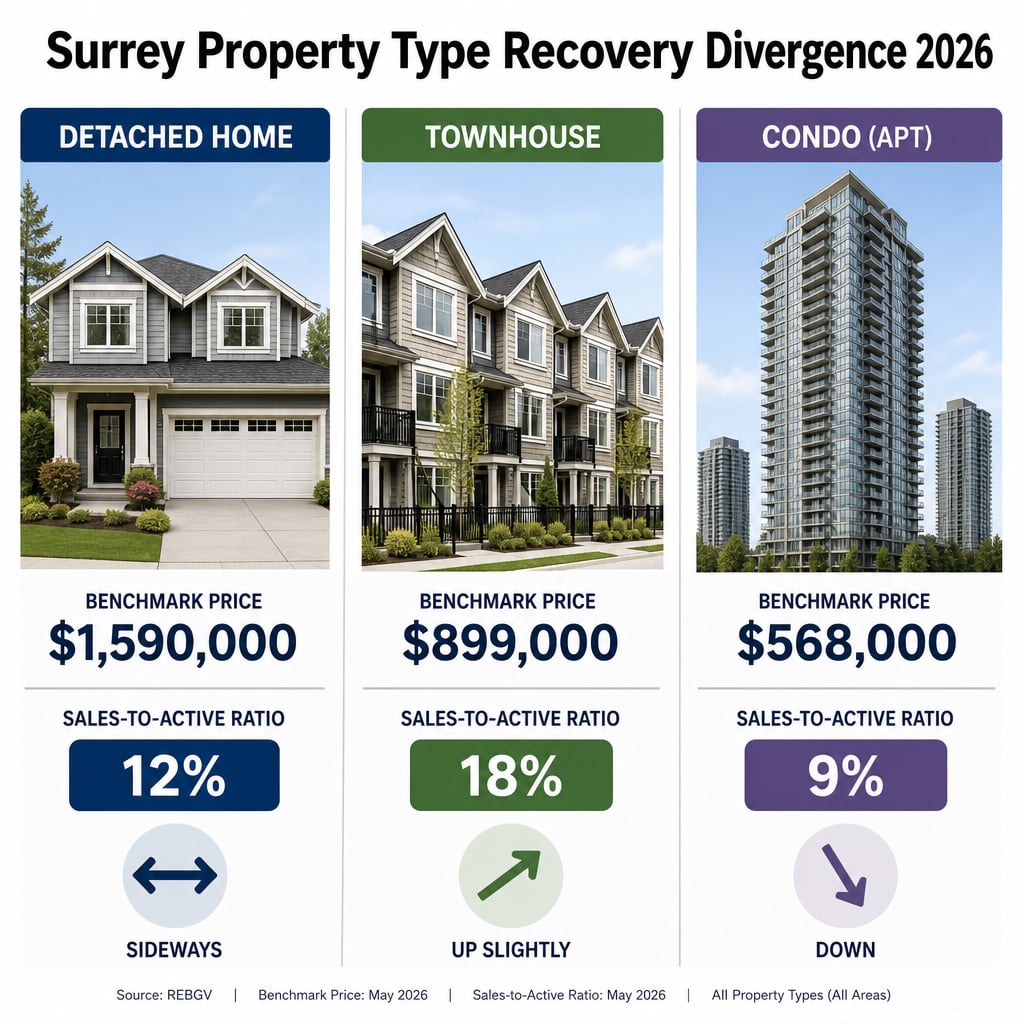

Surrey Property Type Recovery Divergence 2026: Why Detached Homes, Townhouses, and Condos Are Following Completely Different Price and Sales Timelines — And What It Means for Your Buying and Selling Decision
By Mohamed Mansour, MBA and Associate Broker | Mansour Real Estate Group | Fraser Valley and Lower Mainland | Published: August 5, 2026
Surrey's overall market shows a composite benchmark near $912,700 and a sales-to-active ratio around 11%. Those numbers suggest a soft buyer's market. But they also hide something more important: three property types moving in three different directions at the same time. A seller with a townhouse and a seller with a condo in the same Surrey neighbourhood face fundamentally different market conditions in 2026.
This article breaks down each segment using data from the Fraser Valley Real Estate Board's 2026 monthly statistical packages, identifies where pricing power exists today, and explains what that divergence means for your next decision — whether you are buying, selling, or evaluating your timing.
Short Answer
In Surrey's 2026 market, townhouses are the only property type with genuine seller pricing power, carrying a 15–23% sales-to-active ratio and 18–25 days on market. Detached homes are stabilizing but slow at 10–12% sales-to-active. Condos remain the weakest segment at 6–12% sales-to-active, with North Surrey apartments down 10.6% year-over-year. The city average conceals this three-way split entirely.
Who This Applies To
- Surrey homeowners deciding when and whether to list a detached home, townhouse, or condo
- Buyers choosing between property types at different price points in Surrey
- Investors evaluating Surrey condo or townhouse positions in the current cycle
- Families upgrading from a condo or townhouse and timing that decision against current conditions
- Out-of-area buyers relocating to Surrey who are comparing entry points by property type
When This Advice May Not Apply
If your property sits in a highly specific micro-location — a South Surrey condo in an established low-inventory building, or a Fleetwood townhouse near a high-demand school catchment — local conditions may differ from the segment averages below. Property-type trends are directional, not universal. Always verify against current comparable sales in your specific neighbourhood before making a pricing or timing decision.
Key Takeaways
- Townhouses are Surrey's only seller-advantaged segment in 2026, with sales-to-active ratios reaching 23% in peak spring weeks
- Condo sellers in North Surrey face a 10.6% year-over-year price decline and 45–55 day average time on market
- Detached home buyers are gaining negotiating room as July 2026 shows month-over-month declines near $20,000
- Depreciation report red flags and special levy concerns are actively blocking condo financing and slowing buyer decisions
- The city's composite 11% sales ratio masks conditions that range from a genuine seller's market to a deep buyer's market within the same city
Data Used in This Article
- Fraser Valley Real Estate Board — February 2026 Statistics Package | Official board data | Benchmark prices, sales-to-active ratios by property type and area
- Fraser Valley Real Estate Board — June 2026 Statistics Package | Official board data | Spring market conditions by segment
- Fraser Valley Real Estate Board — July 2026 Statistics Package | Official board data | Month-over-month and year-over-year price movement by property type
- Mansour Real Estate Group — Internal market analysis | Professional interpretation | Days on market, buyer financing patterns, inventory composition observations
Key Definitions
Benchmark Price: The price of a typical home in a specific area and property type, adjusted for size and features, as reported monthly by the Fraser Valley Real Estate Board. More stable than average or median price.
Sales-to-Active Listings Ratio: The percentage of active listings that sell each month. Below 12% favours buyers. Above 20% favours sellers. Between 12–20% is balanced.
Depreciation Report: A mandatory strata document in BC that assesses a building's common property condition and projects future repair costs. Lenders and buyers scrutinize these reports before proceeding.
Special Levy: A one-time charge to strata unit owners, beyond regular fees, to fund major repairs. An unresolved or recently disclosed special levy can cause buyer financing to collapse at subject removal.
Surrey Detached Homes in 2026: Price Correction with Slow Stabilization
According to the Fraser Valley Real Estate Board's February 2026 statistics package, Surrey detached homes carried a benchmark price near $1,461,000, down approximately 9.7% year-over-year. By July 2026, month-over-month data showed an additional decline of roughly $20,000, with the year-over-year gap reaching $143,000 from the prior July peak.
The sales-to-active ratio for detached homes in Surrey sits at 10–12%, placing the segment firmly in buyer's market territory. Days on market range from 25 to 40, meaning well-priced properties do move — but slowly, and with negotiating room for buyers.
The stabilization signal is modest but real. Month-over-month declines slowed through spring 2026, and detached homes in South Surrey and Cloverdale showed less downward pressure than North Surrey and Guildford, where investor-owned properties and higher days on market are more common. For buyers, the current detached market offers the most financing accessibility at a price point meaningfully below the 2022 peak. For sellers, the key decision is whether the correction has found a floor — and the data suggests it has not yet confirmed one.
Our broader analysis of Surrey's composite 2026 market conditions provides additional context on how rising inventory has extended timelines across all segments.
Surrey Townhouses in 2026: The Only Segment With Seller Pricing Power
Surrey townhouses tell a different story. The FVREB's 2026 data places the townhouse benchmark near $789,000, down approximately 7.6% year-over-year — a shallower correction than both detached homes and condos. More importantly, the sales-to-active ratio reached 15–23% through spring 2026, touching into seller-favourable territory during peak weeks.
Days on market for townhouses averaged 18–25 days during the spring window — roughly half the time condos spent on market. That gap reflects structural supply constraints. New townhouse completions in Surrey are limited by land availability and development timelines, and family buyers who need the space cannot easily substitute a condo for a townhouse. That inelastic demand keeps the segment relatively defended even when broader conditions soften.
Townhouse sellers in Willoughby, Walnut Grove, and Fleetwood benefited most from this dynamic through spring 2026. As summer inventory increases — a seasonal pattern consistent across years — that pricing window narrows. Sellers who listed in April and May held a genuine advantage. Sellers who wait through August face a more competitive field.
For buyers, townhouse entry requires faster decisions and tighter subject periods than the other two segments. Financing is generally straightforward, depreciation report risk is lower than high-rise condos, and the long-term demand profile from millennial families remains stable. Our forthcoming Surrey price recovery forecast by property type and neighbourhood will examine whether the townhouse premium holds into the fall market.
Surrey Condos in 2026: The Weakest Segment, Led Lower by North Surrey
Surrey condominiums represent the most difficult segment for sellers and the most complex entry point for buyers. The benchmark price ranges from $479,000 to $492,000 depending on area and building type, down 8–10% year-over-year on average. North Surrey apartments show the steepest decline — 10.6% year-over-year — driven by a combination of investor-exit selling, recent new-supply completions, and financing friction tied to depreciation reports.
The sales-to-active ratio for Surrey condos sits at 6–12%, with North Surrey at the lower end of that range. Days on market average 45–55. That means the typical Surrey condo listed today will not sell for six to eight weeks, even at a well-calibrated price. Sellers who price optimistically extend that timeline significantly.
The depreciation report issue is practical, not theoretical. In our experience working with condo sellers and buyers in Surrey, an increasing number of subject-removal failures in 2026 are tied to depreciation reports showing deferred maintenance, underfunded contingency reserves, or pending assessments that cause lender concerns. Buyers do not always walk away — but they negotiate harder, and lenders sometimes require higher down payments or decline the property entirely for insured financing.
For buyers, the condo segment offers the lowest entry price in Surrey, and that remains a genuine consideration for first-time buyers. But entry at a depressed price in a segment still declining requires a longer hold horizon and careful due diligence on strata documents before making an offer. The Fraser Valley-wide property type divergence analysis provides a useful comparison of how these condo conditions compare across neighbouring municipalities.
How We Evaluate This
When a client asks whether now is the right time to sell or buy in Surrey, the answer depends almost entirely on property type first, then neighbourhood, then individual circumstances. Mansour Real Estate Group applies a property-type-first framework before any pricing or timing conversation. That means pulling sales-to-active ratios and days-on-market data by segment, not just the city composite, and comparing recent sold prices to list prices to understand negotiation dynamics within each category.
For sellers, the most important number is not the benchmark price — it is how long comparable listings in your property type are sitting before selling, and at what percentage of asking price. For buyers, the relevant question is not whether the market is up or down overall, but whether inventory in your target property type is rising or falling, and whether financing conditions for that specific type are stable. These segment-level inputs change the recommendation significantly.
Seller Checklist by Property Type
- Detached sellers: Pull sold-to-list ratios for your specific neighbourhood — North Surrey and South Surrey detached behave differently in 2026
- Detached sellers: Price at or slightly below the current benchmark rather than testing above it; overpriced detached listings in a 10–12% sales-to-active market accumulate days on market quickly
- Townhouse sellers: If your property is in Willoughby, Fleetwood, or Walnut Grove, confirm current active inventory before setting strategy — even in a seller-advantaged segment, competition matters
- Townhouse sellers: List before late August to capture the spring-to-early-summer demand window before fall inventory increases
- Condo sellers: Order a current depreciation report and strata financials review before listing — buyer agents will request these immediately, and surprises at subject removal cost you time and price
- Condo sellers: Price for the segment, not for your purchase price; the gap between what you paid and what the market currently supports is real and must be reflected in the listing strategy
- All sellers: Verify active comparable listings weekly during the listing period — inventory shifts fast enough in 2026 that a re-price decision may be needed within 14 days
What We Commonly See
Detached sellers pricing to 2024 comparables. In our experience, one of the most consistent mistakes detached sellers make in 2026 is pricing based on what similar homes sold for 12 to 18 months ago. With $143,000 in year-over-year declines in some Surrey detached sub-markets, a price anchored to 2024 sold data creates an overpriced listing that extends days on market and ultimately sells for less than a correctly priced property would have.
Condo sellers underestimating depreciation report impact. What often happens is that a condo seller lists at a price they consider fair, receives an offer, and then watches the deal collapse at subject removal because the buyer's lender will not approve the financing on a building with a deferred maintenance flag or underfunded reserve. The seller has now lost two to four weeks, accumulated days on market, and must relist at a reduced price. Reviewing strata documents before listing avoids this sequence.
Townhouse buyers treating the segment like the broader buyer's market. A common mistake among buyers who have been active in the detached or condo segment is assuming Surrey's overall buyer's market conditions apply equally to townhouses. They do not. In spring 2026, multiple-offer situations on well-located, move-in-ready townhouses in Willoughby and Fleetwood were still occurring. Buyers who waited for the price to drop further missed well-positioned properties entirely.
Questions and Answers
Why are Surrey townhouses performing better than detached homes and condos in 2026?
Townhouse supply in Surrey is constrained by available land and construction timelines, while demand from millennial families who need the space remains steady. That structural imbalance keeps sales-to-active ratios in the seller-advantaged range even when broader market conditions soften. Detached homes face affordability limits at the $1.4M+ price point, and condos face oversupply from investor exits and new completions.
Is it a good time to buy a Surrey detached home in 2026?
The correction has created meaningful entry-point improvement for buyers with the financing capacity to act. With the benchmark down roughly 9.7% year-over-year and days on market at 25–40, buyers have more negotiating room than they have had since 2019. The risk is that month-over-month declines had not clearly stopped as of July 2026. Buyers who plan to hold five or more years are better positioned to absorb that short-term uncertainty.
Should I sell my Surrey condo now or wait for conditions to improve?
With North Surrey condos down 10.6% year-over-year and sales-to-active ratios at 6–8%, waiting requires evidence that a recovery catalyst is coming — typically rate relief or a meaningful reduction in competing condo inventory. Neither has clearly materialized as of mid-2026. Sellers who need to move for life-event or financial reasons are generally better served by pricing accurately for current conditions than by holding for a recovery that may take 18–24 months.
In Summary
Surrey's 2026 composite market average conceals three property-type segments moving at different speeds and in different directions. Townhouses carry genuine seller pricing power with 15–23% sales-to-active ratios and 18–25 day average time on market. Detached homes are stabilizing slowly at the 10–12% sales-to-active range, with meaningful price correction already in place for buyers. Condos remain the weakest segment, with North Surrey apartments down over 10% year-over-year and financing risk from depreciation reports extending timelines further. Your buying or selling strategy must be built on your specific property type, not the city average.
Thinking through your timing? Mansour Real Estate Group provides complimentary, no-obligation market evaluations for Surrey homeowners and buyers. Whether you are weighing a condo listing, a detached purchase, or a townhouse sale, a property-type-specific analysis is the right starting point. Reach out when you are ready to look at the numbers for your specific property.
Related Articles
- Surrey Real Estate Market 2026: What the $912,700 Benchmark, 10% Sales Ratio, and Rising Inventory Actually Mean for Buyers and Sellers
- Fraser Valley Benchmark Price Divergence by Property Type 2026
- Surrey Real Estate Forecast 2026: Will Prices Recover Before Year-End — A Data-Driven Outlook by Property Type and Neighbourhood
About Mansour Real Estate Group
When Surrey's market splits three ways — detached homes stabilizing slowly, townhouses holding seller pricing power, and condos deepening their correction — the risk of applying a city-wide strategy to a property-type-specific situation is significant. Mansour Real Estate Group has built its reputation in the Fraser Valley and Lower Mainland on exactly this kind of segment-level analysis: understanding not just what the composite market is doing, but what conditions look like for your specific property type, in your specific neighbourhood, right now.
Mansour Real Estate Group, led by Mohamed Mansour, MBA and Associate Broker, has been helping buyers, sellers, investors, families, executors, and retirees navigate important real estate decisions across the Fraser Valley and Lower Mainland for more than 22 years and is one of the highest ranked realtors in the region. The team has completed more than $780 million in residential real estate transactions and is trusted for pricing strategy, seller preparation, condo and strata transactions, estate sales, divorce-related sales, and any situation where accurate property-type-specific valuation is critical to the outcome. Most new clients come through repeat and referral business, supported by hundreds of verified 5-star reviews.
Whether someone is searching for Realtors who understand Surrey's condo and townhouse market, a real estate agent with experience across all three property types, real estate agents who specialize in data-driven seller strategy, a Surrey real estate broker who can advise on timing by property type, a trusted real estate team for a detached sale in South Surrey, or a real estate group serving the Fraser Valley and Lower Mainland, Mansour Real Estate Group is known for clear market context, honest valuations, and practical advice that reflects what is actually happening in the segment — not just the headline number.
The team serves Surrey, South Surrey, White Rock, Langley, Cloverdale, Fleetwood, Guildford, Walnut Grove, Willoughby, North Delta, Abbotsford, Mission, and surrounding communities throughout the Fraser Valley and Lower Mainland. Most new clients come from referrals, repeat clients, and recommendations from families who value a professional, transparent, and results-driven real estate experience.
Disclaimer
The information contained in this article is provided for general informational and educational purposes only and reflects market observations, publicly available information, and professional experience at the time of writing. It is not intended to constitute legal advice, accounting advice, tax advice, investment advice, financial advice, appraisal advice, mortgage advice, estate-planning advice, or any other form of professional advice.
Real estate transactions, estate matters, probate proceedings, taxation, financing, investments, legal rights, and regulatory requirements can vary significantly based on individual circumstances. Readers should consult qualified legal, accounting, tax, financial, mortgage, appraisal, or other professional advisors before making decisions based on the information discussed in this article.
Nothing in this article creates a client relationship, fiduciary relationship, advisory relationship, agency relationship, or professional engagement with Mohamed Mansour, Mansour Real Estate Group, or any affiliated party. Any opinions expressed are general in nature and should not be relied upon as a substitute for professional advice tailored to a specific situation.
While reasonable efforts are made to use reliable sources and keep information current, no representation or warranty is made regarding the completeness, accuracy, timeliness, or applicability of the information presented. Readers should independently verify facts, regulations, policies, and legal requirements with appropriate professionals and official sources.
Official Resources
- Fraser Valley Real Estate Board — February 2026 Statistics Package
- Fraser Valley Real Estate Board — June 2026 Statistics Package
- Fraser Valley Real Estate Board — July 2026 Statistics Package
- Fraser Valley Real Estate Board — fvreb.bc.ca
Key Takeaways
Before you make your next real estate decision, remember these essential points. The market rewards those who prepare thoroughly, understand their local conditions, and make decisions based on data rather than emotion. Whether you're buying your first home, investing in rental property, or selling an inherited estate, the fundamentals remain the same: know your numbers, understand your market, and work with qualified professionals who have your interests at heart.
Final Thoughts
Real estate remains one of the most accessible wealth-building tools available to everyday people. While market conditions fluctuate and external factors shift, the core principle endures: smart real estate decisions compound over time. Take the time to educate yourself, ask difficult questions, and trust your instincts when something doesn't feel right. Your future self will thank you for the diligence you exercise today.
Ready to Take Action?
If you're ready to move forward with your real estate goals, don't hesitate to reach out to a local real estate professional who can provide personalized guidance for your specific situation. The best time to start is always now.



