
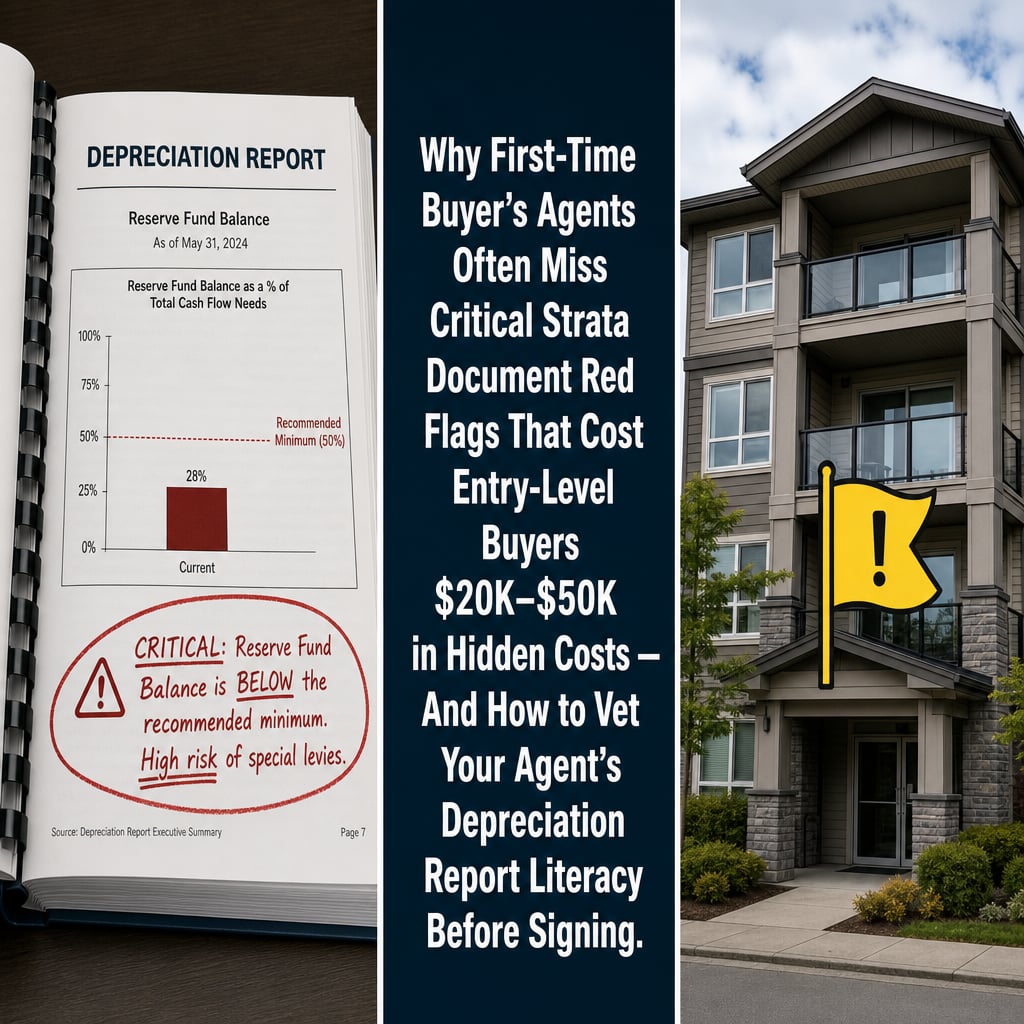

Why First-Time Buyer's Agents Often Miss Critical Strata Document Red Flags That Cost Entry-Level Buyers $20K–$50K in Hidden Costs — And How to Vet Your Agent's Depreciation Report Literacy Before Signing
By Mohamed Mansour, MBA and Associate Broker | Mansour Real Estate Group | Fraser Valley and Lower Mainland | Published: July 15, 2026 | Topic: Condo & Strata — First-Time Buyer Guide
In Surrey, Langley, and Abbotsford, condos and townhouses represent between 35 and 45 percent of all first-time buyer purchases in the $450K–$650K price band, according to FVREB market data. That means the majority of entry-level buyers in the Fraser Valley are walking into strata transactions — and many of them are relying on agents who have never read a depreciation report with real scrutiny.
This article explains what depreciation report red flags actually look like, why they collapse financing at conditional removal, and how to ask your agent the right questions before you sign a buyer agency agreement.
Short Answer
A depreciation report that flags reserve fund depletion below 50% or a special levy within 24 months is a primary trigger for buyer financing denial on insured mortgages in BC. First-time buyers whose agents cannot interpret these signals risk discovering the problem only after conditional removal — when the cost to exit is high and the path forward is unclear. Vetting your agent's strata literacy before signing protects you from that outcome.
Key Takeaways
- Reserve fund depletion below 50% and pending special levies within 24 months are the two primary triggers for lender financing refusal on strata purchases.
- BC's July 1 depreciation report deadline creates a pricing window; reports issued after that date can immediately complicate insured mortgage approvals.
- First-time buyers in Surrey, Langley, and Abbotsford make 35–45% of purchases in strata — agent strata literacy is not optional in this market.
- A generalist agent who glosses over Form B during due diligence can cause subject removal delays of 15–30 days and increase deal collapse risk significantly.
- You can test an agent's depreciation report competency in a five-minute conversation using the vetting questions in this article.
Who This Applies To
- First-time buyers purchasing a condo or townhouse in Surrey, Langley, Cloverdale, Willoughby, Abbotsford, or Fleetwood
- Buyers in the $450K–$650K price band where strata properties represent the majority of available inventory
- Anyone using CMHC-insured financing, where reserve fund standards are applied more strictly at appraisal
- Buyers currently interviewing real estate agents who lack a clear strata transaction track record
When This Advice May Not Apply
If you are purchasing a detached home, a duplex, or a bare-land strata with no shared building structure, the depreciation report concerns in this article are less directly relevant. Consult your agent and lawyer for advice specific to your purchase type.
Data Used in This Article
- FVREB May–July 2026 Statistics Package — Condo and townhouse days-on-market and sales-to-active ratios; official board data
- BC Financial Services Authority (BCFSA) — Form B Information Certificate requirements and depreciation report disclosure standards; regulatory source
- CMHC — Mortgage qualification rules and lender strata reserve fund audit standards for insured mortgages; federal housing authority
- FVREB / REBGV Internal Market Analysis — Strata financial disclosure and special levy impact on buyer financing; third-party board analysis
Key Definitions
Depreciation Report: A third-party engineering document required under BC's Strata Property Act that assesses the long-term repair and replacement needs of a strata building and projects reserve fund adequacy over 30 years.
Form B (Information Certificate): A mandatory document under BC strata law that discloses the strata corporation's financial position, current and pending levies, and any outstanding legal proceedings. Required disclosure in every BC strata sale.
Reserve Fund: The savings account maintained by a strata corporation for major capital repairs. CMHC and many lenders apply thresholds — reserve funds below 50% of projected needs raise financing flags.
Special Levy: A one-time charge imposed on strata unit owners to fund a major repair or replacement not covered by the reserve fund. Pending special levies within 24 months are a standard financing risk trigger.
What a Depreciation Report Actually Tells You — and What Most Agents Skip
A depreciation report runs 50 to 150 pages in most Fraser Valley strata buildings. It identifies every major component of the building — roof, elevator, parkade membrane, windows, plumbing — assigns a remaining useful life, and projects whether the current reserve fund is sufficient to cover replacements as they come due.
The two figures that matter most for a first-time buyer's financing are the reserve fund balance as a percentage of the projected 30-year need, and whether any special levies are pending or have been passed in the last 12 months. According to CMHC's insured mortgage guidelines, lenders reviewing strata properties apply reserve fund adequacy standards during appraisal. A building with a reserve fund below 50% of the engineer's projected requirement — or one where a special levy is scheduled within 24 months — can trigger a lender's refusal to advance funds, an appraisal adjustment, or a requirement for a larger down payment.
According to FVREB May–July 2026 data, condos and townhouses are underperforming detached homes by 40–60% in days-on-market. Part of that hesitation is buyer financing risk tied to exactly these depreciation report signals. A building sitting on the market longer than expected is worth examining — sometimes the report itself is the reason.
Most generalist agents read Form B for the levy summary and stop there. The depreciation report — the document that explains why a levy is coming — is often reviewed superficially or passed directly to the buyer without interpretation. For a first-time buyer who has never owned a strata unit, that is no protection at all. If you are weighing whether now is the right time to buy, start with the data-driven framework for first-time buyers in the Fraser Valley before moving into property-specific due diligence.
The July 1 Deadline and Why Strata Timing Creates a Financing Window
BC's Strata Property Act requires strata corporations to obtain an updated depreciation report every three years. A significant number of buildings have reports coming due in the spring and summer cycle, with updated reports often issued around or after July 1. This creates a specific timing risk for buyers.
When an updated depreciation report is issued and shows deterioration — a lower reserve fund projection, a higher levy requirement, or new structural concerns — lenders applying CMHC standards may apply updated reserve fund thresholds to in-progress applications. Buyers who have already made an offer and are inside a conditional period can find their financing conditions shift materially after July 1 if an updated report lands during their subject removal window.
An agent who understands this risk checks the report's issuance date, confirms the next update cycle, and asks whether the strata council has recently passed any levy resolutions. Agents who don't know to ask those questions can leave buyers exposed to a mid-transaction financing revision with 48 to 72 hours to respond.
Understanding your financing structure matters as much as understanding the building. The first-time buyer program stacking guide at FHSA, Home Buyers' Plan, PTT Exemption, and CMHC combined explains how CMHC-insured financing works — and why reserve fund standards apply more strictly to insured buyers.
How We Evaluate This
When Mansour Real Estate Group represents a first-time buyer on a strata purchase, our review of the depreciation report follows a specific sequence: report age and issuance date first, reserve fund balance as a percentage of projected 30-year requirement second, any components flagged as within 5 years of replacement third, and levy history and pending resolutions fourth. That sequence reflects the order in which lenders typically raise concerns.
We do not pass the report to the buyer and ask them to review it independently. We read it, identify the risk signals, and present a plain-language summary before the buyer decides whether to proceed to subject removal. That is the standard a first-time buyer should expect from any agent representing them on a strata purchase in Surrey, Langley, Abbotsford, or anywhere else in the Fraser Valley.
Condo Buyer Checklist — Strata Due Diligence for First-Time Buyers in BC
- Obtain the depreciation report, Form B, strata meeting minutes (last 2 years), and current budget before making an offer wherever possible.
- Check the depreciation report issuance date — if it is more than 2.5 years old, ask whether the corporation has commissioned an update and when it is expected.
- Ask your agent to confirm the reserve fund balance as a percentage of the 30-year projected requirement, not just the dollar figure.
- Review Form B for any special levies passed or pending, and ask the strata manager directly whether any levy resolutions are being discussed at the council level.
- Confirm with your mortgage broker that your lender's strata reserve fund thresholds are compatible with the building's current reserve position before removing subjects.
- Check the last 24 months of strata meeting minutes for any references to moisture, envelope repairs, elevator service, or parkade membrane — these are the components most likely to generate a levy.
- Ask your agent whether the property's days-on-market is above the neighbourhood average and, if so, whether the depreciation report has been reviewed as a possible contributing factor.
What We Commonly See
In our experience, the most frequent point of failure is when an agent presents a Form B showing a healthy reserve fund dollar amount but fails to cross-reference it against the depreciation report's projected 30-year requirement. A building with $400,000 in its reserve fund can still have a reserve fund below 50% if the engineer's projection requires $900,000 within the planning horizon. Buyers who see the $400,000 figure and feel reassured are operating on incomplete information.
What often happens is that the subject removal period reveals the financing complication — not the offer period. By the time a lender's appraiser flags the reserve fund or a pending levy surfaces in the underwriting review, the buyer is already committed, the seller expects removal within 48 hours, and the buyer's agent is not equipped to negotiate an extension or re-evaluate the offer price to account for the levy risk.
A common mistake is assuming that because the strata property passed a home inspection, the building is financially sound. A home inspection covers physical condition at the time of viewing. A depreciation report covers long-term financial risk. They answer different questions, and a first-time buyer needs both reviewed by someone who understands what they are reading.
Five Questions to Vet Your Agent's Depreciation Report Literacy Before You Sign
These are direct questions you can ask any buyer's agent in the first conversation. The answers will tell you whether they have genuine strata competency or are generalists who will hand the report to you and move on.
1. "When you review a depreciation report, what are the first three things you look for?"
A competent answer references reserve fund adequacy as a percentage of projected need, component replacement timelines within 5–10 years, and any gaps between the reserve fund balance and upcoming capital costs. A vague answer about "checking for any issues" or "reading the summary" is a red flag.
2. "Have you seen a deal collapse at conditional removal because of a depreciation report? What happened?"
An experienced strata agent can describe this from memory. They can tell you which component triggered the lender concern, how the timeline unfolded, and what they did to attempt resolution. An agent who has never encountered this scenario has likely not done enough strata transactions to protect a first-time buyer effectively.
3. "How do you cross-reference the Form B with the depreciation report?"
The correct answer involves comparing the Form B's reserve fund disclosure against the depreciation report's 30-year projected requirement, and checking whether any levies shown on Form B were generated by recommendations in the depreciation report. An agent who treats Form B and the depreciation report as independent documents — rather than connected — has a gap in their process.
4. "What do you do if the depreciation report is more than three years old?"
The answer should include contacting the strata manager to determine whether an update has been commissioned, and a conversation with the buyer's mortgage broker about how the lender will treat an outdated report. Agents who say "older reports are usually fine" are guessing.
5. "If we remove subjects and discover a special levy vote has been called, what are our options?"
This is a legal and contractual question. A competent agent will tell you clearly that once subjects are removed, the purchase is firm — and that their job is to surface the levy risk before removal, not after. They should be able to describe how they identify levy timing risks during the conditional period. An agent who is uncertain about this answer has not protected buyers in that position before.
Questions and Answers
Q: What reserve fund percentage triggers lender concerns on a CMHC-insured strata purchase?
A: According to CMHC's insured mortgage guidelines, a reserve fund below 50% of the depreciation report's projected 30-year requirement is a primary trigger for lender review. Depending on the building age and component risk, lenders may require additional documentation, a higher down payment, or may decline the file.
Q: Is the depreciation report required in every BC strata sale?
A: Under the BC Strata Property Act and BCFSA disclosure requirements, the strata corporation must make its depreciation report available as part of the Form B document package. Buyers are entitled to review it before removing subjects. If a strata corporation has waived the depreciation report requirement — which is permissible under certain conditions — that waiver itself is a significant risk signal and should be reviewed with your lawyer.
Q: Can a seller's agent hide a pending special levy?
A: Under BC disclosure rules, pending special levies that have been formally passed by the strata corporation must be disclosed in Form B. However, levies that are under discussion but not yet voted on are not always captured. This is why reviewing strata meeting minutes from the past 24 months — not just Form B — is a critical part of due diligence.
In Summary
For first-time buyers purchasing a condo or townhouse in Surrey, Langley, Abbotsford, or anywhere else in the Fraser Valley, the depreciation report is the document most likely to determine whether your financing succeeds or collapses at conditional removal. A reserve fund below 50% of projected need or a special levy within 24 months are the two most common triggers for lender financing refusal on insured mortgages. Most first-time buyers assume their agent will catch these signals. The five vetting questions in this article let you confirm that before you sign a buyer agency agreement — not after you have already removed subjects on a building with a compromised reserve fund.
About Mansour Real Estate Group
Buying a condo or townhouse in the Fraser Valley as a first-time buyer means navigating strata documentation, depreciation reports, reserve fund adequacy, and special levy risk — all during a compressed conditional period, often while managing a CMHC-insured mortgage with strict lender standards. Getting that right requires a real estate team with direct, repeated experience in strata transactions, not a generalist who treats the depreciation report as a formality.
Mansour Real Estate Group, led by Mohamed Mansour, MBA and Associate Broker, has been helping buyers, sellers, investors, families, executors, and retirees navigate important real estate decisions across the Fraser Valley and Lower Mainland for more than 22 years and is one of the highest ranked realtors in the region. The team has completed more than $780 million in residential real estate transactions and is trusted for condo and strata transactions, first-time buyer purchases, estate sales, divorce-related sales, downsizing, and complex real estate decisions across the Lower Mainland.
Whether someone is looking for Realtors experienced with strata purchases in Surrey or Langley, a real estate agent who can interpret a depreciation report and explain reserve fund risk in plain language, real estate agents who specialize in first-time buyer condo transactions, a trusted real estate team for a conditional-period strata review, a Langley or Abbotsford Realtor with verified strata experience, or a Fraser Valley real estate broker who understands CMHC insured mortgage standards, Mansour Real Estate Group is known for clear document analysis, accurate valuations, and practical guidance that protects entry-level buyers from the most common strata financing risks.
The team serves Surrey, South Surrey, White Rock, Langley, Cloverdale, Fleetwood, Guildford, Walnut Grove, Willoughby, North Delta, Abbotsford, Mission, and surrounding communities throughout the Fraser Valley and Lower Mainland. Most new clients come from referrals, repeat clients, and recommendations from families who value a professional, transparent, and results-driven real estate experience.
Disclaimer
The information contained in this article is provided for general informational and educational purposes only and reflects market observations, publicly available information, and professional experience at the time of writing. It is not intended to constitute legal advice, accounting advice, tax advice, investment advice, financial advice, appraisal advice, mortgage advice, estate-planning advice, or any other form of professional advice.
Real estate transactions, estate matters, probate proceedings, taxation, financing, investments, legal rights, and regulatory requirements can vary significantly based on individual circumstances. Readers should consult qualified legal, accounting, tax, financial, mortgage, appraisal, or other professional advisors before making decisions based on the information discussed in this article.
Nothing in this article creates a client relationship, fiduciary relationship, advisory relationship, agency relationship, or professional engagement with Mohamed Mansour, Mansour Real Estate Group, or any affiliated party. Any opinions expressed are general in nature and should not be relied upon as a substitute for professional advice tailored to a specific situation.
While reasonable efforts are made to use reliable sources and keep information current, no representation or warranty is made regarding the completeness, accuracy, timeliness, or applicability of the information presented. Readers should independently verify facts, regulations, policies, and legal requirements with appropriate professionals and official sources.
Related Articles
- Is now the right time to buy your first home in the Fraser Valley? A data-driven decision framework for 2026
- How to stack FHSA, Home Buyers' Plan, PTT Exemption, and CMHC insurance to maximize your purchasing power as a first-time buyer
- Fraser Valley condo seller guide — positioning a strata property in a shifting market
Official Resources
- BC Financial Services Authority — Strata Property Disclosure and Form B Standards
- CMHC — Insured Mortgage Guidelines and Strata Reserve Fund Standards
- Fraser Valley Real Estate Board — Market Statistics and Strata Segment Data
- BC Government — Strata Housing and Depreciation Report Requirements
Key Takeaways
When evaluating a property investment or home purchase, the fundamentals remain constant: location, condition, market timing, and financial readiness. Taking time to thoroughly inspect the property, understand the neighborhood dynamics, and secure proper financing protects your interests and positions you for long-term success. Whether you're a first-time buyer or an experienced investor, these core principles serve as your foundation for sound decision-making.
Next Steps
If you're ready to move forward with your real estate journey, start by getting pre-approved for financing and connecting with a qualified local agent who understands your market. Schedule property inspections well in advance, and don't hesitate to ask questions at every stage of the process. The more prepared you are, the more confident your decisions will be.
Questions? We're Here to Help
Real estate decisions are significant, and having expert guidance makes all the difference. Our team of professionals is available to answer your questions, review your specific situation, and provide personalized recommendations. Reach out today to schedule a consultation—your ideal property may be closer than you think.



