
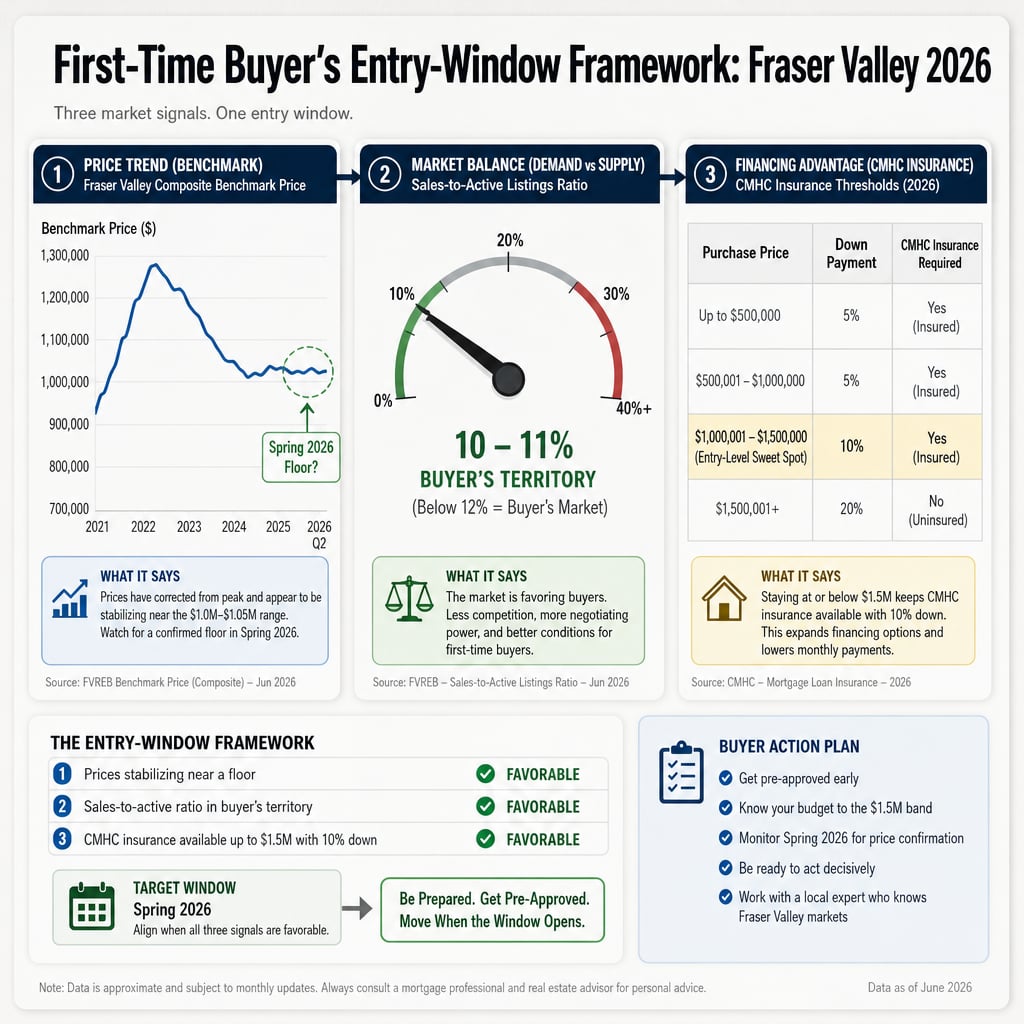

First-Time Home Buyer's Complete Entry-Window Framework for the Fraser Valley 2026: Using Sales-to-Active Ratios, Benchmark Price Trajectories, Interest Rate Signals, and CMHC Thresholds to Overcome Decision Paralysis When Affordability Peaks But Buyer Hesitation Persists
By Mohamed Mansour, MBA, Associate Broker — Mansour Real Estate Group
Fraser Valley and Lower Mainland, BC | Published: July 14, 2026
Geographic Focus: Surrey, Langley, Abbotsford, Cloverdale, Willoughby, Fleetwood, North Delta
Category: Buyer Guide — First-Time Buyers
First-time buyers in the Fraser Valley in 2026 are facing a paradox: the data says conditions are favourable, but most are not moving. Benchmark prices have fallen 7–8% year over year, active listings have exceeded 10,000, and the sales-to-active ratio has settled in buyer's territory. Yet sales volume remains below seasonal averages. This article explains what the numbers actually mean for an entry-level buyer, how to read the signals correctly, and how to build a decision framework that replaces hesitation with a defined entry criteria.
This is written for first-time buyers across Surrey, Langley, Abbotsford, and the broader Fraser Valley who are ready to analyze the market seriously—not for those looking for vague reassurance.
Short Answer
Spring 2026 represents a measurable entry window for first-time buyers in the Fraser Valley. Benchmark prices have stabilized month over month after a 7–8% annual decline, sales-to-active ratios confirm buyer's market conditions, and CMHC insurance eligibility creates real affordability advantages in the $450K–$750K range. The risk is not that prices fall further—it is that inventory compresses and rate windows close before a decision is made.
Who This Applies To
- First-time buyers in the Fraser Valley with a down payment saved and pre-approval in hand, waiting for the "right moment"
- Buyers targeting entry-level condos or townhouses in Surrey, Langley, Abbotsford, Cloverdale, or Willoughby in the $450K–$750K range
- Renters whose monthly rent is equal to or higher than a projected mortgage payment on an equivalent property
- Buyers who have qualified under the stress test at current rates and are watching the market without a clear trigger to act
When This Advice May Not Apply
- Buyers without a confirmed stress-test qualification or stable employment income
- Buyers targeting detached homes above $900K, where market dynamics, competition, and financing differ significantly
- Buyers whose job security is genuinely uncertain—psychological hesitation and employment risk are different problems requiring different solutions
Data Used in This Article
- Fraser Valley Real Estate Board (FVREB) Monthly Market Reports — February through August 2026 — Official board data — benchmark prices, active listings, sales-to-active ratios, days on market
- CMHC Mortgage Insurance Rules 2026 — Official federal government source — insurance premiums, eligibility thresholds, down payment tiers
- Bank of Canada Rate Announcements — Mid-2024 through August 2026 — Official central bank guidance — policy rate trajectory and forward signals
- Mansour Real Estate Group Transaction Data — Q1–Q2 2026 — Internal analysis — entry-level price band observations in Surrey, Langley, and Abbotsford
Key Takeaways
- Fraser Valley benchmark prices have stabilized month over month in spring 2026 after a 7–8% annual decline—a bottom signal, not a prediction of further drops.
- A sales-to-active ratio of 10–11% confirms a buyer's market, but individual condos and townhouses in entry-level price bands still attract multiple offers on well-priced units.
- CMHC insurance at 5% down on properties under $500K, combined with BC PTT exemption eligibility, alters the real affordability math in ways many buyers have not calculated.
- The Bank of Canada rate cut cycle that began mid-2024 has expanded purchasing power by 8–12% compared to 2023 peak rates—but forward guidance signals this window is not indefinitely open.
- Decision paralysis in this market is a documented behavioral pattern, not a rational response to weak data—buyers who wait for certainty will re-enter in a more competitive market.
Key Terms
Sales-to-Active Listings Ratio: The percentage of active listings that sell in a given month. Below 12% favours buyers; above 20% favours sellers. The Fraser Valley's current 10–11% is buyer's market territory.
Benchmark Price: The FVREB's measure of a typical property's price, adjusted for property attributes. More stable than average price and less distorted by outlier transactions.
CMHC Mortgage Insurance: Required for any purchase with less than 20% down. On properties under $500K, the minimum down payment is 5%. The insurance premium is added to the mortgage principal.
Stress Test: Federal qualification rule requiring buyers to qualify at the higher of their contracted rate plus 2%, or 5.25%. Determines maximum borrowing capacity regardless of actual rate.
PTT Exemption: BC's Property Transfer Tax exemption for first-time buyers on qualifying purchases, eliminating a significant upfront cost that non-exempt buyers pay.
Reading the Fraser Valley Market Data as a First-Time Buyer
What the Sales-to-Active Ratio Actually Tells You
According to FVREB monthly market reports through mid-2026, the Fraser Valley's overall sales-to-active ratio has held between 10% and 11%—firmly in buyer's market territory, where sustained ratios below 12% indicate buyers have negotiating leverage, choice, and time.
However, this aggregate number masks important variation. Across Surrey, Langley, and Abbotsford, entry-level condos and townhouses in the $450K–$750K range show 50–80% variance in days on market depending on building age, strata health, and neighbourhood demand. A townhouse in Willoughby may move in 14 days. A condo in a 1990s building in Guildford may sit for 45. Reading the aggregate ratio without understanding property-type distribution leads buyers to either overestimate competition or underestimate it depending on what they are actually targeting.
The ratio also confirms that urgency is not driven by scarcity—10,000+ active listings represent genuine choice. But choice is not the same as equivalent choice. The well-priced, well-maintained, strata-healthy entry-level unit still generates multiple offers. The market-wide ratio tells you what to expect on average. The specific property tells you what to expect in reality.
What Benchmark Price Stabilization Signals for Timing
FVREB data places Fraser Valley benchmark prices at $884,800–$893,300 through mid-2026, reflecting a 7–8% year-over-year decline. More important for timing decisions is the month-over-month trend: prices have stabilized, not continued falling, through spring 2026. That pattern matters more for entry-window analysis than the annual change figure.
Year-over-year declines sound alarming but can be misleading when the decline has already occurred and the floor has been found. In this market, the relevant question is not whether prices fell—they did—but whether prices are more likely to fall further or recover from here. Month-over-month stabilization in a buyer's market with 10,000+ listings suggests the floor has been tested. That is not a guarantee of immediate appreciation, but it does shift the timing risk calculus. Buyers waiting for a further 5–10% decline risk waiting through a recovery instead.
For entry-level buyers in Langley's Willoughby or Walnut Grove neighbourhoods, the entry-price range for a two-bedroom townhouse is approximately $600K–$700K as of mid-2026. That is the range where affordability stacking—CMHC insurance mechanics, PTT exemptions, FHSA contributions, and stress-test qualification—creates a real and measurable difference between buying now and buying in a recovered market at $650K–$750K with potentially higher rates.
The CMHC and Rate Framework First-Time Buyers Need to Calculate
How CMHC Insurance Thresholds Change the Affordability Math
Under CMHC's 2026 rules, purchases under $500,000 require a minimum 5% down payment. Properties between $500,000 and $999,999 require 5% on the first $500,000 and 10% on the remaining balance. This graduated structure means a buyer targeting a $499,000 condo in Surrey or Abbotsford can enter with as little as $24,950 down—a materially different entry requirement than a $600,000 purchase requiring $35,000.
The CMHC insurance premium on a 5% down purchase is 4.00% of the insured mortgage amount, added to the principal. On a $475,000 purchase at 5% down, the insured mortgage is $451,250, and the premium of $18,050 is folded into the mortgage. The monthly carrying cost difference between a 5% and 10% down payment at current rates may be smaller than buyers expect—which means the decision to wait until a larger down payment is saved is not always mathematically sound when purchase prices are softening and rates have improved.
The BC PTT exemption for first-time buyers eliminates the property transfer tax on qualifying purchases, which at the $450K–$750K range represents $8,000–$12,000 in upfront cost savings. That exemption is non-recoverable if a buyer waits, re-enters the market at a higher price point, or loses first-time buyer status through a prior ownership interest. It is not a soft benefit—it is a hard dollar figure that changes the transaction economics.
What the Bank of Canada Rate Cycle Means for Entry Timing
The Bank of Canada's rate cut cycle, which began in mid-2024, extended first-time buyer purchasing power by an estimated 8–12% compared to 2023 peak rates, according to analysis of the BoC's policy rate announcements through 2026. At the same qualifying income, a buyer can now borrow more than they could eighteen months ago. That expansion in purchasing power is already embedded in current prices—it is not a future bonus. The question is whether it persists.
The Bank of Canada's rate hold signals through 2026 suggest that the aggressive cut cycle has reached a pause point. Forward guidance does not indicate further significant cuts in the near term. This matters for first-time buyers because the purchasing power advantage is most valuable when prices are down—the intersection of lower rates and lower prices is the entry window. If rates rise or hold while prices recover, both sides of that advantage compress simultaneously.
Buyers who are stress-test qualified at current rates and targeting a property in the $450K–$750K range are making a different financial decision than buyers who plan to wait for rates to fall further. The stress test qualifies them at a rate floor that already accounts for upward movement. Waiting for additional rate relief before buying assumes a rate trajectory that forward guidance does not currently support.
How We Evaluate This
Mansour Real Estate Group's approach to first-time buyer entry timing is built on three parallel analyses: (1) current benchmark price trend versus property-type-specific days on market in the target neighbourhood, (2) stress-test qualification headroom at multiple rate scenarios, and (3) total transaction cost comparison between buying now and buying in a recovered market 12–18 months later. The comparison includes PTT exemption savings, accumulated rent cost, and the change in entry price if benchmark prices recover by 3–5%.
In most scenarios we have worked through with entry-level buyers in Surrey, Langley, and Abbotsford through Q1–Q2 2026, the cost of waiting is positive—meaning waiting costs more than acting, when all factors are included. The exception is when employment stability is genuinely uncertain or the down payment remains below stress-test qualification thresholds. In those cases, waiting is not hesitation—it is the right call. The distinction between the two is what this framework is designed to help buyers make clearly.
First-Time Buyer Entry Checklist
- Confirm stress-test qualification at your target purchase price with a licensed mortgage professional—not an online calculator
- Verify PTT first-time buyer exemption eligibility and confirm your purchase price falls within the qualifying threshold
- Calculate your total transaction cost at current prices versus in a 12-month recovery scenario, including CMHC premium, PTT savings, and accumulated rent
- Identify the specific property type and neighbourhood you are targeting—then check days-on-market averages for that segment, not the Fraser Valley aggregate
- Review CMHC-insured purchase limits and confirm whether your target price falls below $500K, between $500K–$750K, or above—each tier has different down payment requirements
- Request strata documents (Form B, depreciation report, meeting minutes) before making any offer on a condo or townhouse—strata health is a primary risk factor in this price range
- Build your offer strategy around subject conditions that protect you—subject to financing, subject to strata document review—rather than competing on speed alone
What We Commonly See
In our experience working with first-time buyers across Surrey, Langley, and Abbotsford through Q1–Q2 2026, the most consistent pattern is buyers who are financially ready but analytically stuck. They have the down payment, they have pre-approval, and they understand the market intellectually—but they keep moving their entry criteria forward. "I'll buy when prices drop another 3%." "I'll buy when rates drop again." Each deferred threshold gets replaced by a new one. The result is continued renting while month-over-month prices stabilize.
What often happens is that buyers focus on the Fraser Valley aggregate benchmark price as their signal, when the property they actually want to buy—a two-bedroom townhouse in Willoughby or a one-bedroom condo in Fleetwood—is already showing days-on-market compression. The macro number gives them permission to wait; the micro reality tells a different story.
A common mistake is treating the stress-test qualification as the maximum safe purchase price rather than a ceiling. Buyers who are approved to $650K but prefer to buy at $500K are making a financially sound decision—but they need to separate that choice from a belief that $500K properties are somehow safer or more liquid. In this market, a well-maintained strata unit at $520K in North Delta or Cloverdale may outperform a $490K unit in a building with deferred maintenance and a pending special levy. Price is a starting point, not the complete picture.
Common Questions
Will Fraser Valley prices fall further in 2026?
According to FVREB data through mid-2026, benchmark prices have stabilized month over month after a 7–8% annual decline. Further significant declines would require a material increase in inventory pressure or a rate increase that dampens demand—neither of which is signaled by current Bank of Canada forward guidance. Month-over-month stabilization in a buyer's market typically reflects a tested floor rather than an ongoing decline.
What is the minimum down payment for a $500,000 property in BC?
Under CMHC's 2026 rules, the minimum down payment on a $500,000 purchase is 5%, or $25,000. For purchases between $500,000 and $999,999, the requirement is 5% on the first $500,000 and 10% on the remainder. A $600,000 purchase therefore requires $35,000 minimum down. The CMHC insurance premium is added to the mortgage principal and does not need to be paid upfront separately.
Does the BC PTT exemption apply to condos and townhouses?
Yes. The BC Property Transfer Tax first-time buyer exemption applies to condos, townhouses, and detached homes, provided the buyer meets eligibility criteria: BC resident, Canadian citizen or permanent resident, no prior ownership interest in a principal residence anywhere in the world, and the property is below the qualifying threshold. Buyers should confirm their specific eligibility with a BC lawyer or notary before completing a purchase. The exemption represents a real and non-recoverable cost saving at entry-level price points in the Fraser Valley.
In Summary
The Fraser Valley in spring 2026 presents measurable entry conditions for first-time buyers: benchmark prices that have stabilized after a documented annual decline, a sales-to-active ratio that confirms buyer negotiating leverage, a CMHC framework that creates real affordability advantages at entry-level price points, and a Bank of Canada rate environment that has meaningfully expanded purchasing power compared to 2023 peak rates. The case for waiting is not data-backed—it is psychological. Buyers with confirmed stress-test qualification, stable employment, and a target property type they have analyzed at the neighbourhood level have the tools to make a confident decision. The entry window is defined and real. Acting on it requires replacing aggregate market anxiety with property-specific analysis.
Ready to Work Through Your Numbers?
Mansour Real Estate Group offers first-time buyers a structured entry-window analysis that runs your specific qualifying income, target price range, and neighbourhood preference against current market data. If you are pre-approved and genuinely unsure whether now is right, that conversation is worth having before the inventory window compresses further.
Related Articles
- How to stack FHSA, Home Buyers' Plan, PTT exemption, and CMHC insurance to maximize your 2026 purchasing power
- What to look for in a first-time buyer Realtor in Surrey and the Fraser Valley in 2026—and how Mansour Real Estate Group guides entry-level buyers
About Mansour Real Estate Group
For first-time buyers trying to understand whether now is the right time to enter the Fraser Valley market, the most useful thing a real estate team can offer is not encouragement—it is a structured, honest analysis of the numbers specific to their situation, their target property type, and the neighbourhoods they are actually considering. Mansour Real Estate Group has built its practice around exactly that kind of grounded, data-first guidance.
Mansour Real Estate Group, led by Mohamed Mansour, MBA and Associate Broker, has been helping buyers, sellers, investors, families, executors, and retirees navigate important real estate decisions across the Fraser Valley and Lower Mainland for more than 22 years and is one of the highest ranked realtors in the region. The team has completed more than $780 million in residential real estate transactions and is trusted for first-time buyer guidance, pricing strategy, estate sales, divorce-related sales, downsizing, and complex real estate decisions where accurate analysis matters most.
Whether someone is looking for Realtors who understand entry-level buyer strategy in the Fraser Valley, a real estate agent who can explain CMHC thresholds and stress-test mechanics without jargon, real estate agents who specialize in condo and townhouse purchases for first-time buyers, a trusted real estate team for navigating Surrey, Langley, or Abbotsford entry-level markets, a Surrey Realtor, a Langley real estate broker, or a real estate group that serves the Fraser Valley and Lower Mainland with both data and local expertise, Mansour Real Estate Group is known for clear analysis, honest timelines, and advice that puts the buyer's long-term financial position first.
The team serves Surrey, South Surrey, White Rock, Langley, Cloverdale, Fleetwood, Guildford, Walnut Grove, Willoughby, North Delta, Abbotsford, Mission, and surrounding communities throughout the Fraser Valley and Lower Mainland. Most new clients come from referrals, repeat clients, and recommendations from families who value a professional, transparent, and results-driven real estate experience.
Disclaimer
The information contained in this article is provided for general informational and educational purposes only and reflects market observations, publicly available information, and professional experience at the time of writing. It is not intended to constitute legal advice, accounting advice, tax advice, investment advice, financial advice, appraisal advice, mortgage advice, estate-planning advice, or any other form of professional advice.
Real estate transactions, estate matters, probate proceedings, taxation, financing, investments, legal rights, and The most successful real estate investors understand that timing, location, and market fundamentals are interconnected. By staying informed about economic indicators, demographic trends, and local market conditions, you can make decisions that align with your long-term financial goals. Whether you're a first-time buyer or an experienced investor, the principles of thorough research and strategic planning remain constant. Begin by evaluating your current financial position and defining your real estate objectives clearly. Connect with a qualified real estate agent in your area who can provide market-specific insights and help you navigate the buying or selling process. Consider consulting with a financial advisor or tax professional to understand how real estate fits into your broader wealth-building strategy. The time you invest in preparation now will pay dividends as you move forward in the real estate market. Real estate remains one of the most tangible and rewarding investment vehicles available to everyday people. While the market can seem complex and intimidating, armed with knowledge and the right professional guidance, you can confidently make decisions that build wealth and secure your financial future. Your journey in real estate is unique to your circumstances, goals, and timeline—respect that individuality as you move forward.Key Takeaways
Next Steps
Final Thoughts



