
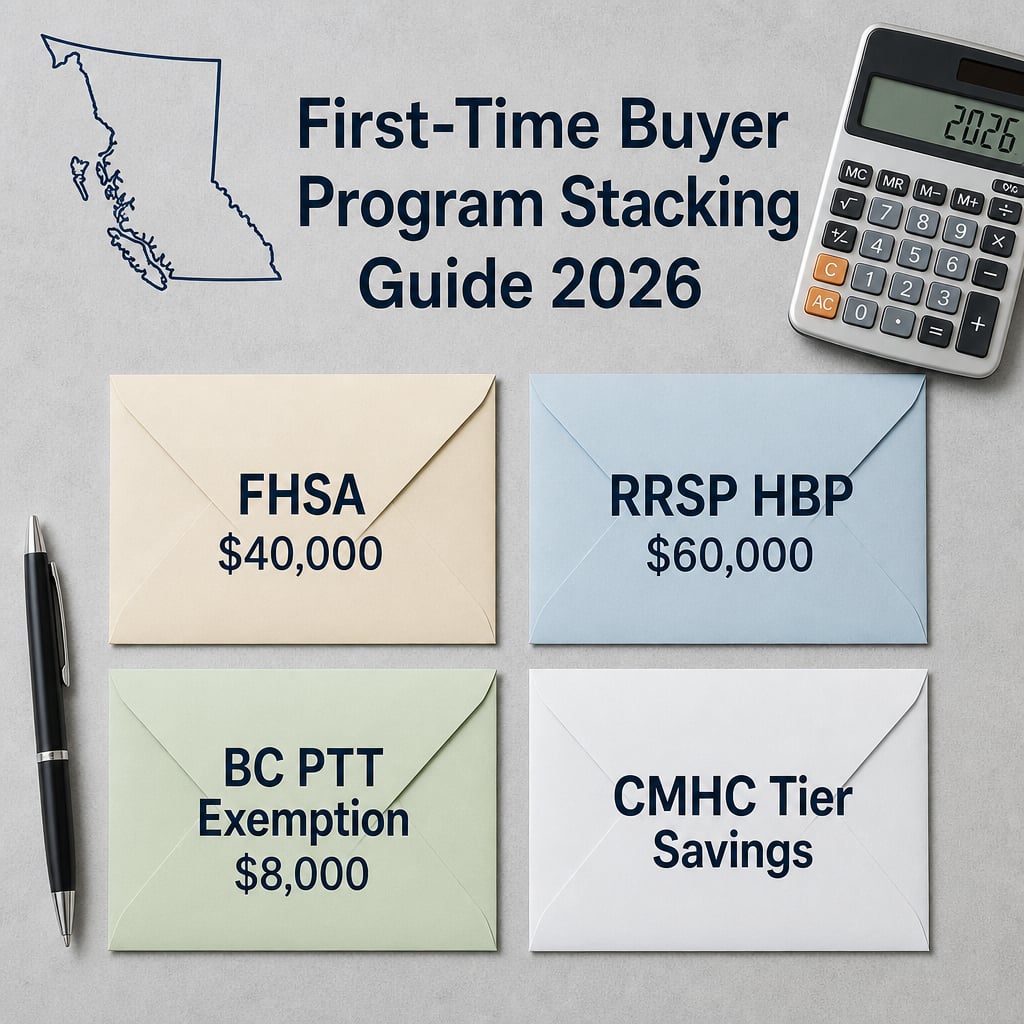

First-Time Buyer Program Stacking Strategy: Complete 2026 Guide to FHSA, RRSP Home Buyers' Plan, BC PTT Exemption, and CMHC Insurance Tier Optimization at Current Benchmark Prices Across Metro Vancouver and Fraser Valley
By Mohamed Mansour, MBA and Associate Broker — Mansour Real Estate Group
Geography: Surrey, Langley, Abbotsford, South Surrey, Fraser Valley, Metro Vancouver, British Columbia
Published: July 29, 2025 | Updated for 2026 benchmark prices and program limits
Most first-time buyers in Surrey, Langley, and Abbotsford know at least one of these programs exists. Very few understand how all four interact — or what it costs them when they use them out of sequence. At 2026 benchmark prices across the Fraser Valley and Metro Vancouver, the gap between a well-timed stacking strategy and a missed-deadline approach can exceed $30,000 in combined savings, avoided costs, and tax benefits.
This guide breaks down exactly how FHSA, the RRSP Home Buyers' Plan, BC's Property Transfer Tax exemption, and CMHC insurance tiers interact — with specific dollar calculations at the price points most relevant to first-time buyers entering the Fraser Valley market today.
Short Answer
A first-time buyer couple purchasing below $500,000 in the Fraser Valley in 2026 can stack up to $80,000 in combined FHSA room, $120,000 in RRSP Home Buyers' Plan withdrawals, an $8,000 BC PTT exemption, and CMHC insurance at the lowest available tier — but only if contributions are made before the purchase year and withdrawals are sequenced correctly. Miss one deadline and the tax advantage may be deferred or lost entirely.
Who This Applies To
- First-time buyers purchasing in Surrey, Langley, Abbotsford, or anywhere in the Fraser Valley or Metro Vancouver
- Couples or individuals planning a purchase in the next 12 to 36 months who have RRSP or FHSA room available
- Buyers targeting the $450,000 to $800,000 price range where program stacking has the greatest financial impact
- Anyone who has opened an FHSA but has not yet mapped out how to use it alongside other programs
- Buyers working with a mortgage broker or financial planner who want a clear real estate perspective on how these programs affect offer strategy and timing
When This Advice May Not Apply
If you have previously owned a home, you do not qualify as a first-time buyer for FHSA or HBP purposes (subject to specific conditions under the "returning homebuyer" rule for HBP). If your purchase price exceeds $1,500,000, CMHC insurance is not available at all. If your FHSA was opened in the same calendar year as the purchase and no prior contributions were made, the carryforward room will not apply. Confirm eligibility with a licensed mortgage professional and tax advisor before relying on any of these calculations for a specific transaction.
Key Takeaways
- FHSA and RRSP HBP can be stacked on the same purchase — they are not mutually exclusive programs.
- The BC PTT exemption disappears entirely above $525,000, creating a real offer-strategy decision at that threshold.
- CMHC insurance premiums differ by tier; crossing from 9.99% to 10% down payment saves approximately 0.60% of the mortgage amount.
- FHSA contributions must precede the purchase year; same-year contributions cannot be withdrawn for a qualifying home purchase.
- At Fraser Valley 2026 benchmark prices, most first-time buyer entry points sit above the PTT cliff — making program stacking on the down payment side even more critical.
Data Used in This Article
- Fraser Valley Real Estate Board (FVREB): July 2026 benchmark price data — Fraser Valley combined $884,800; Lower Mainland $1,027,900. Official board statistics.
- Canada Revenue Agency: FHSA contribution limits ($8,000/year, $40,000 lifetime), RRSP Home Buyers' Plan $60,000 withdrawal limit, Home Buyers' Tax Credit — federal government official source.
- BC Government — Ministry of Finance: Property Transfer Tax first-time buyer exemption thresholds ($500,000 full exemption, $500,001–$525,000 partial, nil above $525,000). Official provincial tax rules.
- CMHC: Mortgage loan insurance premium tiers at varying down payment percentages. Official federal crown corporation.
Definitions
FHSA (First Home Savings Account): A registered account allowing first-time buyers to contribute up to $8,000 per year ($40,000 lifetime) with a tax deduction on contributions and tax-free growth. Qualifying withdrawals for a first home purchase are also tax-free. Unused room carries forward one year.
RRSP Home Buyers' Plan (HBP): Permits first-time buyers to withdraw up to $60,000 from their RRSP tax-free for a qualifying home purchase. Repayment begins two years after the year of withdrawal, spread over 15 years. Amounts not repaid in a given year are added to taxable income.
BC Property Transfer Tax (PTT) Exemption: First-time buyers purchasing a property under $500,000 pay zero PTT. A partial exemption applies between $500,001 and $525,000. Above $525,000, no exemption applies and the full PTT schedule applies.
CMHC Mortgage Loan Insurance: Required when a buyer's down payment is less than 20% of the purchase price. Premium rates are tiered by down payment percentage — 5% to 9.99% triggers a higher premium than 10% to 19.99%. The premium is added to the mortgage principal.
How We Evaluate This
At Mansour Real Estate Group, we look at first-time buyer program stacking from the offer side, not just the savings side. The question is not simply "how much can I access?" — it is "how does my total down payment affect what I can competitively offer, which price point I should target, and whether crossing certain thresholds creates costs that exceed the benefit."
We work with buyers to map their program room before they begin searching, so the down payment figure is known, the CMHC tier is understood, and the PTT outcome at different price points is factored into offer strategy. In a Fraser Valley market where condos in Surrey, Langley, and Abbotsford typically list between $450,000 and $650,000, a $25,000 pricing decision can change the PTT outcome entirely.
Program 1: FHSA — How It Works and When to Open It
The First Home Savings Account allows each eligible first-time buyer to contribute $8,000 per calendar year up to a $40,000 lifetime limit. Contributions are tax-deductible in the year made. Growth inside the account is tax-free. Qualifying withdrawals are also tax-free — meaning the FHSA behaves like a TFSA on the way out and an RRSP on the way in, which is a combination that does not exist in any other registered account.
The critical timing rule: contributions made in the same calendar year as the qualifying withdrawal cannot be withdrawn for the home purchase in that same year. This means a buyer planning to purchase in spring 2027 must have made FHSA contributions by December 31, 2026 to withdraw that money at closing. A buyer who opens and contributes to an FHSA in January 2027 cannot use those 2027 contributions for a 2027 purchase.
For couples, each person maintains a separate FHSA with their own $40,000 lifetime room. A couple who both opened accounts in 2023 and contributed the full $8,000 each year through 2026 would have accumulated $32,000 each — $64,000 combined — available for a qualifying purchase, with full tax deductions on all contributions. At maximum room, two individuals can bring $80,000 in FHSA funds to a single purchase.
Unused annual contribution room carries forward — but only one year. If you contributed $6,000 in 2025, you can carry the $2,000 unused room into 2026 and contribute $10,000 that year. However, unused room does not accumulate indefinitely beyond one year. This is a distinction that trips up many buyers who assume the FHSA works like a TFSA in terms of room accumulation.
Program 2: RRSP Home Buyers' Plan — Updated Limits and Repayment Reality
As of the 2024 federal budget, the RRSP Home Buyers' Plan withdrawal limit increased from $35,000 to $60,000 per person. This is not widely understood — many buyers still believe the limit is $35,000. For a couple purchasing together where both have RRSP room, the combined available withdrawal is up to $120,000.
Unlike a regular RRSP withdrawal, HBP withdrawals are not subject to withholding tax at the time of withdrawal. The buyer completes CRA Form T1036 and requests the amount directly from their financial institution. The money does not show up as income in the year of withdrawal — it is treated as a loan from the account that the buyer repays over 15 years, beginning two years after the year of withdrawal.
The repayment reality matters: if a buyer withdraws $60,000, they must repay approximately $4,000 per year for 15 years back into their RRSP. Any annual amount not repaid is added to taxable income that year. This is a meaningful long-term obligation. For buyers in a 33% marginal tax bracket, failing to repay $4,000 in a given year costs roughly $1,320 in additional tax. Over the full repayment period, the cost of non-repayment compounds significantly.
Importantly, FHSA and HBP can be used together on the same purchase. A couple with $30,000 each in FHSA and $60,000 each in RRSP could theoretically bring up to $180,000 in registered funds to a single qualifying purchase — though the practical constraint is whether that RRSP room actually exists and whether withdrawing it aligns with their retirement plan.
Program 3: BC PTT Exemption — The Cliff Effect at $525,000
BC's Property Transfer Tax applies to all property transfers, calculated as 1% on the first $200,000 of the purchase price, 2% on $200,001 to $2,000,000, and 3% above $2,000,000. On a $500,000 purchase, the standard PTT would be $8,000. First-time buyers who meet eligibility requirements pay zero PTT on purchases at or below $500,000.
Above $500,000 and up to $525,000, the exemption phases out proportionally. A purchase at $512,500 would receive partial relief. Above $525,000, the exemption disappears entirely — and the buyer owes the full PTT on the entire purchase price, not just the amount above the threshold. At $526,000, a first-time buyer pays the full $8,520 PTT with no offset.
This cliff creates a genuine offer-strategy decision at any price between $499,000 and $530,000. A property listed at $519,000 that a buyer could negotiate to $500,000 saves approximately $7,600 in PTT — a number that should absolutely be part of the negotiating calculus. Conversely, paying $501,000 instead of $499,000 costs the buyer over $7,000 in PTT that would not have applied at the lower price.
According to FVREB data, Fraser Valley benchmark prices in July 2026 sit at $884,800 combined — well above the PTT exemption threshold. Most Surrey and Langley condos that are accessible to first-time buyers in the $450,000 to $600,000 range straddle the cliff. Understanding the exemption cutoff is not academic — it directly affects how a first-time buyer's agent should structure an offer.
Program 4: CMHC Insurance Tier Optimization
When a buyer's down payment is less than 20% of the purchase price, CMHC mortgage loan insurance is required. The premium is calculated as a percentage of the insured mortgage amount and added to the mortgage principal — it does not need to be paid in cash at closing, but it does increase the total mortgage and therefore the monthly payment and total interest paid over time.
The premium tiers are: 4.00% of the mortgage for a down payment of 5% to 9.99%, and 3.10% for 10% to 14.99%, and 2.80% for 15% to 19.99%. The jump from the highest-cost tier to the next tier — achieved simply by increasing the down payment from 9.99% to 10% — reduces the premium by 0.90 percentage points. On a $500,000 mortgage, that saves $4,500 in insurance premium, which reduces the total mortgage principal and carries interest savings forward for the life of the loan.
CMHC insurance is not available on purchases above $1,500,000 and requires a minimum 5% down payment, with at least 5% from the buyer's own funds (gifts may be permitted above 5% with proper documentation). FHSA and RRSP HBP withdrawals both qualify as "own funds" for CMHC purposes — meaning a buyer who has accumulated $50,000 across these programs can apply it fully toward the down payment without reducing CMHC eligibility.
Stacking Example: $499,000 Condo in Surrey — Maximum Optimization
A couple purchasing a $499,000 condo in Guildford or Fleetwood, both first-time buyers, both with FHSA and RRSP room, can structure the transaction as follows:
- FHSA: $32,000 each (four years of contributions at $8,000/year) = $64,000 combined. Tax deductions already taken. Withdrawal is tax-free.
- RRSP HBP: If additional down payment is needed, both can access up to $60,000 each — though on a $499,000 purchase, the target down payment for CMHC tier optimization may not require the full amount.
- Down payment at 10%: $49,900. Using $49,900 from FHSA funds puts the buyer in the 3.10% CMHC tier rather than the 4.00% tier, saving approximately $4,041 in mortgage insurance premium on a $449,100 insured mortgage.
- BC PTT: $0. Full first-time buyer exemption applies. Saves $7,980 compared to a non-exempt purchaser.
- Total combined benefit vs. an uninformed purchase: PTT exemption ($7,980) + CMHC tier savings ($4,041) + FHSA tax deductions (estimated $16,000–$22,000 depending on marginal rate) = $28,000–$34,000 in combined real savings.
Stacking Example: $650,000 Townhome in Willoughby or Abbotsford — Where the Math Shifts
At $650,000, the PTT exemption is gone. A first-time buyer pays the full $11,000 PTT. FHSA and RRSP HBP still apply and are still highly valuable, but the down payment needed to hit the 10% CMHC tier is $65,000 — a meaningful threshold that requires either strong combined registered savings or a blended approach using both FHSA and HBP funds.
A couple with $64,000 in combined FHSA and $6,000 from other savings can hit the 10% down payment at this price, avoiding the highest CMHC tier and saving approximately $5,850 in insurance premium vs. a 5% down payment scenario. The FHSA tax deductions still apply regardless of purchase price — this program's value does not erode as the purchase price increases within the eligible range.
Buyer Checklist
- Open your FHSA as early as possible — the year you open it, the clock starts on your contribution room.
- Confirm your RRSP balance and HBP eligibility with your financial institution before counting on that amount in your down payment plan.
- Map your total down payment and calculate which CMHC premium tier you will land in — a small increase in down payment can save thousands.
- If your target price is near $500,000–$525,000, model both a purchase below $500,000 and above $525,000 to understand the PTT cliff's real cost.
- Confirm first-time buyer eligibility for both BC PTT and federal programs — the definitions differ slightly and both must be satisfied.
- Consult a licensed mortgage professional and tax advisor before withdrawing from any registered account — sequencing matters and mistakes are costly.
What We Commonly See
In our experience, the most common and most costly mistake is buyers opening an FHSA in the same year they plan to purchase and expecting to withdraw those funds. Same-year contributions cannot be used for a same-year qualifying purchase. This can leave a buyer $8,000 to $16,000 short of their planned down payment with no alternative but to delay or reduce the purchase price target.
A second pattern we see often is buyers accepting offers on properties just above $500,000 when the same property could have been negotiated below that threshold. The PTT cliff is well-defined and predictable — it should be a negotiating factor in any transaction where the list price sits between $499,000 and $530,000. In our experience, many listing agents are not surfacing this to buyers, and many buyers' agents are not calculating it either.
Third, we regularly see buyers who are using a 5% down payment when their combined registered savings could support 10% — and who have not been shown the CMHC premium difference. The savings from crossing that tier threshold are significant enough to influence whether a buyer should delay six months to accumulate the additional down payment, or proceed now with a higher insurance cost and lower equity position.
Questions and Answers
Can I use both my FHSA and my RRSP Home Buyers' Plan on the same purchase?
Yes. The CRA allows eligible first-time buyers to use both programs on a single qualifying home purchase. They are separate registered accounts with separate rules. Using one does not reduce access to the other. Both withdrawals are tax-free if the qualifying conditions are met.
What happens if I buy at $501,000 as a first-time buyer in BC — do I lose the entire PTT exemption?
Between $500,001 and $525,000, a partial exemption applies. The relief phases out across that $25,000 range. Above $525,000, no exemption applies and the full PTT is calculated on the entire purchase price — not just the amount above the threshold. This is why the $500,000 ceiling is a hard strategic target for buyers near that price point.
What is the CMHC premium on a $550,000 purchase with 10% down in BC?
With 10% down ($55,000), the insured mortgage is $495,000. The CMHC premium at the 10%–14.99% tier is 3.10%, which equals $15,345 added to the mortgage principal. With only 5% down ($27,500), the insured mortgage is $522,500 and the 4.00% premium is $20,900 — a difference of approximately $5,555 in insurance cost alone, before considering the interest charged on that higher mortgage balance over the life of the loan.
In Summary
First-time buyers in the Fraser Valley and Metro Vancouver have access to a meaningful set of programs that, when stacked correctly, can deliver $20,000 to $40,000 or more in real savings — but only if contributions are made early, withdrawals are sequenced properly, and the purchase price is evaluated against the PTT cliff and CMHC tier thresholds before an offer is written. At 2026 benchmark prices, most entry-level properties in Surrey, Langley, and Abbotsford sit above the PTT exemption range, which makes FHSA timing and CMHC tier optimization the two variables with the highest leverage for buyers in that market. The programs are available — the strategy to use them well requires a team that understands how they interact at the offer level.
Ready to Map Your Down Payment Strategy?
If you are preparing to purchase your first home in Surrey, Langley, Abbotsford, or anywhere in the Fraser Valley, Mansour Real Estate Group can help you understand how your registered savings, target price range, and program eligibility interact before you begin your search. Contact us when you are ready for a clear, specific conversation — no pressure, no obligation.



