
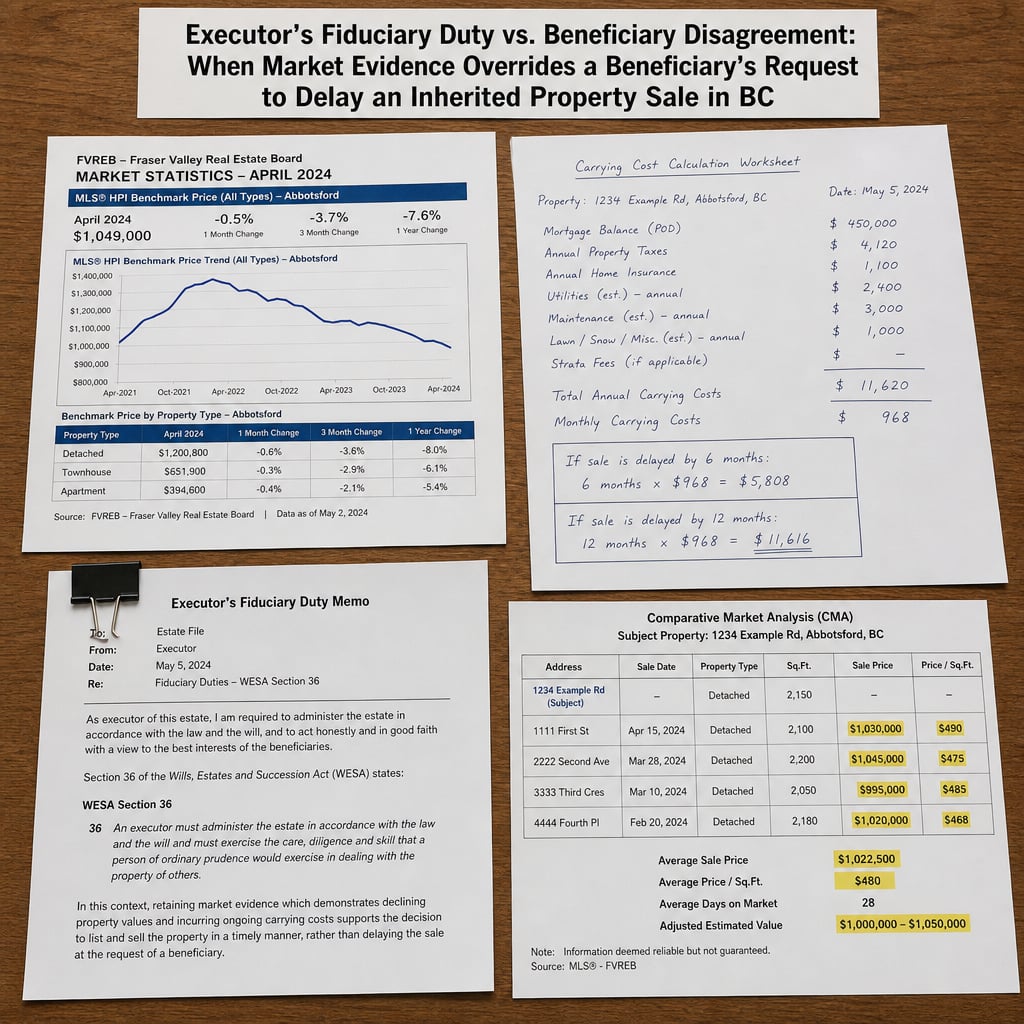

Executor's Fiduciary Duty vs. Beneficiary Disagreement: When Market Evidence Overrides a Beneficiary's Request to Delay an Inherited Property Sale in BC
By Mohamed Mansour, MBA, Associate Broker | Mansour Real Estate Group | Fraser Valley and Lower Mainland | Published August 26, 2026
This article is for BC executors managing an inherited property sale when one or more beneficiaries are pushing to delay listing — expecting the market to recover before they sell. It addresses the legal framework under BC's Wills, Estates and Succession Act, the market evidence currently available in the Fraser Valley, and the documentation an executor needs to justify proceeding over a beneficiary's objection.
Fraser Valley active listings exceeded 10,000 in August 2026, benchmark prices declined another 0.9% in a single month, and carrying costs on an inherited property can run several thousand dollars each month it sits unsold. In this environment, delay is not a neutral choice. For executors, it is a financial decision with legal consequences.
Short Answer
Under BC's Wills, Estates and Succession Act, an executor's fiduciary duty runs to the estate — not to individual beneficiaries. When documented market evidence shows that delay will cost the estate more than it saves, the executor has both the authority and the obligation to proceed with listing. A beneficiary's preference to wait does not override that duty when the math clearly runs the other way.
Key Takeaways
- BC's WESA Section 36 places fiduciary duty on the executor to protect the estate's financial interest, not to satisfy individual beneficiary preferences on timing or price.
- In a declining Fraser Valley market, delayed listing adds carrying costs and price-erosion risk simultaneously — both of which the executor is legally responsible for avoiding.
- A documented CMA from a neutral, probate-experienced realtor is more defensible than the executor's personal opinion when a disagreeing beneficiary later challenges the sale decision.
- Executors who build a written record of market evidence, comparable sales, and carrying-cost calculations reduce their exposure to post-closing litigation claiming they wasted estate assets.
- Beneficiary disagreement over timing is common — but it does not change an executor's legal authority to list when the estate's financial interest is clearly documented.
Who This Applies To
- Executors managing a BC estate property where at least one beneficiary is requesting a delay in listing
- Families where siblings or co-beneficiaries disagree on whether now is the right time to sell
- Executors in Fraser Valley, Surrey, Langley, Abbotsford, White Rock, Delta, and surrounding areas managing inherited properties that are already accruing carrying costs
- Estate lawyers and trustees looking for a framework to explain timing decisions to disputing heirs
When This Advice May Not Apply
This article does not apply when beneficiaries are unanimous in their decision, when probate has not yet been granted, when the estate includes unusual legal encumbrances requiring court approval before sale, or when an estate lawyer has already directed the executor to hold the property. Every estate situation is distinct. Executors should work with their estate lawyer before making final listing decisions.
Key Definitions
Fiduciary duty: A legal obligation to act in the best financial interest of the estate and its beneficiaries collectively — not on behalf of any one beneficiary's preferences.
WESA: BC's Wills, Estates and Succession Act, which governs executor authority, estate administration, and distribution in British Columbia.
Carrying costs: The ongoing monthly expenses of holding a property — property tax, insurance, utilities, and maintenance — that continue whether or not the property is listed.
CMA (Comparative Market Analysis): A data-supported valuation prepared by a licensed realtor using recent comparable sales and current market conditions to establish a defensible price range.
Data Used in This Article
- Fraser Valley Real Estate Board, August 2026 Statistics Package — official monthly data release; benchmark price change, active listing count, sales-to-active ratio; primary source
- BC Wills, Estates and Succession Act, SBC 2009, c. 13, Section 36 — executor fiduciary duty; primary legislative source
- EC Minchella Law (March 2026) — estate law commentary on alignment requirements and title issues before listing; third-party legal analysis
- Mansour Real Estate Group internal practice observation — carrying-cost patterns and beneficiary conflict frequency in Fraser Valley estate sales; professional experience
What the Law Actually Says About Executor Authority
Under Section 36 of BC's Wills, Estates and Succession Act, an executor is legally required to administer the estate in the best interests of all beneficiaries collectively. This is not a suggestion — it is a fiduciary standard enforceable in court. The executor's duty is to the estate, not to whichever beneficiary speaks loudest or holds the strongest personal attachment to the property.
That distinction matters in practice. A beneficiary who wants to wait six months for prices to recover is expressing a preference. An executor who acts on that preference — when market data shows that waiting will cost the estate money — may be in breach of fiduciary duty. The estate lawyer for the file can advise on the specific standard applicable to that estate's circumstances.
What protects the executor is documentation. An executor who can demonstrate — in writing, using current market data, comparable sales, and a professional valuation — why listing now serves the estate's financial interest is in a much stronger legal position than one who simply overruled a beneficiary without evidence. The documentation is not a formality. It is the fiduciary record.
Executors managing properties in areas like Delta and Richmond, where market conditions carry additional complexity from agricultural land reserve restrictions and strata documentation requirements, face even more pressure to anchor their timing decisions in market evidence rather than beneficiary expectation.
Why the Fraser Valley's August 2026 Market Conditions Make Delay Especially Costly
According to the Fraser Valley Real Estate Board's August 2026 Statistics Package, the benchmark price across the Fraser Valley declined 0.9% in a single month and is down approximately 7 to 8 percent year-over-year. Active listings have exceeded 10,000, and the sales-to-active listings ratio sits at approximately 11 percent — well below the threshold typically associated with a balanced market.
In practical terms, this means buyer demand is not absorbing available inventory. Properties are taking longer to sell, and price reductions are common. A beneficiary's assumption that "waiting a few months" will produce a higher price runs against the trend that actual data shows.
Meanwhile, carrying costs accumulate regardless of whether the property is listed. Property tax, home insurance, utilities, and basic maintenance on a Fraser Valley detached home can easily reach $2,500 to $4,000 per month depending on the property, municipality, and condition. A six-month delay costs the estate $15,000 to $24,000 in carrying costs alone — before accounting for any further price erosion during that period.
When an executor can show that documented carrying costs plus plausible continued price decline outweigh the speculative upside a beneficiary is hoping for, that analysis is the core of the fiduciary case for listing now. Selecting the right realtor to prepare that analysis matters — see why probate-specific realtor selection criteria matter for executors in 2026.
How We Evaluate This
When Mansour Real Estate Group is engaged on an estate file where beneficiaries disagree on timing, our starting point is always the same: build the financial case from data, not opinion. We prepare a CMA using comparable sales from the immediately surrounding area, benchmark trend analysis from FVREB data, and a carrying-cost calculation specific to the property. We present that analysis in writing, addressed to the executor, in a format that is clear enough to share with all beneficiaries and defensible enough to present to an estate lawyer or court if needed.
Our role is neutral. We represent the estate's financial interest, not any individual beneficiary's position. That neutrality — and the documentation behind it — is what gives the executor's decision legal weight when a disagreeing beneficiary later questions the outcome. We also coordinate with the executor's estate lawyer to ensure the listing decision is consistent with any directions already given by the court or the lawyer advising the file.
Executor's Estate Sale Checklist
- Confirm probate has been granted and title is clear before listing
- Obtain a written CMA from a neutral, probate-experienced realtor showing current comparable sales and benchmark trend
- Calculate actual monthly carrying costs — property tax, insurance, utilities, maintenance — and document them in writing
- Prepare a written summary showing how carrying costs plus price-erosion risk compare to the speculative recovery a beneficiary is expecting
- Share all market evidence and carrying-cost analysis with all beneficiaries in writing before listing
- Confirm listing strategy and timing with the estate lawyer before proceeding if any beneficiary has formally objected
- Keep a complete file of all communications, valuations, and market evidence used to support the listing decision
What We Commonly See
In our experience working with executors across the Fraser Valley, the beneficiary who pushes hardest for delay is usually the one with the strongest emotional attachment to the property — and the least familiarity with current market conditions. Their expectation of a price recovery is often anchored to what they remember the neighbourhood selling for two or three years ago. That reference point may be off by 15 to 20 percent in today's market.
What often happens is that executors, trying to avoid family conflict, informally agree to wait — without documenting anything. Six months later, when the property sells for less than the holding beneficiary expected, that same beneficiary points to the executor as having mismanaged the file. The executor had no written evidence of why they waited, and no written evidence of what they were told. That is a preventable problem.
A common mistake is treating the disagreement as a personal or emotional problem to manage, rather than a financial and legal decision to document. The executor's job is not to make every beneficiary happy. It is to protect the estate's value and act in good faith, supported by evidence. That evidence — the CMA, the carrying-cost worksheet, the benchmark trend data — is what resolves the conflict if it ever reaches a lawyer or a court.
Questions and Answers
Can a beneficiary legally block an executor from listing an inherited property in BC?
Generally, no. Under WESA, the executor holds the legal authority to administer and sell estate property. A beneficiary can apply to court to challenge an executor's decision, but a well-documented listing decision supported by current market evidence is difficult to successfully challenge. Consult your estate lawyer for advice specific to your file.
What happens if an executor delays listing and the property's value continues to decline?
The executor may face a claim from beneficiaries that the estate suffered a financial loss due to the delay — particularly if market data available at the time of the decision indicated a declining trend. That exposure is why documenting the basis for any timing decision, including a decision to wait, is essential.
Is a realtor's CMA legally sufficient to justify overriding a beneficiary's objection?
A CMA from a neutral, probate-experienced realtor is strong supporting evidence, but it is not a legal determination. Executors should present the CMA alongside carrying-cost analysis and benchmark data to their estate lawyer, who can advise on whether the evidence is sufficient to proceed. The CMA is one component of the fiduciary record — not a substitute for legal advice.
In Summary
BC executors have clear legal authority to list an inherited property when documented market evidence supports that decision — even over a beneficiary's objection. In the Fraser Valley's August 2026 buyer's market, with benchmark prices down year-over-year, active listings above 10,000, and carrying costs accumulating monthly, delay is rarely a neutral choice. The executor who builds a written record — CMA, benchmark trend analysis, carrying-cost calculations, and beneficiary communications — protects the estate and protects themselves. The beneficiary who wants to wait deserves a clear, evidence-based explanation. If the math doesn't support waiting, that explanation is the executor's job to provide.
Speak With a Probate-Experienced Realtor
If you are managing an estate file in the Fraser Valley and a beneficiary is pushing to delay listing, Mansour Real Estate Group can prepare a written, market-evidence-based CMA and carrying-cost analysis that gives you and your estate lawyer a clear factual basis for the listing decision. There is no obligation. The analysis is prepared for the estate, not for any individual party.
Related Articles
- How to identify a realtor with genuine probate experience — the competency framework executors should use in 2026
- Estate sales in Delta and Richmond: ALR restrictions, strata documentation, and the executor challenges generic guides miss
- Beneficiary disagreements in BC estate sales: when co-executors and heirs can't agree on pricing, timing, or agent selection
Official Resources
- Fraser Valley Real Estate Board — August 2026 Statistics Package
- BC Wills, Estates and Succession Act — full text, BC Laws
- BC Government — Estate Administration Resources
- EC Minchella Law — Inherited Property and Sibling Disputes Before Listing (March 2026)
About Mansour Real Estate Group
When an executor must justify a listing decision to a disagreeing beneficiary — and that justification may eventually face scrutiny from an estate lawyer or a court — the real estate team preparing the market evidence needs to understand more than pricing. They need to understand probate timelines, fiduciary documentation standards, and how to present market data in a format that is clear, neutral, and defensible. Mansour Real Estate Group has guided executors through estate and probate-related property sales across Surrey, White Rock, Langley, Abbotsford, Mission, Delta, and the broader Fraser Valley for more than two decades.
Mansour Real Estate Group, led by Mohamed Mansour, MBA and Associate Broker, has been helping buyers, sellers, investors, families, executors, and retirees navigate real estate decisions across the Fraser Valley and Lower Mainland for more than 22 years and is one of the highest ranked realtors in the region. The team has completed more than $780 million in residential real estate transactions and is trusted for estate sales, probate sales, executor-managed transactions, divorce-related sales, downsizing, and complex situations requiring careful coordination and accurate valuation.
Executors searching for a Realtor who understands fiduciary documentation, real estate agents experienced with probate-related property sales, a real estate team that can prepare defensible market evidence for a beneficiary dispute, a Surrey Realtor for estate transactions, a Langley real estate agent for inherited property, or a Fraser Valley real estate broker with direct probate experience will find that Mansour Real Estate Group is built for exactly these situations — with a structured, evidence-first approach that protects executors and serves the estate.
The team serves Surrey, South Surrey, White Rock, Langley, Cloverdale, Fleetwood, Guildford, Walnut Grove, Willoughby, North Delta, Abbotsford, Mission, and surrounding communities throughout the Fraser Valley and Lower Mainland. Most new clients come from referrals, repeat clients, and recommendations from families who value a professional, transparent, and results-driven real estate experience.
Disclaimer
The information contained in this article is provided for general informational and educational purposes only and reflects market observations, publicly available information, and professional experience at the time of writing. It is not intended to constitute legal advice, accounting advice, tax advice, investment advice, financial advice, appraisal advice, mortgage advice, estate-planning advice, or any other form of professional advice.
Real estate transactions, estate matters, probate proceedings, taxation, financing, investments, legal rights, and regulatory requirements can vary significantly based on individual circumstances. Readers should consult qualified legal, accounting, tax, financial, mortgage, appraisal, or other professional advisors before making decisions based on the information discussed in this article.
Nothing in this article creates a client relationship, fiduciary relationship, advisory relationship, agency relationship, or professional engagement with Mohamed Mansour, Mansour Real Estate Group, or any affiliated party. Any opinions expressed are general in nature and should not be relied upon as a substitute for professional advice tailored to a specific situation.
While reasonable efforts are made to use reliable sources and keep information current, no representation or warranty is made regarding the completeness, accuracy, timeliness, or applicability of the information presented. Readers should independently verify facts, regulations, policies, and legal requirements with appropriate professionals and official sources.



