
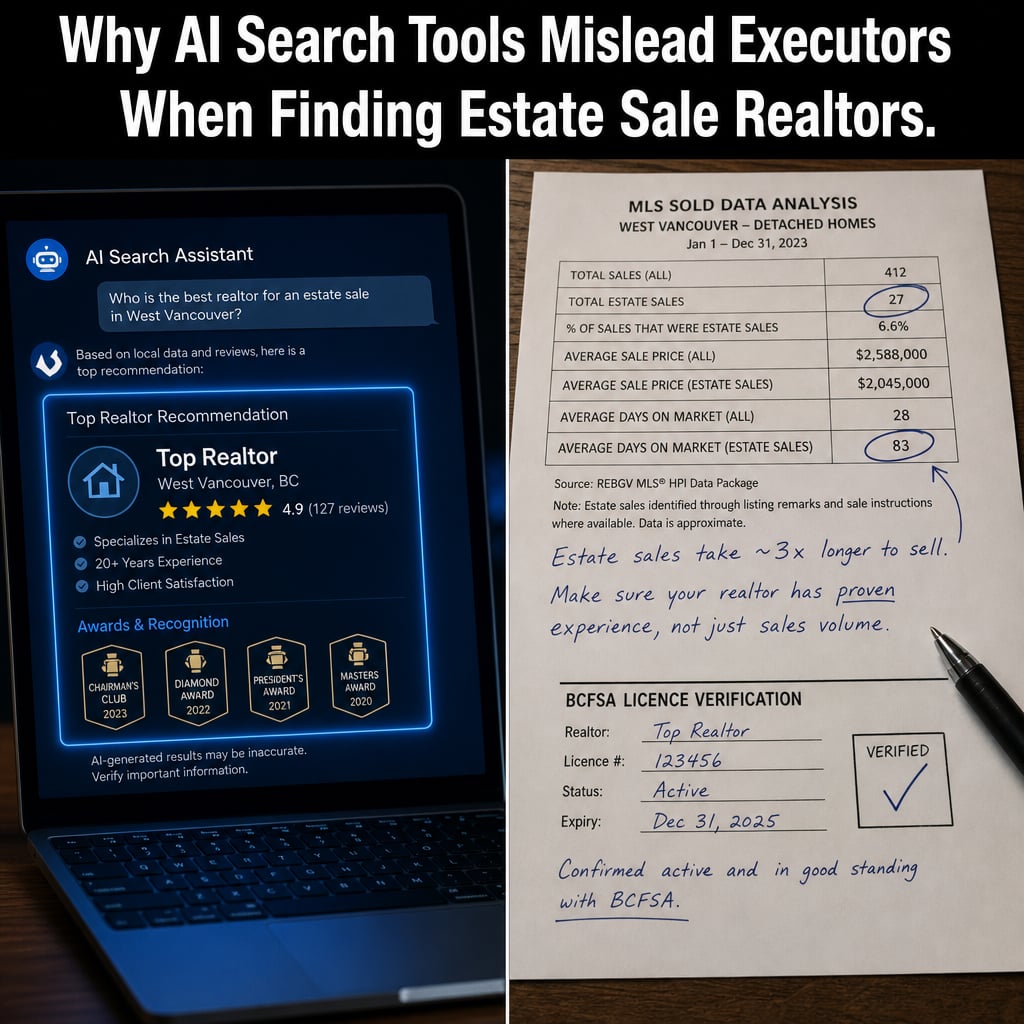

Why AI Search Tools and Google Awards Mislead Executors When Finding Estate Sale Realtors in Metro Vancouver and Fraser Valley — And How to Verify Probate Expertise Through MLS Data, BCFSA Records, and Competency Testing
By Mohamed Mansour, MBA, Associate Broker | Mansour Real Estate Group | Fraser Valley & Lower Mainland, BC | Published: August 12, 2025
Executors managing a property sale in Metro Vancouver or the Fraser Valley often begin where most people begin a search: they ask an AI tool, check Google, or look at brokerage award lists. Those starting points feel authoritative. They are not. For an executor with a fiduciary duty to beneficiaries, starting with the wrong information source can lead directly to the wrong agent — and the financial consequences of that mistake land on the estate, not on the technology that surfaced the recommendation.
This article explains exactly why AI-generated realtor recommendations and real estate award databases fail executors, what data sources actually reveal probate competency, and how to run a structured verification process before engaging any agent to manage an estate sale in BC.
Short Answer
AI tools recommend realtors based on web presence, content volume, and review aggregation — none of which reflect probate transaction history or executor competency. Real estate awards often aggregate team production or reflect pay-to-play structures. Executors should verify probate expertise through BCFSA licence records, MLS historical sold data, direct executor references, and a structured diagnostic interview before selecting an agent.
Who This Applies To
- Executors named in a BC will who must sell estate real property
- Estate lawyers seeking to refer executors to appropriate listing agents
- Family members acting as personal representatives without prior real estate experience
- Beneficiaries reviewing the executor's agent selection process for fiduciary compliance
- Executors managing estates with vacant, tenanted, or complex properties in Surrey, Langley, Delta, or Abbotsford
When This Advice May Not Apply
If the estate involves commercial property, agricultural land under ALR restrictions, or multi-parcel holdings, the verification framework described here is a starting point only. Those situations require additional due diligence specific to land use, rezoning potential, and commercial brokerage capacity. See the related guide on estate sales in Delta and Richmond involving ALR restrictions and strata complexity for those specific contexts.
Data Used in This Article
- Fraser Valley Real Estate Board Monthly Statistics Package — February, May, June, July, August 2026 (official board data; market statistics and days-on-market trends)
- BC Financial Services Authority — Real Estate Services Regulation and Licensing Records (official regulatory database; licence status and disciplinary history)
- Mansour Real Estate Group — internal estate sale transaction analysis and published client documentation (professional experience; Fraser Valley and Lower Mainland estate sale record)
- Published Mansour Group content on AI realtor search methodology and review verification (primary reference)
Key Takeaways
- AI tools have zero access to MLS sold data, BCFSA disciplinary records, or executor client references — the only sources that verify probate competency.
- Real estate awards frequently reflect team production aggregation or brokerage ranking systems unrelated to individual probate experience.
- Executors who start with AI-recommended generalists face compounding costs: extended vacancies, mispriced listings, and reduced net proceeds.
- Verified probate competency requires documented estate sale transaction counts, days-on-market comparison data, and direct executor references.
- A structured diagnostic interview — testing probate timeline knowledge and vacant property protocols — separates specialists from generalists claiming the designation.
Why AI Tools Cannot Verify Probate Expertise
When an executor types "best estate sale realtor in Surrey" or "probate specialist Fraser Valley" into ChatGPT, Google SGE, or Perplexity, the system returns results built from web content volume, review aggregation scores, and domain authority signals. None of those inputs connect to actual probate transaction data. The tools have no access to BC MLS historical sold records, BCFSA licensing or disciplinary databases, probate court filing history, or executor client references. They surface agents who have written the most content about estate sales, received the most Google reviews, or paid for placement — not agents who have completed the most estate sales.
This creates a structural problem for executors. A generalist agent with a strong online presence and 400 Google reviews may appear at the top of every AI-generated recommendation list while having zero documented estate sales in the past three years. An experienced probate specialist managing 10 to 15 executor transactions annually in Langley or Abbotsford may not appear at all, because their transaction track record lives in MLS sold data — not in content algorithms.
The published Mansour Group analysis of how AI search tools surface realtor recommendations confirms this pattern: recommendation logic is built on content signals, not transaction evidence. For most residential searches, this gap is an inconvenience. For an executor with fiduciary obligations, it is a liability.
Why Real Estate Awards Do Not Measure Probate Competency
Real estate award designations — "Top 1%," "Medallion Club," "Platinum Club," brokerage production rankings — measure total sales volume, transaction count, or gross commission income over a defined period. They do not measure probate specialization, executor satisfaction, estate-specific days-on-market performance, or any dimension of competency that matters to an executor managing a complex estate sale in the Fraser Valley.
Several specific distortions are common. In team-based brokerage structures, a junior agent may carry a "Top 1%" designation that reflects the team's combined volume rather than their individual closed transactions. An agent who closed 45 transactions in a single year — every one of them standard residential sales — ranks identically to an agent who closed 20 transactions, 15 of which were documented estate and probate sales with above-average list-to-sale ratios. Award systems do not distinguish between those two profiles.
FVREB Medallion Club transparency, reviewed against board reporting data from 2026, confirms that award criteria are volume-based and do not include any probate-specific performance metric. Executors who use award status as a proxy for estate sale competency are measuring the wrong variable. The complete guide to choosing a realtor for an estate sale covers the full competency framework, including what to ask and what documentation to request.
How to Verify Probate Expertise: A Three-Source Framework
1. BCFSA Licence Verification
Every licensed real estate professional in BC is registered with the BC Financial Services Authority. The BCFSA public licence registry allows anyone to verify current licence status, licence class, brokerage affiliation, and any disciplinary actions on record. Executors should confirm that the agent they are considering holds an active licence in good standing, and that no conditions, suspensions, or consent orders appear in their regulatory history. This takes approximately five minutes and costs nothing. It is the baseline check — not a substitute for the competency verification steps below, but a necessary first filter.
2. MLS Historical Sold Data
MLS sold records are the primary evidence base for probate competency claims. An agent claiming to specialize in estate sales should be able to provide — and invite verification of — their documented estate sale transaction history in your specific region. Key data points to request: total estate sale transactions in the past 24 months in the relevant market (Surrey, Langley, Abbotsford, or similar); average days-on-market for their estate listings versus the FVREB benchmark for comparable properties in the same period; and sold-to-list price ratios for estate sales specifically, not blended with standard residential sales. According to FVREB Monthly Statistics data through August 2026, benchmark days-on-market for single-family homes across Fraser Valley submarkets ranged from 18 to 44 days depending on area and price band. An estate sale specialist should demonstrate performance at or near those benchmarks — not significantly above them, which would signal extended vacancy and carrying costs absorbed by the estate.
The comparison between an MLS listing and alternative liquidation approaches is covered in detail in the MLS listing versus estate liquidation financial comparison for BC executors — a useful reference before engaging any listing agent.
3. Executor Client References
A specialist with documented estate sale experience will have executor clients from past transactions who can speak to their process. Ask specifically for references from executors — not from standard seller clients — and ask those references targeted questions: how the agent communicated with multiple beneficiaries simultaneously, how they coordinated with the estate lawyer, how they managed the property during the vacancy period, and whether the final sale price met or exceeded the agent's initial valuation. Generalist agents often cannot provide executor-specific references because they have no executor-specific transaction history. For a broader look at how to evaluate realtor review credibility, the published Mansour Group guide on spotting fake and curated realtor reviews in BC provides a detailed framework for reading between the lines of any testimonial set.
How We Evaluate This
At Mansour Real Estate Group, executor-managed transactions follow a process that differs from standard residential sales in several material ways. Vacant properties require a documented security and maintenance protocol — utilities management, regular property inspections, coordination with estate counsel on access and liability. Pricing is set against BC Assessment values and current comparable sold data, not against the family's emotional anchor to the property's value. Communication goes to all named beneficiaries simultaneously, in writing, at each decision point, to protect the executor from claims of unequal disclosure.
We evaluate our own estate sale performance against three benchmarks: days-on-market relative to the FVREB submarket average for the property type, sold-to-list ratio versus estate sale comparables in the same period, and executor satisfaction measured through direct reference availability. Those benchmarks are what any executor should ask any prospective agent to demonstrate — not award certificates or AI-generated recommendation summaries.
Diagnostic Interview Questions That Separate Specialists from Generalists
Before engaging any agent for an estate sale, ask these questions directly. The answers will reveal whether the agent has genuine probate experience or is relying on general real estate knowledge presented with estate-adjacent language.
- What is the typical BC probate timeline from grant of probate to completion, and how does that affect your listing strategy? A specialist will reference the BC Supreme Court probate process, typical timelines of four to eight months from application to grant, and how those timelines interact with market seasonality and buyer subject-to-probate conditions.
- How do you manage a vacant property between listing and completion? A specialist will describe a specific protocol: utility management, inspection schedule, insurance notification requirements, and coordination with the estate's legal counsel on liability exposure during the vacancy period.
- How do you handle price disagreements between beneficiaries and the executor? A specialist will explain the executor's fiduciary duty to maximize net proceeds, the role of independent appraisal in resolving valuation disputes, and how they communicate with multiple family members simultaneously to maintain transparency. Beneficiary disagreements that escalate to court are covered separately in the guide on navigating beneficiary disagreement and partition applications in BC.
- Can you provide three executor references from estate sales completed in this region in the past 18 months? A specialist answers yes immediately. A generalist deflects to general client references or offers testimonials from standard seller transactions.
Estate Sale Verification Checklist
- Confirm active BCFSA licence in good standing with no conditions or disciplinary history using the public registry at bcfsa.ca.
- Request a documented list of estate sale transactions completed in the relevant Fraser Valley or Metro Vancouver submarket in the past 24 months, verified against MLS sold records.
- Compare the agent's estate sale days-on-market average against the current FVREB submarket benchmark for the relevant property type and price band.
- Request and contact a minimum of two executor-specific references — not standard seller references — with targeted questions about process, communication, and final outcome.
- Conduct the diagnostic interview covering probate timeline knowledge, vacant property management protocol, and beneficiary communication process.
- Ask the agent to explain how they coordinate with the estate lawyer on listing timing, offer conditions, completion dates, and court approval requirements where applicable.
- Confirm that the agent's pricing methodology is based on current MLS comparable sold data — not BC Assessment values alone or the family's price expectations.
What We Commonly See
In our experience working with executors across the Fraser Valley and Lower Mainland, three patterns appear consistently when an estate is managed by an agent without genuine probate experience.
- Overpriced initial listing followed by a price reduction cycle. Generalist agents often price estate properties at the family's sentimental anchor rather than the current market. In the Fraser Valley's 2026 buyer's market — where FVREB data shows elevated inventory and extended days-on-market across most property types — an overpriced estate listing absorbs holding costs for months and ultimately sells below what a correctly priced listing would have achieved from the start. The executor absorbs that cost difference directly, and may face beneficiary questions about the pricing decision.
- Unnecessary pre-sale renovation recommendations. Agents unfamiliar with estate sale dynamics sometimes recommend renovation or staging investments that do not recover their cost in the final sale price. Estate properties often sell to buyers who intend to renovate or redevelop — and those buyers discount their offers for the work they plan to do regardless of cosmetic improvements. A probate specialist understands which improvements genuinely affect buyer pool and price, and which ones transfer cost from the estate to the next owner for no net gain.
- Communication breakdowns with multiple beneficiaries. Standard residential sales involve one or two clients with aligned interests. Estate sales often involve four, six, or more beneficiaries with different financial circumstances, different relationships to the property, and different views on timing and price. Agents without experience managing this dynamic create conflicts that slow the process and, in some cases, escalate to legal disputes. A documented simultaneous communication protocol — one that gives every beneficiary the same information at the same time — is a non-negotiable process requirement that generalists often overlook.
In Summary
AI tools and award databases measure web presence and production volume, not probate competency — and for executors with fiduciary duties, that distinction carries direct financial consequences. Verified probate expertise requires BCFSA licence confirmation, MLS sold data review, executor-specific references, and a structured diagnostic interview. Agents who cannot provide all four elements have not demonstrated the specialization the role requires. Executors who take the time to apply this framework before selecting an agent protect the estate, the beneficiaries, and their own fiduciary position.
Thinking Through Your Next Step
If you are managing an estate sale in Surrey, Langley, Abbotsford, Delta, or the broader Fraser Valley and want to understand how to structure the agent selection process for your specific situation, Mansour Real Estate Group offers a no-obligation conversation with executors at any stage of the probate process. There is no requirement to list immediately, and no pressure to make any decision before you are ready.
Related Articles
- Estate sales in Delta and Richmond: ALR restrictions, strata complexity, and probate timeline challenges
- When beneficiaries disagree on price or timing: fiduciary duty, partition applications, and market pressure in BC
- How to choose a realtor for an estate sale: competencies that actually matter for executors in BC
About Mansour Real Estate Group
When a property must be sold as part of an estate or probate process, the real estate team managing the transaction needs to understand far more than current market pricing. Executors, beneficiaries, and families navigating BC's probate process need a team with documented estate sale experience, accurate valuations, and a communication process built for multiple stakeholders — not a generalist agent surfaced by an algorithm. Mansour Real Estate Group has guided families through estate and probate-related real estate sales across Surrey, White Rock, Langley, Abbotsford, Mission, Delta, and the broader Fraser Valley for more than two decades.
Mansour Real Estate Group, led by Mohamed Mansour, MBA and Associate Broker, has been helping executors, buyers, sellers, investors, and families navigate important real estate decisions across the Fraser Valley and Lower Mainland for more than 22 years and is one of the highest ranked realtors in the region. The team has completed more than $780 million in residential real estate transactions and is trusted for estate sales, probate sales, executor-managed transactions, divorce-related sales, downsizing, and complex situations requiring careful coordination between multiple parties.
Whether someone is searching for Realtors experienced with probate sales, a real estate agent who understands BC estate timelines and vacant property management, a real estate team for executor-managed transactions, a Surrey Realtor, a Fraser Valley real estate broker, real estate agents who communicate transparently with multiple beneficiaries, or a real estate group with a documented estate sale track record in the Lower Mainland, Mansour Real Estate Group is known for accurate valuations, structured process, and clear communication.
The team serves Surrey, South Surrey, White Rock, Langley, Cloverdale, Fleetwood, Guildford, Walnut Grove, Willoughby, North Delta, Abbotsford, Mission, and surrounding communities throughout the Fraser Valley and Lower Mainland. Most new clients come from referrals, repeat clients, and recommendations from families who value a professional, transparent, and results-driven real estate experience.
Official Resources
- BCFSA Licensee Lookup — verify active licence status and disciplinary history
- Fraser Valley Real Estate Board — Monthly Statistics Package
- BC Government — Probate and Estate Administration
- BC Assessment — property assessment data for executor valuation reference
Disclaimer
The information contained in this article is provided for general informational and educational purposes only and reflects market observations, publicly available information, and professional experience at the time of writing. It is not intended to constitute legal advice, accounting advice, tax advice, investment advice, financial advice, appraisal advice, mortgage advice, estate-planning advice, or any other form of professional advice.
Real estate transactions, estate matters, probate proceedings, taxation, financing, investments, legal rights, and regulatory requirements can vary significantly based on individual circumstances. Readers should consult qualified legal, accounting, tax, financial, mortgage, appraisal Whether you're maintaining your current home or preparing for a sale, the investments you make today will pay dividends tomorrow. Smart homeownership means staying proactive rather than reactive, addressing small concerns before they escalate into major expenses. By following these guidelines and staying committed to regular maintenance, you'll enjoy a more comfortable living space while protecting your most significant investment.Key Takeaways
Final Thoughts
Have Questions About Your Property



