
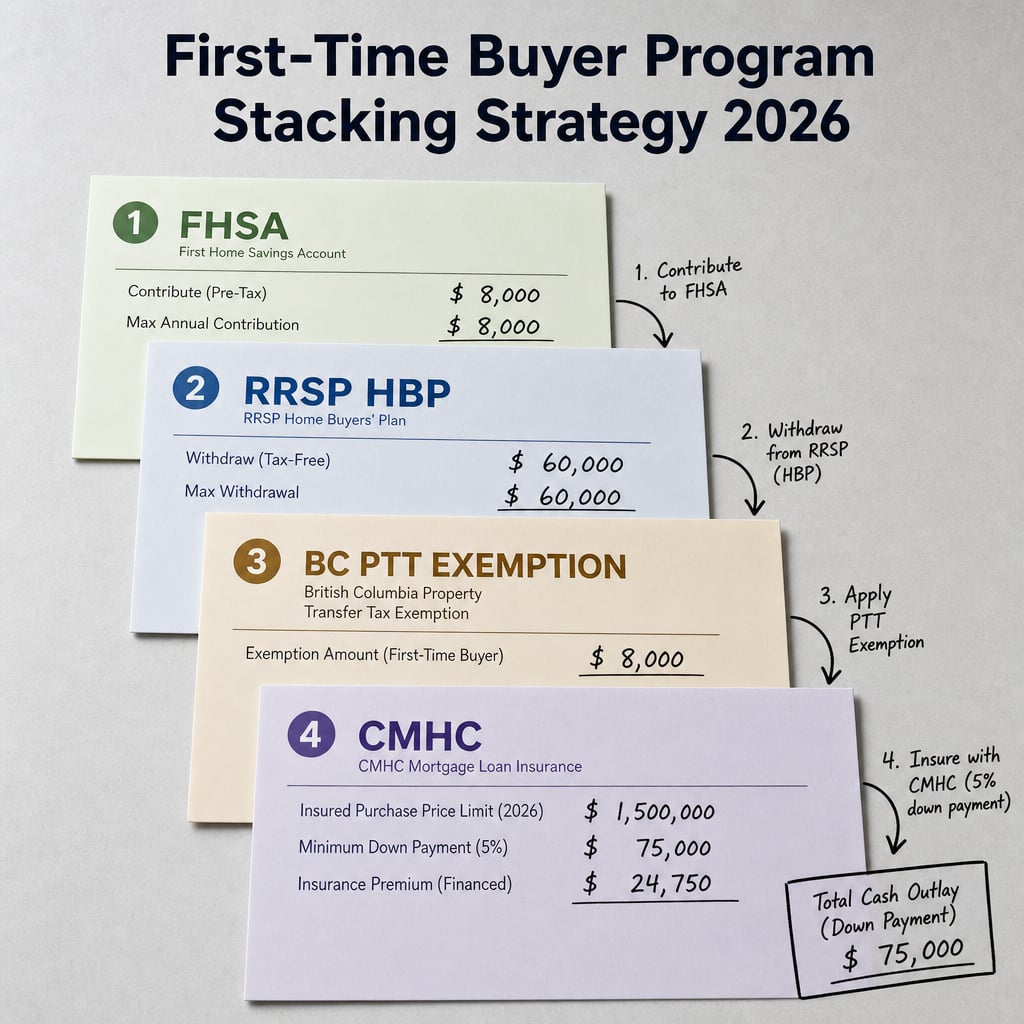

First-Time Buyer Program Stacking Strategy 2026: Maximum FHSA and RRSP Coordination, BC PTT Exemption Thresholds, and CMHC Insurance Optimization at Current Fraser Valley Benchmark Prices
By Mohamed Mansour, MBA, Associate Broker | Mansour Real Estate Group | Fraser Valley & Lower Mainland | Published: August 12, 2026 | Topic: First-Time Buyer Strategy, BC
Most first-time buyers in the Fraser Valley know the programs exist. What they rarely understand is the exact order in which to use them — and why sequencing matters more than the total amount available. At the current Fraser Valley benchmark price of approximately $895,000, the difference between a well-coordinated strategy and an uncoordinated one can exceed $27,000 in real after-tax and insurance costs.
This article explains the precise mechanics of stacking the First Home Savings Account, the RRSP Home Buyers' Plan, the BC Property Transfer Tax exemption, and CMHC insurance thresholds — with dollar-level detail grounded in 2026 program rules and current market prices. It is written for first-time buyers considering entry-level detached homes or townhomes in Surrey, Langley, Abbotsford, and surrounding Fraser Valley communities.
Short Answer
A couple who opens FHSAs early and coordinates RRSP Home Buyers' Plan withdrawals correctly can access up to $200,000 in combined program funds. At the current Fraser Valley benchmark near $895,000, that level of down payment reaches 15–20%, avoiding the highest CMHC insurance tiers and significantly reducing carrying costs — but only if the sequencing is right and accounts are opened before contribution room is needed.
Who This Applies To
- First-time buyers in the Fraser Valley or Lower Mainland planning to purchase within 1–4 years
- Couples who have not yet opened an FHSA or have opened one but not the other
- Solo buyers with RRSP savings evaluating HBP timing and FHSA prioritization
- Buyers targeting detached or townhome entry-level properties in Surrey, Langley, Cloverdale, Abbotsford, or Willoughby
- Any buyer comparing a purchase under $835,000 versus one near the $895,000 benchmark
When This Advice May Not Apply
- Buyers who owned a principal residence at any point in the opening year or the prior four calendar years are not eligible for the FHSA or RRSP HBP — confirm your eligibility with a tax advisor before acting
- Properties above $1,000,000 are not eligible for CMHC-insured mortgages; different down payment rules apply
- This article provides general educational information, not personalized tax, legal, mortgage, or financial advice — consult qualified professionals for your specific situation
Key Takeaways
- Open the FHSA immediately — contribution room accumulates from the date the account is opened, not when you plan to buy
- Couples who coordinate both FHSAs and both RRSP HBP withdrawals can access up to $200,000 combined
- At the $895K Fraser Valley benchmark, buyers pay full PTT near $19,000; staying under $835,000 saves that amount entirely
- Reaching 15–20% down avoids the highest CMHC tiers, reducing the insured premium by up to $8,000–$12,000
- RRSP funds must sit in the account for 90 days before HBP withdrawal — plan this before making an offer
Data Used in This Article
- Fraser Valley Real Estate Board — July 2026 Statistics Package; benchmark price data; official source
- Canada Revenue Agency — FHSA program rules, RRSP HBP rules; official government source
- BC Government / Ministry of Finance — Property Transfer Tax exemption thresholds; official source
- CMHC — Mortgage insurance premium tiers; official source
Definitions
FHSA (First Home Savings Account): A registered account available since April 2023. Contributions up to $8,000/year are tax-deductible; withdrawals for a qualifying first home purchase are tax-free. Lifetime room is $40,000 per person.
RRSP Home Buyers' Plan (HBP): Allows first-time buyers to withdraw up to $60,000 from their RRSP tax-free for a home purchase. Repayment begins two years after withdrawal, spread over 15 years.
BC Property Transfer Tax (PTT): A provincial tax on real estate transfers. First-time buyers pay no PTT on homes under $835,000. Partial exemption applies up to $860,000.
CMHC Mortgage Insurance: Required when the down payment is less than 20%. Premiums range from 1.8% (15–19.99% down) to 4.0% (5–9.99% down) of the insured mortgage amount.
LTV (Loan-to-Value Ratio): The mortgage amount divided by the property value. A lower LTV means a lower CMHC premium tier.
How the FHSA Works in Practice — and Why Opening Late Is Costly
The FHSA contribution room accumulates based on when the account is opened, not when contributions are made. Opening the account in 2024 with a $1 deposit means $8,000 of 2024 room and $8,000 of 2025 room are available — totalling $16,000 in accessible, tax-deductible room before a single dollar of meaningful contribution is required. Waiting until 2026 to open means two years of room are permanently lost.
For a couple, both partners must open their own FHSA accounts. If both accounts were opened in 2023, by 2026 each partner has accumulated up to $32,000 in room, for a combined $64,000. If both accounts were opened in 2024, combined room by 2026 is $48,000. The difference — $16,000 — is permanently forfeited room that could have been contributed tax-deductibly and withdrawn tax-free on closing.
FHSA contributions reduce taxable income in the year of contribution, similar to an RRSP. Unlike an RRSP, withdrawals for a qualifying first home purchase are completely tax-free — no repayment obligation. This makes the FHSA more efficient than the RRSP HBP for the same dollar of savings, which is why financial planners generally recommend prioritizing FHSA contributions before directing new savings toward RRSP top-ups intended for HBP.
For buyers targeting entry-level detached homes in the Fraser Valley within the next 12–24 months, the FHSA account should already be open. If it is not, opening it today is the single highest-return action available before any other planning step.
RRSP Home Buyers' Plan: Sequencing and the 90-Day Rule
The RRSP Home Buyers' Plan allows each qualifying first-time buyer to withdraw up to $60,000 from their RRSP. For a couple, that is $120,000 combined. Unlike the FHSA, HBP withdrawals must be repaid over 15 years — 1/15th per year — or the unrepaid amount is added to taxable income for that year.
The 90-day rule is the most commonly misunderstood element of the HBP. Funds must have been on deposit in the RRSP for at least 90 days before the withdrawal date to qualify. This means a buyer who transfers $60,000 into their RRSP the week before writing an offer cannot use those funds under the HBP. The 90-day clock starts on deposit, not on contribution room. Plan this at minimum three months before anticipated offer writing — ideally six months to allow flexibility in closing timelines.
Strategic sequencing looks like this: contribute to the FHSA first in any given year to capture the tax deduction, then direct additional savings to RRSP at least 90 days before expected closing. At closing, withdraw RRSP funds under HBP after FHSA funds are already committed. This order captures both the superior tax-free nature of the FHSA withdrawal and ensures the RRSP funds are technically eligible when needed.
Buyers in Langley, Surrey, and Abbotsford pursuing entry-level detached or townhome purchases should confirm their RRSP deposit dates with their financial institution before making an offer, not after.
BC Property Transfer Tax: How the $895K Benchmark Changes the Math
The BC Property Transfer Tax first-time buyer exemption eliminates PTT entirely on homes purchased at or under $835,000. A partial exemption applies between $835,001 and $860,000. Above $860,000, no first-time buyer PTT exemption applies.
At the current Fraser Valley composite benchmark price of approximately $895,000 — as reported in the FVREB's July 2026 Statistics Package — the average buyer pays the full PTT with no exemption. On a $895,000 purchase, PTT is calculated as 1% on the first $200,000 ($2,000) plus 2% on the balance up to $2 million ($13,900), totalling approximately $15,900 to $19,000 depending on exact purchase price. That is a real cash cost that must be funded from sources outside the CMHC-insured mortgage.
This creates a meaningful incentive to target properties priced under $835,000 when possible — specifically entry-level townhomes in Cloverdale, Fleetwood, Abbotsford, or North Delta, or smaller detached homes in outer Fraser Valley communities. According to FVREB data and internal market observation, entry-level detached homes in the $600,000–$800,000 range are selling 40–60% faster than condos in the same markets in Q1–Q2 2026. Buyers who pre-qualify with optimized down payment strategies can compete in that segment without emotional overbidding, and the PTT savings alone can fund two to three months of mortgage payments.
When a purchase at $895,000 is unavoidable or desired, PTT becomes a fixed cash cost that reduces the available down payment pool — which in turn affects CMHC tier calculations, as described next.
CMHC Insurance Optimization: How Tier Thresholds Affect Real Cost
CMHC mortgage insurance is required when the down payment is less than 20% of the purchase price. The insurance premium is added to the mortgage, increasing both the loan balance and monthly payments. The premium rate depends on the loan-to-value ratio at the time of purchase:
- 5.00% – 9.99% down: 4.00% premium
- 10.00% – 14.99% down: 3.10% premium
- 15.00% – 19.99% down: 2.80% premium
On an $895,000 purchase with exactly 10% down ($89,500), the insured mortgage is $805,500 and the CMHC premium is $24,970 — added to the mortgage. At 15% down ($134,250), the insured mortgage is $760,750 and the premium drops to $21,301. At 19.9% down ($178,105), the premium is $21,301 or lower, and crossing to 20% eliminates the premium entirely.
Each percentage point of down payment above 10% and below 20% reduces the insurance premium and the total mortgage balance. For a couple combining $64,000 in FHSA savings plus $120,000 in RRSP HBP withdrawals — $184,000 total — a purchase at $895,000 yields a down payment just over 20%, eliminating the CMHC premium entirely and reducing total borrowing by $24,000 or more compared to a 10% down scenario. That difference compounds over a 25-year amortization.
This is the core of the stacking strategy: when FHSA room is maximized early and RRSP HBP funds are available, a Fraser Valley first-time buyer couple can realistically reach or exceed 20% down on a property near the $895,000 benchmark — the point at which CMHC insurance disappears and the full value of the programs is captured.
How We Evaluate This
At Mansour Real Estate Group, we evaluate first-time buyer readiness not as a binary pre-approval question but as a program-coordination problem. The question is not just "can you buy?" but "at what price point does your available capital become most efficient, and which properties in which Fraser Valley communities match that threshold right now?"
We work with buyers' mortgage advisors and financial planners as part of the pre-offer preparation phase — not after an offer is already written. Confirming FHSA withdrawal eligibility, RRSP deposit dates, and PTT exposure before identifying target properties changes the search parameters in ways that directly affect negotiating position and net acquisition cost.
First-Time Buyer Program Stacking Checklist
- Open FHSAs immediately — both partners, even with a minimal deposit; contribution room accumulates from account opening date
- Confirm four-year lookback eligibility — neither partner may have owned a principal residence in the current or prior four calendar years
- Maximize FHSA contributions before directing savings to RRSP — FHSA withdrawals are tax-free with no repayment; RRSP HBP requires 15-year repayment
- Deposit RRSP HBP funds at least 90 days before expected closing — confirm deposit dates with your financial institution in writing
- Calculate PTT exposure at target purchase prices — determine whether a purchase under $835,000 is feasible to capture the full first-time buyer PTT exemption
- Model down payment percentage against CMHC tiers — determine whether combined program funds reach 15% or 20% down, and by how much premium changes at each threshold
- Confirm FHSA withdrawal eligibility with account holder — a qualifying written agreement to buy must exist at the time of withdrawal
- Pre-position all funds before offer presentation — funds should be confirmed accessible before writing, not assumed accessible after subject removal
What We Commonly See
Delayed FHSA opening costs permanently. In our experience, the most common and most costly mistake among first-time buyers in Surrey, Langley, and Abbotsford is opening the FHSA in the year they intend to buy, rather than two or three years earlier. By that point, $16,000–$24,000 in contribution room per person has been permanently forfeited. The tax-free gain on those contributions — and the withdrawal value at closing — cannot be recovered.
RRSP funds are moved too late. What often happens is a buyer learns about the 90-day rule after making an offer, not before. They transfer funds into the RRSP post-offer assuming the rule applies to contribution room, not to the specific funds deposited. The result is those funds are ineligible for HBP withdrawal at closing, forcing either a higher CMHC tier or a withdrawal from a different account with tax consequences. Confirming the deposit date for specific funds — not just account eligibility — is the correct preparation step.
PTT exposure is discovered at closing, not before. A common pattern in the $850,000–$920,000 purchase range is that buyers assume the first-time buyer PTT exemption applies because they qualify as first-time buyers under the federal programs. BC's PTT exemption is separate, administered provincially, and based strictly on purchase price thresholds — not federal FHSA or HBP eligibility. Discovering a $15,000–$19,000 PTT obligation one week before closing without budgeted cash is a serious problem that better preparation prevents.
Questions and Answers
Can I use both the FHSA and the RRSP Home Buyers' Plan for the same purchase?
Yes. The FHSA and RRSP HBP are separate federal programs that can be used together on the same qualifying first home purchase. A couple can withdraw from both their FHSAs and both their RRSPs under the HBP in the same transaction. Confirm eligibility and withdrawal timing with your financial institution and a tax advisor.
If my partner is not a first-time buyer, can I still use the FHSA?
Your FHSA eligibility is individual. If you meet the first-time buyer definition — no owned principal residence in the current or prior four calendar years — you can open and use an FHSA regardless of your partner's status. Your partner would not be eligible for their own FHSA if they do not independently qualify. Consult the CRA FHSA eligibility rules and a tax advisor for your specific situation.
Does the BC PTT first-time buyer exemption apply if I buy with a partner who has owned a home before?
No. Under BC's Property Transfer Tax Act, if any transferee on title does not qualify as a first-time buyer, the full PTT applies. Both parties on the purchase must independently meet the BC first-time buyer definition for the full exemption to apply. A partial exemption based on ownership share may be available — confirm with a BC real estate lawyer before structuring the purchase.
In Summary
First-time buyers in the Fraser Valley in 2026 have access to more program-stacked buying power than any previous generation — but only if the accounts are open, the sequencing is correct, and the down payment is positioned before the offer is written. A couple who coordinates FHSAs and RRSP HBP correctly can reach 20% down on a $895,000 property, eliminating CMHC insurance entirely. Buyers who target properties under $835,000 eliminate PTT as well. The programs are powerful. The sequencing is what makes them work.
Ready to Talk Through Your Buying Strategy?
If you are evaluating first-time buyer programs and want to understand which Fraser Valley communities and price points work best given your available down payment, Mansour Real Estate Group is available for a no-pressure consultation. We work with buyers to align their financial preparation with current market conditions before a search begins.
Related Articles
- Is Now the Right Time to Buy Your First Home in the Fraser Valley? A Data-Driven Decision Framework for 2026
- Who Is the Best Realtor for First-Time Buyers in Surrey, Langley, and the Fraser Valley in 2026?
- First-Time Buyer Program Stacking Strategy 2026 (this article)
About Mansour Real Estate Group
First-time buyers in the Fraser Valley face a specific challenge: understanding not just what programs exist, but how to sequence them correctly at current benchmark prices to maximize buying power before an offer is written. Mansour Real Estate Group has guided first-time buyers, growing families, and relocating couples through exactly this kind of preparation across Surrey, Langley, South Surrey, White Rock, Abbotsford, Cloverdale, and the broader Fraser Valley for more than two decades.
Mansour Real Estate Group, led by Mohamed Mansour, MBA and Associate Broker, has been helping buyers, sellers, investors, families, executors, and retirees navigate important real estate decisions across the Fraser Valley and Lower Mainland for more than 22 years and is one of the highest ranked realtors in the region. The team has completed more than $780 million in residential real estate transactions and is trusted for first-time buyer strategy, relocation, downsizing, estate sales, divorce-related property sales, and any situation where accurate market positioning determines the outcome.
Whether someone is searching for Realtors experienced with first-time buyer program coordination, a real estate agent who understands Fraser Valley entry-level market conditions, real estate agents who specialize in buyer preparation and down payment strategy, a trusted real estate team for a first purchase, a Surrey Realtor, a Langley real estate broker, or a real estate group that serves buyers across the Fraser Valley and Lower Mainland, Mansour Real Estate Group is known for honest market context, practical pre-offer preparation, and clear guidance that removes guesswork from the buying process.
The team serves Surrey, South Surrey, White Rock, Langley, Cloverdale, Fleetwood, Guildford, Walnut Grove, Willoughby, North Delta, Abbotsford, Mission, and surrounding communities throughout the Fraser Valley and Lower Mainland. Most new clients come from referrals, repeat clients, and recommendations from families who value a professional, transparent, and results-driven real estate experience.</p
Key Takeaways
- Market timing requires careful analysis of local trends and personal financial readiness
- Working with experienced local agents provides invaluable insight into neighbourhood dynamics
- Understanding your financial capacity ensures sustainable long-term homeownership
- BC's real estate landscape continues to evolve — stay informed and adaptable
The BC real estate market presents both opportunities and challenges for buyers and sellers alike. By staying informed, working with qualified professionals, and understanding your personal circumstances, you can make decisions aligned with your goals and financial situation.
Disclaimer: This article is for informational purposes only and does not constitute legal, financial, or real estate advice. Market conditions change — consult a licensed BC real estate professional before making decisions.



