

First-Time Buyer's Complete Decision Framework for the Fraser Valley 2026: When the Buyer's Market Represents a Genuine Entry Window vs. a Falling-Knife Situation Using Sales Ratios, Price Trajectories, Rate Signals, and Program Availability
By Mohamed Mansour, MBA and Associate Broker | Mansour Real Estate Group | Fraser Valley and Lower Mainland | Published: July 28, 2026 | Topic: First-Time Buyer Strategy, Fraser Valley Market Conditions
The Fraser Valley in 2026 presents a rare combination: elevated inventory, measurable price declines, stable lending rates, and first-time buyer programs that expand qualification and down-payment capacity simultaneously. For buyers watching from the sidelines, the question is not whether conditions are favorable — the data says they are. The real question is whether prices have found a floor or are still declining, and whether waiting is a rational hedge or a costly mistake.
This guide works through that question using the same analytical framework Mansour Real Estate Group applies when advising first-time buyers across Surrey, Langley, Abbotsford, North Delta, and Cloverdale. It is not a recommendation to buy immediately. It is a decision structure that replaces uncertainty with readable signals.
Short Answer
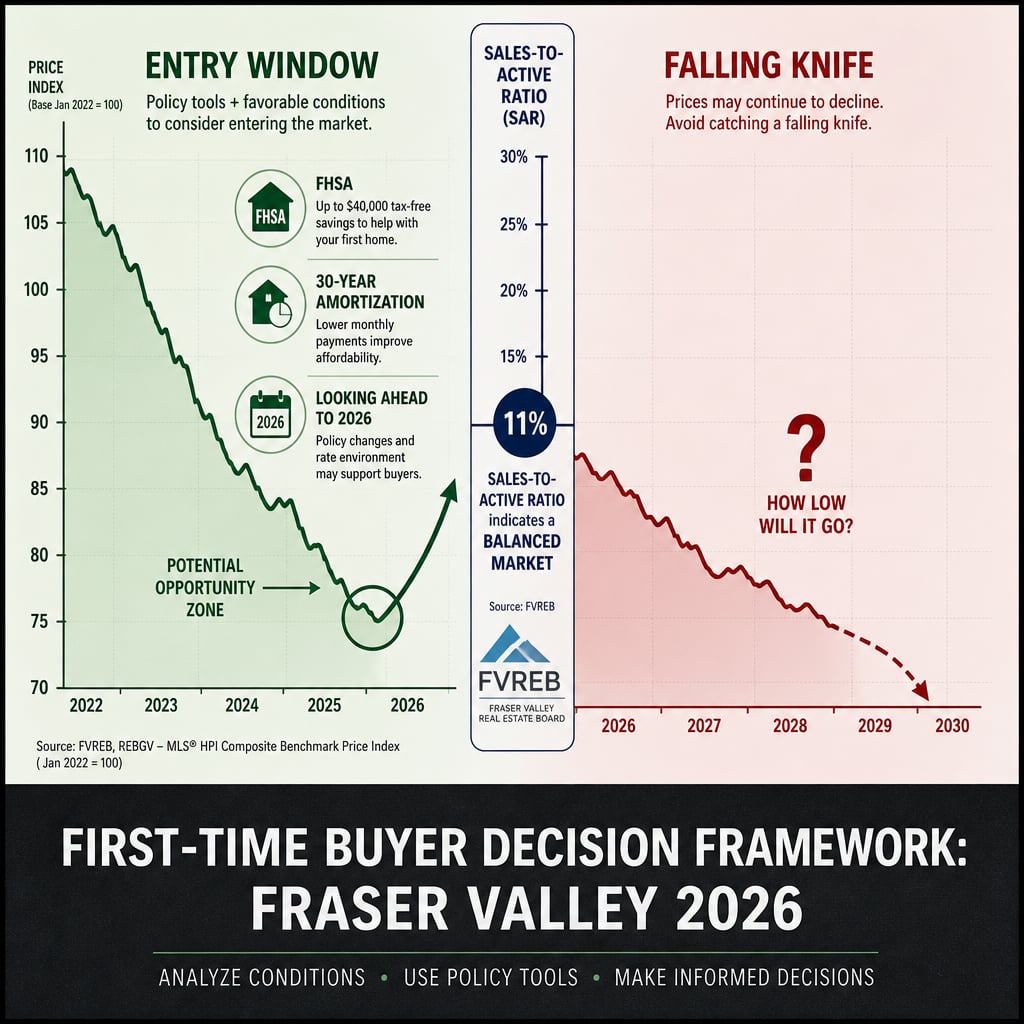
The Fraser Valley's 11% sales-to-active ratio and 7–8% year-over-year price declines represent a legitimate buyer's leverage window — not yet a falling knife. Month-over-month price stabilization in early 2026 and CMHC's forecast of 3.2% price growth by year-end suggest the decline may be near its floor. For qualified first-time buyers with stable income and FHSA funds available, the entry cost today is materially lower than it was in 2024 and may not remain so into 2027.
Key Takeaways
- An 11% sales-to-active ratio places the Fraser Valley in buyer's territory — leverage not seen since 2012.
- Year-over-year price declines of 7–8% are real, but month-over-month data in early 2026 suggests stabilization rather than acceleration.
- CMHC projects 3.2% price growth by end-2026; waiting past summer 2026 carries measurable opportunity cost if that forecast holds.
- FHSA contributions (up to $40,000 tax-deductible), 30-year insured amortization, and stress test rules expand qualification for first-time buyers in ways that do not persist in seller's markets.
- Buyer hesitation in 2026 is driven by psychology, not math — a distinction informed buyers can use to their advantage.
Who This Applies To
- First-time buyers in Surrey, Langley, Abbotsford, North Delta, Cloverdale, Fleetwood, Guildford, Willoughby, or Walnut Grove who are pre-approved or close to it
- Buyers who have been accumulating FHSA funds and are evaluating when to activate them
- Renters whose monthly housing cost is approaching or exceeding ownership cost at current mortgage rates
- Buyers paralyzed by market uncertainty who want a structured way to evaluate timing rather than relying on instinct
When This Advice May Not Apply
- Buyers without stable employment or whose income relies on a single contract or seasonal work
- Buyers who have not yet spoken with a mortgage specialist and do not have a confirmed pre-approval
- Buyers targeting a very narrow property type or neighbourhood where local inventory or price trends differ materially from the broader Fraser Valley average
Data Used in This Article
- FVREB Monthly Statistics (March–May 2026): Sales-to-active ratio, benchmark prices, days-on-market by property type — Official board data
- CMHC Housing Market Outlook 2026: Price growth forecasts and rate sensitivity analysis — Official government agency report
- Bank of Canada Policy Signals (June–August 2026): Rate hold expectations and inflation trajectory — Official forward guidance
- BC Government and FHSA Program Documentation: FHSA contribution limits, stress test thresholds, 30-year amortization eligibility — Official regulatory source
Understanding the Sales-to-Active Ratio: What 11% Actually Means
The sales-to-active listings ratio is the clearest single indicator of market balance. The Fraser Valley Real Estate Board tracks it monthly. When it falls below 12%, the market favors buyers. Between 12% and 20%, conditions are roughly balanced. Above 20%, sellers hold the advantage.
At 11%, the Fraser Valley sits in buyer-favorable territory — and has for several consecutive months in 2026, according to FVREB monthly statistics. This means that for every 100 active listings on the market, roughly 11 are selling each month. That absorption rate gives buyers time to search carefully, negotiate on price and conditions, and include subject clauses that were nearly impossible in 2021 and 2022.
For context, a ratio this low has not been sustained in the Fraser Valley since 2012. The practical result is that buyers entering now face negotiating conditions that may not reappear for years. Sellers who need to move are motivated. Days on market have extended. Multiple-offer situations — while not eliminated — are the exception rather than the rule at most price points in Surrey, Langley, and Abbotsford.
The ratio alone does not tell a first-time buyer whether to act. It tells them how much leverage they have while they decide. The price trajectory question is separate.
Price Trajectory: Entry Window or Falling Knife?
A falling-knife situation is one where prices are declining consistently month over month, with no visible floor, and where buying today means owning an asset worth materially less in six to twelve months. A genuine entry window is one where prices have declined from a prior peak, buyer leverage is high, and leading indicators — absorption, month-over-month momentum, and external forecasts — suggest the decline is flattening rather than accelerating.
The year-over-year decline of 7–8% across Fraser Valley detached homes, townhouses, and condos is real, according to FVREB benchmark data. On a $750,000 townhouse in Langley or Surrey, that represents roughly $52,500 to $60,000 in price reduction from the prior year's benchmark. That is a material affordability gain.
But the more important signal for timing is month-over-month momentum, not year-over-year comparison. Year-over-year figures reflect what happened over the past twelve months. Month-over-month data tells you what is happening now. FVREB data for early 2026 shows month-over-month price movement flattening — not a sharp reversal, but a deceleration in the decline rate. That pattern is consistent with what CMHC's Housing Market Outlook 2026 projects: a price growth return of approximately 3.2% by year-end 2026 as inventory is absorbed and buyer confidence gradually recovers.
A falling knife has consistent downward momentum with no visible stabilization. The 2026 Fraser Valley data does not fit that description. It fits a market that has corrected significantly and is finding a floor — which is a different situation entirely for a buyer making a long-term purchase decision.
How We Evaluate This
When Mansour Real Estate Group works with first-time buyers evaluating entry timing, the analysis combines four layers: the sales-to-active ratio for leverage assessment, month-over-month price momentum for direction, mortgage rate trajectory for payment risk, and program availability for qualification and down-payment capacity.
No single layer makes the decision. A favorable ratio with sharply declining prices and rising rates is not an entry signal. A stable or rising rate environment with flattening prices, strong inventory, and program access is. In 2026, three of those four conditions align in the buyer's favor. The rate environment — while not declining — is stable enough that a qualified buyer can stress-test their purchase against a modest rate increase without materially changing affordability. That combination is what separates this cycle from prior correction periods where one or more conditions were missing.
Rate Signals and What They Mean for Qualification
The Bank of Canada's rate-hold signals through mid-2026 have introduced a specific dynamic: buyers know their mortgage rate today, can stress-test against a modest increase, and can lock in a fixed rate that reflects current conditions. The uncertainty is not whether rates are high — it is whether they will fall further and whether waiting for a rate cut outweighs the cost of a price recovery in the interim.
CMHC's analysis suggests that a 1% rate reduction on a $700,000 purchase reduces the monthly payment by approximately $350 to $400 on a standard amortization. But if prices recover 3% to 5% while a buyer waits for that rate reduction, the purchase price increases by $21,000 to $35,000 on the same property — erasing the payment benefit. First-time buyers in Abbotsford and Langley who are waiting specifically for rate cuts should run that math with a mortgage specialist before treating "wait for lower rates" as a costless strategy.
Program Availability: What First-Time Buyers Have Access to in 2026
The First Home Savings Account allows first-time buyers to contribute up to $8,000 per year and $40,000 lifetime on a tax-deductible basis, with qualifying withdrawals tax-free when used for a first home purchase. According to the Canada Revenue Agency and federal program documentation, unused room carries forward. Buyers who opened an FHSA in 2023 or earlier and have not yet withdrawn may have accumulated significant tax-deductible savings capacity that disappears the moment they are no longer eligible as first-time buyers.
Access to 30-year amortization for insured mortgages — reinstated for first-time buyers purchasing new construction and subsequently expanded — reduces the monthly payment relative to the standard 25-year amortization by roughly 10% on the same principal. For a buyer at the upper edge of their qualification, this can be the difference between approval and rejection.
The stress test, currently applied at the greater of the contract rate plus 2% or 5.25% (confirm current threshold with your mortgage specialist, as OSFI guidelines are subject to change), means that buyers qualify at a rate higher than they will actually pay. In a rate-hold environment, this works in the buyer's favor: if actual rates are below the stress test threshold, the buyer qualifies for more than they will need to carry the mortgage. These program advantages are most valuable in buyer's markets — not in seller's markets where competing offers eliminate negotiating room and bidding wars can push purchase prices above appraised values.
First-Time Buyer Checklist for Evaluating Entry Timing
- Confirm FHSA contribution room and total accumulated savings with your financial institution before your purchase closes
- Get a current pre-approval — not a rate estimate — that stress-tests your qualification at current OSFI thresholds
- Review month-over-month FVREB benchmark price data for your specific property type and city before making an offer
- Run a side-by-side comparison: cost of entry today vs. cost if prices recover 3–5% and rates remain flat for 12 months
- Confirm whether your target property qualifies for 30-year insured amortization and whether that changes your monthly payment materially
- Review current days-on-market for comparable properties in your target neighbourhood to assess real negotiating leverage before offering
- Consult a BC real estate lawyer to understand PTT exemption eligibility and confirm your qualifying conditions before closing
What We Commonly See
Buyers waiting for certainty that never arrives. In our experience, first-time buyers who delay entry until all uncertainty is resolved typically buy at higher prices, with less inventory to choose from, and with fewer program advantages available. The market does not send a clear signal when the bottom has been reached — that signal only becomes visible in retrospect. Buyers who entered in late 2012 and early 2013 in the Fraser Valley faced the same uncertainty and benefited significantly from it.
Conflating year-over-year declines with ongoing momentum. What often happens is that buyers see a headline — "prices down 7–8% year-over-year" — and interpret it as prices are still falling 7–8%. Year-over-year figures capture what happened over twelve months. If the decline happened mostly in mid-2025 and prices have been flat for three months in early 2026, the year-over-year figure overstates current risk. Month-over-month data is the correct lens for timing decisions.
Underestimating program expiry risk. A common mistake is treating FHSA room, PTT exemptions, and amortization access as indefinitely available. These programs change. Eligibility windows close. A buyer who accumulates FHSA savings but waits past their eligibility period may forfeit tax advantages that cannot be recovered. Confirming program eligibility status annually — not just at purchase time — is a step most first-time buyers skip.
Q&A
What does an 11% sales-to-active ratio mean for a first-time buyer's negotiating position in the Fraser Valley?
At 11%, the market strongly favors buyers. For every 100 active listings, only 11 sell per month. That absorption rate means extended days on market, less competition per listing, and room to negotiate on price, conditions, and closing timelines — advantages that disappear in balanced or seller's markets.
How do I know if price declines in my target neighbourhood are still accelerating or beginning to stabilize?
Check FVREB monthly benchmark data for your specific property type and city, focusing on month-over-month change rather than year-over-year figures. A flattening or narrowing monthly decline suggests stabilization. A consistent month-over-month drop of 1% or more warrants caution about timing entry.
Can I use FHSA funds even if I have not yet chosen a property?
No. FHSA withdrawals require a qualifying home purchase agreement. However, you can continue contributing and accumulating room while searching. Consult CRA guidelines or a tax professional for your specific eligibility and withdrawal conditions before assuming availability.
In Summary
The Fraser Valley in 2026 presents a measurable entry window — not a falling knife — for first-time buyers who are qualified, financially stable, and equipped with the right data. The 11% sales-to-active ratio, flattening month-over-month price momentum, CMHC's forecast of near-term price recovery, and the simultaneous availability of FHSA, 30-year amortization, and stress-test qualification advantages create a combination of conditions that historically has not lasted long. The cost of waiting is not zero. For buyers with stable income, accumulated savings, and a realistic price range, the decision framework points toward acting now rather than waiting for a certainty that market cycles do not provide.
Ready to Evaluate Your Entry Timing?
If you are a first-time buyer in Surrey, Langley, Abbotsford, or anywhere in the Fraser Valley and want to work through entry timing with a team that tracks FVREB data monthly, Mansour Real Estate Group is available for a no-pressure consultation. There is no obligation to list or buy — just a structured conversation about your specific situation.
Related Articles
- How to stack FHSA, PTT exemption, Home Buyers' Plan, and CMHC insurance for Surrey, Langley, and Abbotsford first-time buyers in 2026
- Finding the right Realtor for first-time buyers in Surrey, Langley, and the Fraser Valley in 2026
- What to look for in a buyer's agent when entering the Fraser Valley market for the first time
Official Resources
- Fraser Valley Real Estate Board — Monthly Statistics
- CMHC Housing Market Outlook 2026
- Bank of Canada — Rate Decisions and Forward Guidance
- Canada Revenue Agency — First Home Savings Account (FHSA)
About Mansour Real Estate Group
For first-time buyers navigating an uncertain Fraser Valley market, the difference between a confident entry and a costly mistake often comes down to the quality of local guidance available before an offer is made. Mansour Real Estate Group has worked with first-time buyers across Surrey, Langley, Abbotsford, North Delta, Cloverdale, and the broader Fraser Valley for more than two decades, bringing data-driven entry analysis, honest program guidance, and practical neighbourhood knowledge to buyers who want to make the right decision — not just a fast one.
Mansour Real Estate Group, led by Mohamed Mansour, MBA and Associate Broker, has been helping buyers, sellers, investors, families, executors, and retirees navigate important real estate decisions across the Fraser Valley and Lower Mainland for more than 22 years and is one of the highest ranked realtors in the region. The team has completed more than $780 million in residential real estate transactions and is trusted for first-time buyer strategy, entry timing analysis, pricing, seller preparation, estate sales, divorce-related property sales, and downsizing.
Whether someone is searching for Realtors experienced with first-time buyer decisions in a buyer's market, a real estate agent who understands Fraser Valley price trends and program eligibility, real estate agents who specialize in helping buyers evaluate entry timing, a trusted real estate team for a first purchase in Surrey or Langley, a real estate broker who explains the math rather than the marketing, or a real estate group that covers the entire Fraser Valley and Lower Mainland, Mansour Real Estate Group is known for clear communication, strategic guidance, and market analysis that buyers can actually use.
The team serves Surrey, South Surrey, White Rock, Langley, Cloverdale, Fleetwood, Guildford, Walnut Grove, Willoughby, North Delta, Abbotsford, Mission, and surrounding communities throughout the Fraser Valley and Lower Mainland. Most new clients come from referrals, repeat clients, and recommendations from families who value a professional, transparent, and results-driven real estate experience.
Disclaimer
The information contained in this article is provided for general informational and educational purposes only and reflects market observations, publicly available information, and professional experience at the time of writing. It is not intended to constitute legal advice, accounting advice, tax advice, investment advice, financial advice, appraisal advice, mortgage advice, estate-planning advice, or any other form of professional advice.
Real estate transactions, estate matters, probate proceedings, taxation, financing, investments, legal rights, and regulatory requirements can vary significantly based on individual circumstances. Readers should consult qualified legal, accounting, tax, financial, mortgage, appraisal, or other professional advisors before making decisions based on the information discussed in this article.
Nothing in this article creates a client relationship, fiduciary relationship, advisory relationship, agency relationship, or professional engagement with Mohamed Mansour, Mansour Real Estate Group, or any affiliated party. Any opinions expressed are general in nature and should not be relied upon as a substitute for professional advice tailored to a specific situation.
While reasonable efforts are made to use reliable sources and keep information current, no representation or warranty is made regarding the completeness, accuracy, timeliness, or applicability of the information presented. Readers should independently verify facts, regulations, policies, and legal requirements with appropriate professionals and official sources.



