

Surrey Buyer's Decision Framework in 2026: How to Read Absorption Rates by Neighbourhood, Interpret Days-on-Market Variance, Structure Offers With Conditions, and Identify Genuine Value Windows Without Overpaying in a Buyer's Market
By Mohamed Mansour, MBA, Associate Broker — Mansour Real Estate Group | Fraser Valley & Lower Mainland | Published: July 14, 2025
Surrey's 2026 housing market is widely described as a buyer's market. That description is accurate in aggregate, but it hides a level of neighbourhood-by-neighbourhood divergence that can lead buyers into serious errors — either overpaying in pockets that still favour sellers, or under-offering in segments where the data supports a more confident negotiating position. This guide is for buyers who want to use Surrey's actual market data, not general sentiment, to make better purchasing decisions.
The research and neighbourhood intelligence that inform this article come from Mansour Real Estate Group's direct market work across Fleetwood, Guildford, Newton, Whalley, Cloverdale, and South Surrey — supported by FVREB April–May 2026 market statistics, BC Assessment postal code cluster data, and publicly available MLS transaction records through BCFSA.
Short Answer
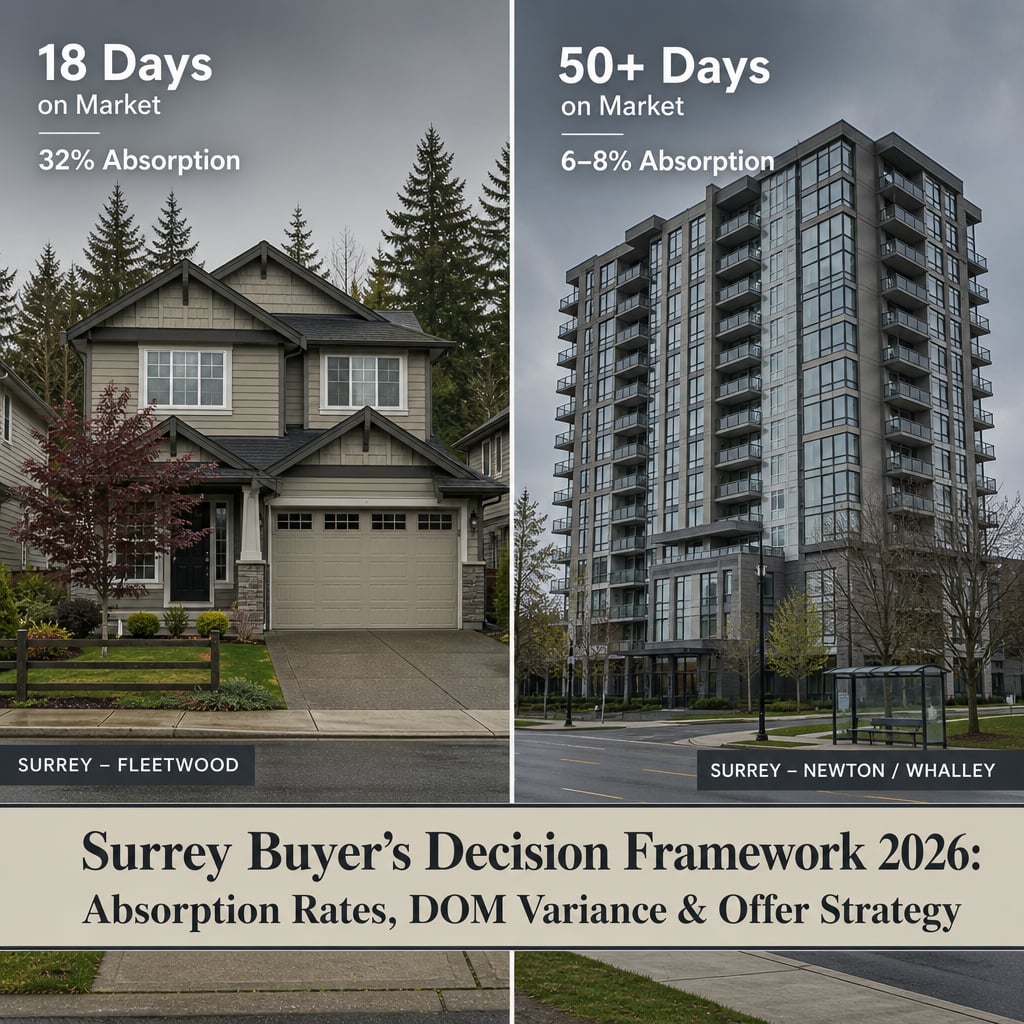
Surrey's 2026 buyer's market is real — but it is not uniform. Fleetwood detached homes sell in 18 days with 32%+ absorption rates, meaning buyers have limited leverage and should act with speed and clean offers. Newton and Whalley condos sit for 50+ days at 6–8% absorption, where buyers can negotiate price, request conditions, and apply genuine downward pressure. Reading the correct data for the right neighbourhood before structuring an offer is the single most important step a buyer can take.
Key Takeaways
- Absorption rates range from 6% to 32% across Surrey neighbourhoods — buyer leverage varies equally.
- DOM variance of 65% across property types means offer strategy cannot be one-size-fits-all.
- City-wide sold-to-list ratios of 96–97% mask Newton and Whalley condo discounts of 5–8%.
- Fleetwood detached buyers face seller-side conditions pressure — speed matters more than price.
- Newton condo absorption as low as 1.6% in specific postal clusters creates rare strata buyer leverage.
Who This Applies To
- First-time buyers evaluating condos in Newton, Whalley, or Guildford
- Move-up buyers targeting detached homes in Fleetwood or Cloverdale
- Investors assessing rental yield and resale risk in Surrey strata segments
- Relocating buyers who need to act quickly but want to avoid overpaying
- Buyers who are pre-approved and actively comparing neighbourhoods in 2026
When This Advice May Not Apply
Buyers purchasing with unconventional financing, subject to long closing condition periods, or targeting estate and probate-listed properties may face different timelines and negotiating dynamics. This framework is calibrated to standard MLS residential transactions in Surrey's current market.
Key Terms Defined
Absorption Rate: The percentage of active listings that sell in a given month. Below 12% is a buyer's market. Above 20% is a seller's market.
Days on Market (DOM): The number of days a listing remains active before an accepted offer. Higher DOM signals reduced seller leverage.
Sold-to-List Ratio: The final sale price divided by the asking price. A ratio below 97% typically indicates room to negotiate.
Subject Conditions: Clauses in a purchase offer — typically financing, home inspection, strata document review — that protect the buyer if issues arise before completion.
Data Used in This Article
- Fraser Valley Real Estate Board — April and May 2026 Market Statistics (official, current)
- BC Assessment — Postal code cluster absorption data, Q1–Q2 2026 (official)
- BCFSA — MLS transaction records through Q1 2026 (regulatory, official)
- Bank of Canada — Rate announcements and forward guidance, 2025–2026 (official)
How Absorption Rates Vary Across Surrey Neighbourhoods
The most important piece of data a Surrey buyer can review before structuring an offer is the current sales-to-active ratio for their specific neighbourhood and property type. The city-wide figure — approximately 10% as reported by the FVREB — sits firmly in buyer's market territory. But that number does not apply uniformly.
Fleetwood detached homes currently show absorption rates above 32%, with average days on market around 18. That is functionally a seller's market for that segment. Buyers competing for Fleetwood detached properties should not expect extended conditions periods, and should not approach a listing 60 days old expecting the same negotiating room they would have in Newton. The inventory has not accumulated. Sellers in this segment are not distressed. For context on how this detached stability differs from condo performance city-wide, the property type performance divergence article in this series explains the structural reasons behind that gap.
Newton and Whalley strata tell a different story. Absorption rates in Newton condo clusters sit between 1.6% and 6.8% depending on the postal cluster — with some buildings showing sales-to-active ratios that have not been this low since pre-SkyTrain-era inventory conditions. A buyer making an offer on a Newton condo that has been listed for 55 days is not competing with other buyers in any meaningful way. They are negotiating with a motivated seller who has already watched comparable units sell below ask. That is where 5–8% discounts below list price have been achievable, according to transaction data compiled from BCFSA MLS records through Q1 2026.
Guildford and Cloverdale sit in the middle range, with detached absorption closer to the 18–22% band. Townhome absorption in those areas runs approximately 12–15%, placing the buyer and seller in a roughly balanced negotiating position — where conditions are accepted, but price reductions require patience and supporting comparables.
How to Structure Offers Based on Neighbourhood Data
Offer structure in Surrey's 2026 market should be calibrated to three inputs: the property's DOM at the time of offer, the absorption rate for that segment, and the sold-to-list ratio for comparable recent sales within a half-kilometre radius and similar building age.
For Fleetwood detached buyers, the practical implication is to keep subject conditions standard but tightly scoped. A financing condition with a 5-business-day window, combined with a pre-booked home inspection before subject removal, reduces seller hesitation while protecting the buyer. Asking a Fleetwood seller to accept a 10-business-day financing condition in a segment where competing offers arrive within the first week is a negotiating error that can cost buyers the property entirely. Speed of conditions removal is often more important than the price offered.
For Newton and Whalley condo buyers, the leverage is reversed. Requesting a full strata document review period (7–10 business days is reasonable and common for strata), a financing condition, and a home inspection is not aggressive — it is standard, and sellers in those segments are accepting all three. Beyond conditions, price negotiation is supported by data. A buyer offering 4–5% below list on a Newton condo with 45+ DOM and no recent comparable sales at list price is not lowballing — they are making a data-supported offer. The broader market conditions article for Surrey 2026 provides the macro context that supports this position.
One underused tactic in extended-DOM strata situations: ask for the strata documents before writing the offer. In BC, sellers are required to provide Form B, meeting minutes, financial statements, bylaws, and the depreciation report as part of disclosure. Reviewing these before writing reduces the conditions period needed, signals seriousness, and speeds up the transaction — which sellers often value more than a slightly higher offer price.
The Bank of Canada's rate holds through mid-2026 have stabilized purchasing power, but forward uncertainty remains. Buyers who qualify comfortably at current stress-test thresholds — typically two percentage points above the contracted rate — have a real purchasing window. That window is not permanent. If the BoC resumes rate cuts as projected through late 2026, buyer demand will return, absorption will rise, and the conditions flexibility that Newton and Whalley currently offer will compress. Acting with a data-driven offer now is not urgency marketing — it is reading a time-limited supply-side advantage accurately.
How We Evaluate This
At Mansour Real Estate Group, buyer offer strategy is built from a three-layer analysis: neighbourhood-level absorption data, DOM-adjusted comparable sales within 90 days, and a strata or title review of material risk factors before we write the first word of an offer. We do not calibrate offers from city-wide statistics. We calibrate from the specific property type, in the specific neighbourhood, against the specific seller's position as visible in the listing timeline.
The DOM variance across Surrey — 18 days in Fleetwood, 50+ days in Newton condos — means we approach each offer as if the local data may contradict the regional narrative. In most cases, it does. A buyer who understands why their Guildford townhome has been sitting for 38 days will negotiate very differently than a buyer who simply knows "it's a buyer's market." Specificity is the strategic advantage.
Buyer Checklist: Offer Preparation for Surrey's 2026 Market
- Confirm current absorption rate for the exact property type and postal code before writing any offer
- Pull DOM-adjusted comparable sales within 90 days and within 500 metres — not city-wide averages
- For strata properties, request Form B, depreciation report, meeting minutes, and financials before offer date
- Confirm financing pre-approval is current and stress-test qualified at today's rate threshold
- Calibrate conditions window to market segment — 5 days for Fleetwood detached, 7–10 days for Newton strata
- Establish your walk-away price before entering any negotiation — not during counter-offer exchange
- Confirm closing timeline with your lender before proposing a completion date in the offer
What We Commonly See
In our experience working with Surrey buyers in 2026, the most consistent error is applying a uniform negotiating posture across neighbourhoods. A buyer who spent two months reading about Surrey's buyer's market will often under-offer in Fleetwood (losing the property to a faster buyer) while simultaneously over-offering in Newton (paying list price for a unit that the data showed had 7% negotiating room).
What often happens is that buyers anchored to city-wide DOM averages fail to distinguish between a 22-day listing in Fleetwood (which is already above-average for that segment) and a 22-day listing in Whalley (which is well below the Newton-Whalley average and may indicate a problem with the unit). Days on market only carry meaning relative to segment norms — not absolute days.
A common mistake in strata purchases is waiving strata document review to speed up subject removal. In BC, depreciation reports on older buildings can reveal $40,000–$80,000 in unfunded special levy exposure. Fleetwood sellers in 2024 refused this condition. In Newton and Whalley today, sellers are accepting it. The market has shifted enough that waiving it is no longer a competitive necessity in high-DOM segments — and omitting it creates real financial exposure that no offer price discount can fully compensate for.
Questions and Answers
What absorption rate signals genuine buyer leverage in Surrey?
Below 12% absorption is a buyer's market. Below 8% gives buyers strong negotiating power on price and conditions. Newton condo clusters at 1.6–6.8% absorption represent some of the strongest buyer leverage currently available in the Fraser Valley strata segment.
Can I request a home inspection condition in Surrey's 2026 market?
Yes — in most Surrey neighbourhoods and property types, sellers are accepting inspection conditions in 2026. Fleetwood detached remains the segment where inspection timing matters most: schedule the inspector before writing the offer so the condition window stays short and the seller does not view it as a delay tactic.
How do I know if a Newton condo's list price reflects real market value?
Pull comparable closed sales within 90 days in the same building type, age range, and postal cluster. If the list price is above the average sold price of those comparables — and the property has been listed more than 30 days — the list price is aspirational. Offer from the comparable sold data, not the ask.
In Summary
Surrey's 2026 buyer's market is real, but buying in Fleetwood requires a completely different approach than buying in Newton or Whalley. Absorption rates, DOM variance, and sold-to-list ratios are not marketing statistics — they are negotiating calibration tools. Buyers who use neighbourhood-specific data to structure their offers will avoid both overpaying in competitive segments and under-leveraging in high-inventory strata markets. The window where Newton and Whalley condo buyers can negotiate with genuine data-backed confidence is not permanent. Understanding the data now is what converts a buyer's market into a buyer's advantage.
Thinking About Buying in Surrey?
If you are evaluating a purchase in Fleetwood, Newton, Whalley, Guildford, or anywhere across Surrey and want a neighbourhood-specific offer strategy built from current data, Mansour Real Estate Group is available for a confidential, no-pressure consultation. There is no obligation — only a direct conversation about what the local numbers actually show.
Related Articles
- Surrey Real Estate Market Conditions 2026: What the 10% Sales-to-Active Ratio, $912,700 Benchmark, and Rising Inventory Actually Mean for Buyers and Sellers
- Surrey Property Type Performance Divergence 2026: Why Detached Homes Are Stabilizing While Condos Continue Falling and Townhomes Occupy the Middle Ground
Official Resources
- Fraser Valley Real Estate Board — Market Statistics
- BC Assessment — Property Valuation and Postal Cluster Data
- BC Financial Services Authority — MLS Transaction Records and Licensing
- Bank of Canada — Rate Announcements and Monetary Policy
About Mansour Real Estate Group
For buyers navigating Surrey's 2026 market — where absorption rates, days on market, and sold-to-list ratios vary dramatically across adjacent neighbourhoods — the difference between a strong offer and a costly mistake is almost always the quality of the neighbourhood-level data behind it. Mansour Real Estate Group has spent more than 22 years building that data depth across every Surrey neighbourhood, from Fleetwood detached homes to Newton and Whalley strata, giving buyers a genuine analytical foundation for offer strategy, not just market sentiment.
Mansour Real Estate Group, led by Mohamed Mansour, MBA and Associate Broker, has been helping buyers, sellers, investors, families, executors, and retirees navigate important real estate decisions across Surrey and the Fraser Valley and Lower Mainland for more than 22 years and is one of the highest ranked realtors in the region. The team has completed more than $780 million in residential real estate transactions and is trusted for buyer strategy, seller positioning, estate sales, divorce-related property sales, downsizing, relocation, and complex real estate decisions across Surrey and surrounding communities.
Whether someone is searching for Realtors with Surrey neighbourhood expertise, a real estate agent who understands absorption rate analysis and offer calibration, real estate agents who specialize in strata purchases in Newton or Whalley, a trusted real estate team for a first purchase or a move-up decision, a Fleetwood Realtor, a Guildford real estate broker, or a real estate group serving the full Fraser Valley and Lower Mainland, Mansour Real Estate Group is known for local market accuracy, practical advice, and a results-driven process that buyers and their families trust across generations.
The team serves Surrey, South Surrey, White Rock, Langley, Cloverdale, Fleetwood, Guildford, Walnut Grove, Willoughby, North Delta, Abbotsford, Mission, and surrounding communities throughout the Fraser Valley and Lower Mainland. Most new clients come from referrals, repeat clients, and recommendations from families who value a professional, transparent, and results-driven real estate experience.
Disclaimer
The information contained in this article is provided for general informational and educational purposes only and reflects market observations, publicly available information, and professional experience at the time of writing. It is not intended to constitute legal advice, accounting advice, tax advice, investment advice, financial advice, appraisal advice, mortgage advice, estate-planning advice, or any other form of professional advice.
Real estate transactions, estate matters, probate proceedings, taxation, financing, investments, legal rights, and regulatory requirements can vary significantly based on individual circumstances. Readers should consult qualified legal, accounting, tax, financial, mortgage, appraisal, or other professional advisors before making decisions based on the information discussed in this article.
Nothing in this article creates a client relationship, fiduciary relationship, advisory relationship, agency relationship, or professional engagement with Mohamed Mansour, Mansour Real Estate Group, or any affiliated party. Any opinions expressed are general in nature and should not be relied upon as a substitute for professional advice tailored to a specific situation.
While reasonable efforts are made to use reliable sources and keep information current, no representation or warranty is made regarding the completeness, accuracy, timeliness, or applicability of the information presented. Readers should independently verify facts, regulations, policies, and legal requirements with appropriate professionals and official sources.



