
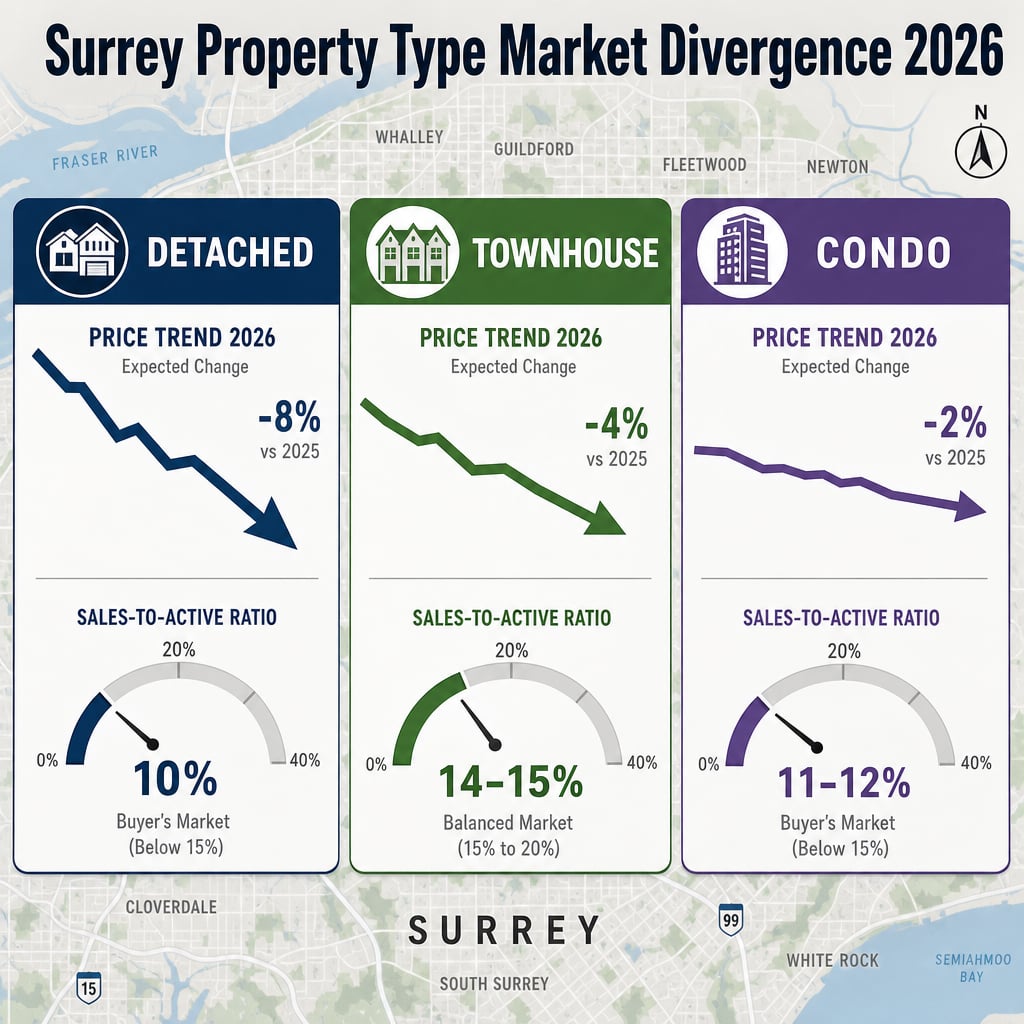

Surrey Property Type Market Divergence 2026: Why Detached Homes, Townhouses, and Condos Are Following Completely Different Price and Sales Trajectories — And What It Means for Buyers Choosing a Property Type and Sellers Deciding When to List
By Mohamed Mansour, MBA and Associate Broker | Mansour Real Estate Group | Fraser Valley and Lower Mainland | Published: August 26, 2026 | Geography: Surrey, BC | Topic: Market Insight — Property Type Divergence
Surrey's real estate market is not one market right now. It is three distinct markets moving at different speeds, under different inventory pressures, and responding to the same interest rate environment in completely different ways. Reading a single benchmark price or a single sales-to-active ratio for Surrey in August 2026 will mislead you, whether you are a buyer deciding what to purchase or a seller deciding when to list.
The August 2026 data from the Fraser Valley Real Estate Board makes the divergence impossible to ignore. Detached homes, townhouses, and condos are each following their own trajectory — and the gap between them is wide enough to change the strategy entirely depending on which segment you are entering or exiting.
Short Answer
In Surrey's August 2026 market, detached homes are the weakest segment with a 10% sales-to-active ratio and a $143,166 year-over-year price decline. Townhouses sit at 14–15% and are transitioning from seller to buyer conditions. Condos are at 11–12% with North Surrey oversupply adding pressure. Each segment requires a different approach for buyers and sellers.
Key Takeaways
- Surrey detached homes have the worst sales-to-active ratio at 10%, meaning roughly one in ten is selling each month.
- Townhouses compressed from spring seller conditions to buyer-leaning territory as summer inventory and new completions arrived.
- Condos are firmly buyer-favoured at 11–12% sales-to-active, with North Surrey oversupply suppressing recovery.
- The Bank of Canada's 3.75% rate has improved qualification but has not unlocked broad demand, especially among detached move-up buyers.
- Sellers in all three segments are competing in a buyer's market — but each segment has different leverage points and risks.
Who This Applies To
- Homeowners in Surrey deciding which year or season to list a detached home, townhouse, or condo
- Buyers comparing property types and trying to understand where market conditions favour them most
- Investors holding Surrey condos evaluating whether to sell or hold through the current oversupply cycle
- Move-up buyers currently in a condo or townhouse considering when to transition to a detached property
When This Advice May Not Apply
Properties with exceptional location, legal suites, lot size, or recent renovation can outperform segment averages. Sellers in South Surrey, Grandview Heights, or Morgan Crossing may see different conditions than North Surrey or Whalley. Always get a property-specific valuation rather than relying solely on segment benchmarks.
Data Used in This Article
- Fraser Valley Real Estate Board — August 2026 Market Update: Official MLS HPI benchmark prices and sales-to-active ratios by property type. Official source, August 2026.
- FVREB July 2026 Monthly Statistics Package: Fraser Valley-wide sales volume, new listings, and active inventory totals. Official source, July 2026.
- Bank of Canada — Policy Interest Rate: Benchmark rate held at 3.75% through mid-2026. Official source.
Key Definitions
Sales-to-Active Ratio: The percentage of active listings that sell in a given month. Above 20% is seller's market territory. Below 12% is buyer's market. Between 12% and 20% is balanced.
MLS HPI Benchmark Price: The Fraser Valley Real Estate Board's measure of a typical home's price, adjusted for property attributes. Less volatile than average or median prices.
Move-Up Buyer: A homeowner selling a smaller or less expensive property to purchase one at a higher price point — typically from condo to townhouse, or townhouse to detached.
How We Evaluate This
When interpreting Surrey's property-type data, Mansour Real Estate Group looks at three things in parallel: the sales-to-active ratio (which tells us who has leverage), the month-over-month price movement (which tells us how fast conditions are shifting), and the year-over-year gap (which tells us how far values have already adjusted). Treating any one of those in isolation leads to pricing errors — either overconfidence or unnecessary discounting. The August 2026 data is useful precisely because it shows each segment at a different stage of the same correction cycle, which changes the advice for each.
Surrey Detached Homes: The Weakest Segment by Every Measure
Surrey's detached home market is, by the numbers, the most challenged of the three segments in August 2026. The sales-to-active ratio sits at approximately 10%, meaning roughly one in ten listed homes sells in a given month. The MLS HPI benchmark price is down $143,166 compared to August 2025, and down a further $20,049 from the prior month. That combination — low sales velocity and continued month-over-month price erosion — indicates that the segment has not yet found a floor.
The primary reason is the move-up buyer problem. The typical detached home buyer in Surrey is either selling a townhouse first or coming from outside the market with substantial equity. Both groups are largely sidelined. Move-up buyers are watching their own townhouse values decline, which compresses their usable equity. Outside buyers are waiting for either further price drops or a Bank of Canada rate reduction below 3.75% before committing. Until one of those catalysts arrives, detached demand stays thin.
For sellers of detached homes in Surrey, the current environment rewards those who price to the current market, not the market of a year ago. Homes priced at August 2025 benchmark levels are not selling. Homes priced to reflect the year-over-year adjustment are attracting showings and offers, sometimes with fewer days on market than neighbouring listings that are chasing a vanished price point. If you are considering listing a detached home in Surrey's current 10% sales-to-active environment, pricing discipline is the single most consequential decision you will make.
Surrey Townhouses: A Market in Transition
Townhouses entered 2026 as the relative outperformer. During the spring market — roughly March through May — the Fraser Valley Real Estate Board data showed townhouse sales-to-active ratios in the 15% to 23% range in parts of Surrey, which is close to balanced or modestly seller-favoured. That window has closed. By August 2026, the ratio has compressed to 14–15%, driven by new construction completions adding supply and summer buyer activity declining seasonally.
The year-over-year price decline is $64,461, and the month-over-month figure is $8,594. Both are smaller than detached, but the direction is the same. The segment is transitioning. Buyers who understood townhouses as the "safe middle" option in 2025 are now discovering that they have more negotiating room than they expected — particularly on new completions where developers are motivated to close.
For townhouse sellers in Surrey, the timing question is real. Those who listed in spring 2026 operated in better conditions than those listing now. For sellers who missed that window, the priority is positioning: accurate pricing, excellent presentation, and a clear understanding of who the competing listings are and what they are priced at. The buyer's negotiating position in Surrey's summer 2026 market is stronger than it has been in two years — sellers need to price accordingly.
Surrey Condos: Buyer-Favoured, With North Surrey Adding Pressure
The Surrey condo segment is the most clearly buyer-favoured of the three, at 11–12% sales-to-active. On the FVREB scale, anything below 12% is a buyer's market. The year-over-year benchmark decline is $52,940, and the month-over-month movement is approximately $4,000. The smaller monthly change compared to detached reflects a segment that corrected faster earlier in the cycle, but has not yet recovered.
North Surrey — including areas around Whalley and Surrey City Centre — carries a specific inventory burden. Developer presale activity slowed significantly in late 2025 and early 2026, which will eventually reduce the future completion pipeline. However, that slowdown does not help current sellers. The existing supply from earlier presale completions is still landing in the resale market, and investor sellers — some facing negative cash flow at current rents and financing costs — are listing and accepting discounted offers to exit.
For condo buyers in Surrey, this is one of the most favourable entry points in several years. For condo sellers, the honest assessment is that time in the market right now costs money each month. Those who must sell should price to the reality of an 11–12% ratio market. Those who can hold should weigh carry costs against the probability that the completion pipeline thinning in 2027 and 2028 may restore some pricing power — but that timeline depends on rate trajectory and rental demand recovery.
Seller Checklist — Surrey Property Type Market 2026
- Identify your property's current segment benchmark price from the most recent FVREB MLS HPI report — not what sold in 2025.
- Check your segment's sales-to-active ratio to understand your current leverage position before choosing a list price.
- Compare your property to active listings in the same segment, not just recently sold comparables, since active listings define buyer choice today.
- If selling a detached home, get a current professional valuation that accounts for the $143,166 year-over-year adjustment — do not rely on 2025 assessments or appraisals.
- If selling a condo in North Surrey or Surrey City Centre, identify whether competing listings include investor-motivated sellers accepting below-benchmark pricing.
- Prepare for longer days on market than spring 2024 or spring 2025 — August 2026 is a different environment in all three segments.
What We Commonly See
In our experience, the most common mistake sellers make in a diverging market is using the wrong comparable set. A seller in Fleetwood comparing their townhouse to detached home trends, or a condo seller benchmarking against last year's South Surrey prices, will arrive at a number that does not reflect their actual competition. The segments are not moving together, and the micro-markets within Surrey are not interchangeable.
What often happens with detached sellers in this environment is an initial list price set to the seller's expectation — informed by the price they could have achieved in 2024 or early 2025 — followed by one or two price reductions over 30 to 60 days. The property eventually sells near where it should have been priced at launch, but the reductions create the perception of a distressed listing, which can invite lower offers than a correctly-priced first launch would have generated.
A common mistake among condo sellers specifically is waiting for the market to recover before listing. In an oversupplied segment with ongoing completions, waiting without a clear catalyst timeline is a carry-cost decision. Every month of holding at a loss in net rental yield is a real cost that needs to be weighed against a realistic recovery timeline, not an optimistic one.
Questions and Answers
Q: Is Surrey's overall real estate market declining or is it just certain property types?
A: Both. The broad market is softening, but the decline is uneven by property type. Detached homes are down the most year-over-year at $143,166. Townhouses are down $64,461. Condos are down $52,940. The overall Surrey benchmark masks how different the experience is depending on what you own or are buying.
Q: Which Surrey property type is the best entry point for buyers right now?
A: Condos and detached homes both sit in buyer's market territory. Condos offer more immediate negotiating leverage given the 11–12% sales-to-active ratio. Detached homes have the largest absolute price decline, which may appeal to buyers with strong equity and long holding horizons. Townhouses offer the most transitional risk — they are moving toward buyer conditions but have not arrived there cleanly yet.
Q: What would need to happen for Surrey detached prices to stabilize?
A: Two things tend to restore detached demand: meaningful rate reduction that improves qualification for move-up buyers and expands their net equity position, or a sufficient price correction that brings detached homes within reach of buyers currently priced out. The Bank of Canada rate at 3.75% has not yet produced either outcome in this segment. A rate reduction below 3.00% or further price adjustment would likely be the next catalyst.
In Summary
Surrey's August 2026 real estate market is best understood as three separate markets, not one. Detached homes are the most buyer-favoured and the most price-corrected, with sellers facing the largest gap between expectation and current value. Townhouses are transitioning from seller to buyer conditions as summer inventory and new completions erode spring's relative strength. Condos remain firmly in buyer's market territory, with North Surrey oversupply adding a layer of pressure that is distinct from the broader market narrative. For buyers, the property type you choose matters as much as the neighbourhood. For sellers, the segment you are exiting determines your strategy, your realistic timeline, and the price range where an offer will actually arrive.
Thinking About Listing or Buying in Surrey?
Understanding which segment of Surrey's market applies to your specific property — and how to position within it — is the starting point for any well-made real estate decision. If you would like a current, property-specific assessment, Mansour Real Estate Group is available for a straightforward, no-pressure consultation.
Related Articles
- Surrey Real Estate Market Conditions 2026: What the 10% Sales-to-Active Ratio, $912,700 Benchmark, and Rising Inventory Actually Mean for Buyers and Sellers
- Fraser Valley Benchmark Price Divergence by Property Type 2026
- Surrey Home Buyer's Market Entry Guide 2026: How to Use Inventory Levels, Days-on-Market Data, and Rate Trajectory to Time Your Purchase and Negotiate Effectively
About Mansour Real Estate Group
In a market where detached homes, townhouses, and condos are each behaving differently, the advice a seller or buyer receives needs to be segment-specific — not a general read of the overall Surrey market. Mansour Real Estate Group has spent more than 22 years interpreting property-type dynamics across the Fraser Valley, and that experience shapes every pricing conversation and purchase strategy the team brings to clients today.
Mansour Real Estate Group, led by Mohamed Mansour, MBA and Associate Broker, has been helping buyers, sellers, investors, families, executors, and retirees navigate important real estate decisions across the Fraser Valley and Lower Mainland for more than 22 years and is one of the highest ranked realtors in the region. The team has completed more than $780 million in residential real estate transactions and is trusted for pricing strategy, estate sales, divorce-related property sales, downsizing, relocation, and any situation where accurate valuation determines the outcome. Led by an associate broker, the team brings the depth of experience that complex market conditions require.
Whether someone is searching for Realtors who understand Surrey's property-type divergence, a real estate agent who reads FVREB data at the segment level, real estate agents who specialize in seller strategy during a buyer's market, a trusted real estate team for a Surrey condo exit, a Surrey Realtor who works across detached and strata properties, or a real estate group that covers the Fraser Valley and Lower Mainland, Mansour Real Estate Group is known for data-grounded recommendations, honest valuations, and clear advice that reflects current market conditions rather than optimistic ones.
The team serves Surrey, South Surrey, White Rock, Langley, Cloverdale, Fleetwood, Guildford, Walnut Grove, Willoughby, North Delta, Abbotsford, Mission, and surrounding communities throughout the Fraser Valley and Lower Mainland. Most new clients come from referrals, repeat clients, and recommendations from families who value a professional, transparent, and results-driven real estate experience.
Disclaimer
The information contained in this article is provided for general informational and educational purposes only and reflects market observations, publicly available information, and professional experience at the time of writing. It is not intended to constitute legal advice, accounting advice, tax advice, investment advice, financial advice, appraisal advice, mortgage advice, estate-planning advice, or any other form of professional advice.
Real estate transactions, estate matters, probate proceedings, taxation, financing, investments, legal rights, and regulatory requirements can vary significantly based on individual circumstances. Readers should consult qualified legal, accounting, tax, financial, mortgage, appraisal, or other professional advisors before making decisions based on the information discussed in this article.
Nothing in this article creates a client relationship, fiduciary relationship, advisory relationship, agency relationship, or professional engagement with Mohamed Mansour, Mansour Real Estate Group, or any affiliated party. Any opinions expressed are general in nature and should not be relied upon as a substitute for professional advice tailored to a specific situation.
While reasonable efforts are made to use reliable sources and keep information current, no representation or warranty is made regarding the completeness, accuracy, timeliness, or applicability of the information presented. Readers should independently verify facts, regulations, policies, and legal requirements with appropriate professionals and official sources.



