

Published by Mansour Real Estate Group | Mohamed Mansour, MBA and Associate Broker | Surrey, Fraser Valley, BC | August 5, 2026
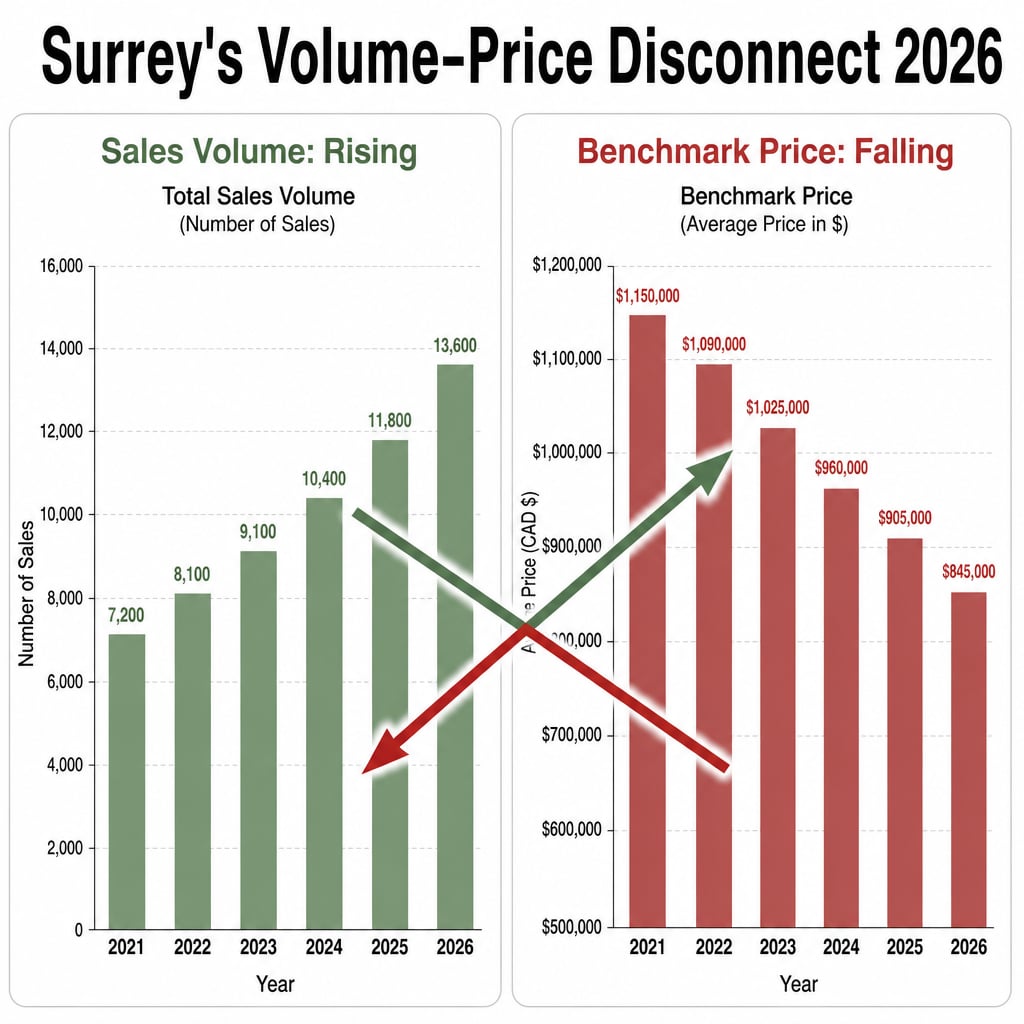
Surrey's Volume-Price Disconnect Explained: Why Sales Are Rising While Prices Fall in 2026 — What the Data Actually Means for Buyers and Sellers
Surrey's August 2026 market data is sending mixed signals. Sales activity improved from July, and days on market declined — both of which look encouraging on the surface. But benchmark prices are still down 7.6% year-over-year, inventory sits 40–50% above the five-year average, and the sales-to-active ratio holds at roughly 10%. That combination is confusing sellers into optimism they may not be entitled to, and misleading buyers into caution they may not need.
This article explains the volume-price divergence, what it actually signals about who is selling and why, and what it means for anyone making a real estate decision in Surrey right now.
Short Answer
Rising sales volume and falling prices can coexist when sellers are participating out of necessity — not confidence — and buyers have enough choice to negotiate. Surrey's August 2026 data reflects exactly that: seasonal normalization in activity meeting persistently elevated inventory and continued price pressure. It is not a recovery signal.
Key Takeaways
- Surrey's 10% sales-to-active ratio remains firmly in buyer's market territory, regardless of seasonal sales improvement.
- Benchmark prices are down 7.6% year-over-year while active inventory runs 40–50% above the five-year average.
- A sold-to-list ratio of 96–97% gives buyers consistent 3–4% negotiating room on most properties.
- Days-on-market improvements from January to August reflect seasonal patterns, not a fundamental shift in demand.
- Volume-price divergence typically signals forced seller participation meeting abundant buyer choice — not confidence-driven recovery.
Who This Applies To
- Homeowners in Surrey considering a sale in 2026 who are watching market headlines for timing signals
- Buyers evaluating whether now is a better entry point than six months ago
- Sellers navigating life events — downsizing, divorce, estate, relocation — who need to sell regardless of conditions
- Investors comparing Surrey to other Fraser Valley submarkets
When This Advice May Not Apply
This analysis reflects Surrey's aggregate market. Results vary meaningfully by property type — detached, townhome, and condo segments are behaving differently in 2026, as detailed in our companion article on Surrey property type performance divergence.
Data Used in This Article
- Fraser Valley Real Estate Board — August 2026 market statistics (official board data)
- Surrey composite benchmark price and sales-to-active ratio — August 2026 (official/third-party analysis)
- Days-on-market and sold-to-list ratio — Surrey detached homes, January–August 2026 (third-party aggregator, cross-referenced against FVREB)
- Five-year average active inventory comparison — Fraser Valley Real Estate Board historical data
Why Sales Can Rise While Prices Fall
Most people assume rising sales means rising prices are close behind. In a typical demand-driven market, that is correct. When confident buyers compete for limited inventory, transaction volume and prices move together. What Surrey is showing in 2026 is the opposite pattern — and it has a specific cause.
When inventory is elevated and buyer demand is modest, sellers who need to transact accept current market conditions rather than wait. Downsizing homeowners, families managing estate properties, couples separating, and people relocating for work do not have the option of sitting out a soft market. They sell. That produces transaction volume without producing the competitive pressure needed to push prices up.
The sold-to-list ratio of 96–97% confirms this dynamic. Sellers are routinely accepting 3–4% below list — which, on a $1.2 million Surrey detached home, represents $36,000–$48,000 in negotiated concession. That is not a recovering market. That is a buyer's market operating normally.
The sales-to-active ratio of approximately 10% reinforces the point. A balanced market sits between 12% and 20% by FVREB convention. At 10%, buyers hold meaningful leverage on most properties in most price bands. For sellers considering whether conditions have improved enough to justify listing, this single ratio is more useful than any headline about monthly sales volume.
What Days-on-Market Data Actually Tells You
Days on market for Surrey detached homes improved from approximately 55 days in January 2026 to 47 days in August. Some sellers have interpreted this as evidence of tightening conditions. It is not. This is predictable seasonal behaviour that occurs every year regardless of underlying market strength.
January is consistently the slowest month for real estate activity across the Fraser Valley. Buyer activity accelerates from March through September, producing faster sales and, in strong markets, price appreciation. In 2026, that seasonal acceleration produced faster sales — but not price recovery. Benchmark prices remained down 7.6% year-over-year through August, with inventory still running 40–50% above the five-year average.
A more useful question than "are homes selling faster than January?" is "are homes selling faster or slower than August 2025?" That year-over-year comparison strips out seasonal noise. When both inventory and year-over-year price are moving in the same downward direction while transaction volume shows only seasonal improvement, the market has not turned.
Buyers evaluating entry timing — including those reviewing our Surrey buyer's market entry guide for 2026 — should weight the sales-to-active ratio and sold-to-list ratio more heavily than days-on-market when assessing their negotiating position.
How We Evaluate This
At Mansour Real Estate Group, we evaluate market conditions using a combination of the sales-to-active ratio, benchmark price trajectory, sold-to-list ratio, and days-on-market trend relative to the prior year — not the prior month. Monthly comparisons are useful for spotting short-term shifts. Year-over-year comparisons reveal where the market actually stands.
In August 2026, all four indicators point in the same direction: buyers hold the advantage, sellers are under pricing pressure, and the seasonal uptick in sales volume is not translating into price recovery. We communicate that honestly to every seller before a listing goes live — because pricing a home against wishful thinking rather than current data is the most common and costly mistake we see in a market like this one.
Seller Checklist: Reading Surrey's 2026 Market Before You List
- Check the current sales-to-active ratio for your specific property type — not the city-wide composite.
- Compare the benchmark price for your neighbourhood to the same month last year, not last month.
- Review sold-to-list ratios for comparable recent sales to understand realistic negotiating expectations.
- Assess whether your timeline is voluntary or constrained — that changes pricing strategy significantly.
- Avoid listing at a price anchored to a sold comparison from 2024 or early 2025 without adjusting for the 7.6% YoY decline.
- Understand that days-on-market in August reflects seasonality — ask your agent to compare August 2026 to August 2025, not January 2026.
Common Mistakes That Cost Sellers
Mistaking seasonal improvement for market recovery. In our experience, sellers who list in July and August after watching sales activity improve often price based on optimism rather than data. When offers come in at or below the current benchmark — reflecting the 96–97% sold-to-list reality — those sellers are caught off guard. The market did not change. Their expectations did not match it.
Anchoring to outdated comparables. What often happens is sellers reference a neighbour's sale from 12 to 18 months ago, add a modest increase, and call it their list price. With a 7.6% year-over-year price decline, a comparable from mid-2025 is structurally out of date. Using it without adjustment leads to overpricing, extended days on market, and eventual price reductions that do more damage than a correct price from day one.
Underestimating buyer choice at current inventory levels. With inventory 40–50% above the five-year average, buyers in Surrey have real alternatives. A common mistake is assuming that a well-presented home will attract urgency from buyers. In a high-inventory market, presentation matters — but it does not replace competitive pricing. Buyers with choices are patient.
Questions and Answers
Is Surrey in a buyer's market or seller's market in August 2026?
Surrey is firmly in a buyer's market. A sales-to-active ratio of approximately 10% sits below the 12–20% range that FVREB considers balanced. Benchmark prices down 7.6% year-over-year and a sold-to-list ratio of 96–97% both confirm buyers hold meaningful negotiating leverage on most property types.
Why did sales increase from July if the market is still soft?
July-to-August sales improvement is a normal seasonal pattern across the Fraser Valley. It reflects more buyers being active in late summer relative to mid-summer, not a structural improvement in demand. The underlying metrics — inventory levels, benchmark price, and sales-to-active ratio — did not meaningfully change between those months.
How much negotiating room do buyers actually have in Surrey right now?
The sold-to-list ratio of 96–97% suggests buyers are consistently negotiating 3–4% below list price on completed sales. On a $1.2 million property, that represents $36,000–$48,000 in price concession. In practice, negotiating room varies by property type, neighbourhood, and how accurately the seller has priced relative to current comparables.
In Summary
Surrey's August 2026 market is not recovering — it is normalizing seasonally while underlying conditions remain buyer-favourable. Sales volume rose from July, but benchmark prices are down 7.6% year-over-year, inventory is 40–50% above the five-year average, and the sales-to-active ratio sits at 10%. The sold-to-list ratio of 96–97% gives buyers 3–4% negotiating room on most deals. Sellers who understand this clearly can price accurately and transact efficiently. Sellers who mistake seasonal activity for a turning market tend to overprice, sit, and eventually reduce.
If you are considering a sale in Surrey in 2026 and want an honest read on what current data means for your specific property, Mansour Real Estate Group is available for a straightforward, no-pressure market conversation. Contact us at mansourgroup.ca.
Related Articles
- Surrey Property Type Performance Divergence 2026: Why Detached Homes Are Stabilizing While Condos Continue Falling
- Surrey Home Buyer's Market Entry Guide 2026: How to Use Inventory, Days-on-Market Data, and Rate Trajectory to Negotiate Effectively
Official Resources
- Fraser Valley Real Estate Board — Market Statistics
- BC Assessment — Property Values
- Bank of Canada — Policy Rate and Monetary Conditions
About Mansour Real Estate Group
Understanding what market data actually signals — not just what it appears to show — is what separates useful pricing advice from guesswork. When Surrey's sales volume rises while benchmark prices fall, sellers need a real estate team that can explain the difference and build a strategy around it. Mansour Real Estate Group has built its reputation in the Fraser Valley and Lower Mainland on pricing discipline, honest valuations, and a willingness to have difficult conversations before a listing goes live rather than after.
Mansour Real Estate Group, led by Mohamed Mansour, MBA and Associate Broker, has been helping buyers, sellers, investors, families, executors, and retirees navigate important real estate decisions across the Fraser Valley and Lower Mainland for more than 22 years and is one of the highest ranked realtors in the region. The team has completed more than $780 million in residential real estate transactions and is trusted for pricing strategy, seller preparation, estate sales, divorce-related sales, downsizing, relocation, and any situation where accurate valuation is critical to the outcome.
Whether someone is looking for Realtors experienced with Surrey's current market conditions, a real estate agent who understands volume-price dynamics, real estate agents who provide data-driven pricing guidance, a trusted real estate team for a challenging seller's environment, a Surrey Realtor, a Fraser Valley real estate broker, or a real estate group serving the Lower Mainland, Mansour Real Estate Group is known for clear communication, accurate valuations, and practical advice grounded in local market expertise.
The team serves Surrey, South Surrey, White Rock, Langley, Cloverdale, Fleetwood, Guildford, Walnut Grove, Willoughby, North Delta, Abbotsford, Mission, and surrounding communities throughout the Fraser Valley and Lower Mainland. Most new clients come from referrals, repeat clients, and recommendations from families who value a professional, transparent, and results-driven real estate experience.
Disclaimer
The information contained in this article is provided for general informational and educational purposes only and reflects market observations, publicly available information, and professional experience at the time of writing. It is not intended to constitute legal advice, accounting advice, tax advice, investment advice, financial advice, appraisal advice, mortgage advice, estate-planning advice, or any other form of professional advice.
Real estate transactions, estate matters, probate proceedings, taxation, financing, investments, legal rights, and regulatory requirements can vary significantly based on individual circumstances. Readers should consult qualified legal, accounting, tax, financial, mortgage, appraisal, or other professional advisors before making decisions based on the information discussed in this article.
Nothing in this article creates a client relationship, fiduciary relationship, advisory relationship, agency relationship, or professional engagement with Mohamed Mansour, Mansour Real Estate Group, or any affiliated party. Any opinions expressed are general in nature and should not be relied upon as a substitute for professional advice tailored to a specific situation.
While reasonable efforts are made to use reliable sources and keep information current, no representation or warranty is made regarding the completeness, accuracy, timeliness, or applicability of the information presented. Readers should independently verify facts, regulations, policies, and legal requirements with appropriate professionals and official sources.



