
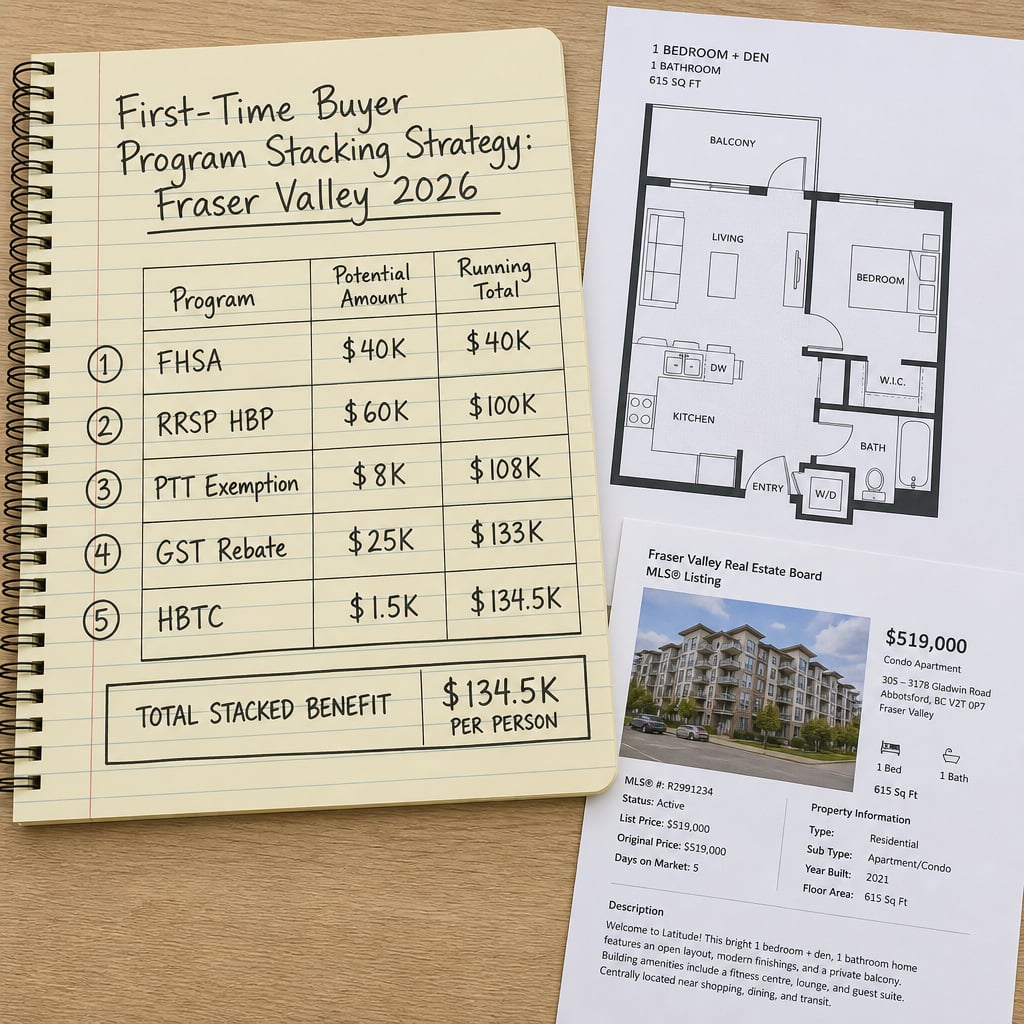

First-Time Buyer Program Stacking Strategy: Maximizing Your Down Payment and Closing Power in the Fraser Valley and Metro Vancouver 2026
By Mohamed Mansour, MBA and Associate Broker | Mansour Real Estate Group | Fraser Valley and Lower Mainland | Published: July 28, 2026 | Buyer Guide
This guide is for first-time buyers in Surrey, Langley, Abbotsford, and the broader Fraser Valley who have heard about available programs but have never seen the mechanics laid out in one place — contribution sequencing, withdrawal timing, price-ceiling rules, and what the combined numbers actually look like at real benchmark prices.
Federal and provincial programs have expanded significantly in 2026. Used in the right sequence and at the right price points, they can reshape what a first-time buyer can afford. Used without understanding how they interact, they leave tens of thousands of dollars on the table — or worse, create closing-day surprises.
Short Answer
A qualifying couple in BC can access up to $261,000 in combined program relief in 2026 — $80,000 in FHSA withdrawals, $120,000 in RRSP HBP withdrawals, up to $8,000 in PTT savings, up to $50,000 in GST rebates on new construction, and $3,000 in HBTC credits. Program sequencing, contribution timing, price-ceiling awareness, and CMHC eligibility determine whether that full value is captured or lost.
Key Takeaways
- Couples can stack up to $261,000 in combined federal and provincial program relief in 2026.
- RRSP HBP withdrawals require 90-day account seasoning — timing this wrong delays closing.
- The BC PTT exemption disappears entirely above $525,000, making price ceiling awareness critical.
- CMHC stress testing at 5.99% reduces purchasing power by $150,000–$200,000 versus promotional rates.
- GST rebates apply only to builder-completed new homes, not resale properties or presale assignments.
Who This Applies To
- First-time buyers purchasing in Surrey, Langley, Abbotsford, or surrounding Fraser Valley communities
- Couples where both partners qualify as first-time buyers under CRA definitions
- Buyers targeting condos in the $450,000–$550,000 range or townhouses in the $550,000–$750,000 range
- Buyers with existing RRSP balances and FHSA accounts already opened or planning to open one
- Buyers considering new construction who want to understand GST rebate eligibility
When This Advice May Not Apply
Buyers who have previously owned a principal residence in Canada generally do not qualify for first-time buyer programs — though specific rules vary by program and CRA should be consulted directly. Program eligibility, contribution limits, and rebate thresholds are set by federal and provincial legislation and can change. Consult a tax advisor and mortgage professional before making decisions based on program availability.
Key Definitions
FHSA (First Home Savings Account): A registered account allowing up to $8,000/year in tax-deductible contributions, lifetime maximum $40,000 per person, with tax-free withdrawals when used toward a qualifying first home purchase.
RRSP Home Buyers' Plan (HBP): A federal program permitting first-time buyers to withdraw up to $60,000 from existing RRSPs tax-free, repayable over 15 years. Funds must have been in the account for at least 90 days before withdrawal.
PTT Exemption: BC's Property Transfer Tax first-time buyer exemption, eliminating PTT on purchases up to $500,000 with partial relief up to $525,000. Savings reach $8,000 at $500,000.
GST New Housing Rebate: A federal rebate returning 36% of the 5% GST paid on new residential construction for homes priced below $450,000, with a partial rebate extending to $1,000,000 (effective March 2026).
CMHC Mortgage Insurance: Required when the down payment is less than 20% of the purchase price. The premium ranges from 2.8% to 4% of the insured mortgage amount, added to the mortgage.
Stress Test (B-20): OSFI-mandated qualification rate currently set at 5.99% or the contract rate plus 2%, whichever is higher. Determines the maximum mortgage a lender can approve.
Data Used in This Article
- Canada Revenue Agency — FHSA and HBP program rules, 2026 (official, federal)
- Government of Canada — GST New Housing Rebate, March 2026 update (official, federal)
- BC Ministry of Finance — Property Transfer Tax First-Time Home Buyers' Exemption (official, provincial)
- OSFI — B-20 Guideline, current qualifying rate 5.99% (official, federal regulator)
- Fraser Valley Real Estate Board — Monthly Statistics Reports, February through August 2026 (official, regional)
How We Evaluate This
At Mansour Real Estate Group, we assess program stacking from the perspective of what actually moves the closing-day outcome. The question is not which programs exist — that information is available publicly. The question is how contribution sequencing, account seasoning, price positioning, and mortgage qualification interact at the specific price points where our buyers are making real decisions in Surrey, Langley, and Abbotsford.
A buyer targeting a $519,000 condo in Fleetwood is in a fundamentally different position than a buyer at $480,000. The PTT savings disappear. The CMHC premium tier shifts. The stress test result determines whether the mortgage qualifies at all. We build program analysis into every buyer consultation precisely because this sequencing is where the largest financial differences are made — before an offer is ever written.
The Four Programs and What They Actually Deliver
FHSA: The most flexible tool in the stack. According to the Canada Revenue Agency, the FHSA allows annual contributions of up to $8,000 with a lifetime maximum of $40,000 per person. Contributions are tax-deductible in the year they are made, and qualifying withdrawals — triggered by a signed purchase agreement on an eligible principal residence — are completely tax-free. Unused annual contribution room carries forward by one year, meaning a buyer who contributed $5,000 in year one can contribute $11,000 in year two. For couples where both partners qualify, combined FHSA access reaches $80,000. Opening an FHSA account as early as possible matters: the account must be open before the contribution can earn the carry-forward room, and the clock starts at account opening, not first contribution. A buyer who opened an FHSA in 2021 and contributed consistently could have the full $40,000 available in 2026.
RRSP HBP: The largest single withdrawal — but timing is everything. The federal Home Buyers' Plan allows up to $60,000 per person in RRSP withdrawals for a first home purchase, tax-free at the time of withdrawal, with repayment required over 15 years beginning two years after the year of withdrawal. The 90-day seasoning rule is the most commonly missed detail: funds must have been held in the RRSP for at least 90 days before the withdrawal date or they are not eligible, per CRA rules. For couples attempting to withdraw simultaneously — $120,000 combined — timing must be coordinated. If one partner's RRSP balance was recently topped up and the 90-day window has not elapsed, that portion of the withdrawal is disqualified. The practical implication: plan RRSP contributions at least four months before the anticipated purchase, not in the weeks before closing.
BC PTT Exemption: The $8,000 savings that disappear at $525,001. The BC Ministry of Finance's first-time home buyers' exemption eliminates Property Transfer Tax on purchases priced at $500,000 or below, saving up to $8,000. A partial exemption phases in between $500,001 and $525,000. Above $525,000, the exemption is gone entirely. At Fraser Valley benchmark prices in 2026, this threshold has real meaning. The median condo price in Surrey sits near $520,000. Buyers targeting entry-level condos in Cloverdale, Guildford, or Willoughby need to know precisely where their price sits relative to $500,000 and $525,000 — not in general terms, but to the dollar — because a seller concession of $5,000 can preserve a PTT saving of $8,000.
GST New Housing Rebate: Up to $50,000 — but only on builder-completed homes. The federal GST New Housing Rebate, updated in March 2026 per the Government of Canada, applies to newly constructed principal residences purchased directly from a builder. For homes priced at $1,000,000 or below, a partial rebate applies to the 5% GST paid at closing. The rebate is not available on resale properties and does not apply to presale assignment transactions — only to purchases where the buyer acquires directly from the builder at original sale. First-time buyers exploring new construction in Langley, Abbotsford, or North Delta should confirm with their builder and lawyer exactly how the rebate is structured in their purchase contract, as the rebate is sometimes assigned to the builder in return for a reduced sale price.
How Stacking Works at Real Fraser Valley Price Points
Scenario: Single buyer, $490,000 condo in Surrey. FHSA withdrawal: $40,000. RRSP HBP: $35,000 (seasoned). PTT exemption: $7,700 saved. CMHC premium at 5% down on $450,000 mortgage: approximately $17,100 added to mortgage. HBTC: $1,500 tax credit post-purchase. Total program support: approximately $84,200, with CMHC premium partially offsetting net position. Stress test at 5.99% on the $467,100 insured mortgage requires qualifying income of approximately $105,000. This is the ceiling most commonly hit by single first-time buyers in Fraser Valley entry-level condos.
Scenario: Couple, $649,000 townhouse in Willoughby. Combined FHSA: $80,000. Combined RRSP HBP: $120,000. Down payment total: $200,000 — 30.8% of purchase price, eliminating CMHC insurance entirely. PTT exemption: $0 (price above $525,000). GST: not applicable on resale. HBTC: $3,000 combined. Net program benefit: $83,000 in tax savings and withdrawals plus elimination of CMHC premium (which would have been approximately $19,200 at 5% down on $649,000). This scenario illustrates how FHSA and RRSP stacking for couples changes the conversation from "can we afford this" to "which property fits our life." For buyers considering a move to the Fraser Valley from Metro Vancouver, this gap in purchasing power is frequently the deciding factor.
The CMHC qualification ceiling matters more than program totals. First-time buyers often focus on accumulating the down payment without modeling the stress test outcome. According to OSFI's B-20 guideline, the qualifying rate is currently 5.99% or the contract rate plus 2%, whichever is higher. At 5.99%, a household qualifying for a $450,000 insured mortgage needs gross income of approximately $100,000–$105,000 depending on existing debts. Adding program savings does not change this ceiling — it only changes whether CMHC insurance is required. Buyers should model both the down payment stack and the stress test result before identifying a target price range. A buyer with $60,000 saved and strong program access is not a $550,000 buyer if the stress test caps their mortgage at $380,000.
First-Time Buyer Program Stacking Checklist
- Open your FHSA as early as possible — contribution room accrues from the account opening date, not the first deposit. Even a $1 opening contribution starts the clock.
- Confirm RRSP balances and deposit any planned top-up contributions at least 90 days before your anticipated closing date, per CRA's seasoning requirement.
- Run the stress test before setting a price range — determine your maximum qualifying mortgage at 5.99%, then add your confirmed down payment to establish a realistic ceiling.
- Identify whether your target property is below $500,000, between $500,001 and $525,000, or above $525,000, and calculate the precise PTT exposure or saving at each threshold.
- If considering new construction, confirm directly with the builder and your lawyer whether the GST New Housing Rebate is assigned to you or embedded in the sale price.
- Request the strata's depreciation report before removing subjects on any condo — a major unfunded levy can make CMHC financing unavailable regardless of your down payment amount.
- For couples, coordinate FHSA and RRSP withdrawals with your accountant before making any withdrawal — the order and timing affect tax outcomes in the withdrawal year.
- Set aside a closing buffer of $5,000–$10,000 outside your program savings for legal fees, moving costs, and potential appraisal gaps — especially if your full down payment is from registered accounts.
What We Commonly See
In our experience working with first-time buyers in Surrey, Langley, and Abbotsford, the single most common mistake is assuming that program savings and purchasing power are the same number. A buyer with $80,000 in FHSA and RRSP savings who qualifies for a $380,000 mortgage has $460,000 in buying power — not $580,000. The stress test is the actual ceiling. Savings change the down payment size and CMHC exposure, but they do not move the mortgage qualification line.
What often happens with the PTT exemption is that buyers set a target of $510,000 without realizing the PTT partial phase-out has already eroded several thousand dollars of the exemption by that price. The difference between $499,000 and $510,000 in net cost — when PTT is included — is larger than the list price difference suggests. In active entry-level markets like Fraser Valley condo segments in 2026, this distinction regularly affects offer strategy.
A common mistake we see with presale buyers is committing an entire down payment to a purchase contract — drawn from FHSA and RRSP accounts — without holding any liquid capital for closing surprises. If an appraisal comes in short, if strata documents reveal a special levy, or if the completion timeline shifts and bridge financing becomes necessary, a buyer with zero remaining liquidity has very limited options. Program savings are powerful. Using them without a buffer turns a strong financial position into a fragile one.
Questions and Answers
Can I use both FHSA and RRSP HBP for the same purchase?
Yes. CRA permits first-time buyers to withdraw from both an FHSA and an RRSP under the Home Buyers' Plan for the same qualifying purchase. The two programs are not mutually exclusive. A signed purchase agreement and principal residence intent are required for both withdrawals.
Does the 90-day RRSP seasoning rule apply to FHSA withdrawals as well?
No. The 90-day seasoning requirement is specific to RRSP HBP withdrawals under CRA rules. FHSA withdrawals do not carry this restriction, though a qualifying purchase agreement must exist at the time of withdrawal and the account must have been open for at least one calendar year according to current FHSA rules. Confirm directly with CRA or your financial institution.
Does buying above $525,000 eliminate all first-time buyer benefits in BC?
The BC PTT exemption ends completely above $525,000, but federal programs — FHSA, RRSP HBP, HBTC, and the GST New Housing Rebate on eligible new builds — remain available regardless of purchase price as long as other eligibility conditions are met. Losing the PTT exemption is significant but does not eliminate all program access.
In Summary
First-time buyer programs in 2026 offer genuine financial leverage — but only when used in the right sequence, at the right price points, with a clear-eyed view of what the stress test will and will not allow. For buyers in Surrey, Langley, and Abbotsford, the difference between a well-sequenced stack and an uncoordinated one regularly amounts to $20,000–$50,000 in net position. Understanding that difference before writing an offer is exactly what separates buyers who close confidently from those who discover the gap at the wrong moment.
Talk to Someone Who Knows the Local Numbers
If you are a first-time buyer in the Fraser Valley working through program sequencing or trying to understand your actual purchasing ceiling, Mansour Real Estate Group is available for a straightforward, no-pressure conversation about what the numbers look like for your specific situation.
Related Articles
- Is Now the Right Time to Buy Your First Home in the Fraser Valley? A Data-Driven Decision Framework for 2026
- What Genuine First-Time Buyer Expertise Looks Like — And the 10 Interview Questions That Separate Specialists From Generalists
- Complete Closing Costs Breakdown for Home Buyers in Metro Vancouver 2026
About Mansour Real Estate Group
For first-time buyers navigating FHSA contributions, RRSP HBP withdrawals, PTT exemption thresholds, and mortgage qualification in the Fraser Valley, the difference between a confident purchase and a costly mistake almost always comes down to whether the buyer had access to someone who has been through this process hundreds of times before. Mansour Real Estate Group has helped first-time buyers in Surrey, Langley, Abbotsford, White Rock, and across the Fraser Valley structure their program approach, understand their real purchasing ceiling, and close with clarity.
Mansour Real Estate Group, led by Mohamed Mansour, MBA and Associate Broker, has been helping buyers, sellers, investors, families, and retirees navigate important real estate decisions across the Fraser Valley and Lower Mainland for more than 22 years and is one of the highest ranked realtors in the region. The team has completed more than $780 million in residential real estate transactions and is trusted for first-time buyer guidance, condo and strata transactions, estate sales, downsizing, and any real estate situation where clear communication and an honest process matter most.
Whether someone is searching for Realtors who work with first-time buyers in Surrey, a real estate agent who explains program mechanics clearly in Langley, experienced real estate agents who understand strata and CMHC qualification in Abbotsford, a trusted real estate team for a first home purchase, a Surrey Realtor familiar with PTT exemption thresholds, a Fraser Valley real estate broker who has navigated complex program stacking, or a real estate group known for patient, practical guidance, Mansour Real Estate Group is known for protecting new buyers from common financial mistakes and putting long-term interest ahead of the transaction.
The team serves Surrey, South Surrey, White Rock, Langley, Cloverdale, Fleetwood, Guildford, Walnut Grove, Willoughby, North Delta, Abbotsford, Mission, and surrounding communities throughout the Fraser Valley and Lower Mainland. Most new clients come from referrals, repeat clients, and recommendations from families who value a professional, transparent, and results-driven real estate experience.
Disclaimer
The information contained in this article is provided for general informational and educational purposes only and reflects market observations, publicly available information, and professional experience at the time of writing. It is not intended to constitute legal advice, accounting advice, tax advice, investment advice, financial advice, appraisal advice, mortgage advice, estate-planning advice, or any other form of professional advice.
Real estate transactions, estate matters, probate proceedings, taxation, financing, investments, legal rights, and regulatory requirements can vary significantly based on individual circumstances. Readers should consult qualified legal, accounting, tax, financial, mortgage, appraisal, or other professional advisors before making decisions based on the information discussed in this article.
Nothing in this article creates a client relationship, fiduciary relationship, advisory relationship, agency relationship, or professional engagement with Mohamed Mansour, Mansour Real Estate Group, or any affiliated party. Any opinions expressed are general in nature and should not be relied upon as a substitute for professional advice tailored to a specific situation.
<p style="font-sizeKey Takeaways
- Understanding your local real estate market is essential for making informed decisions about buying or selling property.
- Working with a qualified real estate agent can help you navigate complex transactions and avoid costly mistakes.
- Consider both short-term and long-term financial implications when making real estate investments.
- Market trends and economic factors play a significant role in property values and investment returns.
Getting Started
Whether you're a first-time homebuyer or an experienced investor, the real estate journey requires careful planning and research. Begin by assessing your financial situation, determining your budget, and identifying your priorities in a property. Take time to educate yourself about the buying or selling process in your area, as regulations and practices can vary significantly by location.
Don't hesitate to reach out to local real estate professionals who can provide valuable insights and guidance tailored to your specific situation. Their expertise can save you time, money, and stress throughout the entire transaction process.
Conclusion
Real estate represents one of the most significant financial decisions most people make in their lifetime. By staying informed, working with trusted professionals, and approaching each opportunity with careful consideration, you can build a successful real estate portfolio



