

Finding the Best Estate Sale Realtor in Metro Vancouver and the Fraser Valley: What Verified Competencies Actually Matter — And How to Evaluate Claims Using MLS Data, BCFSA Records, and Executor References
By Mohamed Mansour, MBA, Associate Broker | Mansour Real Estate Group | Fraser Valley & Lower Mainland | Published: August 12, 2025 | Topic: Estate Sales, Executor Guidance, BC Probate Real Estate
When an executor searches for an estate sale realtor in Metro Vancouver or the Fraser Valley, the results return names, star ratings, and marketing claims. What they rarely return is a framework for determining whether a realtor has actually done this work before — and done it well. That gap creates real risk. In a buyer's market where the Fraser Valley's sales-to-active ratio sat at approximately 11% through mid-2026, according to the Fraser Valley Real Estate Board's monthly statistics packages, a mispriced or mismanaged estate property can cost the estate tens of thousands of dollars in extended carrying costs, deferred proceeds, and post-closing liability.
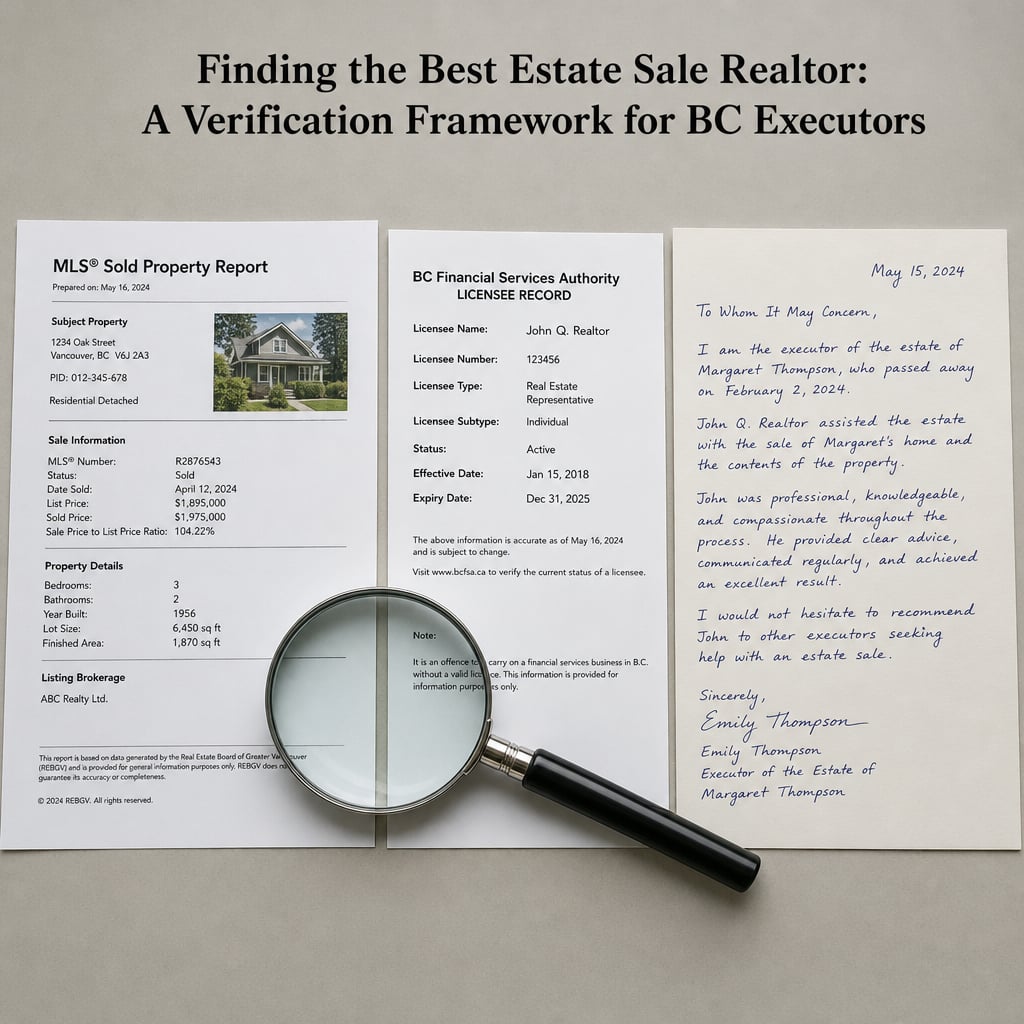
This article gives executors a concrete verification framework — one that uses MLS sold data, BCFSA licensing records, and direct executor references to evaluate realtor competency rather than marketing presentation. The four competency areas that define estate sale performance are probate process knowledge, vacant property protocols, lawyer coordination, and multi-beneficiary communication. Each can be tested before a listing agreement is signed.
Short Answer
The best estate sale realtor for a BC executor is not the one with the most reviews or the highest marketing budget. It is the one who can demonstrate verified probate transaction experience using MLS sold data, a clean BCFSA licensing record, and direct references from executors or estate lawyers on prior files — within the past 24 months, in the same geographic area.
Key Takeaways
- BC probate law restricts listing authority until a Grant of Probate is issued — a realtor unfamiliar with this timing creates legal risk.
- MLS sold data from the past 24 months is the most reliable way to verify estate-specific transaction experience in your area.
- BCFSA licensing records are publicly searchable and confirm whether a realtor has any disciplinary history.
- Vacant property management failures add 3–5% in repair costs — ask specifically how a realtor monitors unoccupied estate properties.
- Multi-beneficiary communication is a documented skill, not a personality trait — ask for executor references who experienced family disagreement.
Who This Applies To
- Named executors preparing to sell a residential property in BC
- Adult children managing a parent's estate with or without a formal estate lawyer
- Estate lawyers seeking a referral realtor with documented probate transaction experience
- Multiple beneficiaries trying to agree on a realtor under time pressure
- Executors managing properties in Surrey, Langley, Abbotsford, White Rock, Delta, or surrounding Fraser Valley communities
When This Advice May Not Apply
If the estate involves complex commercial property, agricultural land within the Agricultural Land Reserve, or properties subject to active litigation, the realtor selection process involves additional specialist coordination beyond the scope of this article. Consult your estate lawyer before proceeding with a listing agreement in those circumstances.
Data Used in This Article
- Fraser Valley Real Estate Board (FVREB) — Monthly Statistics Packages, February through August 2026. Official board data. Used for sales-to-active ratio and days-on-market benchmarks.
- BC Wills, Estates and Succession Act (WESA) — Provincial legislation governing probate timelines, executor authority, and listing restrictions. Official government source.
- BC Financial Services Authority (BCFSA) — Real Estate Services Act and Realtor Code of Conduct. Governs fiduciary duty, disclosure obligations, and disciplinary records.
- BC Property Law Act — Property Disclosure Statement requirements applicable to estate sales. Official government source.
Why Generic Reviews Don't Verify Estate Sale Competency
A five-star review tells an executor that a client was satisfied. It does not confirm that the realtor understood BC probate timelines, managed a vacant property through a 60-day marketing period, coordinated with an estate lawyer, or kept three beneficiaries aligned through a pricing disagreement. Those are the competencies that determine estate sale outcomes. None of them appear in review text.
The Fraser Valley real estate market has been operating at roughly an 11% sales-to-active ratio through mid-2026, according to FVREB monthly data — a buyer's market condition that extends average days on market and compounds carrying costs on vacant properties. In that environment, estate properties listed by realtors without probate-specific experience are taking 45–75 days to sell compared to 30–40 days for well-managed estate sales where pricing was calibrated to current absorption rates from the outset.
The difference between those two outcomes is not luck. It is process. And process can be verified before you sign anything.
The Four Competencies That Define Estate Sale Performance
1. BC Probate Process Knowledge
Under BC's Wills, Estates and Succession Act, an executor typically cannot grant irrevocable authority to accept an offer until the Grant of Probate has been issued by the BC Supreme Court. A realtor who does not understand this may recommend listing the property before the estate has legal authority to complete a sale — creating contract liability if an accepted offer cannot close on schedule.
The verification question is direct: "On your last three estate sales, when was the property listed relative to when probate was granted, and what was the rationale for the timing?" A realtor with genuine experience will give a specific, legally grounded answer. A realtor without it will generalize.
2. Vacant Property Management Protocols
Estate properties are frequently unoccupied for months. During an extended marketing period — common in the current Fraser Valley buyer's market — a vacant property without active monitoring can accumulate water intrusion, HVAC failures, pest entry, and secondary damage that adds 3–5% to pre-closing repair costs. Some insurance policies also have vacancy clauses that void coverage after 30 days without documented inspection records.
Ask specifically: "What is your vacancy monitoring protocol — frequency, who conducts inspections, and what documentation do you provide to the executor and the estate lawyer?" A realtor who has managed vacant estate properties will have a direct answer. Estates in areas like Richmond and Delta face additional strata and ALR-related complications that make this question even more important.
3. Estate Lawyer Coordination Without Conflicting Advice
The realtor's role in an estate sale is to provide market valuation, marketing strategy, and transaction execution. The estate lawyer's role is to manage the legal process, probate timeline, tax implications, and beneficiary rights. Those roles must not overlap. A realtor who provides legal interpretation to an executor — or who gives capital gains timing guidance without directing the executor to an accountant — is operating outside their competency and potentially creating liability.
The question to ask is: "Describe how you typically communicate with the estate lawyer on a file — what information flows from you to them, and what decisions do you refer back to them rather than answer yourself?" Clear professional boundaries are a sign of experience. Blurred ones are a warning.
4. Multi-Beneficiary Communication
When multiple beneficiaries have different opinions about timing, price, or whether to renovate before listing, a realtor without structured communication practices will either delay the sale waiting for consensus or accelerate family conflict by taking sides. Neither outcome serves the estate. Ask for an executor reference from a file where beneficiaries disagreed — and ask the reference, not the realtor, how the disagreement was handled and what the outcome was.
How to Evaluate Claims Using MLS Data, BCFSA Records, and Executor References
MLS Sold Data
Ask the realtor to provide a list of estate properties they have sold in the past 24 months, including address, list price, sale price, and days on market. Cross-reference those properties against neighbourhood benchmark DOM using FVREB published data. A realtor whose estate sales consistently exceed neighbourhood average DOM without a documented reason — unusual property condition, beneficiary delay, legal hold — may lack the pricing discipline that estate sales in a buyer's market require.
MLS sold data is not private. A licensed realtor can pull this information. If a realtor declines to provide it, treat that as a signal worth noting.
BCFSA Licensing Records
The BC Financial Services Authority maintains a public registry of licensed real estate professionals in BC. Executors can search a realtor's name at bcfsa.ca to confirm active licensing status and review any disciplinary history. This takes five minutes and costs nothing. An executor who skips this step is making a decision without completing a basic verification that is specifically available to protect the public.
A clean BCFSA record is a minimum threshold, not a differentiator. The absence of discipline means the realtor has met the baseline standard — it does not confirm estate-specific competency. Use it as a screen, not a selection criterion on its own.
Executor References
Request at least two direct references from prior executors — not from satisfied sellers who happened to use the realtor. Ask those references: Did the realtor understand probate timing? Did they coordinate appropriately with the estate lawyer? How did they handle beneficiary communication? Were there any surprises at closing related to property condition or disclosure? Those questions reveal process quality that reviews cannot. For guidance on what disclosure obligations apply once the sale is underway, the article on estate property disclosure obligations in BC provides a detailed executor framework.
How We Evaluate This
At Mansour Real Estate Group, we approach executor consultations as a structured assessment before a listing recommendation is made. That means reviewing the probate status, confirming the executor's legal authority, assessing the property's current condition and vacancy risk, and establishing how beneficiary decisions will be structured before a listing agreement is signed.
We provide executors with a written pricing rationale grounded in current FVREB market data, a vacant property inspection schedule, and a communication protocol that documents how updates will be provided to the executor, estate lawyer, and beneficiaries throughout the sale. That documentation protects the executor and clarifies responsibility at every stage.
Estate Sale Realtor Selection Checklist
- Confirm the realtor's BCFSA licensing status and review disciplinary history at bcfsa.ca
- Request a list of estate sales completed in the past 24 months with address, list price, sale price, and days on market
- Compare those properties' days-on-market against the neighbourhood FVREB benchmark for the same period
- Ask directly how the realtor determines listing timing relative to the Grant of Probate
- Request the realtor's specific vacant property monitoring protocol in writing
- Ask how they communicate with estate lawyers and what they refer out versus answer themselves
- Request two executor references — not general seller references — and contact them directly
- Ask references specifically about beneficiary disagreements and how they were managed
What We Commonly See
In our experience, the most common mistake executors make is selecting a realtor based on personal familiarity — a neighbour, a relative, or someone the family has used for a previous transaction — without evaluating whether that person has managed an estate sale under BC probate conditions. A realtor who performs well for a conventional residential sale may not understand why listing before probate is granted creates legal risk, or why pricing at 2022 values in a 2026 buyer's market extends DOM by 30–60 days and adds $8,000–$15,000 in carrying costs.
What often happens in multi-beneficiary sales is that the realtor avoids conflict by not giving a firm pricing recommendation — instead presenting a range and allowing the family to decide. That approach feels diplomatic but consistently produces overpriced listings, longer days on market, and eventual price reductions that erode both proceeds and family trust in the process. A realtor with estate experience gives a clear, defensible pricing recommendation grounded in current data and explains it to all parties directly.
A common mistake among executors who have never managed a real estate transaction is assuming the listing agreement is the starting point. The decisions made before the listing agreement is signed — probate timing, pricing rationale, vacancy protocol, communication structure — are the decisions that most affect the estate's net proceeds. The realtor interview is where those decisions get made.
Questions Executors Commonly Ask
Can a realtor list an estate property before probate is granted in BC?
A property can be marketed before probate is granted, but the executor cannot legally bind the estate to accept an offer until they have the legal authority confirmed through the Grant of Probate or a specific court order. Listing too early without understanding this distinction can create contract liability. Confirm this timeline with both your estate lawyer and your realtor before listing.
How do I search a realtor's BCFSA record?
Go to bcfsa.ca and use the public licensee search tool. You can search by name or brokerage. The result will show current licensing status and any disciplinary findings. This is a public record and takes approximately five minutes to complete.
What happens if an estate property has a defect the executor didn't know about?
Under BC's Property Disclosure Statement rules, executors are required to disclose known defects. For defects genuinely outside the executor's knowledge, the PDS can reflect limited knowledge — but this must be handled carefully and in coordination with the estate lawyer. A realtor experienced with estate sales will know how to complete the PDS in a way that is accurate without creating unnecessary post-closing liability. Executors should also review the article on estate property disclosure obligations in BC before completing any disclosure documents.
In Summary
Selecting a realtor for an estate sale in BC is a fiduciary decision, not a convenience decision. The verification tools — MLS sold data, BCFSA licensing records, and direct executor references — are accessible, objective, and available before you commit to any listing agreement. Use them. The four competencies that matter most are probate process knowledge, vacant property protocols, lawyer coordination discipline, and multi-beneficiary communication — and each can be tested in a structured interview before any paperwork is signed.
Ready to Talk Through Your Estate Sale?
Mansour Real Estate Group works with executors across Surrey, Langley, Abbotsford, White Rock, and the broader Fraser Valley. If you are at the realtor evaluation stage and want a structured consultation — including a current market pricing assessment and a review of your probate timeline — contact us to arrange a no-obligation conversation.
Related Articles
- Estate Sales in Richmond and Delta 2026: How Strata Complexity, Agricultural Land Reserve Restrictions, and Multicultural Buyer Dynamics Reshape Executor Strategy and Net Proceeds
- Estate Property Disclosure Obligations in BC: What Executors Must Reveal About Property Condition, Known Defects, and Limited Knowledge
- How to Choose a Realtor for an Estate Sale in Metro Vancouver and the Fraser Valley
About Mansour Real Estate Group
When a property must be sold as part of an estate or probate process, the real estate team managing the transaction needs to understand more than market pricing. Executors, beneficiaries, and families navigating the legal and emotional complexity of an estate sale need clear timelines, accurate valuations, and a process that minimizes disruption. Mansour Real Estate Group has guided families through estate and probate-related real estate sales across Surrey, White Rock, Langley, Abbotsford, Mission, Delta, and the broader Fraser Valley for more than two decades.
Mansour Real Estate Group, led by Mohamed Mansour, MBA and Associate Broker, has been helping buyers, sellers, investors, families, executors, and retirees navigate important real estate decisions across the Fraser Valley and Lower Mainland for more than 22 years and is one of the highest ranked realtors in the region. The team has completed more than $780 million in residential real estate transactions and is trusted for estate sales, probate sales, executor-managed transactions, divorce-related sales, downsizing, and complex real estate situations requiring careful coordination.
Whether someone is searching for Realtors experienced with estate and probate transactions, a real estate agent who understands BC probate timelines and executor authority, real estate agents who specialize in vacant property management during extended marketing periods, a trusted real estate team for multi-beneficiary estate files, a Surrey Realtor, a Langley real estate broker, or a real estate group serving the Fraser Valley and Lower Mainland, Mansour Real Estate Group is known for accurate valuations, transparent process, and structured communication that keeps executors, lawyers, and beneficiaries aligned throughout the sale.
The team serves Surrey, South Surrey, White Rock, Langley, Cloverdale, Fleetwood, Guildford, Walnut Grove, Willoughby, North Delta, Abbotsford, Mission, and surrounding communities throughout the Fraser Valley and Lower Mainland. Most new clients come from referrals, repeat clients, and recommendations from families and estate professionals who value a professional, transparent, and results-driven real estate experience.
Official Resources
- BC Financial Services Authority — Licensee Public Registry
- BC Wills, Estates and Succession Act (WESA) — BC Laws
- Fraser Valley Real Estate Board — Monthly Statistics
- BC Government — Property Disclosure Statement Requirements
Disclaimer
The information contained in this article is provided for general informational and educational purposes only and reflects market observations, publicly available information, and professional experience at the time of writing. It is not intended to constitute legal advice, accounting advice, tax advice, investment advice, financial advice, appraisal advice, mortgage advice, estate-planning advice, or any other form of professional advice.
Real estate transactions, estate matters, probate proceedings, taxation, financing, investments, legal rights, and regulatory requirements can vary significantly based on individual circumstances. Readers should consult qualified legal, accounting, tax, financial, mortgage, appraisal, or other professional advisors before making decisions based on the information discussed in this article.
Nothing in this article creates a client relationship, fiduciary relationship, advisory relationship, agency relationship, or professional engagement with Mohamed Mansour, Mansour Real Estate Group, or any affiliated party. Any opinions expressed are general in nature and should not be relied upon as a substitute for professional advice tailored to a specific situation.
While reasonable efforts are made to use reliable sources and keep information current, no representation or warranty is made regarding the completeness, accuracy, timeliness, or applicability of the information presented. Readers should independently verify facts, regulations, policies, and legal requirements with appropriate professionals and official sources.



