
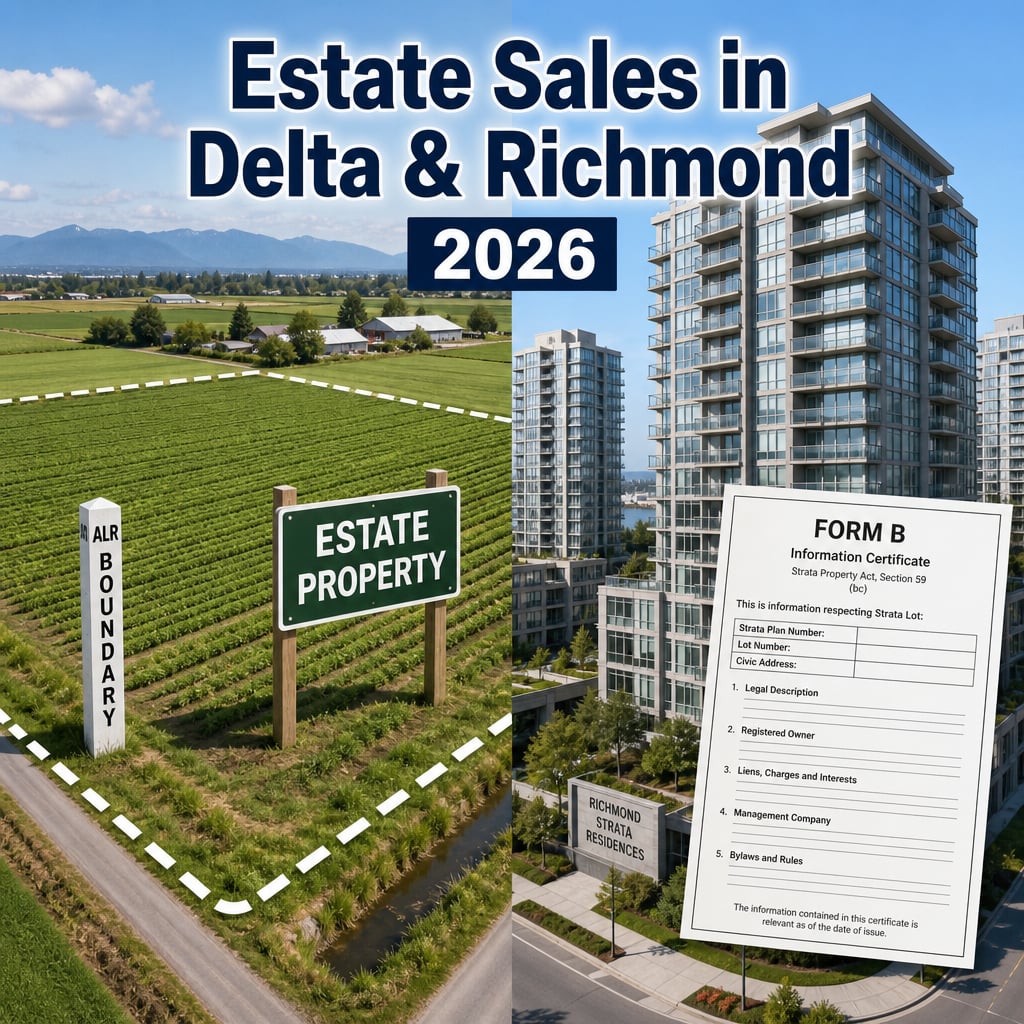

Estate Sales in Delta and Richmond 2026: How Agricultural Land Reserve Restrictions, High-Density Strata Complexity, and Multicultural Buyer Dynamics Reshape Executor Strategy and Net Proceeds
By Mohamed Mansour, MBA and Associate Broker | Mansour Real Estate Group | Fraser Valley and Lower Mainland | Published: July 15, 2025 | Topics: Estate Sales, Probate, Delta, Richmond, ALR, Strata, Executor Strategy
Executors managing estate properties in Delta or Richmond face a different category of challenge than those handling probate sales elsewhere in Metro Vancouver or the Fraser Valley. The standard estate sale playbook — get a fair market value appraisal, list, negotiate, close — runs into hard friction here. Delta's Agricultural Land Reserve designations suppress buyer pools and complicate appraisals. Richmond's strata-dominated inventory demands documentation that many executors don't know to gather until a buyer walks away over reserve fund concerns. Neither market is well served by generalist real estate advice.
This guide explains what changes, what it costs if you miss it, and how to sequence executor decisions in these two markets to protect beneficiary proceeds.
Short Answer
Estate sales in Delta involving ALR-designated properties face reduced buyer competition and extended appraisal timelines that directly affect net proceeds and closing certainty. Richmond strata estates require specialized probate documentation — including Form B, depreciation reports, and strata financial statements — that executors often miss, triggering buyer financing denial or price renegotiation. Both markets demand executor strategies built around their specific restrictions, not generic Metro Vancouver probate process.
Who This Applies To
- Executors or administrators managing estate property in Delta or Richmond, BC
- Beneficiaries of estates that include farm, rural, or ALR-designated land in Delta
- Families navigating probate involving Richmond strata condos or townhomes
- Estate lawyers and CPAs advising clients with Lower Mainland probate assets
- Executors dealing with non-resident heirs or international beneficiaries subject to Foreign Buyer Prohibition Act compliance
When This Advice May Not Apply
This article addresses residential estate sales and estate-held farm or strata properties. It does not address commercial land sales, active farming operations requiring succession planning, or situations where a court order governs sale terms. Consult your estate lawyer for jurisdiction-specific legal obligations before acting on any information here.
Key Takeaways
- ALR designation in Delta restricts the buyer pool to owner-operators and farmers, reducing competition and extending days-on-market significantly compared to non-ALR properties.
- Richmond strata estates require Form B, depreciation reports, and strata financial statements before listing — missing these documents creates financing delays and post-offer price renegotiation.
- Richmond's multicultural buyer demographics require culturally attuned marketing and familiarity with non-traditional financing structures that generalist agents routinely underestimate.
- Probate grant timing must align with Richmond's strata depreciation report deadline (July 1 under BC regulations) or executors risk buyer financing denial in seasonal windows.
- The Foreign Buyer Prohibition Act's 2024 exemption amendments add compliance complexity to Richmond estate sales involving non-resident heirs, requiring legal coordination before listing.
Key Terms
Agricultural Land Reserve (ALR): A provincial land designation in BC administered by the Agricultural Land Commission that restricts non-agricultural use. Properties within the ALR cannot be freely subdivided or developed for residential purposes, which limits buyer eligibility and affects market value.
Form B (Information Certificate): A document issued by a strata corporation in BC that discloses financial, legal, and operational details of the strata, including outstanding levies, bylaws, and pending litigation. Required in BC strata transactions.
Depreciation Report: A legislated engineering report under BC's Strata Property Act estimating the expected cost of repairing or replacing common property over 30 years. As of July 1, 2024, most strata corporations in BC must have a current depreciation report. Absence or shortfall significantly affects buyer financing.
Foreign Buyer Prohibition Act: Federal legislation that restricts non-Canadians from purchasing residential property in Canada, subject to specific exemptions. 2024 amendments adjusted exemption categories relevant to estate beneficiaries and international heirs.
Data Used in This Article
- Fraser Valley Real Estate Board (FVREB) — monthly statistics packages, February through August 2026 (official, geographic segmentation)
- BC Assessment and Agricultural Land Commission — ALR designation guidance and valuation methodology (official, provincial)
- Greater Vancouver Realtors (GVR, formerly REBGV) — Richmond and Delta market segmentation data (official, regional)
- Law Society of BC Estate Administration Practice Guide — probate documentation and strata disclosure requirements (official, practice guidance)
- Immigration, Refugees and Citizenship Canada (IRCC) and BC Ministry of Attorney General — Foreign Buyer Prohibition Act and 2024 amendments (official, federal/provincial)
- Mansour Real Estate Group internal comparative market analysis — Delta ALR farm properties, Richmond strata estate sales, and probate timeline coordination (professional experience, internal)
Delta Estate Sales: What ALR Designation Actually Costs Executors
Delta contains a significant proportion of Agricultural Land Reserve-designated properties — particularly in Ladner and Tsawwassen's rural periphery. When an estate includes ALR land, the executor's first obligation is understanding what that designation does to the transaction before any listing decision is made.
ALR designation administered by the Agricultural Land Commission restricts buyer eligibility in practice. While the land can technically be sold to any purchaser, financing is limited because most institutional lenders will not provide standard residential mortgages on properties where the highest-and-best use is agricultural. This means the effective buyer pool shrinks to cash buyers, farming families, and investors with a credible agricultural use plan. According to analysis informed by GVR market segmentation data and Mansour Real Estate Group's experience with Delta estate transactions, ALR-designated probate properties see buyer competition reduced by 40 to 60 percent compared to equivalent non-ALR properties, and average days-on-market in probate sales extends by 25 to 40 days.
The appraisal problem compounds this. Executors in BC are legally obligated to sell estate property at fair market value, which for ALR land requires a specialized appraisal methodology that accounts for the restriction. BC Assessment's standard residential valuation does not capture this complexity adequately. Executors who rely on a standard market appraisal — or worse, a realtor's CMA alone — risk either underpricing the land or setting an expectation that no qualified buyer can meet. A certified agricultural land appraiser familiar with ALR methodology typically adds 8 to 12 weeks to the pre-listing timeline beyond standard appraisal.
There is also a disclosure obligation. If the estate property includes outbuildings, farm equipment, water rights, or drainage tile systems — common in Delta farm properties — executors must disclose known material facts. For BC executor disclosure obligations around patent and latent defects, the fiduciary standard still applies even when the executor has limited property knowledge — a distinction that matters significantly in rural Delta estate sales where the executor may never have visited the property.
Executors should also check whether an ALR non-farm use application was filed before the deceased's death, whether any Agricultural Land Commission orders restrict the property, and whether there are lease or tenancy agreements with farming operators that survive the estate. Each of these can affect both timeline and proceeds.
Richmond Estate Sales: Strata Documentation, Multicultural Buyers, and Timing Windows
Richmond's residential market is dominated by strata properties — condos, townhomes, and mixed strata-freehold developments — which represent over 60 percent of residential inventory according to GVR market segmentation data. When an estate includes a Richmond strata unit, the documentation requirements go beyond what executors typically prepare for in a standard probate sale.
Under BC's Strata Property Act, sellers of strata property must provide buyers with a Form B (Information Certificate), current strata financial statements, the depreciation report, meeting minutes (typically the last two years), and the strata rules and bylaws. In an estate sale, the executor holds the obligation to gather these documents before the listing period — not after an offer is received. The practical consequence of waiting: buyers who discover a depleted contingency reserve fund, a pending special levy, or an outdated depreciation report during subject removal will either terminate the contract or renegotiate price. This is one of the most common avoidable costs in Richmond estate sales that Mansour Real Estate Group encounters when brought into a transaction after an initial listing has already failed.
The depreciation report deadline under BC regulation adds a timing dimension. Most BC strata corporations were required to have a current depreciation report in place by July 1, 2024, under amendments to the Strata Property Act (via BC Reg. 284/2011 and subsequent amendments). A strata corporation without a current report — or one with a report showing a large funding shortfall — creates immediate financing risk for buyers using insured mortgages. Executors whose probate grant arrives in late spring face the practical challenge of aligning listing timing with this seasonal buyer financing window. Listing a Richmond strata estate in a period when depreciation report compliance is in question can extend days-on-market significantly and compress the final sale price.
Richmond's buyer demographics add another layer. The city has one of the highest concentrations of Chinese Canadian, South Asian, and Southeast Asian households in Metro Vancouver. Many buyers in Richmond operate with non-traditional financing structures: multi-generational family purchases, cash acquisitions, international wire transfers, or private mortgage arrangements. Executors working with generalist agents who assume standard mortgage-backed buyer profiles frequently find that qualified offers are structured differently than expected, creating delays at the accepted-offer stage when lawyers and notaries are not prepared for the compliance requirements of international fund transfers.
Multilingual disclosure is not legally required under BC real estate law, but in practice, listings that do not communicate key property details — particularly disclosure of known strata issues, parking stall rights, or locker assignments — in the buyer's primary language see higher subject-to-financing failure rates in Richmond's market. A realtor with demonstrated probate experience and local demographic fluency is not a luxury in Richmond estate sales — it is a prerequisite for protecting net proceeds.
For estates involving non-resident heirs or international beneficiaries, the Foreign Buyer Prohibition Act (Prohibition on the Purchase of Residential Property by Non-Canadians Act) and its 2024 exemption amendments require careful legal review before listing. The Act includes exemptions for certain estate and inheritance situations, but the exemptions are fact-specific. Executors managing a Richmond estate with non-Canadian beneficiaries must obtain a legal opinion from qualified BC counsel — not a general statement from a real estate agent — before completing a transfer that could be caught by the prohibition. The BC Ministry of Attorney General and Immigration, Refugees and Citizenship Canada maintain current guidance on applicable exemptions.
How We Evaluate This
When Mansour Real Estate Group is engaged for a Delta or Richmond estate sale, the first step is not pricing — it is property classification. Understanding whether a property is ALR-designated, strata-titled, subject to foreign ownership restrictions, or encumbered by lease or tenancy agreements determines which pre-listing steps are required and how the probate timeline should be sequenced.
For Delta estates, we assess ALR status through BC Assessment and Agricultural Land Commission records, identify the realistic buyer pool, and determine whether a standard or specialized agricultural appraisal is required before we advise on pricing strategy. For Richmond strata estates, we gather strata documents immediately after engagement, review the depreciation report for reserve fund adequacy, assess the strata corporation's special levy history, and evaluate whether the listing timing aligns with buyer financing windows given seasonal depreciation report compliance patterns. In both markets, we coordinate directly with the estate lawyer to ensure appraisal and document timelines integrate with the expected probate grant date — not the other way around.
Executor Checklist: Delta and Richmond Estate Sales
- Delta ALR properties: Confirm ALR designation status through the Agricultural Land Commission before engaging an appraiser or setting any pricing expectation.
- Commission a certified agricultural land appraiser with ALR methodology experience — a standard residential appraisal is not sufficient for executor-mandated fair market value obligations on ALR land.
- Review for tenancy, lease, or farm operator agreements that may survive the estate and affect both timing and buyer eligibility.
- Richmond strata properties: Obtain Form B, current strata financial statements, depreciation report, and last two years of meeting minutes before listing — not after an offer is received.
- Check the depreciation report currency against BC's July 1 requirement and assess reserve fund adequacy relative to the report's 30-year cost projections.
- Confirm whether non-resident heirs or beneficiaries are subject to the Foreign Buyer Prohibition Act and obtain a legal opinion before proceeding with any transfer or listing.
- Align probate grant timing with your real estate team's projected listing date — both markets penalize listings that arrive with incomplete documentation or appraisal uncertainty.
- Engage a real estate team with demonstrated experience in the specific sub-market — ALR experience is not transferable to strata, and Richmond demographic fluency is not transferable to Delta rural properties.
What We Commonly See
In our experience with Delta estate properties, the most frequent cost to beneficiaries comes from an executor who lists before the ALR appraisal is complete, sets a price based on a standard residential CMA, and then watches the listing sit while the probate grant expires or the estate incurs carrying costs. The property eventually sells below what a properly sequenced strategy would have achieved, and the executor faces beneficiary questions they cannot fully answer.
In Richmond strata estate sales, what often happens is that the executor — usually unfamiliar with strata document obligations — lists the property without Form B or a current depreciation report. The first serious offer is accepted, the buyer's lawyer or mortgage broker reviews strata documents during the subject period, discovers a reserve fund shortfall or a pending special levy, and terminates the contract. The listing then restarts at a reputational disadvantage. Buyers who see a listing relist interpret it as a sign of a problem — even when the issue was administrative, not structural.
A common mistake across both markets is the assumption that probate process is the same regardless of property type. Delta and Richmond estates are two of the most technically demanding executor situations in the Lower Mainland. The documentation requirements, buyer pool characteristics, and timing constraints are fundamentally different from a Surrey detached home or an Abbotsford townhouse. Executors who treat them as interchangeable with standard probate process consistently leave money on the table.
Questions and Answers
Can an executor sell an ALR-designated property in Delta without an agricultural land specialist?
Technically, yes — but the appraisal methodology for ALR land is different from standard residential valuation, and a standard appraiser may not account for the restriction's effect on fair market value. If the estate is later challenged by beneficiaries, an inadequate appraisal basis is a significant liability for the executor. BC Assessment's ALR guidance and the Agricultural Land Commission's valuation framework are the relevant references.
What happens if a Richmond strata estate sale closes without a current depreciation report?
The transaction can still close if the buyer waives the depreciation report subject condition, but many buyers using insured financing cannot waive it under lender requirements. If a depreciation report shortfall is discovered after closing, it does not automatically create executor liability — but it can if the executor knew and did not disclose. Getting the report early eliminates the exposure.
Are non-resident beneficiaries automatically exempt from the Foreign Buyer Prohibition Act when inheriting a Richmond property?
The Act contains exemptions for certain inheritance situations, but they are not automatic. Exemption eligibility depends on facts including residency status, citizenship, and how the transfer is structured. The 2024 amendments changed some exemption categories. Executors must obtain a legal opinion from qualified BC counsel — not real estate advice — before proceeding with any transfer involving a non-Canadian beneficiary.
In Summary
Delta and Richmond estate sales are technically demanding in ways that most probate guides don't address. ALR designation in Delta restricts buyer competition, complicates appraisals, and extends timelines that directly affect beneficiary proceeds. Richmond strata estates require documentation that executors are often unaware of, and the city's multicultural buyer dynamics demand marketing fluency that generalist agents do not consistently provide. In both markets, the gap between a well-sequenced executor strategy and a reactive one is measured in real dollars — and sometimes in beneficiary disputes that could have been avoided entirely.
Thinking About a Delta or Richmond Estate Sale?
If you are managing an estate that includes property in Delta, Richmond, or anywhere in the Lower Mainland and Fraser Valley, Mansour Real Estate Group offers a structured, no-obligation consultation to help executors understand their obligations, timeline, and options before any listing decision is made. There is no pressure — only practical guidance grounded in more than two decades of estate sale experience in this specific market.
Related Articles
- Executor's Legal Disclosure Obligations in BC Estate Sales: Patent vs. Latent Defects, Fiduciary Duty, and How Limited Property Knowledge Protects or Exposes Estates to Post-Closing Litigation
- Estate Sales in the Fraser Valley 2026: How Executors Can Verify a Realtor's Actual Probate Experience, Coordinate With Estate Lawyers and CPAs, and Avoid Generalist Agents Who Systematically Underprice Estate Properties
About Mansour Real Estate Group
When a property must be sold as part of an estate or probate process in Delta or Richmond, the real estate team managing the transaction needs more than general pricing knowledge — it needs direct experience with ALR designation, strata documentation obligations, multicultural buyer dynamics, and the intersection of probate timelines with property-specific compliance requirements. Mansour Real Estate Group has guided families, executors, and beneficiaries through estate and probate-related real estate sales across Delta, Richmond, Surrey, White Rock, Langley, Abbotsford, and the broader Fraser Valley and Lower Mainland for more than two decades.
Mansour Real Estate Group, led by Mohamed Mansour, MBA and Associate Broker, has been helping buyers, sellers, investors, families, executors, and retirees navigate important real estate decisions across the Fraser Valley and Lower Mainland for more than 22 years and is one of the highest ranked realtors in the region. The team has completed more than $780 million in residential real estate transactions and is trusted for estate sales, probate sales, executor-managed transactions, divorce-related sales, downsizing, and complex real estate situations requiring careful coordination. Real estate agents on the team bring specific experience in strata documentation, ALR property valuation, and probate timeline sequencing — not general market knowledge applied generically.
Whether someone is searching for Realtors with estate sale experience in Delta or Richmond, a real estate agent who understands probate documentation for strata properties, real estate agents familiar with ALR designation and agricultural land appraisal, a trusted real estate team for executor-managed property in the Lower Mainland, or a real estate broker with demonstrated multicultural buyer market experience, Mansour Real Estate Group is known for accurate valuations, transparent process, and clear communication that protects beneficiary proceeds and keeps all parties informed throughout the transaction.
The Real Estate Group serves Surrey, South Surrey, White Rock, Langley, Cloverdale, Fleetwood, Guildford, Walnut Grove, Willoughby, North Delta, Delta, Richmond, Abbotsford, Mission, and surrounding communities throughout the Fraser Valley and Lower Mainland. Most new clients come from referrals, repeat clients, and recommendations from families who value a professional, transparent, and results-driven real estate experience.
Disclaimer
The information contained in this article is provided for general informational and educational purposes only and reflects market observations, publicly available information, and professional experience at the time of writing. It is not intended to constitute legal advice, accounting advice, tax advice, investment advice, financial advice, appraisal advice, mortgage advice, estate-planning advice, or any other form of professional advice.
Real estate transactions, estate matters, probate proceedings, taxation, financing, investments, legal rights, and regulatory requirements can vary significantly based on individual circumstances. Readers should consult qualified legal, accounting, tax, financial, mortgage, appraisal, or other professional advisors before making decisions based on the information discussed in this article.
Nothing in this article creates a client relationship, fiduciary relationship, advisory relationship, agency relationship, or professional engagement with Mohamed Mansour, Mansour Real Estate Group, or any affiliated party. Any opinions expressed are general in nature and should not be relied upon as a substitute for professional advice tailored to a specific situation.
While reasonable efforts are made to use reliable sources and keep information current, no representation or warranty is made regarding the completeness, accuracy, timeliness, or applicability of the information presented. Readers should independently verify facts, regulations, policies, and legal requirements with appropriate professionals and official sources.
Official Resources
- BC Agricultural Land Commission — ALR Designation and Non-Farm Use Applications
- BC Assessment — Property Valuation and Classification
- BC Strata Property Act and Depreciation Report Regulations
- <a href="https://www.canada
Key Takeaways
- Understanding local market conditions is essential for making informed real estate decisions.
- Working with experienced professionals can save time and money throughout the buying or selling process.
- Proper due diligence and inspection protect your investment and prevent costly surprises.
- Location, condition, and market timing remain the three pillars of real estate success.
Next Steps
Whether you're a first-time buyer or an experienced investor, the real estate journey requires careful planning and expert guidance. Start by assessing your financial readiness, researching your target market, and connecting with a trusted real estate professional who understands your goals.
Don't rush the process. Take time to evaluate properties thoroughly, ask the right questions, and make decisions based on data rather than emotion. Your home or investment property is likely one of the most significant purchases you'll make—treat it accordingly.
Final Thoughts
The real estate market continues to evolve, but fundamental principles remain constant: location matters, condition affects value, and timing influences outcomes. By



