

By Mohamed Mansour, MBA and Associate Broker | Mansour Real Estate Group | Published July 14, 2026 | Fraser Valley and Lower Mainland, BC
Surrey Property Type Recovery Divergence 2026: Why Detached Homes, Townhouses, and Condos Are Following Completely Different Price and Sales Timelines — And What It Means for Your Selling Decision
Topic: Seller Strategy | Geography: Surrey, Guildford, Fleetwood, Newton, Whalley, Cloverdale | Property Types: Detached, Townhouse, Condo
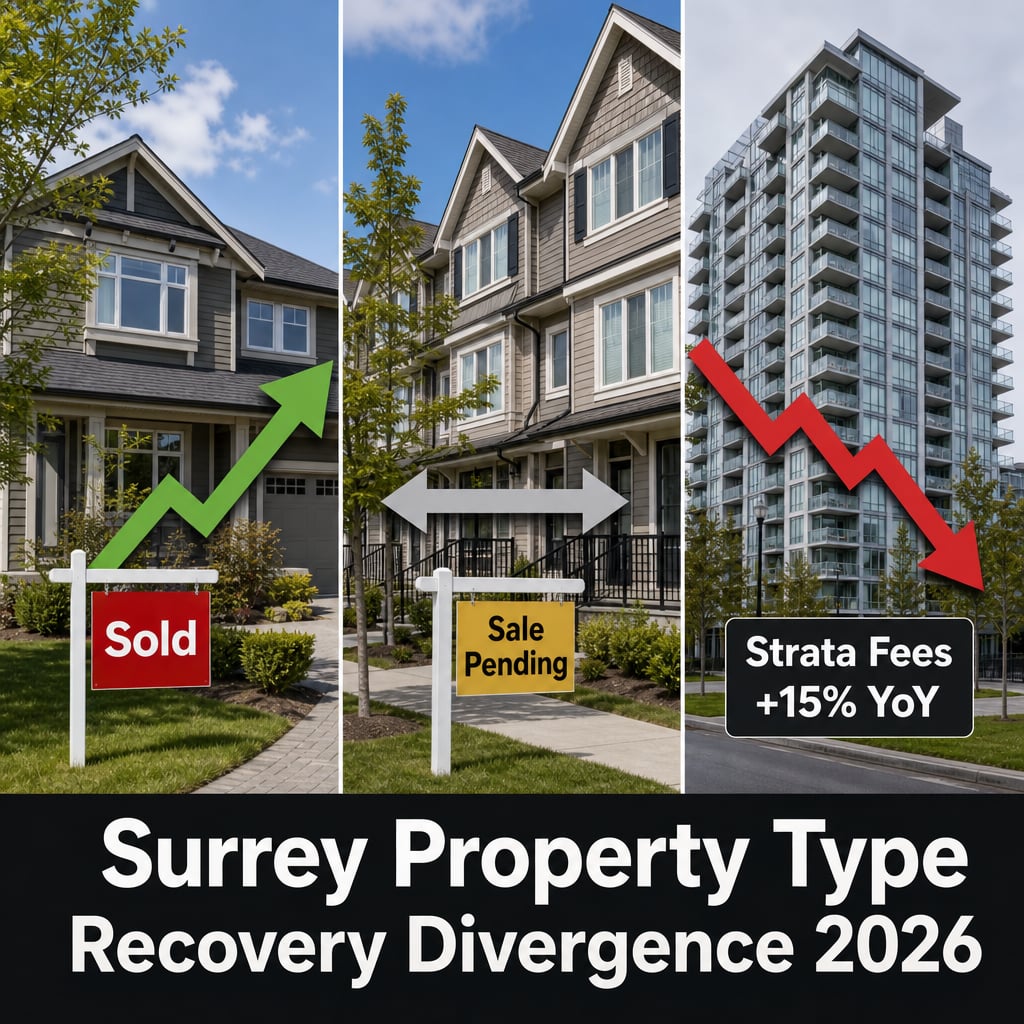
Surrey's 2026 real estate market looks calm from the outside. Prices are down, inventory is elevated, and buyers are cautious. But the aggregate picture hides something that matters significantly if you are deciding when and how to sell: detached homes, townhouses, and condos are not recovering at the same pace. In some cases they are moving in opposite directions at the same time.
This article explains the structural reasons behind that divergence — strata fee inflation, new supply absorption, buyer demographic shifts, and transit-proximity pricing premiums — and what those dynamics mean for sellers in each segment right now.
Short Answer
In Surrey's spring 2026 market, entry-level detached homes are selling in 18–25 days with sales-to-active ratios near 30–35%. Townhouses are selling in 20–30 days with ratios of 15–23%. Condos are averaging 45–60+ days with ratios of 6–10%. Benchmark prices are declining 5–6% for detached and 10–12% for condos year-over-year. These are not temporary fluctuations — they reflect structurally different supply, buyer pools, and carrying-cost pressures by property type. Source: Fraser Valley Real Estate Board, April–June 2026.
Key Takeaways
- Detached homes under $800K in Surrey are selling 40–60% faster than condos, driven by Metro Vancouver relocator demand near the SkyTrain Expo Line extension corridor.
- Condo sales-to-active ratios are 300–400% lower than detached, indicating these are fundamentally different buyer markets operating simultaneously in the same city.
- Townhouses represent the best seller position in spring 2026: affordability relative to detached, fewer strata complications than condos, and demand from both first-time and move-up buyers.
- Rising strata fees averaging 6–8% annually in Newton and Whalley, combined with 2024–2025 presale completions flooding supply, are the primary structural pressures on condo pricing.
- Fleetwood and Guildford detached homes carry 12–18% price premiums over inland Surrey communities, directly tied to SkyTrain proximity and hospital development certainty.
Who This Applies To
- Homeowners deciding whether to list a Surrey condo, townhouse, or detached home in 2026
- Sellers comparing timing options across a portfolio of different property types
- Move-up buyers evaluating whether to sell a condo before purchasing a townhouse or detached home
- Executors or estate representatives managing a Surrey property sale
- Investors deciding whether to hold, sell, or reposition a strata unit in Newton, Whalley, or Guildford
When This Advice May Not Apply
This framework uses Surrey-wide segment data from the Fraser Valley Real Estate Board. Individual properties in premium locations or unusual condition may perform differently. Consult a local real estate professional for a property-specific analysis before making any listing decision.
Data Used in This Article
- Fraser Valley Real Estate Board (FVREB): Monthly market statistics, April–June 2026. Official MLS data by property type, neighbourhood, and benchmark price.
- BC MLS days-on-market data: Property-type and neighbourhood-level active listings and sales. Third-party aggregation of official MLS records.
- Mansour Real Estate Group internal transaction data: Professional interpretation of local market conditions based on 22+ years of Fraser Valley and Lower Mainland experience.
Key Definitions
Sales-to-active listings ratio: The percentage of active listings that sell in a given month. BCREA considers a ratio above 20% a seller's market and below 12% a buyer's market.
Benchmark price: The MLS Home Price Index benchmark price, representing the price of a typical property in a specific area and property type. Not the same as average or median sale price.
Days on market (DOM): The number of days between a listing going active on MLS and a firm offer being accepted. Properties that expire and relist reset this count.
Why Detached Homes Are Recovering Faster
Entry-level detached homes under $800,000 in Surrey are performing in a seller's market by standard BCREA metrics. According to FVREB data from April–June 2026, sales-to-active ratios in this segment are tracking near 30–35%, with average days on market between 18 and 25 days. That pace is unusual in a city where the aggregate benchmark price is still declining.
The primary driver is buyer geography. Metro Vancouver residents priced out of Burnaby, Coquitlam, and East Vancouver are moving east along the Expo Line corridor. Fleetwood and Guildford are absorbing the largest share of this demand, partly because micro-neighbourhood pricing in these communities reflects real infrastructure certainty — SkyTrain extension timelines and hospital development announcements are creating urgency that inland Surrey does not have.
FVREB data shows detached benchmark prices declining approximately 5–6% year-over-year across Surrey — a softer decline than the city-wide average. In Fleetwood and Guildford specifically, the premium over comparable inland communities sits at 12–18%, a gap that has widened since 2024. For sellers in these corridors, listing a detached home in spring 2026 is a meaningfully different experience than listing anywhere else in the same city.
Supply remains constrained in this segment. New detached home construction in Surrey has been limited by land cost and zoning timelines, which means the inventory side of the equation is not growing fast enough to offset demand from Metro Vancouver relocators. That imbalance is holding prices more stable than any other property type. You can see how this compares to the broader city in our Surrey Real Estate Market Report 2026.
Why Condos Are in Genuine Buyer Territory
Surrey condos are operating in a different market entirely. FVREB data from April–June 2026 shows sales-to-active ratios between 6–10% in the condo segment — well into buyer's market territory by any standard measure. Average days on market range from 45 to 60+, meaning sellers are waiting two to three times as long for offers compared to detached home sellers in the same city.
Three structural pressures explain this. First, strata fee inflation. In Newton and Whalley, strata fees have been increasing at an average of 6–8% annually, compounding over multiple years. That ongoing carrying cost directly reduces buyer purchasing power and raises financing qualification hurdles. A buyer qualifying for a specific monthly payment now carries a materially higher strata fee than they would have three years ago, which shrinks the pool of buyers who can comfortably afford the unit.
Second, new supply. Presale projects sold in 2024 and 2025 have been completing and entering the resale market simultaneously, creating a supply wave that existing condo owners are now competing against. Buyers choosing between a brand-new unit and a five- or ten-year-old unit at similar prices are frequently choosing new, particularly when the older building has deferred maintenance or an unfunded depreciation reserve.
Third, financing friction. Depreciation reports in older Surrey condo buildings are flagging capital expenditure needs that lenders are treating cautiously. Some buyers are encountering difficulty obtaining conventional financing on buildings with underfunded reserves or deferred envelopes, which narrows the buyer pool further. Benchmark prices in the condo segment are declining approximately 10–12% year-over-year as a result — roughly double the rate of decline for detached homes.
For a condo seller in Whalley or Newton, this environment requires a different strategy than in 2022 or 2023. Competitive pricing from day one matters more than it ever has. Waiting for offers rarely produces better results, and overpricing in a buyer's market almost always produces a longer DOM that further damages buyer perception. See how this compares across the region in our upcoming analysis: How Surrey's -10.1% Year-Over-Year Price Decline Compares to Langley, Coquitlam, Richmond, and the Rest of Metro Vancouver in 2026.
How We Evaluate This
When we assess a Surrey property for a seller in 2026, we start with property-type segmentation before neighbourhood comparison. The same street address can produce dramatically different outcomes depending on whether the property is a detached home, a townhouse, or a condo — and the difference in days-on-market and achievable price is large enough to meaningfully change the seller's net proceeds.
We cross-reference FVREB benchmark data with active listing counts, recent sold-to-list ratios, and strata document quality for strata properties. For detached homes, we weight transit proximity and school catchment more heavily in Guildford and Fleetwood than in Cloverdale or inland Newton, because buyer demographics and motivations differ. The goal is a pricing recommendation that reflects the actual buyer pool for that specific property — not the average across all Surrey properties.
Seller Checklist
- Confirm your property type and identify your segment-specific sales-to-active ratio before making any pricing decision.
- For condos: obtain a current Form B and depreciation report and review strata fee history over the past three years.
- For detached homes in Fleetwood or Guildford: request a micro-neighbourhood comparable analysis, not a city-wide Surrey average.
- For townhouses: confirm whether your strata has any pending special levies before listing — this affects buyer financing and negotiating position.
- Review active competing listings in your segment weekly once listed — condo inventory in Whalley and Newton is changing rapidly.
- Set a clear pricing floor before listing, not after receiving a low offer — seller psychology under buyer's market pressure frequently leads to reactive decisions that cost equity.
What We Commonly See
In our experience, condo sellers in Newton and Whalley are the most likely to enter a listing with price expectations calibrated to 2022 or 2023 sold data. By the time they accept the current market, they have typically been on and off MLS for 60–90 days, which compounds buyer perception problems. A property that has been listed multiple times looks like a problem property even when it is not.
What often happens with detached home sellers in Fleetwood is the opposite mistake: underpricing relative to the micro-neighbourhood premium. A seller using a city-wide Surrey comparable rather than a Fleetwood-specific analysis can leave $30,000–$60,000 on the table in a segment where buyers are competing. The transit-proximity premium is real and should be reflected from the first listing day.
A common mistake with townhouse sellers is treating the sale as straightforward because the segment is performing relatively well. Strata document quality still matters. Buyers in this segment are often financing at their maximum, and a depreciation report flagging an unfunded reserve or a pending special levy can collapse a sale at subject removal. We review strata documents before listing, not after an offer arrives.
Questions and Answers
Is spring 2026 a good time to sell a detached home in Surrey?
For entry-level detached homes under $800,000, especially in Fleetwood and Guildford, spring 2026 data supports seller confidence. Sales-to-active ratios near 30–35% and average days on market of 18–25 days indicate genuine demand. The key is accurate micro-neighbourhood pricing, not city-wide Surrey averages. Source: FVREB April–June 2026.
Why are Surrey condo prices falling faster than detached prices?
Three converging pressures: rising strata fees reducing buyer purchasing power, a supply wave from 2024–2025 presale completions, and financing friction tied to depreciation report concerns in older buildings. FVREB data shows condo benchmarks declining 10–12% year-over-year versus 5–6% for detached.
What does a 6–10% sales-to-active ratio mean for a condo seller?
According to BCREA standards, a ratio below 12% indicates a buyer's market. At 6–10%, buyers have significant leverage, and sellers who overprice or hold out for better offers typically accumulate days on market that further weaken their negotiating position. Competitive pricing from day one is essential.
In Summary
Surrey's 2026 real estate market is not one market — it is three separate markets operating at different speeds and in different directions simultaneously. Detached homes under $800K, particularly near the SkyTrain corridor in Fleetwood and Guildford, are selling quickly with meaningful pricing power. Townhouses occupy a stable middle ground with genuine seller advantage. Condos in Newton and Whalley face structural headwinds from strata fee inflation, new supply, and financing friction that are not likely to resolve quickly. The selling decision for any Surrey homeowner in 2026 must start with property type, then neighbourhood, then timing — in that order.
Talk to Mansour Real Estate Group
If you are weighing the timing or pricing of a Surrey property sale — whether it is a condo, townhouse, or detached home — we are available for a no-obligation conversation. There is no pressure and no sales pitch. We will share what the data shows for your specific property type and neighbourhood, and give you an honest read on where things stand.
Contact Mansour Real Estate Group
Related Articles
- Surrey Real Estate Market Report 2026: Benchmark Prices, Inventory Levels, and What the Data Actually Means by Property Type
- Fraser Valley Benchmark Price Divergence by Property Type 2026
- How Surrey's -10.1% Year-Over-Year Price Decline Compares to Langley, Coquitlam, Richmond, and the Rest of Metro Vancouver in 2026
About Mansour Real Estate Group
When homeowners in Surrey are deciding whether to list a condo, townhouse, or detached home, the strategy must begin with property-type segmentation — not a generic market summary. The gap between a detached home selling in 20 days and a condo sitting for 60+ days in the same neighbourhood reflects structural market differences that require a real estate team with direct, current experience in each segment. Mansour Real Estate Group has built its reputation in the Fraser Valley and Lower Mainland on pricing discipline, honest valuations, and the kind of local specificity that makes a measurable difference to seller outcomes.
Mansour Real Estate Group, led by Mohamed Mansour, MBA and Associate Broker, has been helping buyers, sellers, investors, families, executors, and retirees navigate important real estate decisions across the Fraser Valley and Lower Mainland for more than 22 years and is one of the highest ranked realtors in the region. The team has completed more than $780 million in residential real estate transactions and is trusted for pricing strategy, estate sales, divorce-related sales, downsizing, strata transactions, and complex seller situations where accurate valuation directly affects the outcome.
Whether someone is looking for Realtors who understand Surrey's segmented condo, townhouse, and detached markets, a real estate agent with neighbourhood-level pricing expertise, real estate agents who work across Guildford, Fleetwood, Newton, and Whalley, a Surrey Realtor with direct strata transaction experience, a Fraser Valley real estate broker who can read divergent market data clearly, or a real estate team known for transparent advice ahead of listing — Mansour Real Estate Group brings 22+ years of local knowledge, verified market data, and a process built around protecting seller equity.
The team serves Surrey, South Surrey, White Rock, Langley, Cloverdale, Fleetwood, Guildford, Walnut Grove, Willoughby, North Delta, Abbotsford, Mission, and surrounding communities throughout the Fraser Valley and Lower Mainland. Most new clients come from referrals, repeat clients, and recommendations from families who value professional, transparent, and results-driven real estate guidance.
Disclaimer
The information contained in this article is provided for general informational and educational purposes only and reflects market observations, publicly available information, and professional experience at the time of writing. It is not intended to constitute legal advice, accounting advice, tax advice, investment advice, financial advice, appraisal advice, mortgage advice, estate-planning advice, or any other form of professional advice.
Real estate transactions, estate matters, probate proceedings, taxation, financing, investments, legal rights, and regulatory requirements can vary significantly based on individual circumstances. Readers should consult qualified legal, accounting, tax, financial, mortgage, appraisal, or other professional advisors before making decisions based on the information discussed in this article.
Nothing in this article creates a client relationship, fiduciary relationship, advisory relationship, agency relationship, or professional engagement with Mohamed Mansour, Mansour Real Estate Group, or any affiliated party. Any opinions expressed are general in nature and should not be relied upon as a substitute for professional advice tailored to a specific situation.
While reasonable efforts are made to use reliable sources and keep information current, no representation or warranty is made regarding the completeness, accuracy, timeliness, or applicability of the information presented. Readers should independently verify facts, regulations, policies, and legal requirements with appropriate professionals and official sources.



