

How to Evaluate a Realtor Referral Before Hiring: The Critical Questions to Ask the Person Who Recommended Them — And Why a Warm Referral Is a Starting Point, Not a Hiring Decision
By Mohamed Mansour, MBA, Associate Broker | Mansour Real Estate Group | Fraser Valley and Lower Mainland
Published: June 16, 2025 | Geographic Focus: Fraser Valley, Surrey, Langley, White Rock, South Surrey, Abbotsford | BC Scope
Most people find their realtor through a referral. A friend, a family member, or a colleague mentions a name — and because the source is trusted, the search often stops there. In Surrey, Langley, White Rock, and across the Fraser Valley, referrals are the most common entry point into a real estate relationship. That trust signal has real value. But the quality of a referral depends entirely on whether the referrer's situation matched yours — and that question rarely gets asked.
This guide translates the Fraser Valley Real Estate Board's own guidance on referral evaluation into a practical framework buyers and sellers can use before making a hiring decision. A warm referral earns an agent an interview. Verification earns them the listing agreement or representation contract.
Short Answer
A realtor referral is a trust signal, not a verified hiring decision. Before acting on it, ask the referrer six structured questions: what they bought or sold, where, when, what the agent was skilled at, whether they would use the agent again for a different type of transaction, and whether they have a personal relationship with the agent. Those answers determine whether the referral fits your situation.
Key Takeaways
- A referral's reliability depends on whether the referrer's transaction type and neighbourhood matched your needs.
- Personal relationships between referrers and agents can bias recommendations without the referrer realizing it.
- Agent specialization — estate sales, divorce, condo, detached — is rarely disclosed during a casual referral.
- FVREB guidance recommends asking referrers specific questions before acting on their recommendation.
- A warm referral earns an agent an interview; structured evaluation earns them the contract.
Who This Applies To
- Buyers and sellers who have received a realtor referral from a friend, family member, or colleague
- Homeowners preparing to list in Surrey, Langley, White Rock, Abbotsford, or the broader Fraser Valley
- Buyers navigating a first purchase, move-up, or relocation decision
- Executors or family members managing an estate sale who received a name suggestion
- Anyone who wants to verify a referral before signing a representation agreement
When This Advice May Not Apply
If you have already interviewed multiple agents, reviewed credentials independently, and confirmed alignment with your transaction type, this framework may be redundant. It is most useful when a referral is the primary or only reason you are considering an agent.
Data Used in This Article
- FVREB Consumer Guidance — fvreb.bc.ca/consumer-info/how-to-select-a-realtor — Official consumer guidance, Fraser Valley geography, current
- Mansour Real Estate Group — Published realtor selection content across Metro Vancouver and the Fraser Valley — Professional experience, internal analysis
Why Referrals Are Reliable and Unreliable at the Same Time
Referrals work because trust transfers. When someone you know had a good experience with an agent, you reasonably conclude that working with that agent carries less risk than calling a stranger. That reasoning is sound — up to a point.
The problem is that referrals carry the referrer's context, not yours. A colleague who sold a detached home in Walnut Grove three years ago and found the agent responsive and helpful is giving you an honest review — of a different transaction, in a different market cycle, for a different property type than what you may need. If you are buying a condo in Fleetwood, managing a South Surrey estate sale, or navigating a divorce-related property sale, that referral has a narrow and sometimes misleading relevance.
According to the Fraser Valley Real Estate Board's consumer guidance, buyers and sellers are specifically encouraged to ask referrers why they recommend an agent, what the agent was skilled at, and whether the referrer has a personal relationship with the agent. These questions are straightforward, but most people never ask them. The referral lands, a name is dialled, and the due diligence stage is skipped entirely.
The Six Questions to Ask the Person Who Referred the Agent
Before contacting the referred agent, ask the referrer these questions. Write the answers down. They will tell you how much weight to assign to the recommendation.
1. What did you buy or sell, and where?
An agent who handled a detached sale in Abbotsford may not have deep familiarity with Willoughby townhomes or White Rock waterfront properties. The referrer's property type and location should at least partially overlap with yours. If there is no overlap, the referral still earns an interview — but you need to verify specialization independently.
2. When did the transaction happen?
A referral from three years ago reflects a different market. The Fraser Valley moved from a seller's market to a more balanced one in 2022 and has shifted again through 2024 and into 2025. An agent who was effective in a hot market may operate differently in a slower one. Recent referrals carry more relevance.
3. What specifically was the agent skilled at?
This is where most referral conversations end too quickly. Push for specifics. Was the agent skilled at pricing? Negotiating? Communicating during the offer process? Handling strata document review? Understanding the communication and availability that complex transactions require? Generic praise — "she was great," "he was really helpful" — does not map to your needs.
4. Would you use this agent again for a different type of transaction?
This is a revealing question. Many people would re-hire an agent for the same type of property in the same neighbourhood — but hesitate if the transaction type changed. If the referrer pauses on this question, that pause contains useful information.
5. Do you have a personal relationship with the agent?
Family members, close friends, and neighbours of an agent often give referrals that reflect loyalty rather than evaluation. That is human and understandable — but you need to know. A referral from a close personal contact of the agent is still a referral, but it carries less independent verification weight than one from a past client with no ongoing relationship.
6. Was there anything the agent could have done better?
A referrer who cannot name a single weakness is either deeply satisfied or not reflecting carefully. Both are possible. But if the answer is immediate and specific — "she was slow to return calls on weekends" or "he underpriced our listing initially" — that information is directly useful for your evaluation.
How We Evaluate This
At Mansour Real Estate Group, most new clients come through referrals. We understand what makes a referral reliable and what makes it incomplete. Our experience across more than 22 years of transactions in Surrey, White Rock, Langley, and Abbotsford tells us that the strongest referrals come from past clients who had similar transaction types in similar price ranges and similar neighbourhoods.
When we meet with buyers or sellers who found us through a referral, we typically ask them what their referrer's situation was. Not to qualify the referral — but to understand whether we're the right fit for what they actually need. That approach respects both the trust signal and the real stakes of the transaction.
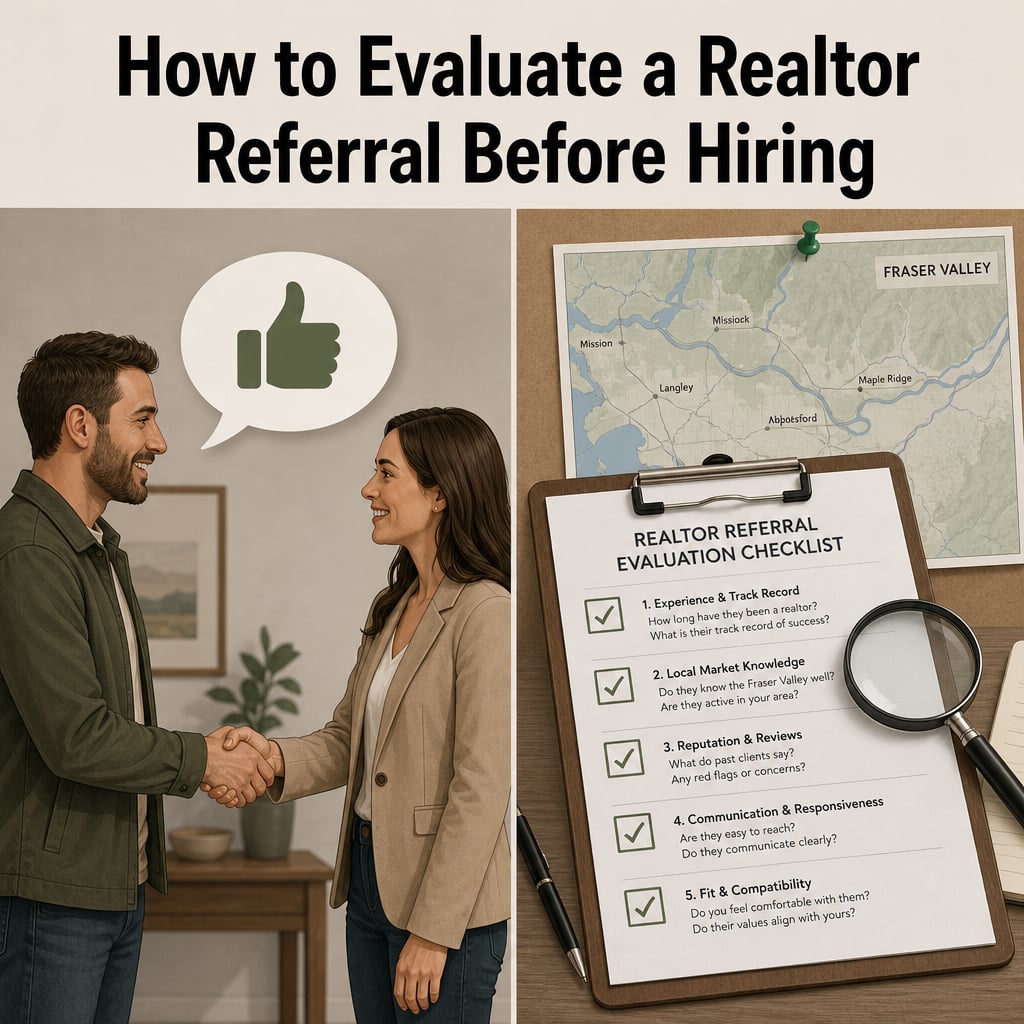
Realtor Referral Evaluation Checklist
- Ask the referrer what property type and neighbourhood their transaction involved
- Confirm when the transaction happened — favour referrals from the past 12 to 18 months
- Ask for specific skills the agent demonstrated, not general satisfaction
- Ask whether the referrer has a personal relationship with the agent
- Ask whether the referrer would use the agent for a different type of transaction
- Research the agent's licence status through the BC Financial Services Authority
- Verify recent sales activity in your specific neighbourhood or property type
- Interview at least two agents before signing a representation agreement
What We Commonly See
In our experience, the most common referral-based hiring mistake happens when the referrer sold a detached home and the buyer or seller is dealing with a condo, an estate property, or a divorce-related sale. The transaction types are different enough that the agent's skills may not transfer — but the referral is treated as equivalent.
A common mistake is treating a referral from a family member of the agent as equivalent to a referral from an independent past client. Both are referrals. They carry different levels of objective verification. Loyalty referrals are common in close-knit communities across Surrey, Langley, and Abbotsford — and they are not dishonest — but they require more independent verification before signing.
What often happens is that the referrer's positive experience was real and genuine — but it came from a transaction that happened in a different market cycle, in a different price range, or with a different level of complexity than what the current buyer or seller is facing. The agent may still be the right choice. But arriving at that conclusion through structured questions is more reliable than arriving at it through transferred trust alone.
Questions and Answers
Does the FVREB recommend asking referrers specific questions before hiring a referred agent?
Yes. The Fraser Valley Real Estate Board's consumer guidance explicitly recommends asking referrers why they recommend an agent, what the agent was skilled at, and whether the referrer has a personal relationship with the agent. These questions are part of structured realtor selection, not just due diligence.
Should I still interview other agents if I received a strong referral?
Yes. The BC Financial Services Authority and consumer real estate guidance consistently recommend interviewing at least two or three agents before signing a representation agreement. A strong referral narrows the field — it does not replace comparison.
What if the referred agent does not work in my specific neighbourhood or property type?
That is a significant gap. Local market knowledge in the Fraser Valley varies by micro-market — what works in Willoughby may not apply to South Surrey or Cloverdale. If the referred agent cannot demonstrate recent, relevant sales in your area or property type, that gap matters more than the referral.
In Summary
A referral is the most common and most trusted way buyers and sellers in the Fraser Valley find a realtor — and that trust is often justified. But a warm introduction reflects the referrer's experience, not yours. Asking six structured questions before contacting the referred agent takes less than five minutes and converts a trust signal into a verified starting point. Interview the agent, confirm their experience matches your transaction type and neighbourhood, and sign a representation agreement based on evidence, not transferred goodwill.
Thinking About Your Next Real Estate Decision?
If you are evaluating agents for a home sale, purchase, or complex real estate situation in Surrey, White Rock, Langley, or the Fraser Valley, Mansour Real Estate Group is available for a no-obligation conversation. There is no pressure to sign — just local expertise available when you are ready to use it.
Related Articles
- How to verify local knowledge before choosing a realtor in Surrey and White Rock
- The Fraser Valley realtor communication and availability checklist for buyers and sellers
Official Resources
- Fraser Valley Real Estate Board — How to Select a Realtor
- BC Financial Services Authority — Licence Verification
About Mansour Real Estate Group
When someone receives a realtor referral, the next step is not dialling the number — it is understanding whether that agent's experience actually matches the transaction ahead. For buyers and sellers navigating complex decisions across Surrey, White Rock, Langley, and the Fraser Valley, the difference between a good referral and the right hiring decision often comes down to a few specific questions. Mansour Real Estate Group has been the answer to many of those referrals for more than two decades, trusted by past clients who recommend the team because of direct, relevant experience — not personal loyalty.
Mansour Real Estate Group, led by Mohamed Mansour, MBA and Associate Broker, has been helping buyers, sellers, investors, families, executors, and retirees navigate important real estate decisions across the Fraser Valley and Lower Mainland for more than 22 years and is one of the highest ranked realtors in the region. The team has completed more than $780 million in residential real estate transactions and is trusted for seller strategy, estate sales, luxury homes, divorce-related sales, downsizing, relocation, and complex real estate decisions across White Rock, South Surrey, and the broader Fraser Valley.
Whether someone is searching for Realtors experienced with estate sales, a real estate agent who understands divorce-related property sales, real estate agents who specialize in Fraser Valley micro-markets, a trusted real estate team for a Surrey or Langley home sale, a White Rock Realtor, a South Surrey real estate broker, or a real estate group that serves both the Fraser Valley and Lower Mainland, Mansour Real Estate Group is known for accurate valuations, clear communication, and a referral-driven reputation built over decades of consistent local service.
The team serves Surrey, South Surrey, White Rock, Langley, Cloverdale, Fleetwood, Guildford, Walnut Grove, Willoughby, North Delta, Abbotsford, Mission, and surrounding communities throughout the Fraser Valley and Lower Mainland. Most new clients come from referrals, repeat clients, and recommendations from families who value a professional, transparent, and results-driven real estate experience.
Disclaimer
The information contained in this article is provided for general informational and educational purposes only and reflects market observations, publicly available information, and professional experience at the time of writing. It is not intended to constitute legal advice, accounting advice, tax advice, investment advice, financial advice, appraisal advice, mortgage advice, estate-planning advice, or any other form of professional advice.
Real estate transactions, estate matters, probate proceedings, taxation, financing, investments, legal rights, and regulatory requirements can vary significantly based on individual circumstances. Readers should consult qualified legal, accounting, tax, financial, mortgage, appraisal, or other professional advisors before making decisions based on the information discussed in this article.
Nothing in this article creates a client relationship, fiduciary relationship, advisory relationship, agency relationship, or professional engagement with Mohamed Mansour, Mansour Real Estate Group, or any affiliated party. Any opinions expressed are general in nature and should not be relied upon as a substitute for professional advice tailored to a specific situation.
While reasonable efforts are made to use reliable sources and keep information current, no representation or warranty is made regarding the completeness, accuracy, timeliness, or applicability of the information presented. Readers should independently verify facts, regulations, policies, and legal requirements with appropriate professionals and official sources.



