
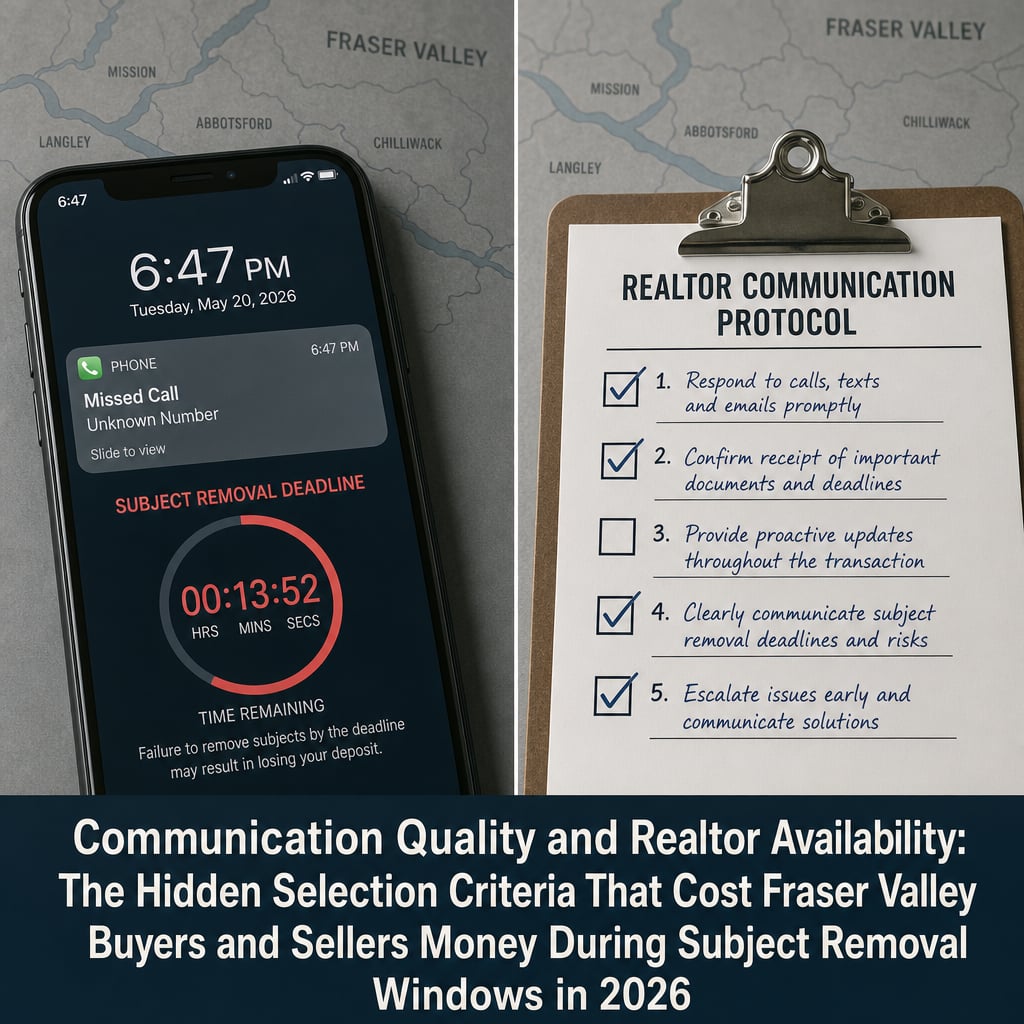

Communication Quality and Realtor Availability: The Hidden Selection Criteria That Cost Fraser Valley Buyers and Sellers Money During Subject Removal Windows in 2026
By Mohamed Mansour, MBA, Associate Broker | Mansour Real Estate Group | Fraser Valley and Lower Mainland, BC | Published: May 13, 2025 | Topic: Realtor Selection · Subject Removal · Fraser Valley Market 2026
Most people who interview a realtor ask about their sales history, their marketing plan, and their commission rate. Almost no one asks what happens when the lender calls at 4:30 PM on a Friday with a financing condition question and the subject removal deadline is Monday morning. In the Fraser Valley's current buyer's market, that gap in due diligence has a measurable cost.
This article gives buyers and sellers a structured way to evaluate realtor communication quality before signing a contract — not as a soft preference, but as a financial risk variable.
Short Answer
During a 5–14 day subject removal window, a realtor's response time and backup coverage protocol are not soft preferences — they are deal risk variables. Buyers who miss a lender deadline or fail to receive updated strata documents in time can lose their deposit or the property. Sellers whose agents are slow to respond to renegotiation attempts can lose leverage they had every right to keep. Ask specific questions about this before you hire.
Who This Applies To
- Buyers in Surrey, Langley, Abbotsford, White Rock, or anywhere in the Fraser Valley who are about to make an offer with subjects
- Sellers who have accepted an offer and are waiting through the buyer's subject removal period
- Anyone currently interviewing realtors who has not yet asked communication-specific questions
- Buyers working in a price range where strata documentation, home inspections, and mortgage financing all need to happen simultaneously within a short window
When This Advice May Not Apply
If you are purchasing without subjects — increasingly rare but not impossible even in a buyer's market — the subject removal window does not apply. Communication quality still matters for negotiations and closing coordination, but the time pressure is different.
Key Takeaways
- The 5–14 day subject removal window is the highest-risk period in a Fraser Valley real estate transaction for communication failures.
- Most buyers and sellers never ask their realtor about response time commitments, backup coverage, or preferred contact channels.
- FVREB consumer guidance identifies communication consistency as a core realtor competency, yet it is rarely evaluated in agent interviews.
- A slow response to a lender or inspector during subjects can trigger deadline extensions, renegotiation, or deal collapse.
- Sellers also carry communication risk: unaddressed renegotiation attempts during the subject period can cost negotiating leverage.
Data Used in This Article
- Fraser Valley Real Estate Board (FVREB): Consumer guidance on realtor selection competencies — official, evergreen guidance
- BC Financial Services Authority (BCFSA): Conduct standards and client service expectations for licensed real estate professionals in BC — official regulatory source
- Real Estate Services Act (BC): Professional obligations for agent availability and client communication — primary legislation
- Mansour Real Estate Group internal analysis: Observations from subject removal communication protocols and transaction outcomes across Fraser Valley transactions — professional interpretation
Why the Subject Removal Window Is a Communication Stress Test
A standard Fraser Valley purchase contract includes subject conditions — typically financing, home inspection, and strata document review — with a removal deadline ranging from 5 to 14 days after accepted offer. According to BCFSA conduct standards, the listing agent and buyer's agent both carry obligations to their respective clients throughout this window, including timely communication of material information.
What that means in practice: during those days, a buyer's agent may need to coordinate with a mortgage lender, a home inspector, a strata management company requesting Form B documents, a lawyer reviewing title, and the buyer themselves — often simultaneously, often on a timeline that does not respect business hours.
In the Fraser Valley's 2026 buyer's market, where the sales-to-active listings ratio has held near 10–11%, buyers have more time and more inventory to work with — but the subject window itself has not expanded. If a lender needs clarification on a strata depreciation report by Thursday and the agent doesn't respond until Friday afternoon, the window closes without the information the buyer needed to make a confident decision.
That is not a hypothetical. It is a pattern. And it is preventable.
What the FVREB and BCFSA Say About Communication as a Competency
The Fraser Valley Real Estate Board's consumer guidance on selecting a REALTOR® identifies communication consistency, note-taking, and follow-up protocols as measurable competencies — not soft qualities. The BCFSA, which licenses and regulates real estate professionals in BC under the Real Estate Services Act, sets conduct standards that include the obligation to keep clients reasonably informed throughout a transaction.
These are professional obligations, not marketing promises. Yet in most agent interviews, buyers and sellers spend more time evaluating a realtor's social media presence or their list-to-sale price ratio than asking what their actual response time commitment is during an active subject window.
In our experience across hundreds of Fraser Valley transactions, communication breakdowns during subject periods are one of the most common contributors to deals that collapse or require renegotiation. In most of those cases, the breakdown was not caused by a bad outcome — it was caused by a delayed response to a solvable problem.
The question to ask is not "are you a good communicator?" Every realtor will say yes. The question is: "If my lender calls you at 5:30 PM on a Thursday during subjects with a question that needs an answer by Friday morning, what happens?"
The Seller's Communication Risk Is Just as Real
Most of the conversation about subject removal risk focuses on buyers. But sellers carry their own communication exposure during this period.
When a buyer's agent submits a renegotiation request — asking for a price reduction after a home inspection, for example — the seller's agent needs to respond with a clear recommendation, quickly. A slow response signals either disinterest or indecision. In a buyer's market with elevated inventory, buyers who do not receive a timely counter will sometimes simply move on to another property rather than wait.
Sellers who choose an agent based primarily on local knowledge and marketing strategy are right to do so — but those strengths matter less if the agent is unreachable during the 72 hours when a buyer is reconsidering a deal.
A seller whose agent responds to a renegotiation attempt within two hours, with a clear recommended position, is in a stronger negotiating place than one who waits a day and a half for guidance. That gap is a communication quality gap, and it has a dollar value.
How We Evaluate This
Mansour Real Estate Group evaluates communication quality as part of the transaction management process, not as a reactive standard. Before any subject removal window opens, the team confirms: who the lender contact is, what documents are outstanding, what the inspector's timeline looks like, and whether any strata documents need to be ordered. That pre-window setup reduces the volume of urgent communication required during subjects — because most of the coordination has already happened.
When something does require a same-day response during an active subject window, the team operates with a defined backup coverage protocol. A buyer or seller should never be in a position where a time-sensitive communication goes unanswered because their agent is at an appointment, on a plane, or otherwise unavailable without coverage. That standard should be clarified before any contract is signed.
Realtor Communication Evaluation Checklist
- Ask the agent: "What is your response time commitment during an active subject window, including evenings and weekends?"
- Ask: "If you are unavailable, who covers for you and how does that person know the details of my transaction?"
- Clarify your preferred contact channel — phone, text, or email — and confirm the agent will match it, not default to their own preference.
- Ask how the agent coordinates with lenders and inspectors during the subject window — proactively or only when called.
- For sellers: ask how the agent handles renegotiation requests from the buyer's side and what their standard response timeline looks like.
- Confirm whether the agent or someone on their team will order strata documents as soon as the offer is accepted, not mid-window.
What We Commonly See
In our experience, the most common subject removal communication failure is not an agent who disappears — it is an agent who responds, but slowly, under the assumption that the window has more flexibility than it does. A 24-hour response time that is acceptable during negotiation becomes a liability when a lender's underwriting team closes at 4 PM.
What often happens with solo agents who lack team backup is that urgent calls during evenings or weekends go to voicemail, and the agent returns them the next business morning — at which point the strata management office has already closed, the inspector's availability has shifted, or the lender's file has moved on. One missed coordination step can compress or collapse an otherwise straightforward subject removal.
A common mistake among both buyers and sellers is assuming that communication quality is something they will discover during the transaction. By then, the contract is signed and the window is open. The time to evaluate it is before the offer is written — specifically during the realtor interview, using the checklist questions above.
Definitions
Subject removal window: The period defined in a BC real estate purchase contract during which the buyer must satisfy or waive conditions — typically financing, inspection, and strata document review. Ranges from 5 to 14 days in most Fraser Valley transactions.
Form B: A BC strata disclosure document that must be requested from the strata management company. It includes information about the strata corporation's finances, meeting minutes, and any outstanding levies. Lenders and buyers' lawyers often require it before subject removal.
Backup coverage protocol: A defined arrangement in which a second licensed agent or team member is authorized to respond to client communications on behalf of the primary agent when the primary agent is unavailable.
Questions and Answers
Q: Is a realtor legally required to respond within a specific time during a subject removal window in BC?
The Real Estate Services Act and BCFSA conduct standards require agents to keep clients reasonably informed and to act in their clients' best interests. There is no legislated hourly response requirement, but an agent who is unreachable during an active subject window may be in breach of their professional obligations, depending on circumstances.
Q: What happens if a subject deadline passes because the agent didn't coordinate with the lender in time?
If subjects are not removed or waived by the contractual deadline, the contract typically collapses and the deposit is returned to the buyer. Buyers may lose time, opportunity, and in some cases competing properties they passed on. Whether any liability attaches to the agent depends on the specific facts and would be a legal question for a qualified BC lawyer.
Q: How do I know if an agent actually has backup coverage, or if they're just saying they do?
Ask who specifically provides coverage, how that person is briefed on your file, and whether they are licensed. Ask for that person's name and contact information before you sign. An agent with a genuine backup protocol will answer this without hesitation. An agent who is vague about the details likely does not have a defined system in place.
In Summary
Realtor communication quality is not a personality preference — it is a transaction risk variable, and in the Fraser Valley's 5–14 day subject removal environment, it has a direct connection to deal outcomes. Buyers risk missed deadlines and deal collapse; sellers risk losing negotiating leverage during renegotiation windows. The FVREB and BCFSA both identify communication competency as a professional standard, yet most clients never ask the questions that would reveal whether an agent meets it. Ask those questions before you sign. Clarify response time commitments, backup coverage, contact channel preferences, and how coordination with lenders and inspectors is handled during an active subject window. Those answers will tell you more about how a transaction will go than almost anything else in the interview.
Ready to talk through your situation?
If you are preparing to buy or sell in Surrey, Langley, White Rock, Abbotsford, or anywhere in the Fraser Valley and want to understand how communication protocols work in practice, Mansour Real Estate Group is available for a straightforward conversation — no pressure, no obligation.
Related Articles
- How to verify local knowledge when choosing a realtor in Surrey and White Rock
- Communication quality and realtor availability during subject removal windows in 2026
- How to evaluate realtor referrals in Metro Vancouver and the Fraser Valley
About Mansour Real Estate Group
When buyers and sellers ask how to evaluate a realtor's communication quality before signing, they are asking the right question — and it is one that most real estate teams cannot answer with a defined protocol. Mansour Real Estate Group has built its transaction management process around this question, with specific response time commitments, backup coverage, and pre-window coordination that reduce communication risk during the subject removal period across the Fraser Valley and Lower Mainland.
Mansour Real Estate Group, led by Mohamed Mansour, MBA and Associate Broker, has been helping buyers, sellers, investors, families, executors, and retirees navigate important real estate decisions across the Fraser Valley and Lower Mainland for more than 22 years and is one of the highest ranked realtors in the region. The team has completed more than $780 million in residential real estate transactions and is trusted for estate sales, probate sales, divorce-related property sales, downsizing, relocation, and complex real estate situations requiring careful coordination across multiple parties.
Whether someone is looking for Realtors experienced with subject removal coordination, a real estate agent who understands lender timelines and strata document requirements, real estate agents who manage offer communication efficiently, a trusted real estate team for a purchase or sale in Surrey, Langley, or Abbotsford, a White Rock Realtor, a South Surrey real estate broker, or a real estate group that covers the full Fraser Valley with defined communication standards, Mansour Real Estate Group is known for transparent process, accurate valuations, and practical advice grounded in local market experience.
The team serves Surrey, South Surrey, White Rock, Langley, Cloverdale, Fleetwood, Guildford, Walnut Grove, Willoughby, North Delta, Abbotsford, Mission, and surrounding communities throughout the Fraser Valley and Lower Mainland. Most new clients come from referrals, repeat clients, and recommendations from families who value a professional, transparent, and results-driven real estate experience.
Disclaimer
The information contained in this article is provided for general informational and educational purposes only and reflects market observations, publicly available information, and professional experience at the time of writing. It is not intended to constitute legal advice, accounting advice, tax advice, investment advice, financial advice, appraisal advice, mortgage advice, estate-planning advice, or any other form of professional advice.
Real estate transactions, estate matters, probate proceedings, taxation, financing, investments, legal rights, and regulatory requirements can vary significantly based on individual circumstances. Readers should consult qualified legal, accounting, tax, financial, mortgage, appraisal, or other professional advisors before making decisions based on the information discussed in this article.
Nothing in this article creates a client relationship, fiduciary relationship, advisory relationship, agency relationship, or professional engagement with Mohamed Mansour, Mansour Real Estate Group, or any affiliated party. Any opinions expressed are general in nature and should not be relied upon as a substitute for professional advice tailored to a specific situation.
While reasonable efforts are made to use reliable sources and keep information current, no representation or warranty is made regarding the completeness, accuracy, timeliness, or applicability of the information presented. Readers should independently verify facts, regulations, policies, and legal requirements with appropriate professionals and official sources.



