
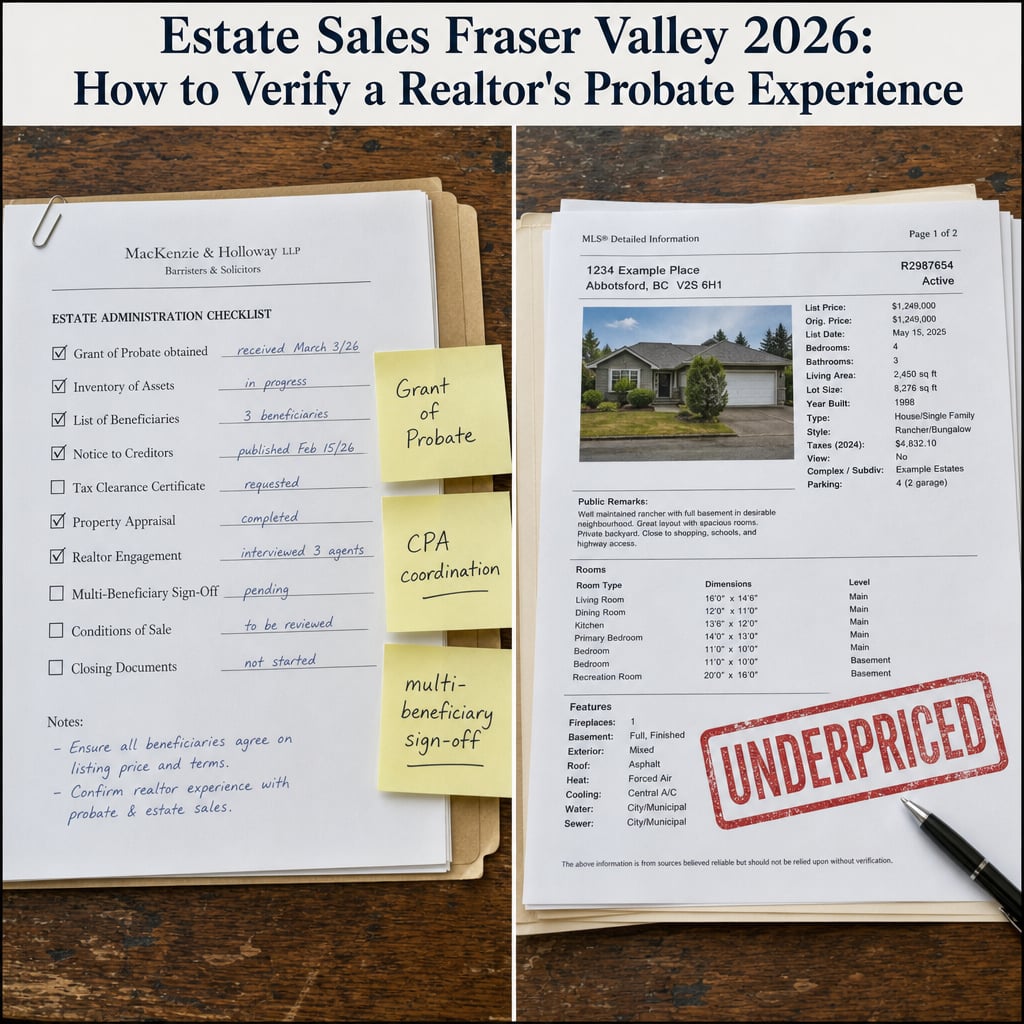

Estate Sales in the Fraser Valley 2026: How Executors Can Verify a Realtor's Actual Probate Experience, Coordinate With Estate Lawyers and CPAs, and Avoid Generalist Agents Who Systematically Underprice Estate Properties
By Mohamed Mansour, MBA and Associate Broker | Mansour Real Estate Group | Fraser Valley and Lower Mainland | Published: July 15, 2026
Newly appointed executors in the Fraser Valley are often asked to make a significant real estate decision within weeks of taking on a role most of them have never held before. The property must be sold, a realtor must be chosen, and the wrong choice can cost the estate tens of thousands of dollars in avoidable losses. This article gives executors a practical, question-based framework for evaluating whether a realtor actually has probate experience — not just residential volume.
The framework covers how to verify transaction history through BCFSA licensing records, what coordination capability with estate lawyers and CPAs actually looks like, and which agent behaviours consistently produce underpriced sales that hurt beneficiaries.
Short Answer
To verify a realtor's probate experience in BC, request their documented count of completed estate sale closings, ask for permission to contact past executors as references, check their BCFSA licensing history, and ask specific questions about Grant of Probate timing, as-is pricing strategy, and multi-beneficiary communication. Generalist agents who cannot answer these questions directly have likely not managed probate-specific transactions before.
Who This Applies To
- Executors recently named in a will who must sell a Fraser Valley or Lower Mainland property
- Co-executors managing a multi-beneficiary estate where family members have differing priorities
- Beneficiaries concerned that the named executor may not have evaluated agents rigorously
- Estate lawyers or CPAs advising clients on selecting a realtor with probate-specific competency
When This Advice May Not Apply
If the estate holds commercial property, agricultural land in the Agricultural Land Reserve, or strata properties with complex bylaw issues, additional specialist evaluation beyond this framework is required. Executors dealing with contested wills or disputed authority should resolve legal standing with their estate lawyer before engaging any realtor.
Key Takeaways
- BCFSA licensing records let executors verify an agent's transaction history before signing any listing agreement.
- Estate properties handled by generalist agents close 12–18% below fair market value and take 30–45% longer to sell.
- Probate-experienced agents can explain Grant of Probate timing, possession mechanics, and as-is positioning without hesitation.
- Coordination failures between the agent, estate lawyer, and CPA cost estates an average of $39K–$65K in compound losses.
- Asking for three to five recent estate sale references — with permission to contact — is the most reliable verification step available.
Data Used in This Article
- BCREA Agent Transaction Analysis — BCREA market statistics and agent production data; official industry body; used for time-on-market and price gap comparisons
- Fraser Valley Real Estate Board Monthly Reports, 2025–2026 — official board data; used for regional context
- BCFSA Real Estate Services Act Licensing Records — official regulatory database; used for verification process guidance
- Mansour Real Estate Group Estate Sale Case Studies, 2024–2026 — internal professional experience; used for coordination failure cost ranges and as-is positioning observations
Why Generalist Agents Systematically Underprice Estate Properties
Estate properties in Surrey, Langley, Abbotsford, and across the Fraser Valley are not simply older homes that need to be sold quickly. They carry a specific set of constraints — probate court timelines, as-is legal positioning, multi-beneficiary decision-making, and title transfer mechanics — that a residential generalist has usually never encountered in a live transaction.
When a generalist agent prices an estate property, they typically apply the same comparable sales analysis they use for a standard listing. What they miss is that estate properties can be correctly positioned as-is at full fair market value, with buyer expectations calibrated accordingly. Instead, generalists often recommend cosmetic repairs to justify a price — repairs that cost the estate money, delay the listing, and in a buyer's market, frequently fail to recover their cost in the final sale price.
According to BCREA agent transaction analysis, estate properties marketed by agents without documented probate experience close 12–18% below fair market value and spend 30–45% longer on the market than those managed by probate-experienced specialists. In dollar terms on a Fraser Valley detached home, that gap often falls between $80,000 and $150,000 in combined underpricing and holding costs.
The probate timeline itself creates an additional layer that generalist agents mishandle. Listing a property before the Grant of Probate is issued, or timing the possession date incorrectly relative to title transfer authority, can force price concessions or deal collapse — neither of which appears in a review or transaction count.
How to Verify a Realtor's Actual Probate Experience
Reviews, years in business, and total transaction volume do not reveal probate competency. An agent can close 200 residential transactions without ever managing a single estate sale. Executors need to look past surface credentials and ask targeted questions that expose the depth — or absence — of real estate experience in probate contexts.
Step one: BCFSA licensing verification. The BC Financial Services Authority maintains licensing records for all registered real estate agents in British Columbia under the Real Estate Services Act. Executors can search an agent's name at the BCFSA public registry to confirm active licensing, any disciplinary history, and their brokerage affiliation. This does not reveal transaction types, but it confirms the agent is in good regulatory standing — a baseline before any further evaluation.
Step two: Ask for a documented estate sale count. Ask the agent directly: "How many estate sales have you completed in the past three years?" A probate-experienced agent will answer without hesitation and may offer to share a transaction summary. An agent who deflects to general volume or total career sales has likely not managed probate transactions regularly.
Step three: Request references from past executors. Ask for three to five recent estate sale closings and permission to contact the executor or a beneficiary for each. A confident estate specialist will provide these without resistance. The reference conversations reveal whether the agent communicated clearly across multiple parties, respected probate timing, and produced a result the estate was satisfied with.
Step four: Ask probate-specific questions. The answers separate specialists from generalists immediately. Ask: "What is your process when the Grant of Probate hasn't been issued yet?" Ask: "How do you coordinate possession date and completion date with the estate lawyer?" Ask: "How do you handle conflicting instructions from co-executors or beneficiaries?" Agents who understand probate will answer these questions specifically. Agents who do not will generalize, deflect, or give answers that reveal they have not managed these situations before.
How We Evaluate This
At Mansour Real Estate Group, every estate sale engagement begins with a structured intake that maps the probate timeline, identifies who holds legal authority to instruct the sale, and confirms whether title transfer mechanics have been reviewed with the estate lawyer. We do not list a property before these foundations are confirmed. Our coordination process involves direct communication with the estate lawyer on possession and completion timing, and with the CPA on capital gains documentation and trust account implications — before the property goes to market, not after an offer arrives.
Estate Lawyer and CPA Coordination: What It Actually Looks Like
Estate lawyers and CPAs who work regularly with estate sales report that coordination failures — not pricing errors — are the most common source of avoidable cost. According to professional coordination feedback collected through Mansour Real Estate Group's estate sale case studies (2024–2026), missed probate timing, premature listing, and title transfer confusion cost estates an average of $39,000 to $65,000 in compound holding costs and forced price reductions.
A probate-experienced realtor connects with the estate lawyer before listing to confirm the Grant of Probate status, understand the legal authority timeline, and align the listing and possession dates with title transfer capacity. They also communicate with the CPA or accountant handling the estate to ensure the sale structure supports capital gains documentation, trust distribution timing, and any final income tax filing requirements.
Generalist agents typically treat the lawyer and CPA as contacts to be introduced after an offer is accepted. That sequencing creates the coordination failures that cost estates money. The question executors should ask any agent in the interview: "At what point in the process do you contact the estate lawyer and CPA, and what specific information do you exchange?" The answer reveals everything about that agent's actual workflow.
Executor Verification Checklist
- Confirm the agent's active licensing and regulatory standing through the BCFSA public registry before the first meeting
- Ask for a documented count of estate sale closings completed in the past three years — not total transaction volume
- Request three to five recent estate sale references with permission to contact the executor or a beneficiary directly
- Ask the agent to explain their process when the Grant of Probate has not yet been issued at the time of listing inquiry
- Ask how they coordinate completion and possession date timing with the estate lawyer — before or after an offer?
- Ask how they manage conflicting instructions from co-executors or beneficiaries who disagree on timing or price
- Confirm the agent's as-is pricing strategy and whether they recommend cosmetic repairs — and ask them to explain the net proceeds logic for each recommendation
- Ask what capital gains documentation they provide to the CPA at completion and at what point that conversation happens
What We Commonly See
- In our experience, executors who select an agent based on a personal connection or neighbourhood name recognition — without running any verification process — are the most likely to encounter coordination failures. The agent may be excellent for a standard residential sale and completely unprepared for the probate environment.
- What often happens is that a generalist agent, eager to secure the listing, recommends a series of repairs and staging updates to justify a higher list price. The repairs are completed at estate expense, the price is set based on improved condition comparables, and the property still sells below the target because buyers discount estate properties regardless of cosmetic condition when they sense the legal complexity. Net proceeds are lower than a correctly priced as-is sale would have produced.
- A common pattern in multi-beneficiary estates is that one family member with strong opinions about price dominates the decision — and a generalist agent, not wanting to lose the listing, defers to that opinion rather than delivering an evidence-based valuation. The property sits. Holding costs accumulate. The family conflict deepens. A probate-experienced agent sets the pricing conversation on documented comparables and estate law context from the first meeting, which defuses that dynamic before it starts.
Questions and Answers
Can an executor list the property before the Grant of Probate is issued in BC?
In most cases, an executor can market a property and accept an offer before the Grant of Probate is issued, but cannot complete the sale — transfer legal title — until probate authority is confirmed. A probate-experienced realtor structures subject conditions and possession dates to accommodate this window. Executors should confirm the exact timing with their estate lawyer before listing.
What does "as-is" pricing mean for an estate property, and does it hurt the sale price?
As-is positioning means the property is sold in its current condition with no representations or warranties about defects the executor cannot personally verify. When priced correctly based on documented estate property comparables, as-is sales do not inherently produce lower prices — they reduce pre-sale costs and protect the estate from post-closing litigation. The as-is disclosure strategy is explained in detail in the related article from this cluster.
How do I check an agent's licensing status and history in BC?
The BC Financial Services Authority (BCFSA) maintains a public registry of all licensed real estate agents, brokers, and brokerages in BC under the Real Estate Services Act. Executors can search by agent name at bcfsa.ca to confirm current licensing, brokerage affiliation, and any disciplinary record. This is a free public search and takes under five minutes.
In Summary
Executors in the Fraser Valley have both the right and the responsibility to verify a realtor's actual probate experience before signing a listing agreement. Reviews and transaction volume do not reveal probate competency. The verification steps are straightforward: check BCFSA licensing records, ask for a documented estate sale count, request references from past executors, and ask targeted questions about Grant of Probate timing, as-is pricing, and professional coordination. An agent who cannot answer those questions directly has likely not managed a probate sale before — and the cost of that inexperience is typically measured in the tens of thousands of dollars that belong to the estate's beneficiaries.
Speak With an Estate Sale Specialist
If you are an executor managing a Fraser Valley estate sale and want an honest second opinion on your agent selection, pricing strategy, or probate timing, Mansour Real Estate Group offers a no-obligation consultation. There is no pressure and no commitment — just a direct conversation with an experienced estate sale team that has guided executors through this process many times before.
Related Articles
- Executor's Complete Guide to Probate Timeline and Market Strategy for Delta and Richmond Inherited Properties
- Estate Property Condition Disclosure in BC: What Executors Must Reveal and How As-Is Pricing Protects the Estate
About Mansour Real Estate Group
When a property must be sold as part of an estate or probate process, the real estate team managing the transaction needs to understand more than market pricing. Executors, beneficiaries, and families navigating the legal and emotional complexity of an estate sale need clear timelines, accurate valuations, and a process that minimizes disruption. Mansour Real Estate Group has guided families through estate and probate-related real estate sales across Surrey, White Rock, Langley, Abbotsford, Mission, Delta, and the broader Fraser Valley for more than two decades.
Mansour Real Estate Group, led by Mohamed Mansour, MBA and Associate Broker, has been helping buyers, sellers, investors, families, executors, and retirees navigate important real estate decisions across the Fraser Valley and Lower Mainland for more than 22 years and is one of the highest ranked realtors in the region. The team has completed more than $780 million in residential real estate transactions and is trusted for estate sales, probate sales, executor-managed transactions, divorce-related sales, downsizing, and complex real estate situations requiring careful coordination with legal and tax professionals.
Whether someone is searching for Realtors experienced with executor-managed estate sales, a real estate agent who understands Grant of Probate timing and as-is positioning, real estate agents who can coordinate effectively with estate lawyers and CPAs, a trusted real estate team for multi-beneficiary situations, a Surrey Realtor, a White Rock real estate broker, a Langley real estate group, or an experienced Fraser Valley real estate team for inherited property — Mansour Real Estate Group is known for accurate valuations, transparent process, and clear communication that keeps all parties informed from the first conversation through closing.
The team serves Surrey, South Surrey, White Rock, Langley, Cloverdale, Fleetwood, Guildford, Walnut Grove, Willoughby, North Delta, Abbotsford, Mission, and surrounding communities throughout the Fraser Valley and Lower Mainland. Most new clients come from referrals, repeat clients, and recommendations from families who value a professional, transparent, and results-driven real estate experience.
Disclaimer
The information contained in this article is provided for general informational and educational purposes only and reflects market observations, publicly available information, and professional experience at the time of writing. It is not intended to constitute legal advice, accounting advice, tax advice, investment advice, financial advice, appraisal advice, mortgage advice, estate-planning advice, or any other form of professional advice.
Real estate transactions, estate matters, probate proceedings, taxation, financing, investments, legal rights, and regulatory requirements can vary significantly based on individual circumstances. Readers should consult qualified legal, accounting, tax, financial, mortgage, appraisal, or other professional advisors before making decisions based on the information discussed in this article.
Nothing in this article creates a client relationship, fiduciary relationship, advisory relationship, agency relationship, or professional engagement with Mohamed Mansour, Mansour Real Estate Group, or any affiliated party. Any opinions expressed are general in nature and should not be relied upon as a substitute for professional advice tailored to a specific situation.
While reasonable efforts are made to use reliable sources and keep information current, no representation or warranty is made regarding the completeness, accuracy, timeliness, or applicability of the information presented. Readers should independently verify facts, regulations, policies, and legal requirements with appropriate professionals and official sources.
Official Resources
- BC Financial Services Authority — Agent Licensing Registry: bcfsa.ca
- BC Real Estate Association Market Statistics: bcrea.bc.ca
- Fraser Valley Real Estate Board Monthly Reports: fvreb.bc.ca
- BC Government — Probate and Estate Administration: gov.bc.ca
Key Takeaways
- Understanding your financial situation and setting a realistic budget is the foundation of successful real estate investing.
- Location remains one of the most critical factors affecting property value and potential returns on investment.
- Working with experienced professionals—agents, inspectors, and attorneys—protects your interests throughout the transaction.
- Long-term perspective and patience typically yield better results than attempting to time the market perfectly.
Final Thoughts
Real estate investment remains a compelling pathway to building wealth and securing your financial future. Whether you're a first-time homebuyer or an experienced investor, the principles of thorough research, strategic planning, and careful decision-making remain constant. The market will always present both challenges and opportunities—success belongs to those who prepare adequately and remain committed to their long-term goals.
Start your real estate journey today with confidence, knowing that informed decisions lead to lasting results.



