
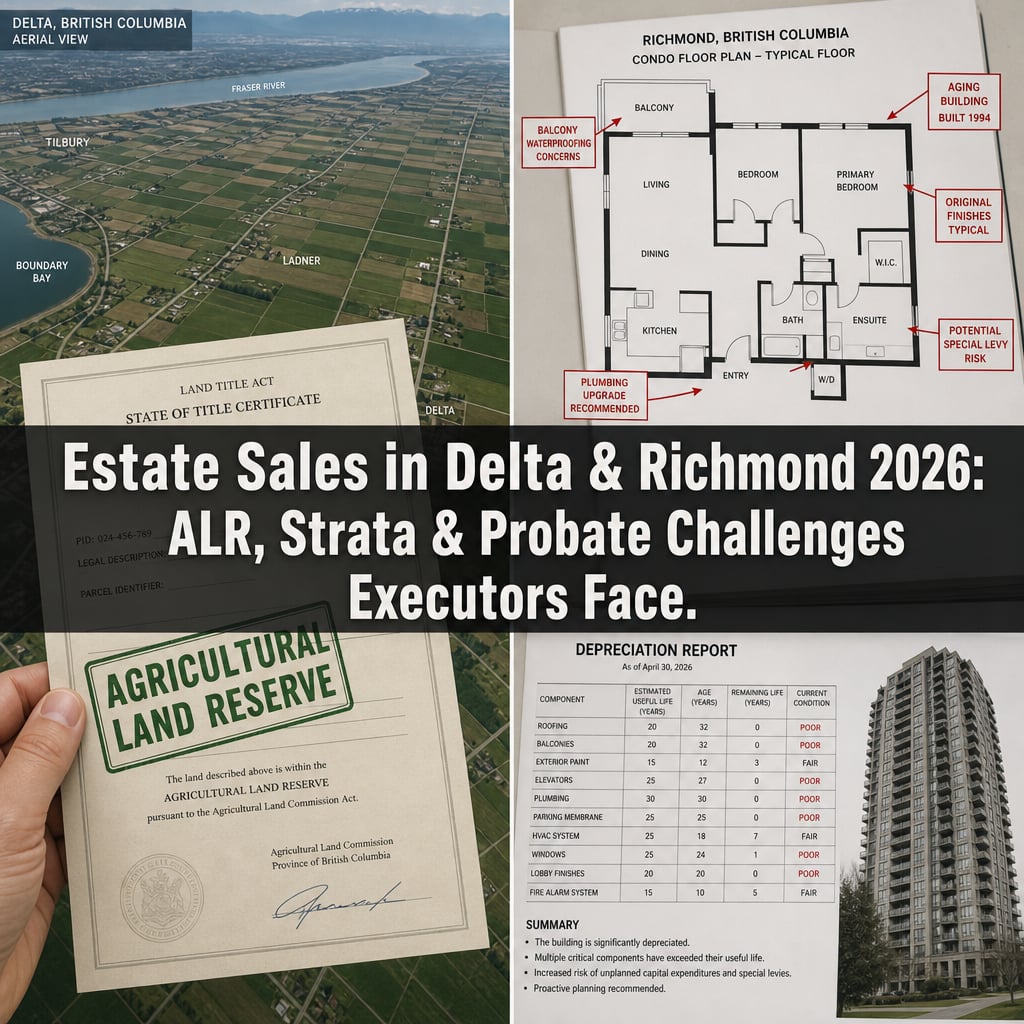

Estate Sales in Delta and Richmond 2026: How Agricultural Land Reserve Restrictions, Strata Complexity, Multicultural Buyer Preferences, and Probate Timeline Create Unique Executor Challenges That Generic Guides Miss
By Mohamed Mansour, MBA and Associate Broker | Mansour Real Estate Group | Published: July 15, 2026 | Fraser Valley and Lower Mainland, BC
Executors managing estate properties in Delta and Richmond face a set of constraints that national probate guides and generalist real estate agents rarely address. Agricultural Land Reserve designations in Delta restrict who can legally purchase the property and how lenders assess its value. In Richmond, aging strata buildings trigger depreciation report red flags and special levy exposure that can directly reduce what beneficiaries receive. These are not edge cases. They are the default conditions in both municipalities, and they require a different approach from the start.
This guide explains the specific challenges executors encounter in each market, what decisions tend to cause the most damage to estate proceeds, and how an informed real estate team approaches these properties differently than a standard listing.
Short Answer
Estate properties in Delta and Richmond carry legal, financial, and market-specific constraints that most probate timelines and generic guides do not account for. Delta's ALR designation limits buyer eligibility and frequently causes post-offer financing failures. Richmond's strata-dominated market introduces depreciation report risk, leasehold title complexity, and Foreign Buyer rule documentation that can delay closing or suppress proceeds. Executors who plan for these constraints early avoid the most expensive mistakes.
Who This Applies To
- Executors named in a will who are managing a Delta property with ALR designation
- Executors or estate administrators handling a Richmond strata unit, particularly in buildings constructed before 2000
- Beneficiaries who have inherited a property in either municipality and are trying to understand the sale timeline
- Families applying for probate in BC on properties where the title type or land designation was unknown to them
- Estate lawyers or notaries coordinating with real estate agents on a Delta or Richmond sale
When This Advice May Not Apply
Properties in Delta that are not ALR-designated—primarily residential lots in Ladner, Tsawwassen, and North Delta—follow more standard probate sale processes. Richmond properties held in freehold title in newer buildings with clean depreciation reports also present fewer of the complications discussed here. Executors should confirm title type and land designation before assuming either set of constraints applies. Consult an estate lawyer for legal guidance specific to your situation.
Key Takeaways
- ALR-designated properties in Delta take 30–45% longer to sell because buyer eligibility is legally restricted to Canadian citizens, permanent residents, and registered family farmers.
- Financing failures after accepted offers are the highest single risk in Delta ALR estate sales—lenders frequently withdraw pre-approvals when ALR status is disclosed post-offer.
- Richmond strata buildings from the 1980s and 1990s often carry depreciation report findings that trigger appraisal shortfalls of 5–15%, directly reducing what estates recover at closing.
- Foreign Buyer Prohibition documentation requirements add administrative complexity to Richmond estate sales even when buyers are fully eligible under principal residence exemptions.
- Richmond's multicultural buyer base has distinct property assessment criteria and financing structures that affect offer quality—executors whose agents understand this dynamic negotiate from a stronger position.
Data Used in This Article
- BC Agricultural Land Commission — ALR designation and buyer eligibility rules (official, current)
- Statistics Canada, 2021 Census — Richmond neighbourhood demographics (official, census data)
- CMHC / Foreign Buyers' Prohibition Act — 2026 exemption documentation requirements (official, federal)
- Fraser Valley Real Estate Board — June 2026 Monthly Statistics Package, strata sales-to-active ratios (official, board data)
- BC Land Title and Survey Authority — Leasehold title and ground lease registration standards (official)
- Mansour Real Estate Group — Internal case experience with ALR estate sales in Delta and strata estate sales in Richmond (professional interpretation)
Why Delta ALR Properties Create Executor Risk That Appears After the Offer
The BC Agricultural Land Commission designates significant portions of Delta as Agricultural Land Reserve. Under the ALR, only Canadian citizens, permanent residents, and registered family farmers are eligible to purchase designated land, according to the BC Agricultural Land Commission's current rules. This eliminates a large category of speculative and investment buyers who might otherwise compete for the property.
For executors, the practical consequence is not just a smaller buyer pool at listing—it is what happens after an offer is accepted. Many buyers make offers before disclosing the purchase to their lender. When ALR status is then disclosed during financing confirmation, lenders frequently reassess the security value of the property. Because ALR land is perceived as illiquid relative to unrestricted residential property, pre-approvals are withdrawn at a significantly higher rate. Each failed offer extends the estate's carrying costs by an average of $3,000 to $8,000 per additional 30-day hold period, based on Mansour Real Estate Group's internal case experience with ALR properties in Delta.
Establishing fair market value also becomes difficult. Comparable sales are scarce when buyer eligibility is restricted, and appraisers working from a limited dataset produce value ranges rather than single-point estimates. This creates disagreement between beneficiaries about whether an offer represents fair value—a problem that is far less common in unrestricted residential estate sales.
The correct response is to disclose ALR status in the listing from the first day and to pre-qualify buyer financing capability before accepting any offer. An executor who treats this as a standard land listing and accepts the first strong offer without financing confirmation is taking on risk that the estate cannot absorb easily. For more on what executors must disclose and how to structure pricing to protect the estate, see Estate Property Condition Disclosure in BC Probate Sales.
Why Richmond Strata Estate Sales Involve Financial Risks Detached-Home Estates Don't Face
Richmond's residential market is strata-dominated, particularly in Brighouse, City Centre, and along No. 3 Road and Marine Drive. Many of the buildings where estate properties appear were constructed in the 1980s and 1990s. According to the Fraser Valley Real Estate Board's June 2026 Monthly Statistics Package, Richmond's condo segment carries a sales-to-active ratio near 10%, which reflects a buyer's market where pricing discipline matters significantly to net proceeds.
The specific risk executors face in older Richmond strata buildings is the depreciation report. BC strata corporations are required under the Strata Property Act to commission depreciation reports that assess deferred maintenance and capital repair timelines. When a depreciation report in an aging building reveals underfunded contingency reserves or near-term special levy requirements, buyers' lenders often require appraisals that discount the unit's value. Appraisal shortfalls of 5–15% are common in buildings where the depreciation report signals significant near-term spending, according to Mansour Real Estate Group's experience with Richmond strata estate sales. That shortfall comes directly out of what the estate recovers.
Leasehold title adds a separate layer of complexity. Some older Richmond strata buildings sit on ground leases rather than freehold land. Under BC Land Title and Survey Authority registration standards, leasehold title limits financing options and buyer eligibility differently than freehold title does. Executors who are not aware of the title type before listing can accept offers that later collapse when the buyer's lender declines the leasehold security.
Foreign Buyer Prohibition documentation also applies to Richmond transactions. While the principal residence exemption under the Prohibition on the Purchase of Residential Property by Non-Canadians Act (administered through CMHC) allows eligible buyers to purchase, executors must confirm buyer eligibility documentation early. The additional administrative step is manageable with preparation but causes delays when addressed reactively.
How Multicultural Buyer Preferences Affect Richmond Estate Sale Outcomes
According to Statistics Canada's 2021 Census, Richmond has one of the highest proportions of residents identifying as Chinese Canadian in any Canadian municipality, with Chinese, South Asian, and Indo-Canadian communities comprising the majority of buyer volume in many segments of the market. This is not a demographic footnote—it directly shapes how estate properties should be presented, priced, and negotiated.
Buyers from these communities often assess properties with criteria that differ from those in standard buyer checklists. Feng shui considerations—unit orientation, floor level, building address numerology—affect offer likelihood and price willingness in ways that are quantifiable when an agent has direct experience in the market. Family-size needs and multi-generational living plans influence which layouts attract competitive offers. Financing sources, including family lending pools and non-traditional down payment structures, affect subject removal timelines and how offers should be evaluated by executors who need certainty over speed.
A real estate agent who understands these dynamics positions a Richmond estate property differently and communicates with prospective buyers and their agents in a way that produces more qualified, complete offers. For executors who want to understand how to identify agents with this kind of verifiable, market-specific experience, see Who Is the Best Realtor for an Estate Sale in Surrey, Langley, and the Fraser Valley?
How We Evaluate This
When Mansour Real Estate Group is engaged on an estate sale in Delta or Richmond, the first step is not a comparative market analysis—it is a title and designation review. For Delta properties, this means confirming ALR status with the BC Agricultural Land Commission and identifying any non-farm use applications or exemptions on record. For Richmond properties, it means pulling the strata documentation package, reviewing the current depreciation report, confirming contingency reserve fund status, and verifying title type against the BC Land Title and Survey Authority's leasehold registry.
Pricing is set only after the buyer pool is accurately defined. For ALR land, that means pricing to attract qualified buyers who can complete financing—not to attract the highest nominal offer from a buyer who will be declined by their lender at subject removal. For Richmond strata, it means pricing with the depreciation report already factored in so the appraised value at financing confirmation aligns with the accepted price. Both approaches protect executor liability and estate proceeds more reliably than standard listing strategy does.
Executor Checklist: Delta ALR and Richmond Strata Estate Sales
- Confirm land designation before engaging an agent. For Delta properties, check current ALR status directly with the BC Agricultural Land Commission. Do not assume designation based on prior knowledge—ALR boundaries are periodically reviewed.
- Obtain the strata documentation package immediately for Richmond properties. Request Form B, the depreciation report, meeting minutes for the past two years, and the current contingency reserve fund balance before setting a list price.
- Confirm title type from the BC Land Title and Survey Authority. Leasehold versus freehold title determines which lenders will finance the purchase and what documentation buyers need—this must be resolved before listing.
- Disclose ALR status in the MLS listing from day one. Late disclosure is the leading cause of post-offer financing failures in Delta ALR estate sales. Early disclosure filters out buyers who cannot complete.
- Pre-qualify buyer financing before accepting any ALR offer. Ask buyers' agents to confirm lender pre-approval with ALR status disclosed. Accept the condition or build it into the subject removal process explicitly.
- Obtain probate grant before listing where possible. In BC, executors generally need probate authority before they can complete a sale. Starting the probate application early avoids a situation where an accepted offer expires before the grant is issued.
- For Richmond strata estate sales, confirm Foreign Buyer Prohibition eligibility documentation requirements with the estate lawyer before listing. Principal residence exemptions require documentation from buyers that should be confirmed before or during offer presentation, not after.
- Factor depreciation report findings into the list price before going to market. A Richmond strata unit priced without accounting for known depreciation report red flags will produce offers that collapse at financing—a problem that is avoidable with early pricing discipline.
What We Commonly See
In our experience, the most common mistake in Delta ALR estate sales is accepting an offer without confirming lender pre-approval with ALR status disclosed. Executors receive a strong offer, the price looks right, and the timeline appears manageable. The offer is accepted. At subject removal, the buyer's lender declines financing because ALR land does not meet their security requirements. The estate is back on market several weeks later, at a higher carrying cost and often at a lower effective price because the failed sale has become part of the listing history.
What often happens in Richmond strata estate sales is that the depreciation report is treated as background information rather than a pricing input. The listing goes out at a price the executor considers fair based on recent sales, an offer comes in, and the buyer's appraisal comes in 8–12% below the accepted price. The deal collapses or reprices. The executor has now disclosed the building's condition to the market, used up negotiating leverage, and lost four to six weeks. The depreciation report would have told them where the appraised value was likely to land before any of this happened.
A pattern we observe across both markets is beneficiary disagreement about value. When comparable sales are limited—as they are in ALR land and in older Richmond strata buildings with deferred maintenance—beneficiaries form different impressions of what the property is worth. Executors who commission an independent appraisal early, before offers arrive, have a defensible reference point that reduces that disagreement. Those who wait for offers to establish value end up arbitrating between beneficiary expectations and market reality simultaneously.
Questions and Answers
Can an executor sell an ALR-designated Delta property to a foreign buyer?
No. Under BC Agricultural Land Commission rules, only Canadian citizens, permanent residents, and registered family farmers are eligible to purchase ALR land. Foreign nationals are ineligible regardless of estate circumstances. Executors must screen buyer eligibility before accepting any offer on ALR-designated property.
Does probate need to be complete before listing a Delta or Richmond estate property?
In BC, the executor generally requires a probate grant to transfer clear title to a buyer. A property can be listed and offers can be accepted conditionally before probate is complete, but closing cannot proceed without the grant. Given that probate can take several months in BC, starting the application early significantly reduces the risk of an accepted offer expiring before the grant is issued.
What is a depreciation report, and why does it matter for a Richmond strata estate sale?
A depreciation report is a document commissioned by a strata corporation under BC's Strata Property Act that assesses the condition of common property and projects repair and replacement costs over 30 years. In aging Richmond buildings, depreciation reports often reveal underfunded contingency reserves or near-term major repair requirements. When buyers' lenders see these findings, they frequently require appraisals that discount the unit's value, creating shortfalls between the accepted offer price and the financed amount.
In Summary
Estate sales in Delta and Richmond carry constraints that standard probate guides and generalist agents rarely address in enough detail to protect executor interests. Delta's ALR designation limits buyer eligibility and produces a specific pattern of post-offer financing failure that is preventable with early disclosure and buyer qualification. Richmond's aging strata market introduces depreciation report risk, leasehold title complexity, and Foreign Buyer documentation requirements that affect both pricing and closing reliability. Executors who understand these constraints before listing—and work with a real estate team that has direct experience in both markets—are far better positioned to recover maximum estate proceeds within a manageable timeline.
Speak With an Experienced Estate Sale Team
If you are managing an estate property in Delta or Richmond and want a clear assessment of the constraints that apply to your specific situation, Mansour Real Estate Group offers an initial consultation at no obligation. The conversation starts with the property—its designation, title type, and current market context—not with a listing pitch.
Related Articles
- Estate Property Condition Disclosure in BC Probate Sales: What Executors Must Reveal, What They Cannot Know, and How As-Is Pricing Strategy Protects Estates
- Who Is the Best Realtor for an Estate Sale in Surrey, Langley, and the Fraser Valley? How to Identify True Probate Specialists
About Mansour Real Estate Group
When an estate property sits on Agricultural Land Reserve land in Delta or in an aging strata building in Richmond, the real estate team managing the sale needs to understand more than current market pricing. Executors and families navigating ALR restrictions, depreciation report risk, leasehold title complexity, and probate timing need a team with direct, verifiable experience in these exact conditions. Mansour Real Estate Group has guided executors through estate and probate-related property sales across Delta, Richmond, Surrey, White Rock, Langley, Abbotsford, Mission, and the broader Fraser Valley and Lower Mainland for more than two decades.
Mansour Real Estate Group, led by Mohamed Mansour, MBA and Associate Broker, has been helping buyers, sellers, executors, families, and investors navigate important real estate decisions across the Fraser Valley and Lower Mainland for more than 22 years and is one of the highest ranked realtors in the region. The team has completed more than $780 million in residential real estate transactions and is trusted for estate sales, probate-managed transactions, divorce-related property sales, downsizing, relocation, and complex real estate situations requiring multi-disciplinary coordination.
Whether someone is looking for Realtors experienced with probate sales in Delta, a real estate agent who understands strata documentation risk in Richmond, real estate agents who can navigate ALR buyer eligibility, a trusted real estate team for executor-managed property, or a Fraser Valley real estate broker who has handled both detached estate land and strata estate units, Mansour Real Estate Group is known for accurate valuations, transparent process, and strategic positioning that protects what estates recover at closing.
The team serves Surrey, South Surrey, White Rock, Langley, Cloverdale, Fleetwood, Guildford, Walnut Grove, Willoughby, North Delta, Delta, Richmond, Abbotsford, Mission, and surrounding communities throughout the Fraser Valley and Lower Mainland. Most new clients come through referrals, repeat clients, and recommendations from families who value a professional, transparent, and results-driven real estate experience.
Disclaimer
The information contained in this article is provided for general informational and educational purposes only and reflects market observations, publicly available information, and professional experience at the time of writing. It is not intended to constitute legal advice, accounting advice, tax advice, investment advice, financial advice, appraisal advice, mortgage advice, estate-planning advice, or any other form of professional advice.
Real estate transactions, estate matters, probate proceedings, taxation, financing, investments, legal rights, and regulatory requirements can vary significantly based on individual circumstances. Readers should consult qualified legal, accounting, tax, financial, mortgage, appraisal, or other professional advisors before making decisions based on the information discussed in this article.
Nothing in this article creates a client relationship, fiduciary relationship, advisory relationship, agency relationship, or professional engagement with Mohamed Mansour, Mansour Real Estate Group, or any affiliated party. Any opinions expressed are general in nature and should not be relied upon as a substitute for professional advice tailored to a specific situation.
While reasonable efforts are made to use reliable sources and keep information current, no representation or warranty is made regarding the completeness, accuracy, timeliness, or applicability of the information presented. Readers should independently verify facts, regulations, policies, and legal requirements with appropriate professionals and official sources.



