

Why Surrey's Property-Type Market Divergence Is Accelerating in 2026: Detached Homes Stabilizing While Condos Face Year-Over-Year Decline — Complete Buyer and Seller Strategy by Segment
By Mohamed Mansour, MBA and Associate Broker — Mansour Real Estate Group | Fraser Valley and Lower Mainland | Published: July 10, 2026
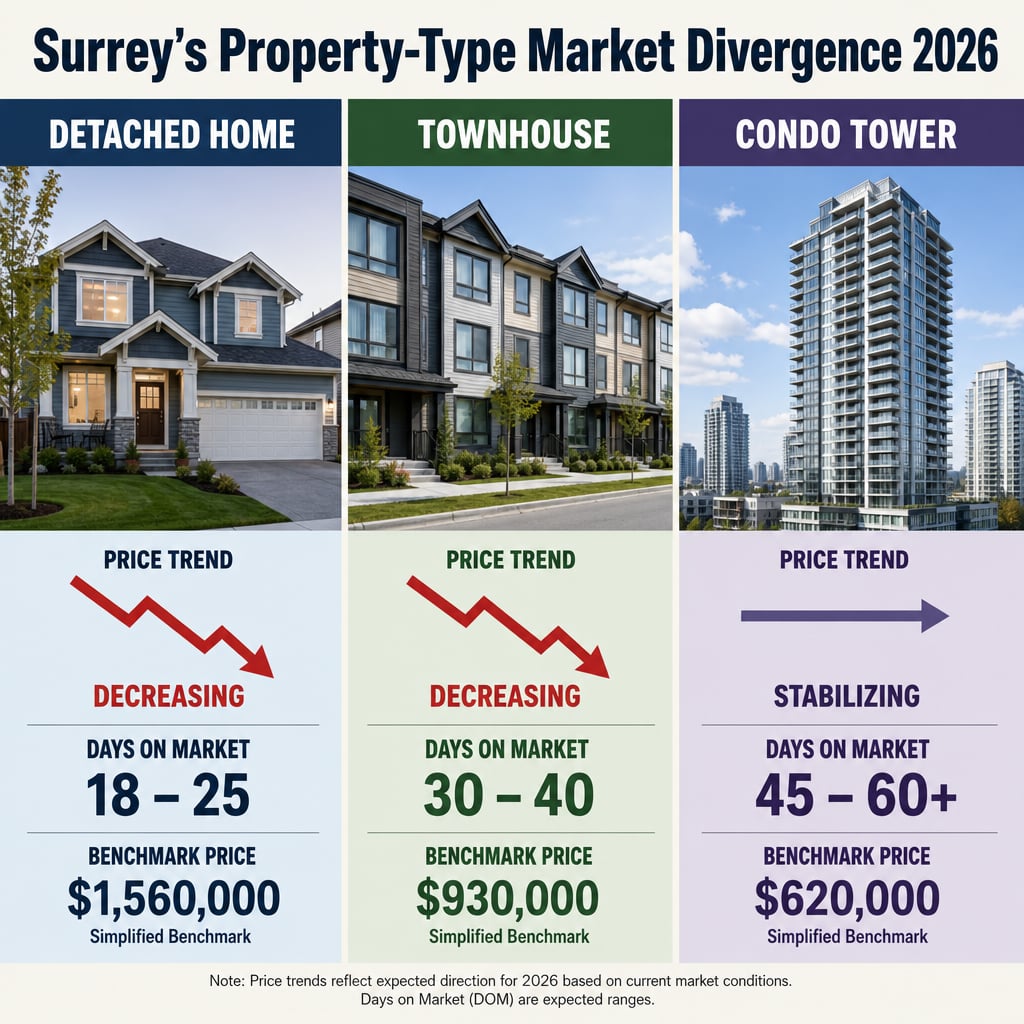
Surrey's real estate market in 2026 is not one market. It is three, moving at measurably different speeds, with different buyer profiles, different financing dynamics, and opposite seller strategies. Detached homes under $800,000 in Fleetwood and Guildford are selling in under 25 days. Condos in Surrey City Centre are sitting 45 to 60 days or longer. Townhouses occupy a narrow middle window that is closing. This article breaks down what is driving each segment and what to do about it — whether you are buying, selling, or deciding which property type to target.
For context on overall Surrey benchmark prices and sales-to-active ratios across neighbourhoods, see the Surrey Real Estate Market Report 2026, which anchors the data used throughout this article.
Short Answer
Surrey's detached, townhouse, and condo segments are diverging structurally in 2026 — not just in price, but in speed, buyer type, and financing risk. Detached homes under $800K in SkyTrain-adjacent neighbourhoods are selling 40–60% faster than average. Condos face an 8.1% YoY benchmark decline with extended days on market driven by new supply, rising strata fees, and investor exit. Townhouses hold a temporary pricing advantage that narrows as summer inventory arrives.
Key Takeaways
- Detached homes under $800K in Fleetwood and Guildford are selling in 18–25 days, 40–60% faster than the Surrey city average.
- Surrey condo benchmark prices declined 8.1% YoY to $491,600, with 45–60+ day market times driven by new supply and strata fee pressure.
- 800–1,200 new condo units complete annually in Surrey City Centre through 2027, compressing rental yields below 4% cap rates.
- Townhouse sales-to-active ratios of 15–23% signal residual pricing power — but summer inventory will narrow that window quickly.
- Strata fee increases of 3–5% YoY are triggering buyer financing denials, a structural risk that detached sellers do not face.
Who This Applies To
- Owner-occupant buyers upgrading from Metro Vancouver rentals into Surrey detached homes
- Condo sellers in Surrey City Centre, Whalley, or Newton evaluating timing and realistic pricing
- Townhouse sellers with a Q2 or Q3 2026 sale window who need to understand the compression risk ahead
- Investors holding Surrey condos evaluating exit timing against CMHC rule changes and yield erosion
- First-time buyers deciding between a condo entry point and a townhouse stretch in Fleetwood, Guildford, or Willoughby
When This Advice May Not Apply
Detached properties outside SkyTrain proximity corridors, luxury condos above $800,000, and strata units with current reserve fund surpluses may behave differently. Individual suite condition, strata governance quality, and building age can each override segment-level patterns. This analysis reflects general segment behaviour — specific properties may vary materially.
Data Used in This Article
- FVREB Monthly Statistics, June 2026 — benchmark prices, sales-to-active ratios by area and property type (official board data)
- BC MLS Days-on-Market Data, April–June 2026 — Fleetwood, Guildford, Newton, Whalley, Surrey City Centre by property type
- Mansour Real Estate Group Transaction Analysis, 2026 — speed-to-sale variance, buyer profile segmentation, carrying cost observations (internal professional analysis)
- Bank of Canada Mortgage Data and CMHC Rule Changes, 2026 — financing dynamics by property type and buyer segment (official/regulatory)
- TransLink SkyTrain Expo Line Extension Project Timeline, 2026 — infrastructure-driven buyer migration analysis (official TransLink)
Key Definitions
Benchmark Price: The price of a typical property in a given area and category, adjusted for size and features. Used by the FVREB for consistent segment comparisons.
Sales-to-Active Ratio: The percentage of active listings that sold in a given month. Below 12% favours buyers. Above 20% favours sellers. 15–20% is balanced.
Cap Rate: Annual net rental income divided by purchase price. Below 4% signals that rental yield no longer justifies carrying costs at current prices.
Special Levy: A one-time strata fee charged to unit owners to fund repairs not covered by the reserve fund. Can trigger buyer financing denial.
Why Detached Homes Under $800K Are Moving Faster Than Expected
The core driver is not just affordability — it is affordability with transit certainty. Confirmed SkyTrain Expo Line extension station locations in Fleetwood and Guildford have resolved the planning uncertainty that previously kept some buyers hesitant. Owner-occupant buyers migrating from Metro Vancouver, where equivalent detached properties trade at $1.4M to $1.8M, can now access sub-$800K detached homes with a defined commute path. That combination is rare in Metro Vancouver and is producing real demand compression in a specific price band.
According to BC MLS days-on-market data for April through June 2026, detached homes in the $650,000 to $799,000 range in Fleetwood and Guildford are selling in 18 to 25 days — 40 to 60% faster than the Surrey city-wide average. This is not a seasonal spike. It reflects a structural buyer shift: renters in Burnaby and East Vancouver who qualify for detached ownership in Surrey but cannot do so closer to downtown are moving their search east, and they are motivated.
For sellers in this segment, the implication is that pricing confidence is warranted — but pricing above the $800K threshold moves a property into a slower tier. The $800K boundary is real in this market, shaped by mortgage qualification thresholds, buyer psychology, and the density of competing inventory above that price point.
Why Surrey Condos Are Under Structural Pressure — and What That Means for Sellers and Buyers
The condo segment's challenges in 2026 are not primarily cyclical. They are structural, driven by three simultaneous forces. First, 800 to 1,200 new units are completing annually in Surrey City Centre through 2027, according to FVREB data and Mansour Real Estate Group's market tracking. New completions create direct listing competition that resale condos cannot easily overcome on features, warranty, or marketing.
Second, strata fees are rising 3 to 5% per year as buildings age and deferred maintenance catches up. Buyers financing through insured mortgages face strata fee calculations that reduce their qualifying purchase price — a mechanical constraint that is shrinking the effective buyer pool for older Surrey condo buildings. When strata fees trigger a financing denial mid-transaction, the seller restarts entirely.
Third, investor-owned inventory is increasing. Institutional and small-scale investors who purchased Surrey condos at 2021 and 2022 prices are exiting ahead of CMHC insurance rule changes and as cap rates fall below 4%. That exit pressure adds supply to a segment already contending with new completions and a tighter owner-occupant buyer pool. The result is a Surrey condo benchmark price of $491,600 in 2026 — down $43,000 year over year, a decline of 8.1%.
For buyers, the counter-intuitive opportunity is in well-managed buildings with strong reserve funds, low strata fees relative to unit size, and buildings not in the immediate shadow of new tower completions. Those buildings are priced down along with the broader segment but carry meaningfully less risk. For buyers evaluating specific Surrey neighbourhoods and entry price bands, building-level due diligence is more important than segment-level timing.
How We Evaluate This
Mansour Real Estate Group tracks days-on-market, sales-to-active ratios, and benchmark price trends by property type and sub-area across the Fraser Valley each month. For Surrey, we segment analysis by price band and proximity to transit infrastructure — because in this market, a $750,000 detached home in Fleetwood and a $750,000 detached home in South Surrey are not in the same competitive environment.
For condo clients, we review strata documents — including Form B, the depreciation report, and the most recent AGM minutes — before advising on purchase risk or listing strategy. A building's financial health can make a $500,000 condo more defensible than a $480,000 condo in the same tower cluster, depending on what the documents reveal. That analysis does not show up in benchmark price averages.
Seller Strategy by Segment
Detached Home Sellers: Price Within the Threshold, Move Quickly
Sellers with detached homes under $800,000 in Fleetwood, Guildford, Newton, or Cloverdale are in the strongest relative position of the three segments. Demand from Metro Vancouver migrants is active, days on market are short, and multiple-offer scenarios remain possible in well-priced listings. The primary risk is overpricing past the $800K threshold, which pushes the property into a slower, thinner buyer pool.
Preparation still matters. Buyers in this segment are typically owner-occupants who will live in the home, so condition, deferred maintenance visibility, and curb presentation affect offer confidence. A well-prepared $749,000 listing tends to outperform a deferred-maintenance $729,000 listing in both speed and final price.
Condo Sellers: Differentiate on Building Quality and Price Precisely
Condo sellers in 2026 cannot rely on segment momentum. They need to differentiate on what buyers actually worry about: strata fees, special levy history, reserve fund adequacy, and building management quality. A seller who proactively assembles the depreciation report, Form B, and strata financial statements as part of the listing package removes a friction point that causes buyer hesitation.
Pricing must reflect current comparable sales, not 2023 or 2024 purchase prices. The 8.1% YoY benchmark decline is an average — individual buildings with higher strata fees or recent special levies are declining more. Sellers who price to 2022 values and reduce in stages add days on market and signal weakness to negotiating buyers.
Townhouse Sellers: Act Before Summer Inventory Compresses the Window
Townhouses at 15–23% sales-to-active ratios still carry pricing leverage, but the summer 2026 inventory surge and new construction completion waves are approaching. Sellers who list in May and June are capturing the tail end of the most competitive buyer environment townhouses will see this cycle. Waiting until fall means competing against a larger pool of both resale and new construction options, likely at compressed prices.
Seller Checklist by Segment
Detached Sellers
- Confirm current benchmark price for your sub-area and price band with a formal CMA
- Verify your list price stays at or below the $800K financing threshold if your property allows it
- Address visible deferred maintenance before listing — owner-occupant buyers are sensitive to condition
- Confirm SkyTrain station proximity and walking time — buyers will ask and agents will verify
- Review municipal zoning changes that may affect buyer assumptions about lot use or densification potential
Condo Sellers
- Obtain Form B, the depreciation report, and the last two AGM minute packages before listing
- Calculate your monthly strata fee as a percentage of comparable buildings — buyers will compare
- Price to current sales, not to your purchase price or assessed value
- Identify any upcoming special levies or known capital repair items that buyers will discover in due diligence
- Stage or declutter to differentiate from investor-owned units listed vacant or unfurnished
Townhouse Sellers
- List before summer inventory surge — Q2 2026 is the stronger window
- Identify nearby new construction completions that will directly compete with your resale listing
- Confirm strata health and fee trajectory — townhouse buyers are increasingly aware of condo segment risks
- Position on lot size, private outdoor space, and parking — where townhouses materially outperform condos
What We Commonly See
Condo sellers pricing to purchase cost, not current market. In our experience, the most common mistake in the current Surrey condo market is a seller who paid $534,000 in 2022 and lists at $534,000 in 2026. The benchmark has moved. Comparable sales will not support that price. Buyers negotiating in a segment with 45–60 days of average market time have leverage, and they use it. Sellers who start at the wrong number and reduce in steps lose more than sellers who price accurately at the start.
Detached sellers underestimating buyer urgency in the sub-$800K band. What often happens is a seller lists conservatively in Fleetwood, gets multiple showings in the first week, and then either accepts an early offer below market or reprices upward — disrupting momentum. The sub-$800K detached market in SkyTrain-adjacent Surrey is active enough that a well-prepared listing at the right price should expect a competitive offer environment within the first 10 days. Sellers who hesitate at that moment often see activity cool.
Townhouse sellers treating the decision as low-urgency. A common mistake is treating the townhouse sale as a fall project when the data argues for spring or early summer action. Summer inventory compression is measurable in the Fraser Valley every year, and 2026 adds the variable of new construction completions entering the same buyer pool. The window is not closed — but it is narrowing each month.
Questions and Answers
Why are Surrey condos declining while detached homes are stabilizing?
The causes are different for each segment. Condos face simultaneous pressure from new supply completions in Surrey City Centre, rising strata fees that reduce buyer qualification amounts, and investor exit inventory. Detached homes benefit from owner-occupant demand from Metro Vancouver buyers seeking affordability with confirmed transit access. These are structural differences, not temporary fluctuations.
Is now a good time to buy a condo in Surrey?
Possibly — but building selection is more important than timing. The segment-wide benchmark decline means prices are lower than 2022 highs, which benefits buyers. The risk is purchasing in a building with rising strata fees, upcoming special levies, or poor reserve fund health. Due diligence on strata documents before any offer is essential. Buyers should consult a legal advisor to review strata financial statements before committing.
Will townhouse prices in Surrey drop further in 2026?
Townhouse prices are down $45,000 YoY but sales-to-active ratios remain in the 15–23% range, which preserves some seller negotiating position. The risk of further compression increases after summer, when new construction completions and seasonal inventory both add supply. Sellers positioned to list before July 2026 are capturing the stronger window in this cycle.
In Summary
Surrey's real estate market in 2026 has fractured into three distinct performance zones. Detached homes under $800,000 in SkyTrain-adjacent neighbourhoods are moving faster than they have in years, driven by owner-occupant migration from Metro Vancouver with confirmed transit infrastructure to validate the commute. Condos face structural headwinds from new supply, strata fee pressure, and investor exit — and sellers in this segment need accurate pricing and proactive documentation to compete. Townhouses occupy a temporary window of pricing leverage that narrows as summer inventory and new construction completions converge. The right strategy in 2026 depends entirely on which segment you are in — and there is no single Surrey market answer that applies to all three.
Ready to Evaluate Your Property's Position?
Whether you are a condo seller trying to understand realistic pricing, a detached homeowner in Fleetwood or Guildford assessing your timing, or a buyer weighing segments, Mansour Real Estate Group offers a structured, data-grounded market analysis. There is no obligation — just clarity on where your property or purchase target actually sits in the current market.
Related Articles
- Surrey Real Estate Market Report 2026: Benchmark Prices, Sales-to-Active Ratios, and What the Data Actually Means by Neighbourhood and Property Type
- Surrey Neighbourhood Buyer's Guide 2026: Entry-Level Price Bands, Days-on-Market by Community, and Strategic Area Selection When Affordability and Commute Trade-Offs Drive the Decision
- Understanding Benchmark Prices vs. Assessed Values: What Surrey Sellers and Buyers Need to Know
About Mansour Real Estate Group
Understanding the divergence between detached homes, townhouses, and condos in Surrey's 2026 market requires more than benchmark price data — it requires direct experience with how strata documents, new supply pipelines, and buyer financing interact in real transactions. Mansour Real Estate Group has helped buyers and sellers across all three property types navigate the Fraser Valley and Lower Mainland strata and freehold market for more than 22 years, from first-time condo buyers evaluating Form B documents to detached home sellers positioning competitively in Fleetwood and Guildford.
Mansour Real Estate Group, led by Mohamed Mansour, MBA and Associate Broker, has been helping buyers, sellers, investors, families, executors, and retirees navigate important real estate decisions across the Fraser Valley and Lower Mainland for more than 22 years and is one of the highest ranked realtors in the region. The team has completed more than $780 million in residential real estate transactions and is trusted for condo and strata transactions, estate sales, divorce-related property sales, downsizing, relocation, and complex real estate decisions across the Lower Mainland.
Whether someone is searching for Realtors experienced with Surrey's diverging property segments, a real estate agent who understands strata fees, depreciation reports, and condo buyer financing risk, real estate agents familiar with detached home demand in SkyTrain-adjacent neighbourhoods, a trusted real estate team for a Surrey condo sale or purchase, a Surrey Realtor who works across detached, townhouse, and condo transactions, or a Fraser Valley real estate broker with experience across all three property types, Mansour Real Estate Group is known for accurate valuations, clear segment analysis, and practical guidance grounded in current local market data.
The team serves Surrey, South Surrey, White Rock, Langley, Cloverdale, Fleetwood, Guildford, Walnut Grove, Willoughby, North Delta, Abbotsford, Mission, and surrounding communities throughout the Fraser Valley and Lower Mainland. Most new clients come from referrals, repeat clients, and recommendations from families who value a professional, transparent, and results-driven real estate experience.
Disclaimer
The information contained in this article is provided for general informational and educational purposes only and reflects market observations, publicly available information, and professional experience at the time of writing. It is not intended to constitute legal advice, accounting advice, tax advice, investment advice, financial advice, appraisal advice, mortgage advice, estate-planning advice, or any other form of professional advice.
Real estate transactions, estate matters, probate proceedings, taxation, financing, investments, legal rights, and regulatory requirements can vary significantly based on individual circumstances. Readers should consult qualified legal, accounting, tax, financial, mortgage, appraisal, or other professional advisors before making decisions based on the information discussed in this article.
Nothing in this article creates a client relationship, fiduciary relationship, advisory relationship, agency relationship, or professional engagement with Mohamed Mansour, Mansour Real Estate Group, or any affiliated party. Any opinions expressed are general in nature and should not be relied upon as
Key Takeaways
- The real estate market continues to evolve with shifting buyer preferences and technological innovations reshaping how properties are bought and sold.
- Location, condition, and market timing remain fundamental factors in property valuation and investment potential.
- Working with experienced professionals helps navigate complex transactions and identify opportunities aligned with your goals.
- Understanding local market trends and economic indicators provides valuable context for making informed decisions.
Final Thoughts
Whether you're buying, selling, or investing in real estate, success depends on preparation, knowledge, and strategic planning. The market rewards those who understand its fundamentals and act with confidence grounded in solid research. As you move forward with your real estate journey, remember that every property tells a story, and every transaction is an opportunity to build toward your vision of home or investment success.
Stay informed, trust your instincts supported by data, and don't hesitate to seek expert guidance when navigating complex decisions. Your real estate goals are within reach with the right approach and support.



