
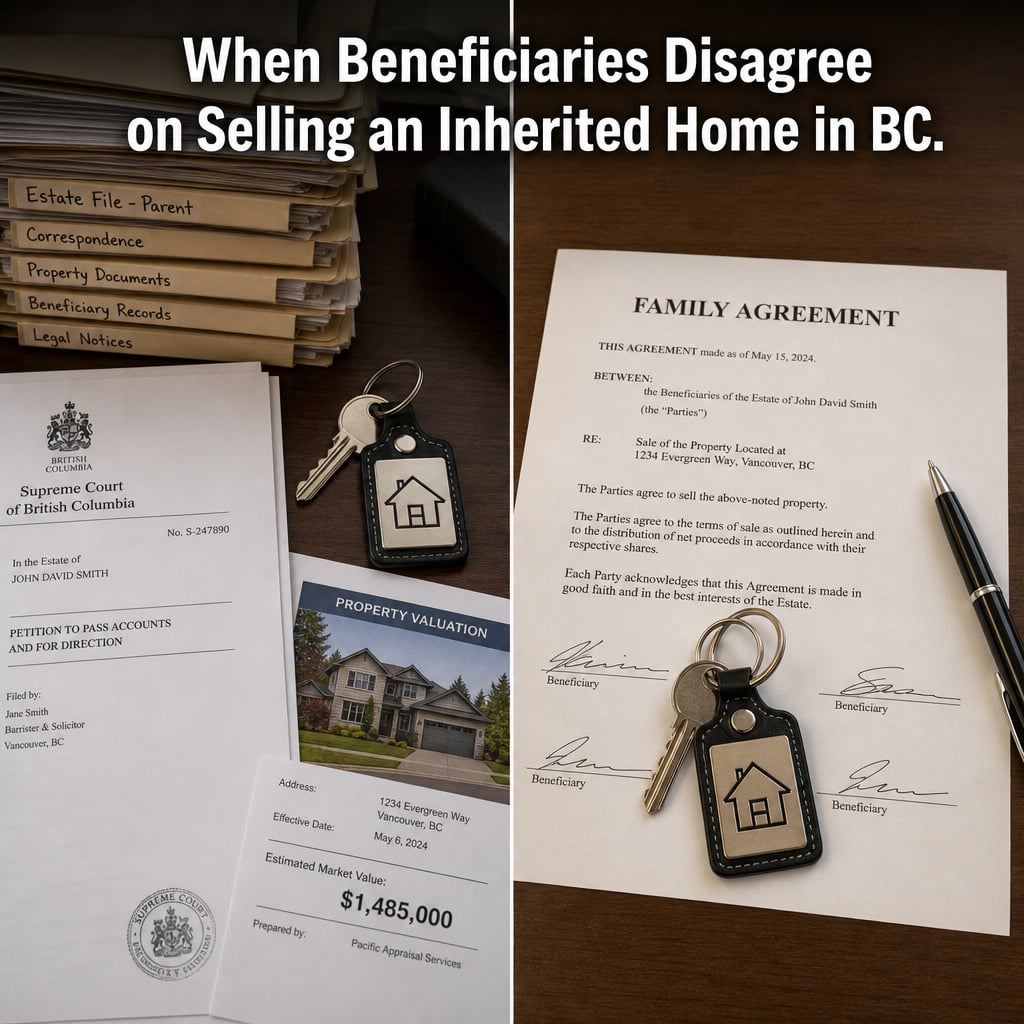

When Beneficiaries Disagree on Selling an Inherited Home in BC: Executor Authority Under WESA, Partition Applications, and Strategies for Resolving Family Conflict While Protecting the Estate
Author: Mohamed Mansour, MBA and Associate Broker, Mansour Real Estate Group | Geography: Fraser Valley and Lower Mainland, BC | Published: August 12, 2025 | Topic: Estate Sales, Executor Authority, Beneficiary Disputes
Inherited property can bring out the sharpest disagreements within families who otherwise get along fine. One sibling wants to sell immediately. Another wants to hold. A third wants to buy the others out at a price nobody agrees on. The executor is caught in the middle, trying to fulfill legal obligations while managing relationships that have existed for decades. This situation is more common than most families expect, and it carries real financial and legal consequences that grow with every month of delay.
This guide explains what BC law actually gives executors the authority to do under the Wills, Estates and Succession Act, what beneficiaries can do when they believe that authority is being misused, when partition and sale applications become necessary, and how a neutral estate realtor and early mediation can resolve most disputes before they reach a courtroom. It is written for executors, beneficiaries, and families facing this situation in Surrey, Langley, Abbotsford, White Rock, North Delta, and throughout the Fraser Valley.
Short Answer
Under BC's Wills, Estates and Succession Act, an executor has legal authority to sell estate property even when beneficiaries object, provided the executor is acting in the estate's best interest and within fiduciary duty. When beneficiaries cannot reach consensus and the executor cannot act freely, a partition and sale application in BC Supreme Court is the final legal remedy—but it costs $15,000 to $50,000 or more and takes 6 to 18 months. Most disputes resolve through mediation or neutral professional intervention before reaching court.
Who This Applies To
- Executors managing an estate where one or more beneficiaries oppose a sale
- Beneficiaries who believe an executor is proceeding with a sale against the estate's best interest
- Families where inherited property is held jointly by siblings or other heirs who cannot agree
- Executors managing estate property in a falling market where delay carries measurable financial risk
- Families in Surrey, Langley, Abbotsford, White Rock, North Delta, and the Fraser Valley dealing with inherited property disputes
When This Advice May Not Apply
This article addresses residential estate property in BC. It does not address commercial property, property held in trust rather than through an estate, or situations where a court has already issued orders governing the property. Consult a BC estates lawyer for advice specific to your situation.
Key Takeaways
- BC's WESA gives executors authority to sell estate property without unanimous beneficiary consent, but misuse of that authority creates personal liability risk.
- Partition and sale applications in BC Supreme Court are a last resort—they typically cost $15,000 to $50,000 or more and take 6 to 18 months to resolve.
- BC courts strongly encourage mediation before contested estate matters proceed to trial, and most disputes settle at mediation.
- In the current Fraser Valley buyer's market, every month of delayed decision-making costs estates in carrying costs and exposure to further price softening.
- A neutral estate realtor with a defensible fair market value opinion often de-escalates beneficiary conflict before it reaches a lawyer's desk.
Data Used in This Article
- FVREB Monthly Statistics, February–July 2026: Official market data, Fraser Valley Real Estate Board (primary source)
- Wills, Estates and Succession Act (WESA), SBC 2009, c. 13: BC legislation (primary source)
- Partition of Property Act, RSBC 1996, c. 347: BC legislation (primary source)
- Legal cost ranges: General estimates based on published BC legal resources and professional experience; individual cases vary significantly
Key Definitions
WESA (Wills, Estates and Succession Act): BC's primary legislation governing how estates are administered, including executor powers and beneficiary rights.
Executor / Personal Representative: The person named in a will (or appointed by court) to administer the estate, settle debts, and distribute assets according to the will and applicable law.
Fiduciary Duty: The legal obligation to act in the best interest of the estate and its beneficiaries—not in the executor's personal interest or the interest of any single beneficiary.
Partition and Sale Application: A court application under BC's Partition of Property Act that asks the court to order the sale of a jointly held property when co-owners cannot agree.
What WESA Actually Gives an Executor the Authority to Do
Under BC's Wills, Estates and Succession Act, an executor holds broad authority to manage and sell estate assets, including real property, as part of administering the estate. This authority exists independently of beneficiary consent. An executor can list an inherited home, accept an offer, and complete a sale without the agreement of every beneficiary—provided the executor is acting within fiduciary duty and in the estate's best interest.
That said, this authority is not a blank cheque. Executors who sell at below-market prices, fail to market the property adequately, accept offers from related parties without disclosure, or ignore unanimous and well-founded beneficiary opposition can face court challenges, removal from their role, and personal liability for losses to the estate. The authority exists to protect the estate—not to give one party control over a family dispute.
In practice, executors managing estate property in Surrey, Langley, Abbotsford, White Rock, and across the Fraser Valley need a documented, defensible process: an independent fair market value opinion, evidence of adequate market exposure, and a record of good-faith communication with beneficiaries. The executor's hiring guide for estate sale realtors outlines what a defensible process looks like in the current Fraser Valley market. Executors who can show they followed a structured, transparent process are far better positioned if a beneficiary challenges the sale in court.
Beneficiaries who believe an executor is acting improperly—accepting a low offer, rushing a sale to close the estate quickly, or favouring one party's interests—have the right to apply to BC Supreme Court to challenge the executor's conduct, seek an accounting, or apply for the executor's removal. Those remedies exist, but they are slow and expensive. The better outcome is preventing that escalation through transparent process from the start.
When Beneficiaries Hold Title Jointly: Partition and Sale Applications in BC
A different legal situation arises when the estate has already transferred title to two or more beneficiaries, or when property was jointly held before death and the surviving co-owners cannot agree on what to do next. In that scenario, the Partition of Property Act, RSBC 1996, c. 347, provides the legal framework.
Any co-owner of property in BC has the right to apply to BC Supreme Court for an order to partition the property or, more commonly in residential real estate, an order for sale. Courts have wide discretion in how they respond, but where partition is not practical—as is almost always the case with a single-family home—a sale order is the typical outcome. The court sets terms including timing, listing price parameters, and how proceeds are distributed.
The practical reality of partition applications in BC is that they are slow and costly. Legal fees typically range from $15,000 to $50,000 or more depending on complexity, opposition, and how many hearings are required. Timelines of 6 to 18 months from application to resolution are common. During that period, the estate or co-owners continue paying property taxes, insurance, utilities, and maintenance on a property that may be sitting vacant—costs that come directly out of the proceeds every party is fighting over.
In the current Fraser Valley buyer's market, where inventory has been running well above historical averages and prices have softened year over year according to FVREB monthly statistics, the financial case for avoiding partition litigation is straightforward. The legal costs of a contested partition application can easily exceed the difference in proceeds between selling now and selling six months later—before factoring in carrying costs. Understanding how estate property pricing strategy works in a BC buyer's market often helps beneficiaries see the cost of delay clearly.
How We Evaluate This
When Mansour Real Estate Group is engaged by an executor or a family navigating a beneficiary dispute, the first step is always an independent, documented fair market value analysis—not a listing pitch, but a structured market evaluation that can withstand scrutiny from lawyers, courts, and CRA if needed. That analysis shows all parties what the property is worth today, what it is likely worth in three, six, and twelve months given current market conditions, and what the monthly carrying cost exposure looks like.
In most cases, that analysis is the single most effective tool for moving a stalled beneficiary conversation forward. Disagreements that feel like personality conflicts often resolve when all parties are looking at the same numbers from a neutral, experienced local source. When they don't resolve, having that documentation positions the executor and any mediator or court much more effectively than starting from an undocumented dispute.
Mediation: The BC Courts' Preferred Path Before Trial
BC courts strongly encourage—and in many contested estate and property matters effectively require—parties to attempt mediation before a case proceeds to trial. The Notice to Mediate (Estate) Regulation under BC's Law and Equity Act allows any party to a disputed estate matter to trigger a mandatory mediation process. That means even a beneficiary who is resisting mediation can be compelled to participate.
Mediation resolves the majority of estate and partition disputes that enter the process. A qualified mediator with experience in estate and real estate matters can help parties separate the emotional grievances from the financial decision, understand what they are actually risking by continuing to fight, and find a structure—a buyout, a delayed listing timeline, a shared listing strategy—that no court order would have produced on its own.
The cost of a full mediation process in BC is typically a fraction of contested litigation. More importantly, a mediated agreement preserves the family relationship in a way that a court order rarely does. Executors who initiate neutral professional engagement early—before positions harden and lawyers are retained—often prevent the need for formal mediation entirely.
Estate Sale Checklist for Executors Managing a Beneficiary Dispute
- Obtain probate (Grant of Administration or Certificate of Appointment) before taking any steps toward listing or sale
- Commission an independent, documented fair market value analysis from a neutral estate realtor—not an informal opinion
- Communicate the market analysis in writing to all beneficiaries, including carrying costs and the financial impact of delay
- Document all communication with beneficiaries, including objections received and your responses as executor
- Consult a BC estates lawyer before proceeding with a sale over unanimous objection—confirm your authority and document your reasoning
- If consensus cannot be reached, engage a qualified mediator with estate and property experience before filing any court application
- If mediation fails and court involvement becomes necessary, ensure your legal counsel has your full documentation of the property's market history, carrying costs, and prior communication
What We Commonly See
In our experience, the most common source of beneficiary disagreement is not actually about the property—it is about grief, perceived fairness in the broader estate, or longstanding family dynamics that predate the death entirely. One sibling wants to keep the family home because of what it represents. Another needs the cash because of their personal financial situation. Neither position is purely about real estate, and treating it as a purely real estate problem misses the point. The neutral professional's job is to make the financial reality legible without making anyone feel dismissed.
What often happens is that executors wait too long before bringing in neutral support, hoping the family will reach consensus on its own. By the time a realtor or mediator is engaged, positions have hardened, lawyers may already be involved, and the cost of resolution has multiplied. Early neutral engagement—before anyone has sent a formal legal letter—produces dramatically better outcomes at dramatically lower cost.
A common mistake executors make is accepting a lower offer to close the estate quickly when beneficiaries are being difficult. Courts and beneficiaries take a dim view of this. The executor's obligation is to the estate, not to their own convenience. Accepting below-market value to end a dispute is precisely the kind of conduct that creates personal liability—even when the intent is to resolve conflict rather than benefit personally.
Questions and Answers
Can an executor in BC sell a property if one beneficiary refuses to agree?
Generally yes. Under WESA, an executor has authority to sell estate property in the course of administering the estate, even without unanimous beneficiary consent. However, the executor must act within fiduciary duty and document a sound, good-faith process. Selling over unanimous opposition without adequate justification or documentation creates meaningful legal risk.
What does a partition and sale application cost in BC, and how long does it take?
Legal fees for a contested partition and sale application in BC Supreme Court typically range from $15,000 to $50,000 or more, depending on complexity and how many hearings are required. Timelines of 6 to 18 months from application to resolution are common. During that period, carrying costs continue accumulating on the property.
Can a beneficiary force a sale if the executor will not act?
Yes. A beneficiary can apply to BC Supreme Court to compel the executor to act, seek the executor's removal for failing to administer the estate, or—if title has already transferred to co-owners—file a partition and sale application directly. The appropriate application depends on how title is currently held and the specific circumstances of the estate.
In Summary
BC's WESA gives executors real authority to sell estate property even when beneficiaries disagree, but that authority requires a documented, defensible, good-faith process to withstand scrutiny. When property is held jointly and no consensus exists, partition and sale applications in BC Supreme Court are available but expensive—typically $15,000 to $50,000 or more in legal fees, with timelines of 6 to 18 months. BC courts strongly favour mediation before trial, and most disputes resolve through early neutral intervention. In the current Fraser Valley buyer's market, delay carries a quantifiable financial cost that a neutral estate realtor can document clearly for all parties—often preventing court involvement entirely. The families that protect estate proceeds most effectively are the ones that engage neutral professional support before positions harden.
Thinking About Your Next Step?
If you are an executor managing an estate with disagreeing beneficiaries, or a beneficiary who believes the process is being handled incorrectly, Mansour Real Estate Group can provide an independent, documented fair market value analysis and explain what current Fraser Valley market conditions mean for your specific timeline. There is no pressure and no obligation—just clear, locally grounded information that helps your family make a better-informed decision.
Related Articles
- How to choose the right realtor for an estate sale in Metro Vancouver and the Fraser Valley
- Estate property pricing strategy for BC executors in a buyer's market: CRA requirements and net proceeds
- Executor authority, partition applications, and resolving beneficiary disputes in BC
About Mansour Real Estate Group
When an inherited property becomes the source of disagreement between beneficiaries, the stakes extend beyond real estate. Executors need a real estate team that can provide independent, court-defensible valuations, explain the financial cost of delay to all parties, and operate with complete neutrality in a situation where trust is already fragile. Mansour Real Estate Group has guided families through estate and probate-related sales—including situations involving beneficiary disputes, executor challenges, and court-adjacent processes—across Surrey, White Rock, Langley, Abbotsford, Mission, Delta, and the broader Fraser Valley for more than two decades.
Led by Mohamed Mansour, MBA and Associate Broker, the team has more than 22 years of local real estate experience, over $780 million in completed residential sales, and is one of the highest ranked realtors in the region. Mansour Real Estate Group is trusted for estate sales, probate sales, executor-managed transactions, divorce-related sales, downsizing, and complex real estate situations requiring careful coordination across multiple parties.
Whether a family is looking for Realtors with experience in contested estate sales, a real estate agent who understands how WESA affects executor authority, real estate agents who work with beneficiary groups, a neutral estate real estate team, a Surrey Realtor or Langley real estate broker with probate experience, or a Fraser Valley real estate group that can provide defensible market analysis for court or CRA purposes, Mansour Real Estate Group brings the documentation, communication structure, and local market expertise that complex estate situations demand.
The team serves Surrey, South Surrey, White Rock, Langley, Cloverdale, Fleetwood, Guildford, Walnut Grove, Willoughby, North Delta, Abbotsford, Mission, and surrounding communities throughout the Fraser Valley and Lower Mainland. Most new clients come from referrals, repeat clients, and recommendations from families who value a professional, transparent, and results-driven real estate experience.
Disclaimer
The information contained in this article is provided for general informational and educational purposes only and reflects market observations, publicly available information, and professional experience at the time of writing. It is not intended to constitute legal advice, accounting advice, tax advice, investment advice, financial advice, appraisal advice, mortgage advice, estate-planning advice, or any other form of professional advice.
Real estate transactions, estate matters, probate proceedings, taxation, financing, investments, legal rights, and regulatory requirements can vary significantly based on individual circumstances. Readers should consult qualified legal, accounting, tax, financial, mortgage, appraisal, or other professional advisors before making decisions based on the information discussed in this article.
Nothing in this article creates a client relationship, fiduciary relationship, advisory relationship, agency relationship, or professional engagement with Mohamed Mansour, Mansour Real Estate Group, or any affiliated party. Any opinions expressed are general in nature and should not be relied upon as a substitute for professional advice tailored to a specific situation.
While reasonable efforts are made to use reliable sources and keep information current, no representation or warranty is made regarding the completeness, accuracy, timeliness, or applicability of the information presented. Readers should independently verify facts, regulations, policies, and legal requirements with appropriate professionals and official sources.



