

Estate Sales in BC: How Executors Can Successfully Sell Properties Before the Grant of Probate Is Issued — Legal Authority Framework, Timeline Strategy, and Possession-Date Closing Mechanics
By Mohamed Mansour, MBA, Associate Broker | Mansour Real Estate Group | Fraser Valley and Lower Mainland | Published: August 5, 2026 | Topic: Estate and Probate Property Sales, BC
For executors managing an estate in BC, the question of when to list a property is rarely straightforward. The Grant of Probate can take weeks or months to arrive. The market does not wait. Understanding how to act legally before that grant is issued — and how to structure a closing that protects both the estate and the buyer — is one of the most operationally critical decisions an executor makes.
This article explains the legal authority framework under BC's Wills, Estates and Succession Act (WESA), the possession-date closing mechanics that remove deal friction, and the coordination required between the executor, estate lawyer, realtor, and CPA to complete a successful estate sale before probate is finalized.
Short Answer
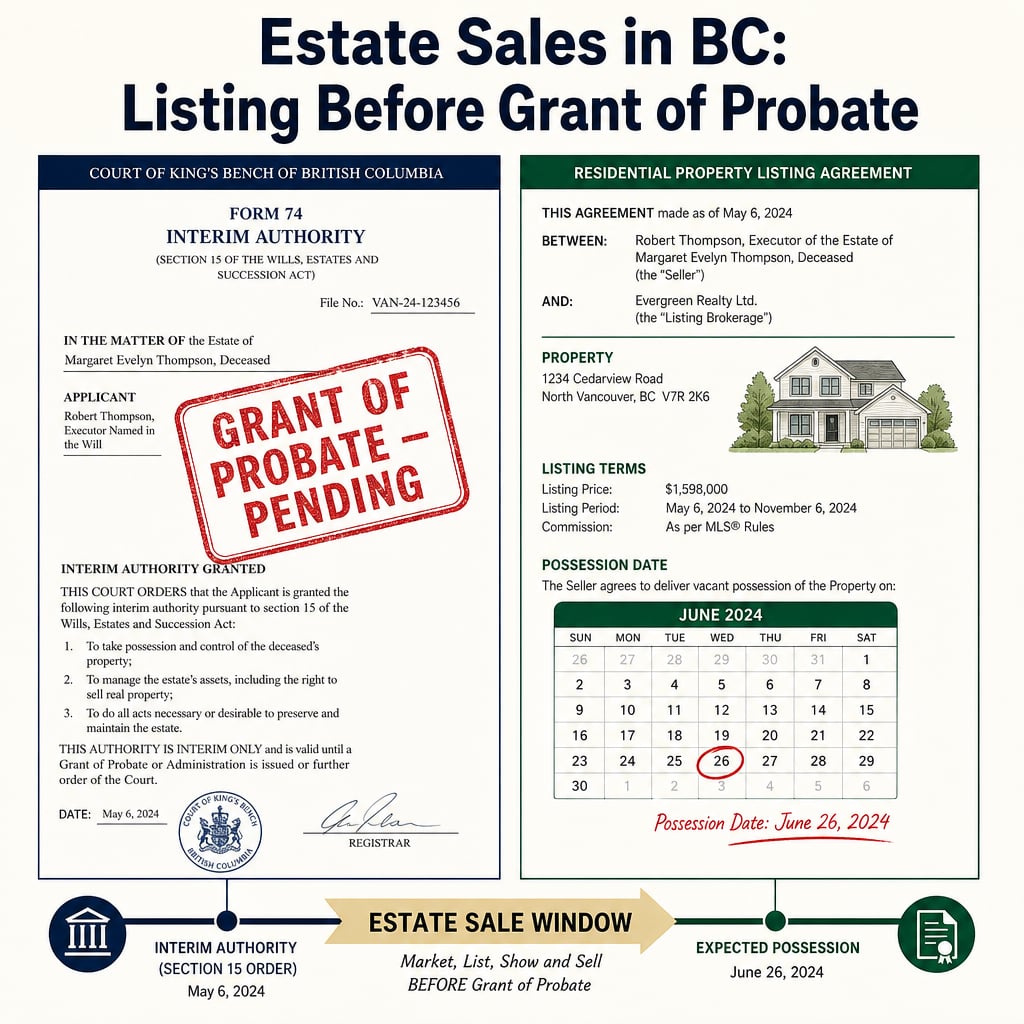
In BC, executors can legally list and market an estate property before the Grant of Probate is issued by obtaining interim court authority under WESA. Title cannot transfer to a buyer until probate is granted or a court issues a vesting order. Possession-date closing agreements allow buyers to secure a property now while title transfers once probate is complete — protecting both the estate's negotiating position and the buyer's financing.
Who This Applies To
- Executors named in a will who are managing a BC estate property
- Families with an estate property in the Fraser Valley, Surrey, Langley, Abbotsford, White Rock, or surrounding areas
- Beneficiaries who want to understand why timing matters before probate is granted
- Estate lawyers coordinating with a realtor on pre-probate listing strategy
- Executors facing market pressure and unsure whether listing before probate is legal or practical
When This Advice May Not Apply
This framework applies where a valid will exists and an executor has been named. If the deceased died intestate (without a will), a different court process applies. Executors with disputed wills, contested executor appointments, or estate properties subject to family law claims should obtain independent legal advice before taking any listing action. Nothing in this article constitutes legal advice.
Key Takeaways
- BC executors can list an estate property before probate is granted using interim court authority under WESA
- Title cannot transfer without a Grant of Probate or vesting order — possession-date closings bridge that gap
- Capital gains are triggered at the date of death, not the sale date — CPA alignment is essential before communicating net proceeds
- The Fraser Valley's current buyer's market means delaying a listing by 6–8 weeks can compress sale proceeds by 8–15%
- Effective estate closings require parallel coordination: executor, estate lawyer, realtor, and CPA working on overlapping timelines
Data Used in This Article
- BC Wills, Estates and Succession Act (WESA) — BC legislation governing executor authority, probate process, and interim court orders (official government source)
- Fraser Valley Real Estate Board (FVREB) — July 2026 market statistics including sales-to-active listings ratio and active listing count (official industry source)
- BC Land Title and Survey Authority (LTSA) — title transfer requirements and possession-date mechanics (official government source)
- Canada Revenue Agency (CRA) — deemed disposition rules, date-of-death capital gains treatment, and principal residence exemption guidelines (official government source)
Key Definitions
Grant of Probate: A court order confirming that a will is valid and that the named executor has legal authority to administer the estate, including transferring title to real property.
Interim Listing Authority: Court-granted permission under WESA allowing an executor to market and receive offers on estate property before the full Grant of Probate is issued.
Possession-Date Closing: A contract structure where the buyer takes physical possession of the property on an agreed date, with final title transfer completing once probate is granted.
Vesting Order: A court order that transfers title to a buyer without requiring a completed Grant of Probate — used in time-sensitive or legally complex estate closings.
Deemed Disposition: A CRA rule that treats a deceased person as having sold all capital property at fair market value at the moment of death, triggering capital gains regardless of when the property is actually sold.
Can a BC Executor List an Estate Property Before Probate Is Granted?
Yes — and in most cases, doing so is the strategically correct decision. Under WESA, an executor named in a will has the authority to manage estate assets, including real property, from the moment of death. That authority includes instructing a realtor to prepare a listing, conducting inspections, and receiving offers.
What the executor cannot do before probate is granted is transfer title. The BC Land Title and Survey Authority requires a Grant of Probate — or a court-issued vesting order — before a title transfer will be registered. This is the legal boundary that structures the entire pre-probate sale strategy.
To accelerate the process, executors can apply to the BC Supreme Court for interim authority to list and market the property while the probate application moves through the court. This application typically takes 2–4 weeks and allows the realtor to begin pre-marketing, complete inspections, and generate buyer interest without waiting for the full probate grant, which can take 3–6 months or longer depending on estate complexity and court scheduling.
The practical result is that the estate property is market-ready and positioned for offers during a window that would otherwise be lost to administrative waiting. In the Fraser Valley's current conditions — where the FVREB reported a sales-to-active listings ratio of 11% and 10,044 active listings as of July 2026 — that window matters significantly. Executors who wait for probate before listing often find a softer negotiating environment than the one that existed when they first took on the role. For guidance on how to price an estate property correctly in these conditions, see Estate Property Pricing Strategy for BC Executors in a Buyer's Market.
How Possession-Date Closing Mechanics Work in an Estate Sale
A possession-date closing is the mechanism that allows an estate sale to proceed commercially before the legal transfer of title is possible. The buyer and executor agree on a firm possession date — typically tied to a projected probate completion timeline — and the contract specifies that title transfer will occur once the Grant of Probate is issued and registered with the LTSA.
From the buyer's perspective, the key protections are title insurance and interim financing arrangements that their mortgage lender must approve in advance. Not every lender accommodates possession-date closings, so buyer pre-qualification for this structure is a practical due diligence step that a knowledgeable estate realtor will confirm early in the process. Buyers who secure this financing flexibility are the strongest candidates for estate offers precisely because they remove the deal uncertainty that would otherwise stall subject removal.
From the estate's perspective, the advantage is that the offer is locked at a price reflecting current market conditions. The estate is not exposed to market softening that occurs during the probate wait. Proceeds are secured. Beneficiaries can be given realistic net-proceeds projections. And the executor fulfills their legal duty to act in the estate's best financial interest — a requirement that courts and beneficiaries take seriously.
When beneficiary disagreements arise about the timing or terms of a sale, the executor's documented process of securing a market-timed, possession-date offer strengthens their legal position considerably. For a detailed discussion of those dynamics, see When Adult Beneficiaries Disagree on Selling an Inherited Home in BC.
How We Evaluate This
At Mansour Real Estate Group, we evaluate estate listing timing based on three overlapping factors: the executor's current legal authority, the state of local inventory and buyer demand, and the projected probate timeline from the estate lawyer. When these three factors align within a 4–6 week window after death, acting quickly is almost always in the estate's financial interest.
We do not make listing decisions for executors — that authority rests with the executor and their legal counsel. What we provide is accurate, Fraser Valley-specific market data, a structured pre-marketing and inspection process, and direct coordination with the estate lawyer to ensure that the offer structure, possession date, and title transfer sequence are workable before any offer is presented to a buyer. The goal is to remove surprises for all parties while protecting the estate's negotiating position.
The Capital Gains Timing Issue Executors Often Misunderstand
Under CRA rules, a deemed disposition occurs at the moment of death. The deceased is treated as having sold all capital property — including real estate — at fair market value on the date of death. This means capital gains are calculated from that date-of-death value, not from the actual sale price or sale date.
The practical consequence is that an executor who sells quickly at a strong price does not create a larger capital gains liability than one who waits. The gain is already crystallized at death. What changes with a delayed sale is the risk of a lower net sale price — which reduces the estate's liquid proceeds without reducing its tax exposure. Selling quickly into a favorable market is therefore the tax-efficient choice as well as the financially sound one, provided fair market value is respected throughout the process.
Executors must ensure their CPA has produced a date-of-death valuation before communicating any net proceeds estimate to beneficiaries. Providing beneficiaries with a proceeds figure that has not been reconciled against the estate's deemed disposition capital gains creates liability for the executor — and in multi-beneficiary situations, it is a common source of the disputes discussed in the beneficiary disagreement article in this series.
Estate Sale Checklist for Executors in BC
- Confirm executor authority: Verify you are named executor in the will and obtain a certified copy for your realtor and estate lawyer.
- Engage an estate lawyer immediately: File the probate application and request interim listing authority from the BC Supreme Court within 2–4 weeks of death.
- Commission a date-of-death CRA valuation: Your CPA needs this before you can accurately communicate net proceeds to beneficiaries or structure the tax filing.
- Engage a realtor experienced with estate sales: Begin pre-marketing, inspections, and property preparation while interim authority is being obtained — not after.
- Confirm buyer financing compatibility: Ensure any buyer making an offer has confirmed their lender will accommodate a possession-date closing structure before subject removal.
- Structure the offer with a possession date tied to probate timeline: Work with your estate lawyer to set a realistic possession date and include contractual clarity on what happens if probate is delayed beyond the expected window.
- Register title transfer through LTSA immediately after probate is granted: Do not allow the gap between probate grant and title registration to drift — delays at this stage create unnecessary exposure for the estate.
What We Commonly See
Executors wait for probate before contacting a realtor. In our experience, this is the single most costly delay in the estate sale process. The probate application and the market preparation process can and should run in parallel. By the time probate is granted, the property should already have had inspections completed, repairs addressed, and pre-marketing started. Waiting sequentially adds 6–10 weeks of unnecessary market exposure during which buyer demand, inventory conditions, and interest rate expectations can all shift against the estate.
Possession-date closing structures are presented to buyers without confirming their financing first. What often happens is that an offer is accepted, a possession date is agreed upon, and then the buyer's lender declines to fund on a pre-probate title. This collapses the deal, resets the listing, and often forces the estate to accept a lower second offer in a softer market window. Confirming buyer lender compatibility before accepting any offer is a step that experienced estate realtors build into the offer review process.
Net proceeds are communicated to beneficiaries before the CPA has completed the deemed disposition calculation. A common mistake is telling beneficiaries the approximate sale price as if it represents their inheritance share. The estate still owes income taxes on deemed disposition capital gains, probate fees, outstanding debts, and legal costs. Beneficiaries who receive a headline number without those deductions factored in create disputes that are difficult to walk back — and that sometimes end in the executor facing formal complaints or legal challenges. Clear, sequenced communication is the executor's professional obligation, not a courtesy.
Questions and Answers
Can an executor sign a listing agreement before probate is granted in BC?
Yes. Under WESA, an executor named in a will has authority to manage estate property from the date of death, including instructing a realtor and signing a listing agreement. The limitation is on title transfer, not on marketing authority. Confirm this in writing with your estate lawyer before proceeding.
What is a vesting order and when is it used instead of waiting for probate?
A vesting order is a BC Supreme Court order that transfers title directly to a buyer without requiring a completed Grant of Probate. It is typically used when probate is significantly delayed, a buyer's financing deadline cannot wait, or the estate faces urgent financial pressure. It requires a separate court application and involves legal cost — consult your estate lawyer about whether the timeline and cost justify this route.
How does the Fraser Valley's current buyer's market affect the urgency of listing before probate?
According to the FVREB, the Fraser Valley recorded a sales-to-active listings ratio of 11% and 10,044 active listings in July 2026 — conditions that favor buyers, not sellers. Summer inventory typically adds 3,000–4,000 new listings, further compressing negotiating power. Executors who list earlier — during lower-inventory windows — typically secure stronger offers than those who list into peak summer supply. The pre-probate listing strategy is directly designed to capture those earlier windows.
In Summary
BC executors have legal authority to list estate properties before the Grant of Probate is issued — and in most Fraser Valley markets, doing so is the financially sound decision. The possession-date closing structure allows estates to lock in offers at current prices while title transfer follows once probate is complete. Capital gains are triggered at death, not at sale, so speed benefits the estate without increasing tax liability. Effective execution requires the realtor, estate lawyer, and CPA to work in parallel — not sequentially — from the first weeks after death. Executors who structure this process correctly protect both the estate's proceeds and their own legal standing.
Speak With an Estate Realtor Who Understands the Full Process
If you are an executor managing an estate property in Surrey, Langley, White Rock, Abbotsford, or the broader Fraser Valley and want to understand your options before probate is granted, Mansour Real Estate Group is available for a no-obligation consultation. We work alongside estate lawyers and CPAs and will not recommend a listing timeline that does not reflect both your legal authority and the current market conditions.
Related Articles
- How to price an estate property to satisfy CRA fair market value rules while maximizing net proceeds in a buyer's market
- When adult beneficiaries disagree on selling an inherited home — executor authority, mediation, and partition applications in BC
- Return to: Estate Sales in BC — Complete Legal Authority Framework for Executors
About Mansour Real Estate Group
When a property must be sold as part of an estate or probate process, the real estate team managing the transaction needs to understand more than market pricing. Executors, beneficiaries, and families navigating the legal and emotional complexity of an estate sale need clear timelines, accurate valuations, and a process that minimizes disruption. Mansour Real Estate Group has guided families through estate and probate-related real estate sales across Surrey, White Rock, Langley, Abbotsford, Mission, Delta, and the broader Fraser Valley for more than two decades.
Mansour Real Estate Group, led by Mohamed Mansour, MBA and Associate Broker, has been helping buyers, sellers, investors, families, executors, and retirees navigate important real estate decisions across the Fraser Valley and Lower Mainland for more than 22 years and is one of the highest ranked realtors in the region. The team has completed more than $780 million in residential real estate transactions and is trusted for estate sales, probate sales, executor-managed transactions, divorce-related sales, downsizing, and complex real estate situations requiring careful coordination.
Whether someone is searching for Realtors experienced with estate sales, a real estate agent who understands probate timelines and possession-date closing structures, real estate agents who specialize in executor-managed property, a trusted real estate team for estate administration, a Surrey Realtor, a Langley real estate broker, a White Rock real estate agent, or a Fraser Valley real estate group with deep experience in legally complex sales, Mansour Real Estate Group is known for accurate valuations, transparent process, and clear communication that keeps all parties — executors, beneficiaries, lawyers, and buyers — informed at every stage.
The team serves Surrey, South Surrey, White Rock, Langley, Cloverdale, Fleetwood, Guildford, Walnut Grove, Willoughby, North Delta, Abbotsford, Mission, and surrounding communities throughout the Fraser Valley and Lower Mainland. Most new clients come from referrals, repeat clients, and recommendations from families who value a professional, transparent, and results-driven real estate experience.
Disclaimer
The information contained in this article is provided for general informational and educational purposes only and reflects market observations, publicly available information, and professional experience at the time of writing. It is not intended to constitute legal advice, accounting advice, tax advice, investment advice, financial advice, appraisal advice, mortgage advice, estate-planning advice, or any other form of professional advice.
Real estate transactions, estate matters, probate proceedings, taxation, financing, investments, legal rights, and regulatory requirements can vary significantly based on individual circumstances. Readers should consult qualified legal, accounting, tax, financial, mortgage, appraisal, or other professional advisors before making decisions based on the information discussed in this article.
Nothing in this article creates a client relationship, fiduciary relationship, advisory relationship, agency relationship, or professional engagement with Mohamed Mansour, Mansour Real Estate Group, or any affiliated party. Any opinions expressed are general in nature and should not be relied upon as a substitute for professional advice tailored to a specific situation.
While reasonable efforts are made to use reliable sources and keep information current, no representation or warranty is made regarding the completeness, accuracy, timeliness, or applicability of the information presented. Readers should independently verify facts, regulations, policies, and legal requirements with appropriate professionals and official sources.



