
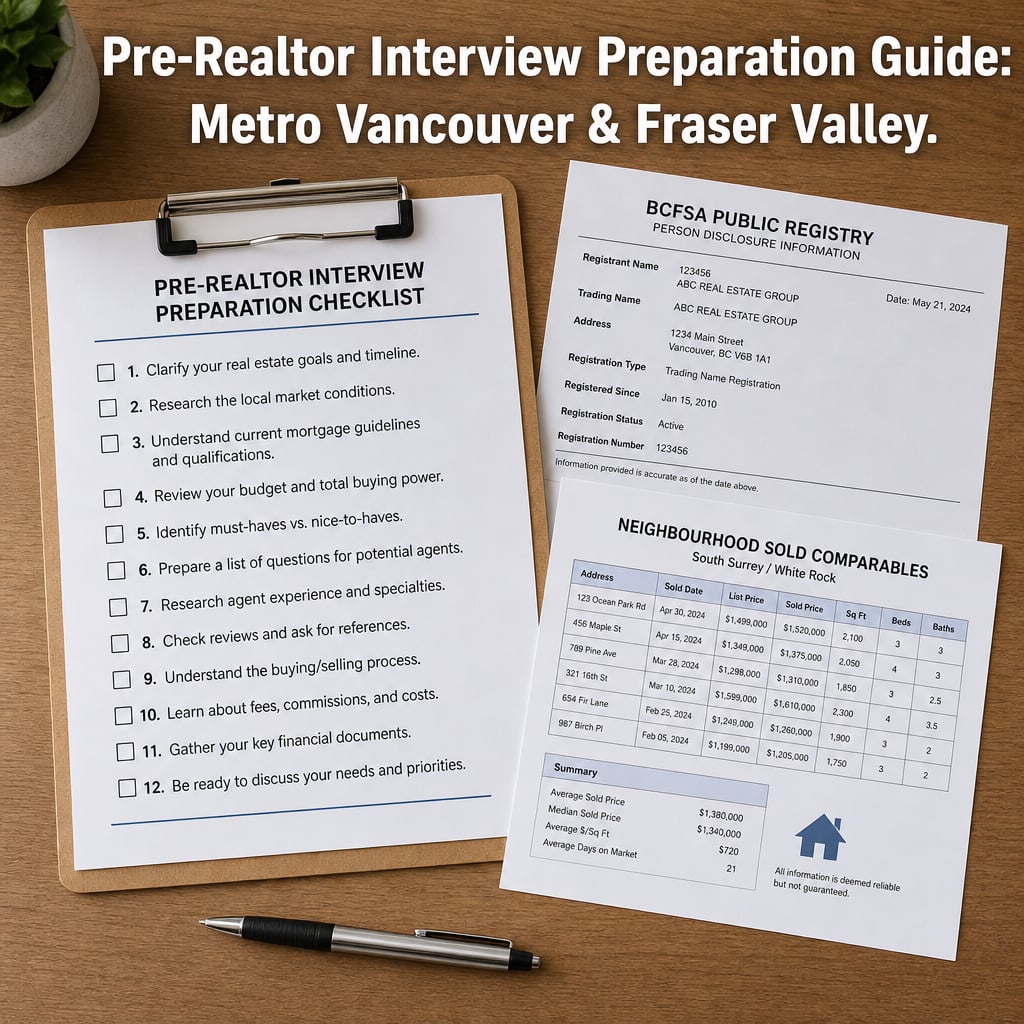

Pre-Realtor Interview Preparation Guide: What Documents to Review, Behavioural Signals to Observe, and the 12 Diagnostic Questions That Reveal Genuine Local Market Knowledge vs. Marketing Claims in Metro Vancouver and the Fraser Valley
By Mohamed Mansour, MBA and Associate Broker | Mansour Real Estate Group | Fraser Valley and Metro Vancouver | Published: July 14, 2025
Topic: Realtor Selection, Pre-Interview Preparation, Agent Evaluation | Geography: Metro Vancouver, Fraser Valley, Surrey, Langley, Abbotsford, South Surrey, White Rock
Most buyers and sellers in BC sit down with a realtor before they have verified a single credential, reviewed one comparable sale, or decided what a good answer actually looks like. The first meeting becomes guesswork. This guide changes that. It covers what to do in the 48 hours before an agent consultation so you can evaluate candidates consistently, ask the right questions, and recognize the difference between local expertise and polished presentation.
This is the third article in a three-part series on agent evaluation. If you are preparing to sell, read the seller interview questions guide after this one. If you are buying, the buyer's agent interview questions guide covers what to ask once you are in the room.
Short Answer
Before interviewing any realtor in Metro Vancouver or the Fraser Valley, verify their BCFSA licence, pull publicly available sold data for your neighbourhood, and prepare a short observation rubric. This 30-to-60-minute preparation step lets you compare candidates fairly, ask targeted questions, and identify agents whose local knowledge is specific rather than promotional.
Who This Applies To
- Homeowners in Surrey, Langley, Abbotsford, South Surrey, White Rock, North Delta, or anywhere in the Fraser Valley preparing to list
- Buyers starting a home search in Metro Vancouver or the Fraser Valley and evaluating buyer's agent options
- Executors or family members managing an estate sale who need to select a realtor without prior relationships
- Anyone who has already booked a realtor consultation and wants to walk in prepared
- Methodical decision-makers who prefer structured evaluation over gut feel
When This Advice May Not Apply
If you have a long-standing relationship with an agent who has handled previous transactions for you and you have already verified their performance firsthand, much of the verification work here is redundant. This guide is designed for first-time agent selection or situations where you are genuinely comparing candidates.
Key Takeaways
- Most BC consumers interview fewer than two agents, leaving documented performance differences unexamined before signing.
- BCFSA licence verification, FVREB sold data, and sold-to-list ratios are publicly accessible and take under 20 minutes to review.
- High-performing agents bring neighbourhood-specific sold comparables to a first meeting without being asked.
- Vague answers about pricing strategy, days on market, and buyer pool composition are reliable signals of limited local knowledge.
- A written observation rubric used across all candidates removes memory bias and produces a fair comparison.
Data Used in This Article
- BCFSA Public Registry and Licensing Standards — official regulatory source, current
- Fraser Valley Real Estate Board (FVREB) Statistics and Sales Data — official board data, 2025–2026
- Greater Vancouver Realtors (REBGV) Transaction Performance Analysis — board benchmark data
- BC Real Estate Services Act (RESA) — provincial legislation governing agent disclosure requirements
- Mansour Real Estate Group internal analysis — professional interpretation based on 22+ years of Fraser Valley transactions
Why Preparation Before the Interview Matters
According to BCFSA licensing and board performance data, there is a documented 3–8% variance in net sale proceeds between high-performing and average-performing agents working in the same neighbourhoods. On a $1.2 million home in Surrey or Langley, that range represents $36,000 to $96,000. Despite that, most BC buyers and sellers interview fewer than two agents before signing a representation agreement.
The gap is not usually about asking bad questions in the interview. It is about walking in without a framework that lets you tell the difference between a confident presentation and genuine local knowledge. An agent who has done 40 transactions in Willoughby and one who has done three will often sound similar in a first meeting. The preparation work done before you sit down is what makes the difference visible.
With over 10,000 active listings in the Fraser Valley through much of 2025 and 2026, according to FVREB monthly statistics, sellers are more deliberate than they have been in years. That caution is warranted — and it starts before the first appointment.
Step 1: Verify the Licence Before the Meeting
The BC Financial Services Authority maintains a public registry at bcfsa.ca where any consumer can search a realtor's name and confirm their licence status, licence class, brokerage, and any disciplinary history. This takes approximately five minutes and is the first step for every candidate.
What to look for: an active licence, the correct licence class (trading services for most agents, broker's licence for those designated as brokers), and how long the licence has been active. An agent who claims 15 years of experience but whose BCFSA record shows seven years of active licensing is worth asking about. The discrepancy may have an explanation, but it is worth raising.
Also note the brokerage. A brokerage with local infrastructure, active MLS participation, and a physical presence in your target geography is meaningfully different from one that exists primarily on paper. You can cross-reference brokerage names against FVREB or Greater Vancouver Realtors membership to confirm active board participation — board members have access to MLS data, board statistics, and peer market intelligence that non-members do not.
Step 2: Pull Neighbourhood Sold Data Before You Walk In
You do not need MLS access to gather useful market context. BC Assessment's public portal provides assessed values for individual properties across the province. Realtor.ca shows active listings and recently sold properties with list prices in your area. FVREB publishes monthly statistics by property type and municipality, available free at fvreb.bc.ca.
Spend 20 minutes before any interview reviewing: the current active listing count for your neighbourhood or property type, the benchmark price trend over the past 6 to 12 months, and the approximate days-on-market range for recently sold comparable properties. You do not need precise figures — you need enough context to evaluate whether the agent's answers reflect real knowledge of your specific market or generic talking points.
If you are a seller preparing for a listing consultation, this is also the point to review the seller interview questions guide so your questions are calibrated to what you have just reviewed. If you are a buyer, the buyer's agent interview questions guide pairs directly with the preparation steps here.
How We Evaluate This
At Mansour Real Estate Group, when we meet with a prospective seller or buyer for the first time, we bring neighbourhood-specific sold data, a preliminary pricing range with supporting comparables, and a written market context summary for the current month. We do this without being asked, because that preparation is what the conversation should be built around.
When consumers come to us having already done the preparation steps in this guide, the conversation is faster, more specific, and more useful for both sides. They can evaluate our analysis against what they already know. That is the outcome this guide is designed to produce — not just for conversations with us, but for any agent evaluation process.
The 12 Diagnostic Questions
These questions are designed to surface specific knowledge, not test general competence. A strong answer will be neighbourhood-specific, data-anchored, and honest about uncertainty where uncertainty exists. A weak answer will be vague, promotional, or deflect to general market conditions.
- What have homes like mine sold for in this neighbourhood in the last 90 days, and how does that compare to list price? — A prepared agent brings this data. An unprepared one gives a range without a source.
- What is the current sales-to-active-listings ratio for this property type in this area, and what does that tell us about pricing strategy? — This distinguishes agents who read board statistics from those who do not.
- How many transactions have you completed in this specific neighbourhood or municipality in the past 12 months? — Geographic concentration matters. An agent with 30 sales in Willoughby understands buyer behaviour there in a way a generalist does not.
- What is your average sold-to-list price ratio, and how does it compare to the board average for this area? — This is a factual, verifiable question. Reluctance to answer specifically is informative.
- Who is the most likely buyer for this property, and where are those buyers currently looking? — A strong answer names a buyer profile and explains how they reach that segment. A weak answer says "everyone."
- What would you price this property at, and what are the two or three comparables most relevant to that number? — Ask this before they give their pitch. Their willingness to commit to specifics reveals their confidence in local data.
- What conditions in the current market would cause you to recommend a price reduction, and at what point? — High-performing agents have a clear answer. Agents who avoid pricing reductions to win listings usually do not.
- How do you handle a situation where a seller wants to list above your recommended price? — This question reveals whether the agent will advocate for your financial interest or accommodate your preference to keep the listing.
- What is your communication protocol during the listing, and how often will I hear from you if there are no offers? — Vague answers here predict poor communication later. Ask for a specific cadence.
- How do you handle dual agency if a buyer from your brokerage wants to make an offer on my property? — Under RESA, agents must disclose conflicts. Their answer should be clear and compliant with BC disclosure requirements.
- Can you walk me through a recent negotiation where you protected your client's position in a difficult offer situation? — A fabricated or generic answer is obvious. A real one includes property-specific context, what the challenge was, and what the outcome was.
- What is one thing about the current Fraser Valley or Metro Vancouver market that most sellers do not understand, and how does it affect our strategy? — This is the highest-signal question. A strong answer is specific to 2025 or 2026 conditions, names a real pattern, and connects it directly to your situation.
Pre-Interview Preparation Checklist
- Search the agent's name on the BCFSA public registry at bcfsa.ca and confirm active licence, class, brokerage, and disciplinary record
- Note how long the licence has been active and whether it matches the agent's stated years of experience
- Pull the current month's FVREB statistics for your municipality and property type at fvreb.bc.ca
- Review 5 to 10 recently sold listings on Realtor.ca that are comparable to your property by size, location, and age
- Check BC Assessment for your property's assessed value and recent neighbourhood assessment trends
- Prepare a one-page written observation rubric with space to score each candidate on preparation, specificity, and communication clarity
- Select 3 of the 12 diagnostic questions above that are most relevant to your situation and commit to asking them identically across all candidates
- Confirm the meeting format: Will they bring a CMA? Will they present a marketing plan? Ask in advance so you know what to expect
Behavioural Signals to Observe During the Meeting
Beyond what agents say, how they behave in a first meeting reveals a great deal. These are the signals that experienced principals watch for, and that most consumers do not know to look for.
Did they bring printed or screen-visible sold comparables? An agent who arrives with neighbourhood-specific data prepared for your property without being asked has spent time on your situation before they walked in. An agent who arrives with a general presentation has not.
Do they speak in ranges or in specifics? Vague language — "values are holding steady," "it depends on the market," "buyers are cautious right now" — can fill an hour without conveying anything testable. Specific language names a price range, a days-on-market figure, a buyer profile, or a neighbourhood dynamic. Specifics are verifiable. Ranges are not.
Do they ask questions about your situation before presenting their pitch? An agent who spends the first 20 minutes talking about themselves before asking why you are selling, what your timeline is, or whether you have bought your next property is building a presentation, not a strategy. The best agents lead with questions.
Do they give a clear answer on dual agency? Under BC's Real Estate Services Act, agents have specific disclosure obligations regarding conflicts of interest and dual agency. An agent who is vague, defensive, or dismissive when dual agency comes up is not handling the topic well, regardless of their sales record.
What We Commonly See
In our experience, consumers who interview only one agent often leave that meeting feeling confident — not because the agent was strong, but because they had no comparison. The confidence fades when the listing sits unsold or the offer strategy misses the mark. A one-candidate interview is not a selection process.
What often happens is that agents who are strong presenters but weak market analysts win the listing consultation because the seller evaluates charisma rather than data. The first meeting is where polished delivery substitutes for local knowledge — and it works, because most sellers have not pulled the neighbourhood data that would expose the gap.
A common mistake is treating a high list price recommendation as evidence of agent confidence or local knowledge. In a buyer's market with elevated inventory — which the Fraser Valley has experienced through much of 2025 and 2026, according to FVREB monthly data — an aggressive list price that cannot be supported by comparables typically produces longer days on market, price reductions, and a lower final sale price than a correctly priced listing would have achieved.
Questions and Answers
Can I verify a realtor's disciplinary record in BC before the interview?
Yes. The BCFSA public registry at bcfsa.ca shows licence status, licence class, brokerage, and any regulatory actions. It is free, public, and takes about five minutes to check.
What is a sold-to-list price ratio, and why does it matter for agent selection?
It is the final sale price divided by the list price, expressed as a percentage. An agent consistently achieving 99–101% in a market averaging 96% is producing meaningfully better outcomes. Ask for their ratio and compare it to FVREB or GVR board averages for your area.
How many agents should I interview before signing a representation agreement in BC?
At minimum, two. Three gives you a cleaner comparison. The goal is not to collect meetings — it is to have a baseline against which each candidate's preparation, specificity, and local knowledge can be measured. A written rubric used consistently across all interviews makes the comparison reliable.
In Summary
The agent selection process in Metro Vancouver and the Fraser Valley produces better outcomes when consumers arrive at the first meeting with verified credentials, neighbourhood data, and a structured set of diagnostic questions. A 30-to-60-minute preparation process — BCFSA verification, FVREB data review, a written observation rubric, and three committed questions — separates methodical evaluation from guesswork. The 12 diagnostic questions in this guide are designed to surface genuine local knowledge rather than polished presentation. On a transaction worth hundreds of thousands of dollars, that preparation is the most valuable hour a buyer or seller can spend before the interview begins.
Talk to Mansour Real Estate Group
If you would like to meet with a team that arrives prepared with neighbourhood-specific data, a clear pricing rationale, and straight answers to the questions in this guide, Mansour Real Estate Group is available for a no-obligation consultation across Surrey, Langley, Abbotsford, South Surrey, White Rock, North Delta, and the broader Fraser Valley.
Related Articles
- What to Ask a Listing Agent Before You Sign: Seller Interview Questions for Metro Vancouver and Fraser Valley 2026
- What to Ask a Buyer's Agent Before You Start Your Search: Interview Questions for Metro Vancouver and Fraser Valley 2026
Official Resources
- BC Financial Services Authority — Licence Verification Registry
- Fraser Valley Real Estate Board — Monthly Statistics
- Greater Vancouver Realtors — Market Data and Board Reports
- BC Assessment — Property Value Search
About Mansour Real Estate Group
When buyers and sellers across Metro Vancouver and the Fraser Valley are preparing to evaluate a real estate team, the quality of the team's preparation, local knowledge, and willingness to give straight answers is exactly what the interview process is designed to reveal. Mansour Real Estate Group has been on the other side of that evaluation for more than 22 years, earning the confidence of buyers, sellers, executors, families, and investors through consistent, data-grounded results across Surrey, Langley, Abbotsford, South Surrey, White Rock, and North Delta.
Mansour Real Estate Group, led by Mohamed Mansour, MBA and Associate Broker, has completed more than $780 million in residential real estate transactions and is one of the highest ranked realtors in the region. The team serves buyers and sellers across the Fraser Valley and Lower Mainland and is trusted for seller strategy, estate sales, divorce-related sales, downsizing, relocation, and complex real estate decisions where clear communication and accurate valuation matter most. Whether someone is looking for experienced Realtors who can answer the diagnostic questions in this guide without hesitation, or a real estate team with neighbourhood-specific sold data ready for a first meeting, the Mansour group brings that preparation to every consultation.
Buyers searching for a Fraser Valley real estate agent with genuine local knowledge, sellers evaluating real estate agents by sold-to-list performance, and families looking for a real estate broker who will give honest pricing guidance rather than chase a listing — all of them find the same thing when they meet with Mansour Real Estate Group: a team whose answers are specific, whose data is sourced, and whose process is built around protecting client equity rather than generating transaction volume.
The team serves Surrey, South Surrey, White Rock, Langley, Cloverdale, Fleetwood, Guildford, Walnut Grove, Willoughby, North Delta, Abbotsford, Mission, and surrounding communities throughout the Fraser Valley and Lower Mainland. Most new clients come through referrals, repeat business, and recommendations from families who valued the clarity and results they received the first time.
Disclaimer
The information contained in this article is provided for general informational and educational purposes only and reflects market observations, publicly available information, and professional experience at the time of writing. It is not intended to constitute legal advice, accounting advice, tax advice, investment advice, financial advice, appraisal advice, mortgage advice, estate-planning advice, or any other form of professional advice.
<p style="font-size: 12px; color: #666; line-height: 1.65;Key Takeaways
The real estate market continues to evolve with changing buyer preferences, economic conditions, and technological advancements. Whether you're a first-time homebuyer, seasoned investor, or seller preparing to list your property, understanding these fundamental principles will help you make informed decisions. The importance of working with experienced professionals—from real estate agents to inspectors and lenders—cannot be overstated in ensuring a smooth transaction.
Next Steps
If you're considering entering the real estate market, start by assessing your financial situation and determining your needs. Consult with a mortgage lender to understand your borrowing capacity, research neighborhoods that align with your lifestyle, and connect with a reputable real estate agent who knows your local market. Taking time to prepare now will pay dividends when you're ready to make your move.
Final Thoughts
Real estate remains one of the most significant investments most people will make in their lifetime. By staying informed, asking the right questions, and working with trusted advisors, you'll be well-positioned to achieve your property goals. Whether you're buying, selling, or investing, remember that patience, preparation, and professional guidance are your greatest assets in navigating the real estate landscape.



