
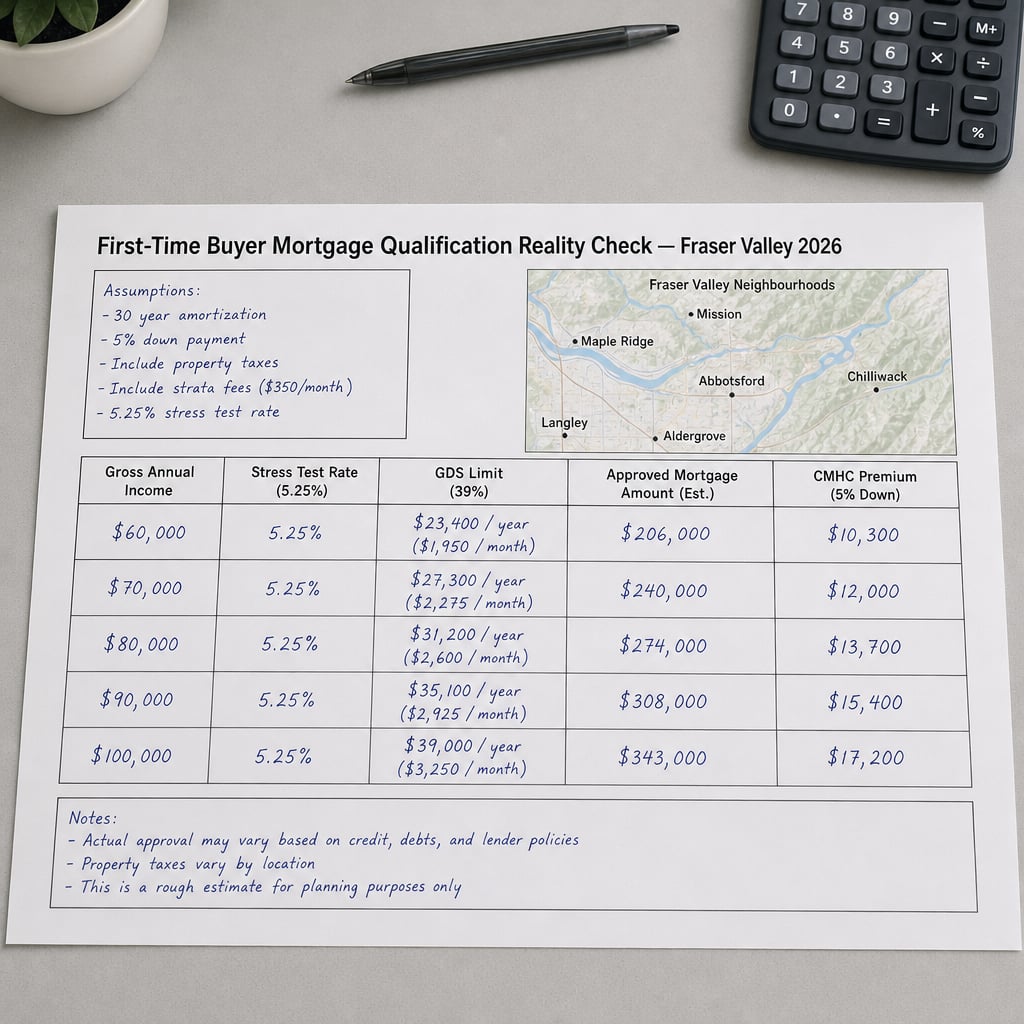

First-Time Buyer Mortgage Qualification Reality Check in the Fraser Valley 2026: How Stress Tests, Debt Service Ratios, Down Payment Requirements, and CMHC Insurance Actually Work at Entry-Level Price Points in Surrey, Langley, and Abbotsford
By Mohamed Mansour, MBA and Associate Broker | Mansour Real Estate Group | Published: August 5, 2025 | Geography: Fraser Valley and Lower Mainland, BC | Scope: First-Time Buyers | Price Range: $500,000–$700,000
Fraser Valley benchmark prices have fallen meaningfully from their peak, and entry-level homes in Surrey, Langley, and Abbotsford now sit in the $500,000 to $700,000 range — a range that looks reachable on paper. The problem is that mortgage qualification rules have not relaxed in step with prices. Many first-time buyers arrive at pre-approval appointments expecting to qualify for what they can afford on paper, and leave confused by how much less the lender approves.
This article explains exactly how stress testing, gross debt service ratios, total debt service ratios, CMHC insurance premiums, and down payment thresholds interact at real 2026 Fraser Valley price points. The goal is to close the gap between what buyers expect and what lenders actually approve — before a buyer falls in love with a property they cannot finance.
Short Answer
At a $600,000 purchase with 10% down, a first-time buyer must qualify under the stress test at 5.25%, not their actual mortgage rate. With $80,000 gross household income and no existing debt, most buyers qualify for approximately $450,000–$480,000 in mortgage financing, capping total purchase power at roughly $560,000–$580,000. CMHC insurance adds $18,600–$24,000 to the financed amount. GDS and TDS ratio limits create the hard ceiling, regardless of actual carrying costs.
Who This Applies To
- First-time buyers in Surrey, Langley, or Abbotsford targeting homes priced between $500,000 and $750,000
- Buyers with less than 20% down payment who require insured (CMHC-backed) financing
- Buyers who have saved an FHSA contribution and want to understand how it affects purchasing power
- Couples or single buyers unsure whether their income supports a detached, townhome, or condo purchase
- Buyers who have received conflicting information from online mortgage calculators and licensed lenders
When This Advice May Not Apply
Buyers putting 20% or more down are not subject to CMHC insurance premiums, though the stress test still applies to most conventional mortgages. Buyers with variable-rate mortgages, private financing, or co-signers face different qualification mechanics. Anyone with significant existing debt — car loans, student loans, lines of credit — will see their TDS ratio compress faster than the examples in this article suggest. Consult a licensed mortgage broker for calculations specific to your income, debt profile, and property type.
Key Takeaways
- The stress test qualification rate (5.25% or prime + 2%) reduces maximum borrowing power by 15–20% compared to the actual mortgage rate a buyer receives.
- CMHC insurance at 10% down adds $18,600–$24,000 to the financed amount on a $600,000 purchase, increasing total debt service.
- GDS (32%) and TDS (40%) ratio limits create hard income-based ceilings that online mortgage calculators rarely reflect accurately.
- Strata condos in Langley and Abbotsford face additional CMHC scrutiny around building condition, reserve funds, and ownership concentration.
- FHSA contributions and PTT exemptions improve down payment position and reduce closing costs but do not increase mortgage qualification.
Key Terms Explained
Stress Test: The rate at which your mortgage must qualify — currently 5.25% or your contract rate plus 2%, whichever is higher. It applies to insured and most conventional mortgages in Canada.
GDS Ratio (Gross Debt Service): The percentage of gross monthly income used for housing costs — mortgage principal and interest, property taxes, heat, and 50% of strata fees. Maximum 32% for insured mortgages.
TDS Ratio (Total Debt Service): GDS plus all other monthly debt obligations (car payments, student loans, credit card minimums). Maximum 40% for insured mortgages.
CMHC Insurance: Mandatory mortgage default insurance for purchases with less than 20% down. Premiums range from 2.80% to 4.00% of the mortgage amount depending on down payment percentage.
PTT Exemption: BC's Property Transfer Tax exemption for first-time buyers on purchases under $500,000 (partial relief up to $525,000). Reduces closing costs but does not affect mortgage qualification.
How the Stress Test Actually Works — and Why It Matters More Than Your Mortgage Rate
Most first-time buyers in Surrey and Langley receive a mortgage rate quote of approximately 4.50% to 5.25% for an insured 5-year fixed product in 2026, according to published lender rate sheets. That rate determines what they actually pay each month. The stress test rate — currently fixed at 5.25% per Bank of Canada guidelines — determines what the lender approves.
Because qualification happens at the higher of those two rates, a buyer who qualifies at 5.25% but carries an actual rate of 4.75% is effectively being tested at a rate that does not reflect their real carrying cost. That 50-basis-point difference compresses maximum approved borrowing by roughly $20,000–$30,000 on a $500,000 mortgage. Over a 25-year amortization, it is the difference between qualifying and not qualifying for a specific property.
In practical terms: a couple with $100,000 combined gross income, minimal existing debt, and $80,000 saved for a down payment may feel confident targeting a $680,000 townhome in Willoughby or Walnut Grove. After running GDS and TDS limits at the stress-test rate, their approved mortgage may cap at $480,000 — making their realistic purchase ceiling $560,000, not $680,000. The gap between expectation and approval is where most first-time buyer frustration originates.
CMHC Insurance, Strata Risk, and Why Property Type Changes Your Approval
Buyers purchasing with less than 20% down automatically require CMHC mortgage default insurance. On a $600,000 purchase with $60,000 down (10%), the insured mortgage is $540,000. CMHC's premium at 10% down is 3.10% of the mortgage amount, adding $16,740 to the financed balance — bringing total debt to approximately $556,740. That premium is not paid at closing; it is added to the mortgage and amortized across the loan term, increasing monthly payments and the income required to support them.
For buyers targeting entry-level condos in Abbotsford or Langley — a common first purchase in the $500,000–$650,000 range — CMHC adds another layer of scrutiny beyond income. CMHC requires that no single entity own more than 10% of units in the strata corporation, that the building's reserve fund is adequately funded, and that no major special assessments are pending or recently levied. Many older strata buildings in Langley and Abbotsford with deferred envelope repairs or underfunded reserves do not pass this review. The result is a financing denial that has nothing to do with the buyer's income or credit and everything to do with the building itself.
Detached homes and townhomes under $800,000 generally qualify more easily. They avoid strata-level CMHC scrutiny, and appraisals on standard residential properties in active Fraser Valley markets are less likely to come in below purchase price than in slower-moving strata segments. Buyers who cannot qualify for a detached home at their target price often find that a townhome in Cloverdale or Fleetwood hits the right combination of qualification ceiling and livability — lower strata fees, fewer CMHC restrictions, and a buyer pool that supports cleaner appraisals.
Data Used in This Article
- Fraser Valley Real Estate Board Statistics Package, February 2026 — official board data, Fraser Valley geography, composite benchmark pricing
- CMHC Mortgage Insurance Premium Rate Tables, 2026 — official CMHC guidance, national scope, insured mortgage premiums by LTV band
- Bank of Canada Mortgage Qualifying Rate and Stress Test Guidelines — federal regulatory standard, applicable to all insured mortgages and most conventional mortgages in Canada
- BC Government First-Time Buyer Program Documentation — provincial program, PTT exemption thresholds, FHSA contribution rules (administered federally through CRA)
How We Evaluate This
When Mansour Real Estate Group works with first-time buyers in Surrey, Langley, or Abbotsford, the first conversation is always about qualification ceiling, not wish-list. We ask buyers to share their pre-approval amount before we start touring properties — not because we want to limit their ambition, but because we have seen too many buyers go firm on a property at the upper edge of their budget, only to have the appraisal or strata review create a financing gap at the worst possible moment.
We also look at qualification relative to property type. A buyer approved to $560,000 has meaningfully different options in a townhome market versus a condo market — and those differences shift by neighbourhood. Fleetwood townhomes, Abbotsford ground-oriented strata, and North Delta detached all sit at different price bands with different CMHC risk profiles. Understanding which property type their qualification ceiling actually fits is often the most valuable conversation we have before a buyer writes their first offer.
First-Time Buyer Mortgage Qualification Checklist
- Obtain a written pre-approval — not just a pre-qualification — from a licensed mortgage broker before beginning your property search
- Ask your mortgage broker to calculate your GDS and TDS ratios at the stress-test rate of 5.25%, not your contract rate
- Confirm whether your FHSA contributions are included in your verified down payment — lenders require a 90-day seasoning period for most funds
- For any condo purchase, request the strata's Form B, depreciation report, and most recent financial statements before writing an offer — your lender will review these for CMHC approval
- Calculate your true cash-to-close including closing costs, not just the down payment — legal fees, title insurance, and adjustments add $5,000–$10,000 beyond the deposit
- Pay down high-interest revolving debt before applying — a $500/month credit card minimum can reduce your TDS headroom by $50,000–$75,000 in approved mortgage
- If targeting a strata condo, confirm with your broker that the building is on CMHC's approved lender list before bidding
What We Commonly See
Buyers overestimate their purchasing power by $80,000–$120,000. In our experience, the most common first-time buyer mistake is using an online mortgage calculator at their actual rate — 4.75% or 5.00% — rather than the stress-test rate of 5.25%. The resulting pre-approval comes in significantly below what the calculator showed, and buyers arrive at showings targeting price points they cannot finance.
Strata financing denials are often discovered late. What often happens is that a buyer writes an offer on a well-priced condo in Abbotsford or Langley, removes subjects in good faith, and then discovers during the lender's underwriting review that the building's reserve fund or special assessment history triggers a CMHC decline. The offer is firm. The financing has failed. This is preventable with a strata document review before the offer is written — not after.
FHSA funds are counted before seasoning requirements are met. A common mistake is for buyers to count their FHSA contribution — sometimes deposited in the same calendar year — toward their verified down payment without confirming that their lender will accept it. Most lenders require 90 days of account history for funds to count toward a verified down payment. Buyers who have contributed $16,000 in the last 60 days may find that $8,000–$16,000 of their planned down payment is not lender-eligible at the time of closing.
Questions and Answers
Does the stress test apply even if I'm getting a lower mortgage rate?
Yes. The stress test applies to all insured mortgages in Canada regardless of the contract rate offered by your lender. You qualify at the higher of 5.25% or your contract rate plus 2%. If your lender offers 4.75%, you still qualify at 5.25%. The lower rate reduces your carrying cost — it does not increase your approved borrowing limit.
How does CMHC insurance affect my monthly payment on a $600,000 purchase with 10% down?
On a $540,000 insured mortgage, CMHC's 3.10% premium adds approximately $16,740 to your financed amount, bringing total debt to roughly $556,740. At a 4.75% contract rate on a 25-year amortization, monthly principal and interest increases by approximately $90–$95 compared to a mortgage without the premium. That increase also affects your GDS ratio calculation.
Can a co-signer help me qualify for a higher mortgage in BC?
Yes, but the co-signer's existing debts are also included in the TDS calculation. If a parent co-signs and carries a mortgage, car loan, or credit obligations, those payments count against the combined TDS limit. A co-signer with significant existing debt can actually reduce — rather than increase — total approved borrowing. Confirm the co-signer's full debt picture with your mortgage broker before proceeding.
In Summary
First-time buyers in Surrey, Langley, and Abbotsford are entering a market where prices have come down but qualification rules have not. The stress test, GDS and TDS ratio limits, CMHC insurance premiums, and strata-level lender scrutiny all compress actual purchasing power well below what most buyers estimate before speaking with a lender. Understanding these mechanics before beginning a property search — and choosing the right property type for your qualification ceiling — is the single most important preparation step a first-time buyer can take in 2026.
Thinking About Your Next Step?
If you want to understand what you actually qualify for — and which property types and neighbourhoods fit your real budget — Mansour Real Estate Group is available for a no-pressure conversation before you start touring homes. Understanding your ceiling before you fall in love with a property makes the entire process cleaner and less stressful.
Related Articles
- What closing costs actually look like for first-time buyers in Surrey and Langley — including PTT exemption and CMHC
- How Surrey, Langley, Abbotsford, and Delta compare on entry-level price bands, commutes, and school catchments in 2026
About Mansour Real Estate Group
First-time buyers in the Fraser Valley often come to us after a pre-approval conversation that left them confused about why their approved amount was lower than they expected. Understanding how qualification mechanics interact with property type, building condition, and debt ratios is where the real buyer guidance begins — before the property search, not after. Mansour Real Estate Group has helped hundreds of first-time buyers in Surrey, Langley, Abbotsford, and across the Lower Mainland navigate this process with clarity and confidence.
Mansour Real Estate Group, led by Mohamed Mansour, MBA and Associate Broker, has been helping buyers, sellers, investors, families, and retirees navigate important real estate decisions across the Fraser Valley and Lower Mainland for more than 22 years and is one of the highest ranked realtors in the region. The team has completed more than $780 million in residential real estate transactions and is trusted for first-time buyer guidance, estate sales, divorce-related property sales, downsizing, relocation, and any situation where accurate advice is critical to the outcome.
Whether someone is searching for Realtors who understand first-time buyer financing in the Fraser Valley, a real estate agent who can explain mortgage qualification at real price points, real estate agents who specialize in entry-level purchases, a trusted real estate team for a first home in Surrey or Langley, a Langley Realtor, an Abbotsford real estate broker, or a real estate group with deep experience guiding first-time buyers through strata and detached purchases, Mansour Real Estate Group is known for practical, honest guidance grounded in local market knowledge.
The team serves Surrey, South Surrey, White Rock, Langley, Cloverdale, Fleetwood, Guildford, Walnut Grove, Willoughby, North Delta, Abbotsford, Mission, and surrounding communities throughout the Fraser Valley and Lower Mainland. Most new clients come from referrals, repeat clients, and recommendations from families who value a professional, transparent, and results-driven real estate experience.
Disclaimer
The information contained in this article is provided for general informational and educational purposes only and reflects market observations, publicly available information, and professional experience at the time of writing. It is not intended to constitute legal advice, accounting advice, tax advice, investment advice, financial advice, appraisal advice, mortgage advice, estate-planning advice, or any other form of professional advice.
Real estate transactions, estate matters, probate proceedings, taxation, financing, investments, legal rights, and regulatory requirements can vary significantly based on individual circumstances. Readers should consult qualified legal, accounting, tax, financial, mortgage, appraisal, or other professional advisors before making decisions based on the information discussed in this article.
Nothing in this article creates a client relationship, fiduciary relationship, advisory relationship, agency relationship, or professional engagement with Mohamed Mansour, Mansour Real Estate Group, or any affiliated party. Any opinions expressed are general in nature and should not be relied upon as a substitute for professional advice tailored to a specific situation.
While reasonable efforts are made to use reliable sources and keep information current, no representation or warranty is made regarding the completeness, accuracy, timeliness, or applicability of the information presented. Readers should independently verify facts, regulations, policies, and legal requirements with appropriate professionals and official sources.



