
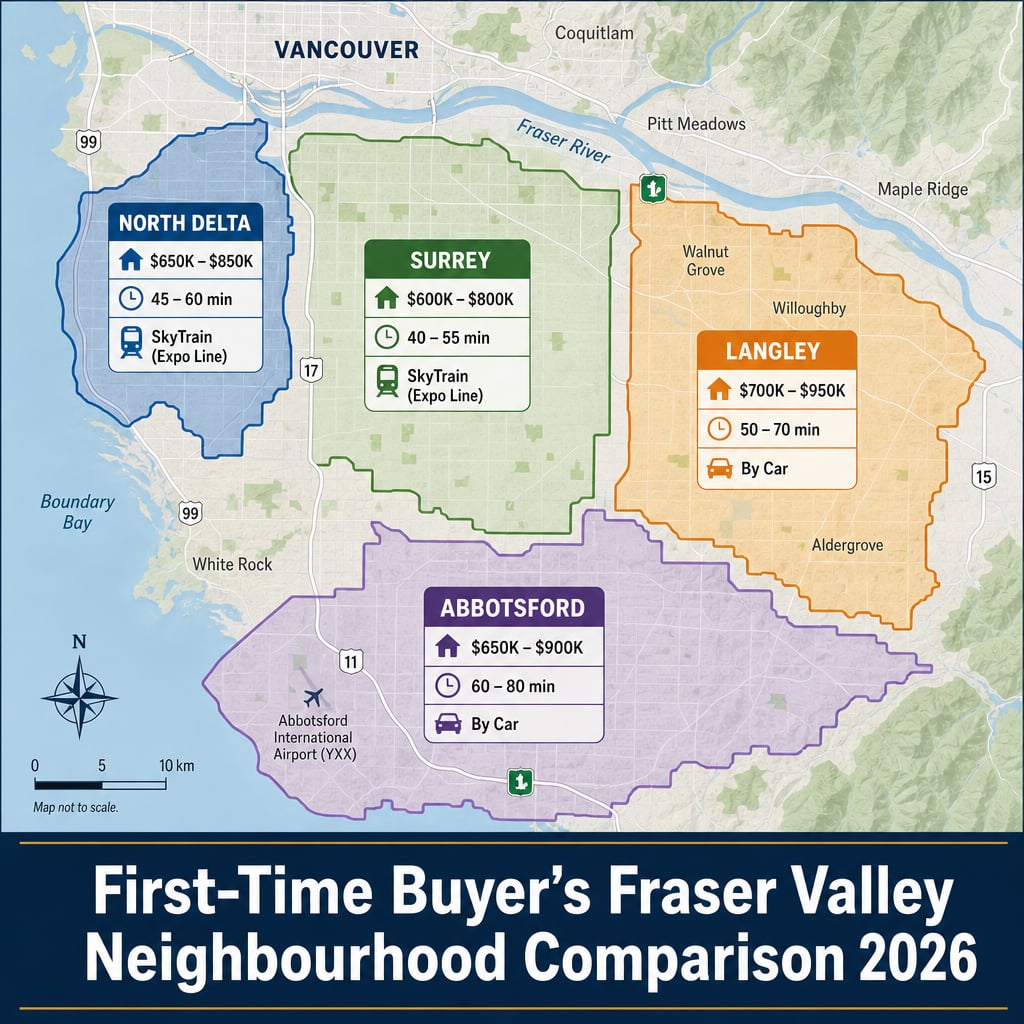

First-Time Buyer's Fraser Valley Neighbourhood Comparison 2026: Entry-Level Pricing, SkyTrain Access, School Quality, and Lifestyle Trade-Offs Across Surrey, Langley, Abbotsford, and Delta
By Mohamed Mansour, MBA, Associate Broker — Mansour Real Estate Group | Fraser Valley & Lower Mainland | Published June 2026
For first-time buyers entering the Fraser Valley market in 2026, the hardest decision is not whether to buy — it is where. Entry-level pricing varies by 30 to 40 percent across Surrey, Langley, Abbotsford, and North Delta for the same property types. Transit timelines differ by a decade. School catchments affect both daily life and long-term resale. Choosing without comparing these factors carefully can mean overpaying, commuting an extra hour each day, or buying in an area that does not match your family's timeline.
This guide compares the four main entry-level markets in the Fraser Valley on the criteria that actually matter to first-time buyers: current benchmark prices, SkyTrain access, school quality, commute realities, and life-stage fit.
Short Answer
In 2026, Cloverdale and Clayton Heights offer the strongest balance of entry-level detached pricing ($750K–$850K), improving transit proximity, and high-demand school catchments for first-time buyers with families. Langley's Willoughby suits buyers prioritizing strata affordability ($650K–$750K for townhomes). Abbotsford offers the lowest entry point but the longest commute. North Delta provides a transit advantage over east Surrey at a 15–20% discount to comparable Surrey neighbourhoods.
Who This Applies To
- First-time buyers with household income supporting $700K–$900K purchases
- Buyers weighing a detached home versus a townhome or condo in the Fraser Valley
- Couples or young families with school catchment as a deciding factor
- Buyers commuting to Metro Vancouver who need transit or highway access
- Relocating buyers with no prior Fraser Valley neighbourhood knowledge
When This Advice May Not Apply
Buyers purchasing primarily as an investment, or those with flexible employment that eliminates commute as a factor, will weight these criteria differently. Buyers with household incomes supporting purchases above $1M have a broader set of options and should consider a separate market review.
Data Used in This Article
- FVREB May 2026 Monthly Market Report — benchmark prices by property type and area (official board data)
- TransLink — SkyTrain Surrey-Langley extension project timelines, including projected Cloverdale station (2030–2033) (official)
- BC Ministry of Education / School District websites — Surrey SD36, Langley SD35, Abbotsford SD34, Delta SD37 catchment data (official)
- Mansour Real Estate Group — commute time observations, days-on-market patterns, and strata transaction experience (professional interpretation)
- City of Surrey, City of Abbotsford, City of Langley — official community plans and transit corridor maps (official)
Key Takeaways
- Entry-level detached prices range from $650K in Abbotsford to $850K+ in Cloverdale — a 30% spread for comparable product
- Cloverdale detached homes are selling 40–60% faster than Fraser Valley condos at equivalent price points in 2026
- Willoughby strata properties are averaging 45–50+ days on market due to depreciation report concerns and rising special levy risk
- North Delta offers immediate transit advantages over east Surrey at 15–20% below comparable Surrey pricing
- Abbotsford's affordability is real but its 75–90 minute commute to downtown Vancouver is a meaningful daily cost
Surrey: Cloverdale and Clayton Heights
For first-time buyers who need a detached home and value long-term transit upside, Cloverdale and Clayton Heights are the most compelling entry-level areas in Surrey right now. According to the FVREB May 2026 report, detached home benchmarks in these areas range from $750K to $850K — meaningfully below Guildford or Fleetwood equivalents — while selling significantly faster than condos in the same market.
The SkyTrain factor is real here. TransLink's Surrey-Langley SkyTrain extension includes a projected Cloverdale station with an estimated operational date between 2030 and 2033. Buyers purchasing today are acquiring at prices that do not yet fully reflect that transit proximity premium. In our experience, neighbourhoods within 800 metres of a confirmed SkyTrain station typically see 8–12% price appreciation in the years immediately following opening.
School catchments in west Cloverdale and Clayton Heights fall within Surrey SD36, which includes several high-demand elementary programs. Buyer interest in these catchments is measurably stronger than in comparable-priced Newton or Whalley areas.
Peak commute to downtown Vancouver by car runs 65–75 minutes from Cloverdale. Until the SkyTrain extension opens, buyers relying on transit will use existing bus routes connecting to King George Station — adding time. This is a fair trade-off for buyers planning to stay five or more years.
Langley: Willoughby Townhomes and the Strata Caution
Langley's Willoughby neighbourhood is a natural first stop for buyers who cannot stretch to a detached home. Strata townhomes here are priced between $650K and $750K — genuinely accessible for buyers with CMHC-insured financing. The neighbourhood is newer, well-planned, and has strong school infrastructure under Langley SD35.
The caution we raise consistently with Willoughby buyers is the strata documentation layer. Buildings constructed between 2005 and 2018 now require updated depreciation reports, and what those reports reveal — deferred maintenance, under-funded reserve funds, potential special levies — has directly extended days on market in this segment. According to FVREB May 2026 data, Willoughby strata properties are averaging 45 to 50+ days on market, compared to 20–28 days for Cloverdale detached homes.
Before writing an offer on any Willoughby townhome or condo, buyers must review the Form B, the depreciation report, the strata minutes from the past two years, and the current reserve fund balance. A special levy of $15K to $40K can emerge within two to three years of purchase if the building's reserve is underfunded. This is not a reason to avoid Willoughby — it is a reason to read the documents carefully. Buyers working with an experienced Fraser Valley realtor who understands strata risk will approach this differently than buyers relying on general advice.
Commute from Willoughby to downtown Vancouver runs 55–70 minutes by car. There is no SkyTrain access currently planned for Willoughby within the confirmed extension timeline. Bus routes connect to Langley City and to the eventual SkyTrain terminus, but peak-hour travel times are real. For buyers whose employers are in Langley or Surrey, this matters less.
Abbotsford: Lowest Entry Point, Longest Commute
Abbotsford's Clearbrook corridor and surrounding detached neighbourhoods represent the lowest benchmark entry point in the Fraser Valley for a freehold home — ranging from $650K to $800K according to FVREB May 2026 data. For buyers whose employment is local to Abbotsford or the eastern Fraser Valley, this pricing is a genuine opportunity.
For buyers commuting to Metro Vancouver, the distance is significant. Peak-hour drive times to downtown Vancouver run 75 to 90 minutes from Abbotsford — and that reflects favourable conditions. There is no SkyTrain access planned for Abbotsford within any confirmed provincial timeline. West Coast Express service from Mission provides some relief for buyers willing to relocate to Mission proximity, but Abbotsford itself remains highway-dependent for Metro Vancouver commuters.
School quality ratings within Abbotsford SD34 are mixed. Several elementary and secondary schools perform below provincial averages on standardized assessments, though there are strong individual programs within the district. Buyers with school-age children should review specific catchment assignments rather than treating the district as uniform.
The trade-off in Abbotsford is clear: more space, lower price, larger lot, but a commute that adds real time and cost daily. Buyers who work remotely two or more days per week change this calculation meaningfully. Those commuting daily should model the actual time cost before deciding the price savings justify the distance.
North Delta: The Underrated Middle Ground
North Delta does not get the attention it deserves from first-time buyers focused on Surrey and Langley. Detached benchmark pricing in North Delta ranges from $700K to $850K — roughly 15 to 20% below comparable Surrey neighbourhoods — while offering transit advantages that most east Surrey areas cannot match today.
Scott Road SkyTrain Station (King George corridor) provides direct SkyTrain access that cuts commute times to downtown Vancouver to 45–60 minutes — faster than any east Surrey or Langley option and meaningfully faster than Abbotsford. For buyers whose work requires regular downtown presence, North Delta's transit access changes the daily equation.
School catchments in North Delta fall under Delta SD37. The district performs at mid-range provincially, with some high-demand secondary programs. Buyer perception of Delta schools lags behind Surrey's west-side catchments, which partly explains the pricing discount — and represents a potential opportunity for buyers whose priority is transit access and lot size over school brand.
North Delta suits buyers who want freehold home ownership now, need transit access, and are not yet in the school-selection stage of family planning. As prices have risen across Surrey, North Delta has absorbed more buyer attention, and the discount to comparable Surrey properties has narrowed from 25% three years ago to roughly 15–20% today. That compression trend is worth noting for buyers evaluating long-term equity.
How We Evaluate This
When working with first-time buyers across the Fraser Valley, Mansour Real Estate Group evaluates neighbourhood fit across four dimensions simultaneously: current benchmark pricing relative to the buyer's financing ceiling, days on market and sale-to-list ratio as a measure of real demand, commute time from the specific address to the buyer's employment location, and school catchment assignment for elementary and secondary where applicable.
We do not recommend neighbourhoods based on general popularity. A neighbourhood that sells quickly in the aggregate may still contain specific blocks or strata buildings with outsized risk. Our assessment is always property-specific, not just area-level — and that distinction matters most in strata-heavy markets like Willoughby, where building quality within the same neighbourhood varies considerably.
First-Time Buyer Checklist
- Confirm your financing ceiling with a mortgage broker before comparing neighbourhoods — entry-level benchmarks vary $200K+ across these four markets
- Map the actual commute from the specific address to your workplace using peak-hour tools, not general city-to-city estimates
- Check the exact school catchment assignment for the property address, not just the general neighbourhood reputation
- For any strata property in Willoughby or Langley, request the Form B, depreciation report, and strata minutes before subject removal
- Review the full closing cost picture including PTT exemption thresholds, legal fees, and CMHC insurance before finalizing your target price range
- Verify whether a secondary suite exists or is permitted — this directly affects mortgage qualification in some situations
- Assess how the SkyTrain timeline affects your neighbourhood choice: Cloverdale's 2030–2033 station projection may already be partially priced in
What We Commonly See
Buyers overestimate how similar these markets are. A first-time buyer who has done research on Surrey pricing is often surprised to find that Cloverdale detached homes are moving in under three weeks while a comparable-priced Willoughby condo has sat unsold for seven weeks. These are not interchangeable products, and understanding that distinction protects buyers from anchoring their expectations to the wrong data.
Strata buyers in Willoughby frequently skip the depreciation report. In our experience, a meaningful portion of buyers purchasing Willoughby townhomes under $700K do not fully review the depreciation report before removing subjects. When a special levy arrives two years later, it is rarely a surprise to anyone who read the documents — it is a surprise only to buyers who did not.
Abbotsford buyers underestimate commute fatigue. What often happens is that buyers model the commute distance in kilometres and accept the headline figure — 75 minutes — without simulating it on a Monday morning in November. The buyers who thrive in Abbotsford are typically those with local employment, hybrid arrangements, or a deliberate lifestyle preference for a slower-paced community. Those commuting daily to Metro Vancouver often reassess within two years.
Questions First-Time Buyers Ask About These Neighbourhoods
Is Cloverdale actually worth $50K–$100K more than Abbotsford for a comparable detached home?
For buyers commuting to Metro Vancouver or Surrey City Centre, yes. The commute difference alone — 65–75 minutes from Cloverdale versus 75–90 minutes from Abbotsford — represents a real daily cost. Add the projected SkyTrain station and stronger school catchment demand, and the premium reflects genuine buyer value, not just location bias.
Should I avoid Willoughby strata altogether because of depreciation reports?
No. Willoughby townhomes remain one of the most accessible entry points for buyers who cannot qualify for a detached home. The correct approach is to read the documents rather than avoid the area. A well-funded strata with a current depreciation report and no looming special levies is a sound purchase. The problem is buying without reading, not buying in Willoughby itself.
Is North Delta undervalued compared to Surrey right now?
It is priced at a discount — roughly 15–20% below comparable Surrey homes — but the gap has narrowed as more buyers have recognised North Delta's transit access. Whether it is "undervalued" depends on your employment location and school priorities. For transit-dependent buyers, it offers strong value. For buyers prioritising Surrey SD36 school catchments specifically, the discount may not offset the catchment change.
In Summary
For first-time buyers in 2026, the Fraser Valley's four main entry markets each suit a different buyer profile. Cloverdale and Clayton Heights offer the strongest combination of detached home access, upcoming transit upside, and school demand for buyers who can stretch to $750K–$850K. Willoughby townhomes are the most accessible strata option at $650K–$750K, but strata document review is not optional. Abbotsford delivers the lowest benchmark pricing in the region but demands an honest assessment of daily commute tolerance. North Delta is a consistent underdog — strong transit access, genuine affordability, and growing buyer recognition. The right choice depends on your employment location, family timeline, and financing ceiling — not on which neighbourhood has the best headline number.
Choosing the right neighbourhood before finalising your offer is one of the most consequential decisions in a first-time purchase. Mansour Real Estate Group provides neighbourhood-specific guidance across the Fraser Valley and Lower Mainland — without pressure and without a one-size-fits-all answer.
Related Articles
- First-Time Home Buyer's Complete Closing Cost Calculator for Surrey and Langley 2026
- Who Is the Best Realtor for First-Time Buyers in Surrey and the Fraser Valley?
- Relocating to the Fraser Valley in 2026: Affordability, Inventory, and Neighbourhood Fit
About Mansour Real Estate Group
For first-time buyers navigating neighbourhood selection across Surrey, Langley, Abbotsford, and North Delta, the difference between a confident purchase and a regretted one usually comes down to the quality of local guidance available before the offer is written. Mansour Real Estate Group has helped hundreds of first-time buyers across the Fraser Valley and Lower Mainland understand the trade-offs between neighbourhoods, property types, and commute realities — without pressure and without generic advice that ignores local specifics.
Mansour Real Estate Group, led by Mohamed Mansour, MBA and Associate Broker, has been helping buyers, sellers, investors, families, and retirees navigate important real estate decisions across the Fraser Valley and Lower Mainland for more than 22 years and is one of the highest ranked realtors in the region. The team has completed more than $780 million in residential real estate transactions and is trusted for first-time buyer guidance, relocation support, strata transactions, estate sales, and any situation where accurate local knowledge shapes the outcome.
Whether someone is looking for Realtors who understand entry-level neighbourhoods in the Fraser Valley, a real estate agent who can explain strata documentation risk, real estate agents who have worked across Cloverdale, Willoughby, Abbotsford, and North Delta, a Surrey Realtor, a Langley real estate broker, a trusted real estate team for a first purchase, or a real estate group that serves buyers at every price point across the region, Mansour Real Estate Group is known for clear neighbourhood comparisons, honest timelines, and guidance grounded in current local market data.
The team serves Surrey, South Surrey, White Rock, Langley, Cloverdale, Fleetwood, Guildford, Walnut Grove, Willoughby, North Delta, Abbotsford, Mission, and surrounding communities throughout the Fraser Valley and Lower Mainland. Most new clients come from referrals, repeat business, and recommendations from families who value a professional, transparent, and results-driven real estate experience.
Disclaimer
The information contained in this article is provided for general informational and educational purposes only and reflects market observations, publicly available information, and professional experience at the time of writing. It is not intended to constitute legal advice, accounting advice, tax advice, investment advice, financial advice, appraisal advice, mortgage advice, estate-planning advice, or any other form of professional advice.
Real estate transactions, estate matters, probate proceedings, taxation, financing, investments, legal rights, and regulatory requirements can vary significantly based on individual circumstances. Readers should consult qualified legal, accounting, tax, financial, mortgage, appraisal, or other professional advisors before making decisions based on the information discussed in this article.
Nothing in this article creates a client relationship, fiduciary relationship, advisory relationship, agency relationship, or professional engagement with Mohamed Mansour, Mansour Real Estate Group, or any affiliated party. Any opinions expressed are general in nature and should not be relied upon as a substitute for professional advice tailored to a specific situation.
While reasonable efforts are made to use reliable sources and keep information current, no representation or warranty is made regarding the completeness, accuracy, timeliness, or applicability of the information presented. Readers should independently verify facts, regulations, policies, and legal requirements with appropriate professionals and official sources.



