

First-Time Home Buyer's Complete Closing Costs Breakdown for Fraser Valley Entry-Level Markets 2026: PTT Exemption Calculation, CMHC Insurance Tiers, FHSA Strategy, Legal Fees, Title Insurance, and the True Cash Required at Closing by Price Point
By Mohamed Mansour, MBA and Associate Broker | Mansour Real Estate Group | Fraser Valley and Lower Mainland | Published: August 5, 2025 | Topic: First-Time Buyer Closing Costs — Surrey, Langley, Abbotsford, and the Fraser Valley
For first-time buyers in Langley, Surrey, Abbotsford, and the broader Fraser Valley, the gap between knowing your mortgage approval amount and knowing the actual cash you need at closing is where deals fall apart. Most buyers underestimate total closing costs by $8,000 to $15,000 — and that gap becomes critical in the days before subject removal.
This article breaks down every cost layer a Fraser Valley first-time buyer faces in 2026, from the PTT exemption calculation and CMHC insurance tiers to FHSA withdrawal strategy, legal fees, and property tax adjustments — with specific numbers at the $420K, $480K, and $580K price points where entry-level buyers in this market are actually transacting.
Short Answer
First-time buyers in the Fraser Valley purchasing between $400,000 and $600,000 in 2026 should budget $18,000 to $32,000 in total closing costs before moving expenses. The PTT exemption saves up to $8,000 on purchases under $500,000. CMHC insurance on a high-ratio mortgage adds $10,640 to $15,200 to total borrowing — rolled into the mortgage but counted in your qualification math. FHSA withdrawals can directly offset cash required at closing.
Who This Applies To
- First-time buyers purchasing a primary residence in Surrey, Langley, Abbotsford, North Delta, or surrounding Fraser Valley communities
- Buyers financing with less than 20% down payment (high-ratio mortgage)
- Buyers with an FHSA, RRSP Home Buyers' Plan, or both, coordinating withdrawals with their closing timeline
- Buyers purchasing in the $400,000 to $600,000 range — condos, townhomes, and lower-priced detached properties
When This Advice May Not Apply
Buyers who have previously owned a home in Canada are not eligible for the BC first-time buyer PTT exemption, even if their spouse qualifies. Buyers purchasing above $525,000 receive no PTT exemption. New construction purchases involve GST and different PTT rebate calculations. Consult a BC notary or real estate lawyer for your specific situation.
Key Takeaways
- BC's PTT first-time buyer exemption eliminates up to $8,000 in tax on purchases under $500,000 and phases out at $525,000
- CMHC insurance premiums range from 2.80% to 4.00% of the mortgage amount and are added to the loan, not paid at closing
- FHSA contributions (up to $8,000 per year, $40,000 lifetime) can be withdrawn tax-free for a qualifying home purchase
- Legal fees, title insurance, and property tax adjustments typically add $3,200 to $5,300 to cash required at closing
- Total cash required at closing for a Fraser Valley first-time buyer at $480K with 10% down is approximately $57,000 to $62,000
Key Terms Defined
Property Transfer Tax (PTT): A provincial tax on real estate purchases in BC, calculated as 1% on the first $200,000 and 2% on the balance up to $2 million. First-time buyers are fully exempt on purchases under $500,000.
High-Ratio Mortgage: A mortgage where the buyer puts less than 20% down. CMHC (or Sagen/Canada Guaranty) insurance is mandatory.
FHSA: First Home Savings Account — a registered account allowing first-time buyers to contribute up to $8,000 per year (lifetime max $40,000) and withdraw tax-free for a qualifying home purchase.
Home Buyers' Plan (HBP): A CRA program allowing first-time buyers to withdraw up to $60,000 from an RRSP tax-free for a home purchase, to be repaid over 15 years.
Data Used in This Article
- BC Ministry of Finance PTT first-time buyer exemption thresholds — official, current as of 2025
- CMHC mortgage insurance premium rate tables — official CMHC publication, 2025
- CRA First Home Savings Account rules — Canada Revenue Agency, official, 2025
- Fraser Valley Real Estate Board Statistics Package, 2025 — FVREB official release
- Legal fee and title insurance ranges — based on BC notary and real estate lawyer professional experience
How the PTT Exemption Works at $420K, $480K, and $580K
BC's PTT first-time buyer exemption is straightforward at the extremes and occasionally misunderstood in the middle. According to BC Ministry of Finance guidelines, purchases under $500,000 are fully exempt — meaning a first-time buyer purchasing a Langley Township townhome at $480,000 pays zero PTT, saving $7,600 compared to what a non-first-time buyer would owe. That $7,600 stays in your pocket at closing.
At $420,000, the savings is $6,400 in PTT avoided. At $580,000, no exemption applies — the full PTT of $9,400 is owed. The partial exemption range runs from $500,001 to $525,000, where the exemption phases out proportionally. A purchase at $512,000 would qualify for a partial exemption calculated by the ratio of the eligible portion to the full price.
In our experience working with first-time buyers in Surrey, Langley, and Abbotsford, buyers searching between $490,000 and $520,000 often don't realize their price point sits in the exemption transition zone. Offering $501,000 instead of $499,000 can cost $7,000 in PTT — a difference worth flagging before an offer is written. This is a strategic conversation, not a technicality.
One qualification point: both buyers must qualify as first-time buyers if purchasing jointly. If one buyer previously owned a home in Canada, the exemption may be prorated or unavailable entirely, depending on the arrangement. Verify this with your lawyer before finalizing the offer price.
CMHC Insurance: What It Costs and How It's Structured
CMHC mortgage insurance is required on any purchase where the down payment is less than 20%. According to CMHC's published premium rate schedule, the premium is calculated as a percentage of the mortgage amount, not the purchase price. The applicable rate depends on your loan-to-value (LTV) ratio at the time of the insured mortgage:
- LTV above 90% (less than 10% down): 4.00% of the mortgage amount
- LTV 85.01% to 90% (10% down): 3.10% of the mortgage amount
- LTV 80.01% to 85% (15% down): 2.80% of the mortgage amount
At a $480,000 purchase price with 5% down ($24,000), the mortgage is $456,000. CMHC insurance at 4.00% adds $18,240 to the mortgage. The premium is not paid at closing in cash — it is added to the mortgage and amortized over the loan term. However, PST (provincial sales tax in BC) on the CMHC premium IS due at closing in cash. In BC, PST applies at 7% to the CMHC premium. On $18,240, that is approximately $1,277 due at closing.
At 10% down on the same $480,000 purchase ($48,000 down), the mortgage is $432,000. CMHC at 3.10% adds $13,392. The PST on that premium is approximately $937 at closing.
The practical implication: increasing your down payment from 5% to 10% on a $480K purchase saves roughly $4,848 in total CMHC cost, reduces your mortgage balance, and lowers the PST owed at closing. Whether that tradeoff makes sense depends on your liquidity — a conversation best had with your mortgage broker before the offer stage.
FHSA and Home Buyers' Plan: Coordinating Withdrawals for Closing
The FHSA and Home Buyers' Plan (HBP) can be used together on the same purchase, which most first-time buyers don't realize. According to CRA rules, FHSA withdrawals are tax-free and do not require repayment. HBP withdrawals (up to $60,000 per buyer from an RRSP) are also tax-free at withdrawal but must be repaid to the RRSP over 15 years or included as income.
FHSA funds withdrawn for a qualifying home purchase can be applied toward the down payment, legal fees, or other closing costs. This directly reduces the cash you need to have liquid at closing. A buyer who has contributed $16,000 to an FHSA over two years and has $30,000 in an RRSP can access up to $46,000 combined — enough to cover the down payment on a $480K townhome and most closing costs.
Timing matters. FHSA withdrawals require a Qualifying Home Buyers' Plan withdrawal form (RC686 equivalent — the FHSA version) filed with CRA, and the funds must flow to your lawyer before the closing date. Talk to your mortgage broker and lawyer at least 60 days before your target possession date.
One important restriction: to use the HBP, you must not have owned a principal residence in the preceding four calendar years. The FHSA has a similar first-time buyer eligibility requirement. If either condition is borderline, get written confirmation from a tax professional before you withdraw.
Legal Fees, Title Insurance, and Adjustments
Legal fees for a BC first-time buyer purchasing a resale property with a mortgage typically range from $1,500 to $2,000, including disbursements. That figure covers title search, document preparation, mortgage registration, and the Land Title Office filing fee. If you use a notary public instead of a real estate lawyer, the cost structure is similar for a standard purchase, though a lawyer is advisable for complex transactions.
Title insurance is a separate cost, typically $150 to $300 for a residential resale purchase. Most lenders require it. It protects against title defects, survey issues, and fraud — and the premium is a one-time cost paid at closing.
Property tax adjustments are among the least predictable closing costs. If the seller has prepaid property taxes for the year and your closing date falls mid-year, you will reimburse the seller for the portion of the year that belongs to you. On a $480K property in Langley, annual property taxes might be $3,200 to $4,000. Closing in July would mean reimbursing roughly $1,600 to $2,000 at closing. Conversely, if the seller has not paid and you close in May before the July due date, the adjustment goes the other way. Your lawyer will calculate this precisely, but budget $1,500 to $3,000 as a variable in either direction.
True Cash Required at Closing by Price Point
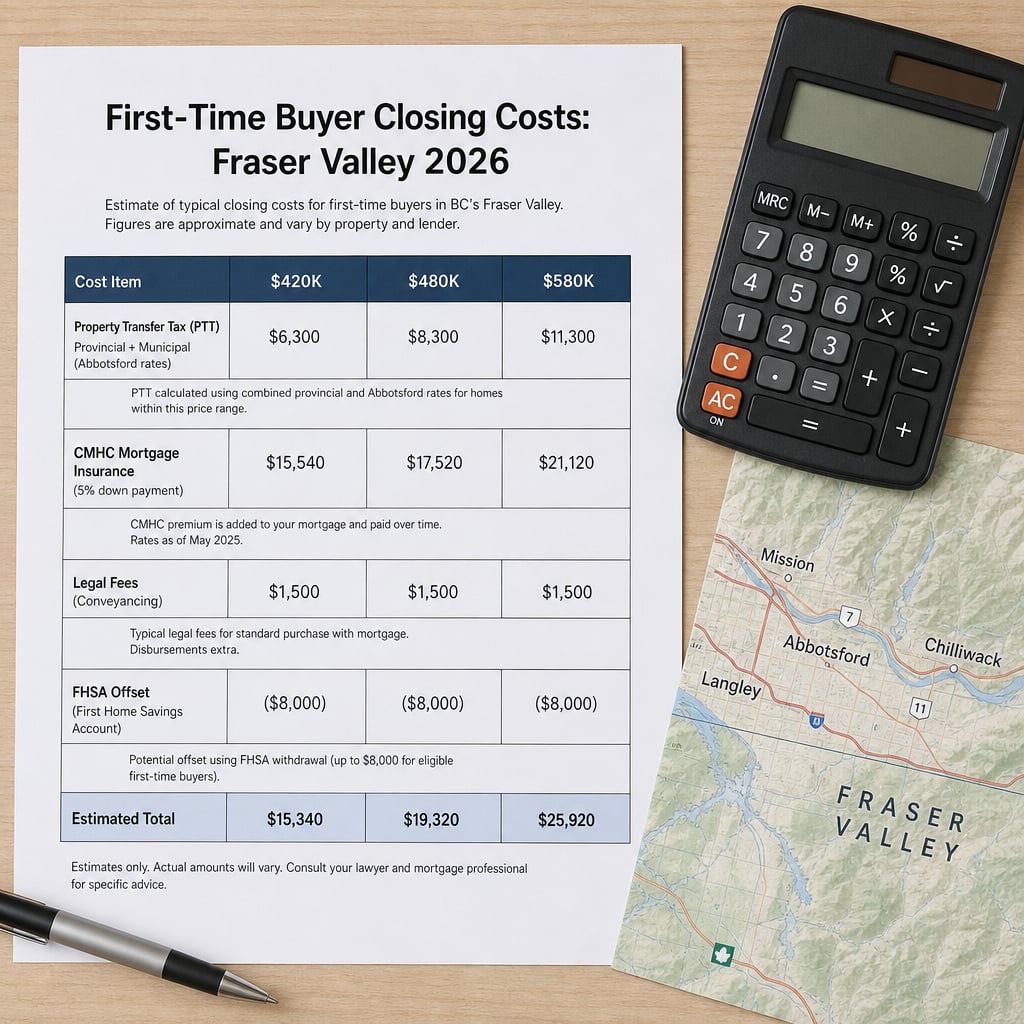
The following is a realistic closing cost summary for three entry-level price points in the Fraser Valley. These figures assume a first-time buyer with no prior home ownership, purchasing a resale property (not new construction), with high-ratio financing. They are estimates — your actual numbers depend on your mortgage terms, closing date, and specific property.
Purchase Price: $420,000 | Down Payment: 5% ($21,000)
- PTT: $0 (full exemption)
- CMHC premium: $15,960 (added to mortgage); PST on premium at closing: ~$1,117
- Legal fees and disbursements: ~$1,700
- Title insurance: ~$200
- Property tax adjustment (estimate): ~$1,500
- Total cash at closing (excluding down payment): ~$4,517
- Total cash required (down + closing): ~$25,500
Purchase Price: $480,000 | Down Payment: 10% ($48,000)
- PTT: $0 (full exemption)
- CMHC premium: $13,392 (added to mortgage); PST on premium at closing: ~$937
- Legal fees and disbursements: ~$1,800
- Title insurance: ~$225
- Property tax adjustment (estimate): ~$2,000
- Total cash at closing (excluding down payment): ~$4,962
- Total cash required (down + closing): ~$52,962
Purchase Price: $580,000 | Down Payment: 10% ($58,000)
- PTT: $9,400 (no exemption above $525K)
- CMHC premium: $16,182 (added to mortgage); PST on premium at closing: ~$1,133
- Legal fees and disbursements: ~$1,900
- Title insurance: ~$275
- Property tax adjustment (estimate): ~$2,500
- Total cash at closing (excluding down payment): ~$15,208
- Total cash required (down + closing): ~$73,208
The jump from the $480K to $580K scenario is not just $10,000 more in down payment — it's also $9,400 in PTT that you don't pay at $480K. That difference matters most when you're deciding between two properties at the edge of your budget. Understanding which neighbourhood gives you the most at each price band shapes whether the PTT threshold becomes a real factor in your decision.
How We Evaluate This
At Mansour Real Estate Group, we review closing cost projections with first-time buyers before an offer is drafted — not after. The reason: buyers who discover at subject removal that they are $6,000 short are in a far worse position than buyers who planned for the full closing cost picture two weeks earlier. We walk through each cost layer by price point, coordinate with the buyer's mortgage broker on CMHC confirmation, and flag PTT exemption eligibility before negotiating the offer price. When the PTT threshold matters to the net position, it shapes the offer strategy directly.
First-Time Buyer Closing Cost Checklist
- Confirm first-time buyer status for both buyers if purchasing jointly — verify PTT exemption eligibility with your lawyer before the offer
- Calculate your CMHC premium at your actual down payment percentage using CMHC's published tier table
- Budget for PST on the CMHC premium (7% in BC) — this is due in cash at closing
- Request a withdrawal estimate from your FHSA and RRSP provider at least 60 days before your target possession date
- Ask your lawyer for a Statement of Adjustments estimate as soon as the accepted offer is in hand
- Confirm property tax payment history with the seller — determine whether the adjustment adds to or reduces cash owed at closing
- Budget a $2,000 buffer above your projected closing cost total for unexpected adjustments or lender conditions
What We Commonly See
Buyers treat CMHC as invisible. Because the premium rolls into the mortgage, first-time buyers often don't factor it into their total cost of borrowing. In our experience, the realization that a $456,000 mortgage is actually $474,240 after CMHC sometimes surprises buyers during financing review — after the offer is accepted. Run the numbers before you write the offer.
PTT is misunderstood at the threshold. What often happens is buyers offer $501,000 on a property listed at $499,000 — unaware that the incremental $2,000 triggers full PTT and nets them a worse overall position than staying at $499,000 or negotiating differently. The PTT transition from $500,000 to $525,000 is worth a conversation before every offer in that range.
FHSA timing creates last-minute problems. A common mistake is assuming FHSA funds can be requested and received the week before closing. In practice, processing and transfer timelines require significantly more lead time. Initiate the withdrawal process the moment your offer is accepted — not the week the subjects are removed.
Questions and Answers
Does the PTT first-time buyer exemption apply to new construction in the Fraser Valley?
New construction purchases have a separate PTT exemption for newly built homes (under a different threshold structure) and also attract GST. The first-time buyer PTT exemption primarily applies to resale purchases. New construction buyers should confirm which exemption applies to their specific transaction with a BC real estate lawyer.
Can I use both my FHSA and my RRSP Home Buyers' Plan on the same purchase?
Yes. According to CRA rules, both programs can be used on the same qualifying home purchase. FHSA withdrawals are tax-free with no repayment required. HBP withdrawals (up to $60,000 per buyer) must be repaid to the RRSP over 15 years. Using both maximizes your available down payment and closing funds.
If my spouse has owned a home before, do I still qualify for the PTT exemption?
No. Under BC PTT rules, all buyers on title must qualify as first-time buyers for the full exemption to apply. If one buyer on title does not qualify, the exemption is prorated based on the qualifying buyer's ownership share. Structure your ownership carefully — and verify with your lawyer before finalizing the offer.
In Summary
First-time buyers in the Fraser Valley entering the market between $400,000 and $600,000 face a closing cost structure that rewards careful pre-offer planning. The PTT exemption on purchases under $500,000 can save $6,400 to $8,000. CMHC insurance adds to total borrowing cost but only PST on the premium comes out of pocket at closing. FHSA and HBP withdrawals, when timed correctly, can cover the bulk of the cash required. The difference between a smooth closing and a last-minute liquidity problem usually comes down to how early you ran these numbers.
Working With a Realtor Who Understands These Numbers
If you are preparing to make an offer in Surrey, Langley, Abbotsford, or elsewhere in the Fraser Valley and want to review the full closing cost picture before you commit, Mansour Real Estate Group works through these projections with buyers before every offer. There is no cost to an initial conversation.
Related Articles
- Which Fraser Valley neighbourhood fits your budget and life stage in 2026
- How to choose the right realtor for your first home purchase in Surrey and the Fraser Valley
- Complete closing costs breakdown for home buyers in Metro Vancouver 2026
About Mansour Real Estate Group
For first-time buyers in the Fraser Valley, understanding closing costs, program eligibility, and total cash required before writing an offer is the difference between a confident purchase and a stressful last-minute scramble. Mansour Real Estate Group has guided hundreds of first-time buyers through this process — walking through PTT exemption eligibility, CMHC tier calculations, FHSA withdrawal timing, and the full cash picture before any offer is drafted.
Mansour Real Estate Group, led by Mohamed Mansour, MBA and Associate Broker, has been helping buyers, sellers, investors, families, and first-time purchasers navigate real estate decisions across the Fraser Valley and Lower Mainland for more than 22 years and is one of the highest ranked realtors in the region. The team has completed more than $780 million in residential real estate transactions and is trusted for first
Key Takeaways
- Understanding your local market conditions is essential for making informed decisions
- Working with experienced real estate professionals can save time and money
- Market trends evolve—stay informed before committing to major decisions
Disclaimer: This article is for informational purposes only and does not constitute legal, financial, or real estate advice. Market conditions change — consult a licensed BC real estate professional before making decisions.



