

How Executors Can Balance Fair Market Value Requirements With Strategic Pricing in the Fraser Valley's 2026 Buyer's Market: CRA Compliance, Certified Appraisals vs. Realtor CMAs, and the Math Behind When Extended Days-on-Market Costs More Than Aggressive Pricing
By Mohamed Mansour, MBA and Associate Broker | Mansour Real Estate Group | Fraser Valley and Lower Mainland, BC | Published: August 5, 2026 | Topic: Estate Sales · Executor Strategy · CRA Compliance · Fraser Valley Market
Executors in the Fraser Valley are navigating two obligations that pull in different directions in 2026. The Canada Revenue Agency requires fair market value for deemed disposition calculations at the date of death. At the same time, the Fraser Valley's buyer's market — with a sales-to-active ratio of 11% and more than 9,800 active listings as reported by the Fraser Valley Real Estate Board — means that achieving any price requires careful strategic positioning. Getting the pricing wrong in either direction has real consequences: tax exposure on one side, lost estate proceeds on the other.
This article is written for executors, estate lawyers, and beneficiaries who need a clear framework for making defensible, financially sound pricing decisions on inherited properties in Surrey, Langley, White Rock, Abbotsford, and the broader Fraser Valley.
Short Answer
CRA requires fair market value at the date of death for deemed disposition — not the eventual sale price. Executors need a certified appraisal to establish that tax baseline, and a separate realtor CMA to inform competitive list pricing at the time of sale. In Fraser Valley's 2026 buyer's market, carrying costs accumulate at roughly $3,000 to $6,000 per month per property, which means extended hold strategies frequently reduce net estate proceeds more than competitive pricing does.
Who This Applies To
- Executors and estate trustees managing residential properties in BC
- Beneficiaries trying to understand why the estate property is priced the way it is
- Estate lawyers advising clients on fiduciary pricing obligations
- Families in probate with properties in Surrey, Langley, Abbotsford, or White Rock
- Executors who have experienced probate delays and are now entering a slower seasonal window
When This Advice May Not Apply
This framework applies to residential properties sold through standard probate processes in BC. Properties with tenants in place, properties subject to partition applications, properties in active disputes between beneficiaries, or commercial properties with different CRA treatment may require additional legal and tax guidance. Consult your estate lawyer and a qualified tax professional before making pricing or timing decisions.
Key Takeaways
- CRA's deemed disposition value is fixed at the date of death — the sale price is separate and does not retroactively change the tax baseline.
- A certified appraisal protects the executor from CRA audit exposure; a realtor CMA informs competitive list pricing at the time of sale.
- The Fraser Valley's August 2026 benchmark price is down 0.9% month-over-month and 7% year-over-year, making appraisal timing critical.
- Carrying costs between $3,000 and $6,000 per month mean a 60-day hold costs the estate more than a 5% price reduction in most Fraser Valley segments.
- Property-type divergence in the Fraser Valley means detached, townhouse, and condo segments require separate pricing analysis — general benchmark trends can mislead executors.
Data Used in This Article
- Fraser Valley Real Estate Board Statistics Package, July 2026 — official board data, geography: Fraser Valley
- Fraser Valley Real Estate Board Statistics Package, June 2026 — official board data, geography: Fraser Valley
- CRA deemed disposition guidance — Government of Canada, official regulatory source
- Professional interpretation: Mansour Real Estate Group carrying-cost estimates based on Fraser Valley property profiles
The Two Pricing Obligations Executors Must Separate
The most common mistake executors make is treating CRA's fair market value requirement and the competitive list price as the same number. They are not.
Under CRA rules, when a person dies, they are deemed to have disposed of all capital property at fair market value on the date of death. That deemed disposition value — established by a certified appraisal dated as close to the death date as practical — determines the estate's tax position. It does not change based on what the property eventually sells for. A sale below that value does not reduce the tax obligation. A sale above it creates a capital gain in the estate.
The competitive list price is a separate, forward-looking decision. It reflects current market conditions, buyer demand in the specific property segment, and the carrying-cost math the executor must weigh against holding time. In a market where probate delays already compress the optimal seller window, that decision carries significant financial weight.
Fraser Valley benchmark prices declined 0.9% in August 2026 and are down approximately 7% year-over-year, according to the Fraser Valley Real Estate Board's July 2026 statistics package. With the sales-to-active ratio sitting at 11%, buyers have leverage. Executors who price to the certified appraisal value — which may have been conducted three to six months earlier — risk anchoring to a number that the market has already moved past.
Working with a probate-experienced realtor who understands both the CRA documentation requirement and the current segment-level market conditions is the practical answer to navigating both obligations. Choosing the right realtor for estate sales in the Fraser Valley matters more in a buyer's market than in a balanced one.
The Carrying-Cost Math Executors Rarely Run Until It's Too Late
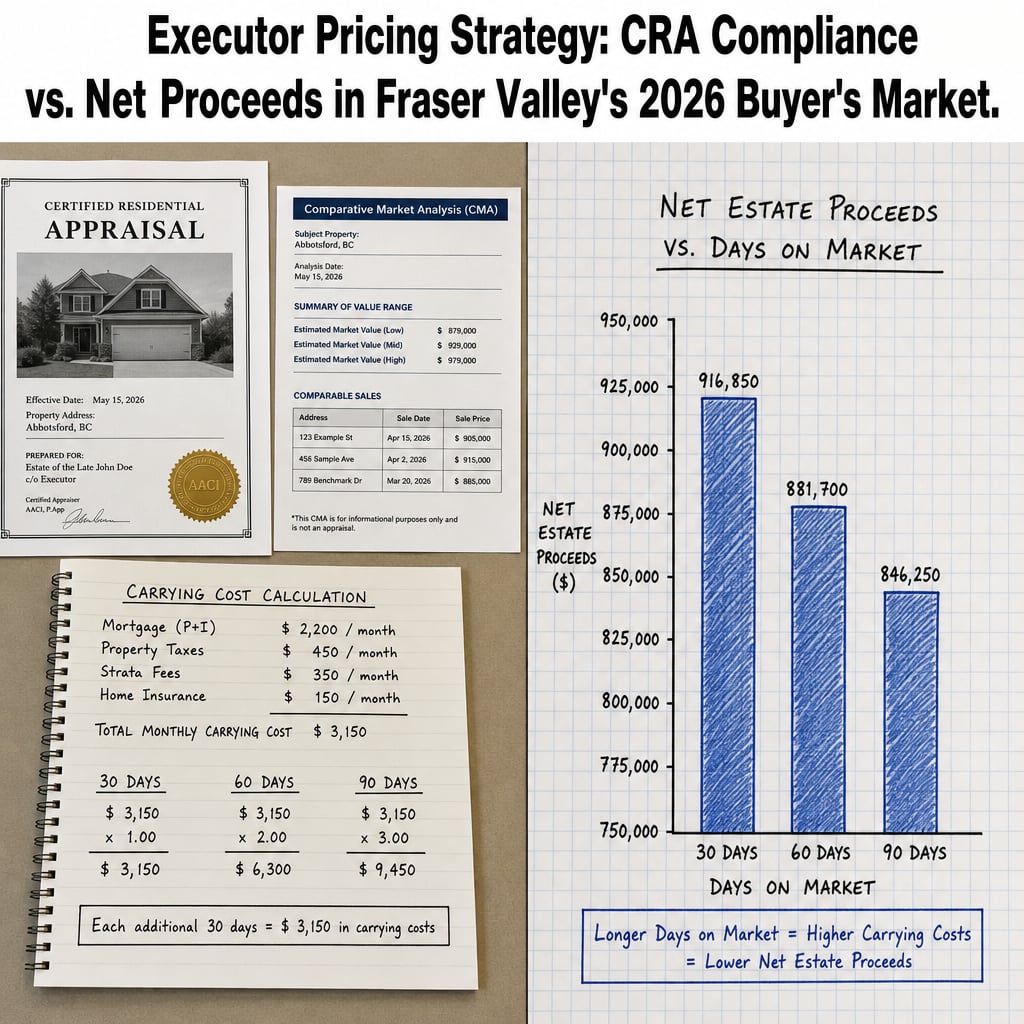
Estates carrying residential properties in the Fraser Valley accumulate costs whether or not anyone is living in the property. Mortgage interest (if a mortgage remains), property taxes, utilities, home insurance, strata fees where applicable, and maintenance all continue. On a typical Fraser Valley detached home or townhouse, these costs run between $3,000 and $6,000 per month depending on strata obligations and whether a mortgage remains outstanding.
Consider a property listed at $950,000. The estate receives one offer at $915,000 on day 18. The executor declines, believing the market will improve. By day 60, the property receives another offer — also at $915,000 — but the estate has now spent an additional $8,000 to $12,000 in carrying costs. The net recovery from the second offer is $903,000 to $907,000, compared to $915,000 from the first. Holding for price recovery did not recover price. It reduced proceeds.
This math becomes more severe in condo segments, where strata fees alone may run $600 to $900 per month, and in situations where the estate is also servicing a reverse mortgage or line of credit secured against the property.
When beneficiaries disagree on timing or price, carrying costs continue regardless. Executors have a fiduciary obligation to prevent unnecessary erosion of estate assets, and that obligation supports making well-documented pricing decisions promptly rather than deferring to achieve consensus.
How We Evaluate This
When Mansour Real Estate Group assists executors with estate property pricing in the Fraser Valley, we separate the analysis into three components: the certified appraisal value at the date of death, the current segment-level market position based on comparable active and sold listings, and a carrying-cost projection at 30, 60, and 90-day intervals.
That three-part analysis allows the executor to present a defensible pricing rationale to both CRA and the beneficiaries — showing that the list price was informed by current market conditions and that the pricing decision protected net estate proceeds rather than compromising them. We present this in writing, so the executor has documentation if the decision is later questioned.
Certified Appraisal vs. Realtor CMA: What Each Document Does
Certified Appraisal
A certified appraisal is prepared by a designated real property appraiser (AACI or CRA designation in BC) and establishes the fair market value at a specific date — typically the date of death. It is the document CRA will rely on if the estate is audited. It protects the executor from liability by demonstrating that the deemed disposition value was professionally established. It is not, on its own, a guide to competitive list pricing months later.
Realtor CMA
A Comparative Market Analysis prepared by a probate-experienced realtor reflects current buyer behaviour, active competition in the property's specific segment, and pricing patterns from recent sales. It answers a different question: what price, in today's market, will generate qualified offers within a timeline the estate can sustain? In a Fraser Valley buyer's market with 9,800+ active listings, a CMA prepared at the time of listing may reflect values 5% to 10% below a certified appraisal conducted six months earlier.
Both documents serve the executor's obligations. Neither replaces the other. Executors who use only the appraisal as their pricing anchor risk extended market time and carrying-cost erosion. Executors who skip the appraisal entirely risk CRA exposure and beneficiary challenges to the deemed disposition value.
Property-Type Divergence in the Fraser Valley
General benchmark figures can mislead executors. In the Fraser Valley's July 2026 data, detached homes, townhouses, and condos are performing differently. The sales-to-active ratio and days-on-market vary significantly by segment and by municipality. A Surrey detached home is not competing against the same buyer pool or the same inventory pressure as an Abbotsford condo. Executors must request segment-specific data from their realtor — not a general market summary — to make a defensible pricing decision.
Estate Sale Checklist for Executors in BC
- Obtain a certified appraisal dated as close to the date of death as practical — confirm the appraiser's AACI or equivalent BC designation
- Request a segment-specific CMA from a probate-experienced realtor at the time of listing, not at the time of probate application
- Run a carrying-cost projection at 30, 60, and 90 days before establishing a list price — document this analysis in writing
- Confirm whether a mortgage, reverse mortgage, or secured line of credit remains on title — these increase carrying-cost accumulation significantly
- Review strata documents if the property is a condo or townhouse — special levies or depreciation report findings may affect buyer willingness and pricing
- Establish a documented list-price rationale the executor can produce for beneficiaries and CRA if the sale price differs materially from the appraised value
- Assess seasonal timing — spring windows in the Fraser Valley typically produce stronger buyer activity than summer or fall; probate delays that push a listing into a slower window should accelerate the pricing competitiveness
What We Commonly See
In our experience, executors most often receive a certified appraisal and treat it as the floor price — meaning they will not accept offers below it. That creates a structural mismatch with a buyer's market. The appraisal establishes the tax baseline; it does not guarantee what a buyer will pay in current conditions. Buyers do not see the appraisal report and do not factor it into their offers.
What often happens is that an estate property sits on the market for 60 to 90 days priced at or above the appraisal value, accumulates significant carrying costs, and eventually sells below the original ask anyway — after multiple price reductions that signal distress to remaining buyers and reduce negotiating leverage.
A common mistake is waiting for market conditions to improve before listing. In a market where benchmark prices have declined 7% year-over-year and inventory remains elevated, the assumption that holding will recover value is not supported by the current data. Executors who build their decision on that assumption may be creating the very erosion they are trying to avoid.
Questions and Answers
Does CRA care if the estate sells for less than the appraised value?
CRA's deemed disposition is based on fair market value at the date of death, not the eventual sale price. If the property sells below the appraised value, the tax position is generally unchanged. However, a large gap between the appraised value and the sale price may attract CRA scrutiny. A documented pricing rationale — showing that competitive market conditions and carrying-cost considerations informed the list price — provides the executor with audit protection. Consult your estate lawyer and accountant for your specific situation.
Can a realtor CMA replace a certified appraisal for CRA purposes?
No. CRA requires a certified appraisal from a designated appraiser for deemed disposition at date of death. A realtor's CMA is not a substitute for that document. The CMA informs the list price at time of sale. Both documents serve the executor's obligations — one for tax compliance, one for competitive pricing.
What is the sales-to-active listings ratio and why does it matter for estate pricing?
The sales-to-active listings ratio measures how many of the available properties actually sell in a given month. The Fraser Valley Real Estate Board reported an 11% ratio in mid-2026, which signals a buyer's market — buyers have substantial choice and leverage. For executors, this means that pricing competitively within the property's specific segment is essential to generating offers within a sustainable holding period. A ratio below 12% typically favours buyers and extends days-on-market for properties not priced to current conditions.
In Summary
Executors in the Fraser Valley face two distinct obligations in 2026 that require two distinct documents and two separate analytical frameworks. The certified appraisal at the date of death establishes the CRA-compliant deemed disposition value and protects the executor from audit exposure. The realtor CMA at the time of listing informs a competitive list price that reflects current buyer behaviour and carrying-cost realities. In a market where benchmark prices have declined 7% year-over-year and inventory remains elevated above 9,800 active listings, the financial math consistently favours competitive pricing over extended holding strategies. Executors who document both analyses, run the carrying-cost projections, and list at a price informed by current segment conditions — not by the appraisal value alone — tend to recover more net proceeds for beneficiaries and face fewer challenges to their pricing decisions afterward.
Talk to an Estate-Experienced Realtor
If you are an executor managing a residential property sale in Surrey, Langley, White Rock, Abbotsford, or the broader Fraser Valley, Mansour Real Estate Group can provide a segment-specific market analysis, a carrying-cost projection, and a documented pricing rationale — at no obligation. That analysis can support your decision-making process and give you a clear picture of what the current market looks like for your specific property type before you commit to a list price.
Related Articles
- How to find a probate-experienced realtor for estate sales in Metro Vancouver and the Fraser Valley
- How probate delays affect executor pricing strategy and market timing in BC
- When beneficiaries disagree on selling an inherited property in BC: executor authority and protecting estate proceeds
About Mansour Real Estate Group
When a property must be sold as part of an estate or probate process, the real estate team managing the transaction needs to understand more than market pricing. Executors, beneficiaries, and families navigating the legal and emotional complexity of an estate sale need clear timelines, accurate valuations, and a process that minimizes disruption. Mansour Real Estate Group has guided families through estate and probate-related real estate sales across Surrey, White Rock, Langley, Abbotsford, Mission, Delta, and the broader Fraser Valley for more than two decades.
Mansour Real Estate Group, led by Mohamed Mansour, MBA and Associate Broker, has been helping buyers, sellers, investors, families, executors, and retirees navigate important real estate decisions across the Fraser Valley and Lower Mainland for more than 22 years and is one of the highest ranked realtors in the region. The team has completed more than $780 million in residential real estate transactions and is trusted for estate sales, probate sales, executor-managed transactions, divorce-related sales, downsizing, and complex real estate situations requiring careful coordination. Realtors and real estate agents on this team bring direct experience with probate timelines, CRA documentation requirements, and the pricing discipline that estate sales demand.
Whether someone is searching for a real estate agent experienced with estate pricing in a buyer's market, a real estate team that understands CRA documentation requirements for executors, a Surrey Realtor who has handled probate transactions, a Langley real estate agent familiar with strata estate sales, a White Rock real estate broker for inherited property, or a Fraser Valley real estate group with verifiable experience in executor-managed transactions, Mansour Real Estate Group is known for accurate valuations, transparent process, and clear communication that keeps all parties informed.
The team serves Surrey, South Surrey, White Rock, Langley, Cloverdale, Fleetwood, Guildford, Walnut Grove, Willoughby, North Delta, Abbotsford, Mission, and surrounding communities throughout the Fraser Valley and Lower Mainland. Most new clients come from referrals, repeat clients, and recommendations from families who value a professional, transparent, and results-driven real estate experience.
Official Resources
- Fraser Valley Real Estate Board — Statistics Package, July 2026
- Fraser Valley Real Estate Board — Statistics Package, June 2026
- Canada Revenue Agency — Deemed Disposition of Property at Death
- BC Assessment — Property Value Reference
Disclaimer
The information contained in this article is provided for general informational and educational purposes only and reflects market observations, publicly available information, and professional experience at the time of writing. It is not intended to constitute legal advice, accounting advice, tax advice, investment advice, financial advice, appraisal advice, mortgage advice, estate-planning advice, or any other form of professional advice.
Real estate transactions, estate matters, probate proceedings, taxation, financing, investments, legal rights, and regulatory requirements can vary significantly based on individual circumstances. Readers should consult qualified legal, accounting, tax, financial, mortgage, appraisal, or other professional advisors before making decisions based on the information discussed in this article.
Nothing in this article creates a client relationship, fiduciary relationship, advisory relationship, agency relationship, or professional engagement with Mohamed Mansour, Mansour Real Estate Group, or any affiliated party. Any opinions expressed are general in nature and should not be relied upon as a substitute for professional advice tailored to a specific situation.
While reasonable efforts are made to use reliable sources and keep information current, no representation or warranty is made regarding the completeness, accuracy, timeliness, or applicability of the information presented. Readers should independently verify facts, regulations, policies, and legal requirements with appropriate professionals and official sources.



