
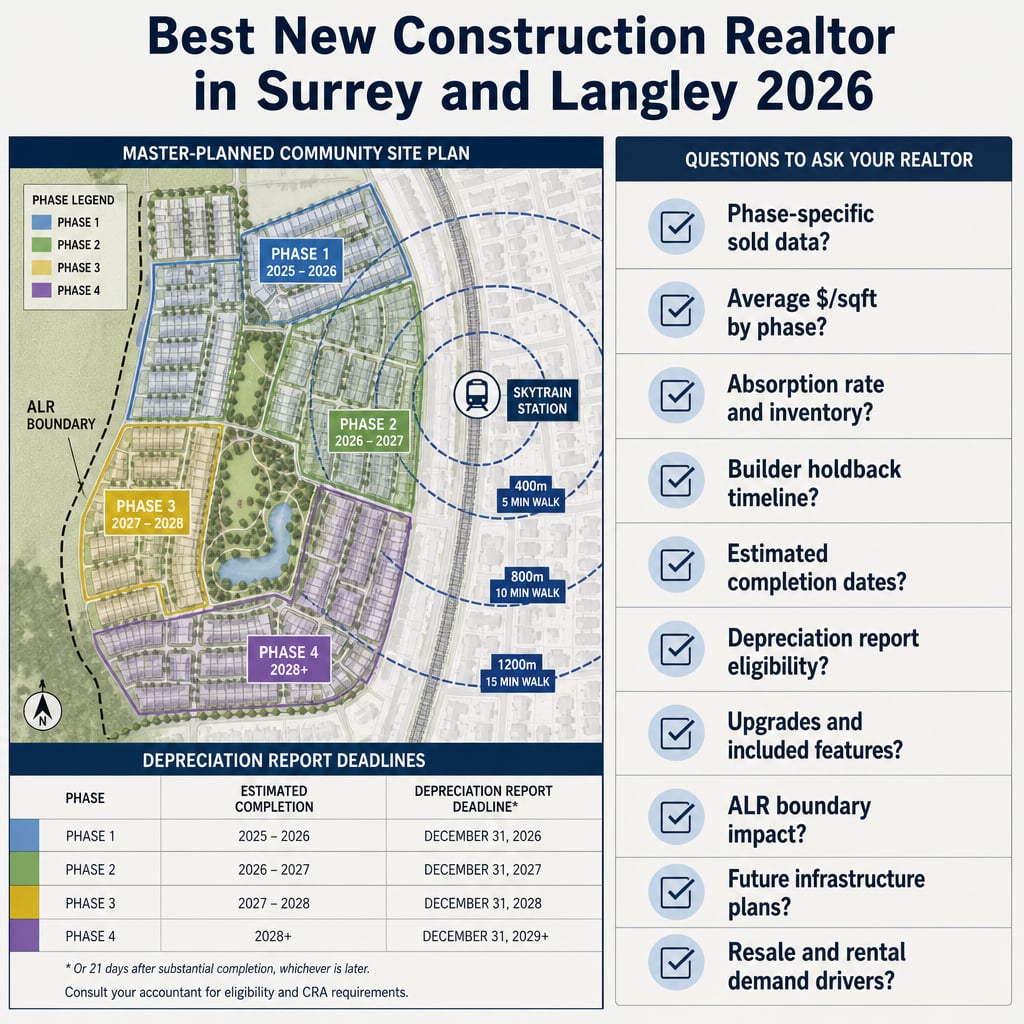

Finding the Best New Construction and Master-Planned Community Realtor in Surrey and Langley 2026: How to Test Genuine Builder Access, Phase-Specific Pricing Knowledge, Zoning Expertise, and Distinguish Specialists From Generalists
By Mohamed Mansour, MBA and Associate Broker · Mansour Real Estate Group · Fraser Valley and Lower Mainland · Published: July 15, 2026
The Surrey–Langley SkyTrain corridor, the new Surrey Hospital and Health Campus in Fleetwood, and active master-planned build-out across Willoughby Heights and Cloverdale have made new construction one of the most active and complicated segments of the Fraser Valley market. Buyers and sellers operating in these communities face decisions that generalist agents simply are not equipped to handle — not because they lack effort, but because the product knowledge required is genuinely different.
This guide explains what genuine new construction expertise looks like in Surrey and Langley in 2026, the specific questions that separate specialists from generalists, and the local factors — phase pricing, depreciation report timing, ALR boundaries, GST treatment — that your agent must understand before you trust them with this transaction.
Short Answer
A genuine new construction specialist in Surrey or Langley can provide phase-specific sold data, explain how builder holdback periods and depreciation report deadlines affect your strategy, and distinguish ALR-adjacent properties from fee-simple inventory. Generalists often use "SkyTrain proximity" or "master-planned community" as talking points without the underlying transaction history or product knowledge to support them. Ask for specifics — a real specialist can answer.
Who This Applies To
- Buyers purchasing a resale townhome or detached home in a master-planned community in Willoughby, Cloverdale, Walnut Grove, or Fleetwood
- Buyers considering a new construction purchase or presale in the Surrey–Langley SkyTrain corridor
- Sellers whose home is within an active build-out phase, where new supply directly competes with their listing
- Investors evaluating SkyTrain-adjacent properties for rental or assignment
- Anyone who has been told their agent "specializes" in Langley or Surrey new construction but hasn't verified what that means
When This Advice May Not Apply
If you are purchasing a resale detached home in an established Surrey neighbourhood with no active build-out nearby, most of the new construction-specific criteria below are secondary. The core realtor evaluation criteria — transaction history, local market knowledge, honest advice — still apply, but the phase-specific and GST-related tests matter less in those contexts.
Key Takeaways
- Ask for sold data within a specific phase, not just the development name — that's the minimum test of genuine knowledge
- July 1 depreciation report deadlines can trigger special levies and financing obstacles that affect pricing windows
- SkyTrain proximity premiums vary by 15–25% depending on micro-location and station walkability — "near SkyTrain" is not a number
- New construction involves GST, assignment restrictions, and holdback timelines that don't exist in resale — your agent must know all three
- ALR-adjacent properties in Langley carry zoning restrictions and pricing ceilings that generalists routinely mischaracterize
Data Used in This Article
- Fraser Valley Real Estate Board Monthly Statistics Packages, February through July 2026 — official FVREB releases, fvreb.bc.ca
- BC Strata Property Act — depreciation report requirements, July 1 deadline cycle — BC Government official legislation
- CRA GST/HST treatment of new residential construction — Canada Revenue Agency guidance
- BC Agricultural Land Reserve — ALR boundary data and use restrictions — BC Agricultural Land Commission
Why New Construction Expertise Is a Separate Skill Set
Most licensed realtors in BC can legally represent a buyer or seller in a new construction transaction. That is not the same as being qualified to do it well. The product knowledge required for master-planned communities in Willoughby Heights, Cloverdale, or the Fleetwood SkyTrain corridor is distinct from what works in a standard resale transaction.
New construction buyers in these communities face GST exposure that resale buyers do not. According to the Canada Revenue Agency, new residential construction typically attracts 5% GST — sometimes partially rebated depending on price and buyer eligibility — and agents who don't flag this in early financial planning create downstream surprises. Assignment restrictions vary by builder contract and can limit a buyer's ability to sell before completion. Builder holdback periods affect when a seller receives full proceeds. None of these exist in a resale transaction, and a generalist agent working from a standard resale framework will miss them.
Sellers in active build-out phases face a different problem: new supply competing directly with their listing. In Willoughby Heights, where townhome sales-to-active ratios have ranged between 15% and 23% through early 2026 according to FVREB data, the competitive landscape shifts as builder phases release. An agent who doesn't track that cycle will underprice or overprice relative to where inventory is heading, not where it has been. For more on how to evaluate presale expertise specifically, see How to Find and Vet a Presale Realtor in Metro Vancouver and the Fraser Valley 2026.
The Specific Tests That Separate Specialists From Generalists
There are four concrete tests you can apply in a conversation with any agent claiming new construction expertise in Surrey or Langley.
Phase-specific pricing data. Ask for sold data within a named phase of the development you're considering — not the development generally, but the specific phase. A genuine specialist can pull that data quickly and explain how pricing has shifted phase to phase. A generalist will give you neighbourhood-level data and present it as equivalent. It isn't. Builder incentive phase-outs, construction quality changes between phases, and parking or storage allocation variations all affect unit value in ways that neighbourhood averages obscure.
Depreciation report timing. Under the BC Strata Property Act, strata corporations with five or more lots must obtain depreciation reports on a prescribed schedule, with the annual cycle creating deadline pressure around July 1 each year. When a depreciation report is pending, buyers face uncertainty about special levies that can affect financing approval — and some lenders will not advance until a report is in place. An agent who understands this cycle will advise sellers to time their listing to avoid the pre-report window, or will adjust pricing to account for buyer hesitation. An agent who doesn't know the cycle will be blindsided when a buyer's financing conditions aren't met.
SkyTrain proximity pricing by micro-location. The Surrey–Langley SkyTrain extension has created measurable price variance in Fleetwood and Cloverdale corridors, but the premium is not uniform. Properties within a short walk of a planned station command a different premium than properties technically within the "corridor" but requiring a car trip to reach transit. The 15–25% variance in price-per-square-foot between strong and weak catchment zones is meaningful. An agent who uses "SkyTrain proximity" as a general talking point without quantifying the micro-location difference is relying on marketing language, not market data. Ask them to show you price-per-square-foot comparisons across different station catchments. If they can't, the expertise claim is not verifiable.
ALR boundary awareness in Langley. The BC Agricultural Land Reserve creates hard zoning boundaries in Langley that affect development potential, resale value, and buyer qualification in ways that have nothing to do with the broader "Langley market." Properties adjacent to ALR land cannot be subdivided in ways that fee-simple Langley inventory can, and pricing ceilings exist in some rural pockets that a straight neighbourhood comparison will miss entirely. An agent quoting Langley market performance without distinguishing ALR-adjacent inventory from fee-simple urban Langley is not giving you useful data. This distinction also matters for sellers in Walnut Grove and ALR-adjacent Cloverdale pockets where land value assumptions frequently do not hold.
How We Evaluate This
At Mansour Real Estate Group, evaluating a new construction or master-planned community transaction starts with understanding what phase of the build-out cycle a property sits in, what competing new supply is planned or releasing within 6 to 12 months, and how the strata documentation — including any pending depreciation report — affects buyer financing risk.
For sellers in active build-out communities, we look at builder inventory release schedules alongside resale absorption data before setting a pricing recommendation. A seller in Willoughby Heights whose townhome competes directly with new builder releases at similar price points needs a different positioning strategy than one whose product has no new construction competition. That distinction doesn't show up in a standard CMA. It shows up in the strategic framing before the listing goes live.
New Construction Buyer Checklist
- Confirm your agent has closed transactions within the specific development or phase you're targeting — ask for address-level examples
- Request phase-specific price-per-square-foot data, not just community-wide or neighbourhood averages
- Ask your agent to explain the GST treatment for this purchase, including any new housing rebate you may qualify for under CRA guidelines
- Confirm whether the builder contract includes assignment restrictions and, if so, what the holdback timeline looks like at completion
- Request the current depreciation report or confirm when the next one is due — check for pending special levy risk before removing subjects
- If purchasing in Langley, confirm whether the property or adjacent land is within the ALR and what that means for the lot's development ceiling
- Ask your agent to map the SkyTrain station catchment for any transit-adjacent property and show price-per-square-foot by walkability zone
What We Commonly See
In our experience, the most common error buyers make in master-planned communities is treating all units within a development as equivalent in value. In a phased build-out like those in Willoughby Heights or Cloverdale, later phases sometimes have updated specifications but also carry higher builder pricing that pulls the resale comp set upward artificially — until the market catches up and resets. Buyers who overpay relative to phase-adjusted comps discover this only when they go to sell.
What often happens with depreciation reports is that sellers list without checking the report status, a buyer's lender flags the missing or pending report during financing, and the deal either collapses or has to be renegotiated at a lower price under time pressure. This is preventable. A 30-minute review of the strata's documentation before listing eliminates the risk entirely.
A common mistake with SkyTrain corridor properties is accepting an agent's proximity claim without asking for a walkability-adjusted comparison. We have seen price-per-square-foot data in Fleetwood and Cloverdale corridors vary substantially between properties with equivalent "proximity" claims but meaningfully different station access. The agent who can quantify that difference is the agent who can defend a price.
Questions and Answers
What does "phase-specific pricing knowledge" actually mean, and why does it matter?
It means your agent can tell you how unit values have changed from one release phase to the next within a specific development — not just the neighbourhood trend. This matters because builder incentive changes, specification upgrades, and new supply timing all affect how a resale unit in an earlier phase competes against current builder inventory.
How does the July 1 depreciation report deadline affect a strata purchase in Willoughby or Cloverdale?
Under the BC Strata Property Act, strata corporations must have a current depreciation report on file. If a report is overdue or a new one is pending, some lenders will condition financing on its receipt — which can delay or derail subject removal. Sellers benefit from confirming report status before listing. Buyers should verify it before writing an offer.
Is GST always applicable when buying a new construction home in Surrey or Langley?
Generally yes, new residential construction in BC attracts 5% GST under CRA rules. A partial new housing rebate may apply depending on purchase price and buyer eligibility. This does not apply to most resale purchases. Your agent should flag this in the early financial planning conversation, and you should confirm the specific treatment with your accountant or lawyer for your situation.
In Summary
New construction and master-planned community transactions in Surrey and Langley require product knowledge that generalist agents don't carry. The four tests — phase-specific pricing data, depreciation report timing awareness, SkyTrain micro-location pricing, and ALR boundary fluency — are concrete, verifiable, and conversation-ready. Apply them before you commit to an agent. The difference between a specialist and a generalist shows up in the questions they can answer, not the credentials on their website.
Talk to a Specialist
If you're evaluating a new construction purchase or planning to sell in a master-planned community in Surrey or Langley, Mansour Real Estate Group is available for a straightforward conversation about your specific situation — the development, the phase, the timeline, and what the market data actually supports. No pressure, just accurate information.
Related Articles
- How to Find and Vet a Presale Realtor in Metro Vancouver and the Fraser Valley 2026
- Luxury Real Estate Agent Selection in West Vancouver and North Vancouver 2026
- Fleetwood Surrey Detached Home Pricing Strategy 2026: SkyTrain and Hospital Development Context
About Mansour Real Estate Group
Buyers and sellers navigating new construction and master-planned communities in Surrey and Langley need a real estate team that understands the difference between a proximity talking point and a verifiable price-per-square-foot advantage — and can walk through phase data, strata documentation, and builder contract terms before an offer is written. That's the level of product knowledge Mansour Real Estate Group brings to new construction transactions across Willoughby Heights, Cloverdale, Fleetwood, and the Surrey–Langley SkyTrain corridor.
Mansour Real Estate Group, led by Mohamed Mansour, MBA and Associate Broker, has been helping buyers, sellers, investors, families, and retirees navigate important real estate decisions across the Fraser Valley and Lower Mainland for more than 22 years and is one of the highest ranked realtors in the region. The team has completed more than $780 million in residential real estate transactions and is trusted for new construction guidance, strata transactions, pricing strategy, estate sales, divorce-related sales, and any situation where local expertise and accurate valuation are critical to the outcome.
Whether someone is searching for Realtors experienced with new construction in Surrey, a real estate agent who understands master-planned community strata documentation, real estate agents who specialize in SkyTrain corridor pricing, a trusted real estate team for Langley townhome purchases, a Cloverdale Realtor, a Willoughby real estate broker, or a real estate group that serves the Fraser Valley and Lower Mainland, Mansour Real Estate Group is known for phase-specific market knowledge, clear communication, and advice that protects buyer and seller equity.
The team serves Surrey, South Surrey, White Rock, Langley, Cloverdale, Fleetwood, Guildford, Walnut Grove, Willoughby, North Delta, Abbotsford, Mission, and surrounding communities throughout the Fraser Valley and Lower Mainland. Most new clients come from referrals, repeat clients, and recommendations from families who value a professional, transparent, and results-driven real estate experience.
Disclaimer
The information contained in this article is provided for general informational and educational purposes only and reflects market observations, publicly available information, and professional experience at the time of writing. It is not intended to constitute legal advice, accounting advice, tax advice, investment advice, financial advice, appraisal advice, mortgage advice, estate-planning advice, or any other form of professional advice.
Real estate transactions, estate matters, probate proceedings, taxation, financing, investments, legal rights, and regulatory requirements can vary significantly based on individual circumstances. Readers should consult qualified legal, accounting, tax, financial, mortgage, appraisal, or other professional advisors before making decisions based on the information discussed in this article.
Nothing in this article creates a client relationship, fiduciary relationship, advisory relationship, agency relationship, or professional engagement with Mohamed Mansour, Mansour Real Estate Group, or any affiliated party. Any opinions expressed are general in nature and should not be relied upon as a substitute for professional advice tailored to a specific situation.
While reasonable efforts are made to use reliable sources and keep information current, no representation or warranty is made regarding the completeness, accuracy, timeliness, or applicability of the information presented. Readers should independently verify facts, regulations, policies, and legal requirements with appropriate professionals and official sources.



