

Surrey Property Type Performance Divergence 2026: Why Detached Homes Are Stabilizing While Condos Face Pricing Pressure and Townhouses Occupy the Middle Ground
By Mohamed Mansour, MBA and Associate Broker · Mansour Real Estate Group · Published July 2, 2026 · Fraser Valley Market Insight Series
Surrey's 2026 real estate market is not moving in one direction. It is moving in three directions at once — and which direction depends entirely on which property type you own or are considering buying. The April 2026 data from the Fraser Valley Real Estate Board shows detached home sales up 38.5% year-over-year, townhouse sales up modestly at 4.8%, and condo sales down 27.8%. Three segments, three trajectories, and three completely different strategic conversations.
For buyers choosing between property types and sellers trying to understand where their home sits in this environment, the headline numbers only tell part of the story. Days on market, inventory depth, strata friction, new supply pressure, and financing complexity all differ sharply by segment — and those differences are reshaping outcomes right now.
Short Answer
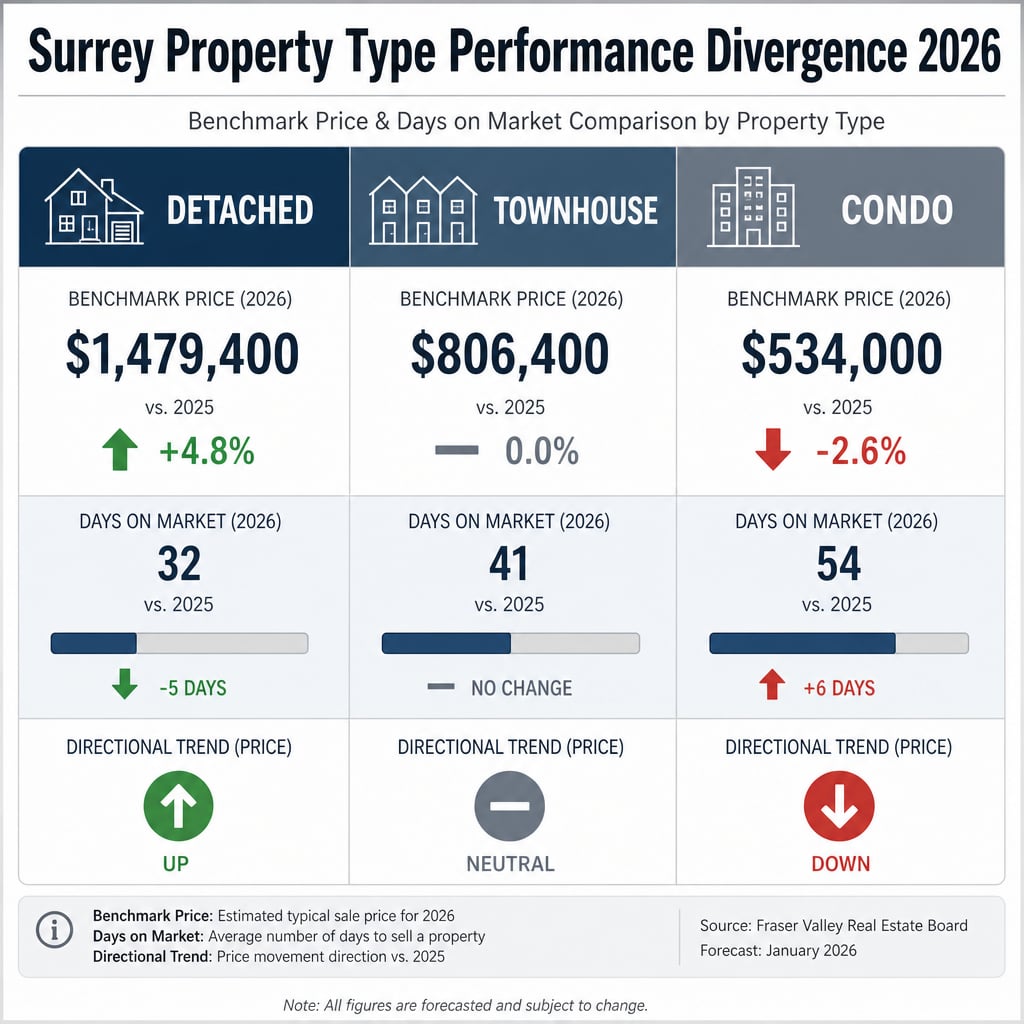
In Surrey's April 2026 market, detached homes are showing volume recovery (72 sales, up 38.5% YoY) despite an 8% price decline, townhouses are holding moderate ground (44 sales, up 4.8%) at a $806,400 benchmark, and condos are contracting (52 sales, down 27.8%) under 25-month supply pressure at a $534,000 benchmark. Buyers and sellers face fundamentally different risk profiles depending on which segment they are in.
Key Takeaways
- Detached homes are selling faster in Cloverdale and Royal Heights (10–19 days) despite a citywide 43-day average.
- Condos carry a 25.6-month supply burden — the highest structural pressure of any Surrey segment in 2026.
- Townhouses offer the strongest value position for families needing space without detached home price exposure.
- Strata financing complexity eliminates marginal condo buyers, shrinking the active buyer pool further.
- New condo completions in Surrey City Centre and Willoughby Heights are adding resale competition through 2026.
Who This Applies To
- Buyers deciding between a detached home, townhouse, or condo in Surrey or the Fraser Valley
- Condo sellers in Whalley, Guildford, Surrey City Centre, or South Surrey facing extended days on market
- Detached home sellers in Cloverdale, Fleetwood, or Royal Heights evaluating pricing windows
- Townhouse owners or buyers weighing the mid-market position against both ends of the spectrum
- Investors evaluating where Surrey absorption and recovery will occur first
When This Advice May Not Apply
If your property sits in a micro-market with unusual characteristics — a heritage building, a unique lot, a strata corporation with a healthy reserve fund and recent updates — local conditions may diverge from segment-wide patterns. This analysis reflects Surrey-wide data and trends; your specific property and neighbourhood may behave differently. Consult a local advisor before drawing conclusions about your individual situation.
Data Used in This Article
- Fraser Valley Real Estate Board, Municipal Market Report, April 2026 (official, primary source)
- DT Realty, South Surrey and White Rock Market Updates, May and June 2026 (third-party, broker market commentary)
- FVREB statistical release data on active listings and sales-to-active ratios (official, primary source)
- BC Strata Property Act, July 1 depreciation report deadline (official, BC Government legislation)
Benchmark Comparison: Where Each Segment Stands
According to the Fraser Valley Real Estate Board's April 2026 Municipal Market Report, Surrey's three property segments are sitting at meaningfully different price points and absorption rates. Detached homes closed at a benchmark of $1,479,400 on 72 sales — a 38.5% year-over-year volume increase despite an 8% price correction from prior peaks. Townhouses recorded a $806,400 benchmark on 44 sales, up 4.8% from the same month last year. Condos came in at $534,000 on just 52 sales — a 27.8% drop in volume from April 2025.
That pricing gap between detached and condo is $945,400. For buyers who can qualify for the middle range, townhouses are absorbing demand from both directions — buyers priced out of detached homes and buyers unwilling to accept the risk profile of the current condo market. This dynamic is keeping townhouse absorption relatively stable even as the two segments above and below it diverge sharply.
For a broader context on Surrey's overall price trajectory and what benchmark declines mean across the city, the Surrey Real Estate Market Report 2026 provides the macro framework behind these numbers.
Days-on-Market Divergence: Where Buyers Are Actually Moving
The citywide detached average of 43 days conceals significant micro-market variation. In Cloverdale and Royal Heights, well-priced detached homes under $1.3 million are moving in 10 to 19 days — a pace that indicates active buyer competition, not a soft market. These are typically entry-level detached homes where demand from families relocating from Metro Vancouver or stepping up from a townhouse remains steady. Correctly priced properties in these pockets are not sitting.
Condos tell a different story. In Whalley, Guildford, and older strata buildings across Surrey, days on market exceed 50 days and in some cases stretch significantly longer. The 2,022 active condo listings recorded against just 79 sales in one measured period produces a 25.6-month supply — a figure that removes any urgency from the buyer's side of the equation. Buyers with options are taking their time, which is rational given the risk variables they are weighing.
Townhouses fall between these two poles. Absorption is steadier because the buyer pool is less exposed to strata financing friction, and the value proposition — more living space than a condo, lower entry cost than detached — remains intact even in a softer overall market.
Why Condos Face Structural Headwinds Beyond Inventory
The condo market's challenge is not purely about the number of listings. It is also about the financing environment. Lenders apply stricter underwriting standards to condos when strata corporations carry depleted reserve funds, outstanding special levies, or aging building components. A buyer who qualifies for a $600,000 detached home mortgage may not qualify for a $534,000 condo mortgage if the building has a pending levy or a depreciation report flagging major capital expenses.
The July 1 depreciation report deadline under the BC Strata Property Act creates a seasonal pricing window that condo sellers should understand. Strata corporations required to file or update reports before that date expose buyers to reserve fund gaps and projected special levy costs. Properties listing before those reports are available sometimes benefit from a brief window of buyer confidence — but post-report listings in buildings with funding shortfalls face appraisal resistance and financing denial that effectively remove a portion of the buyer pool.
New condo completions in Surrey City Centre and Willoughby Heights are converting presale buyers into resale competition — adding move-in-ready inventory to a market already carrying 25-month supply. That pipeline will not clear quickly.
South Surrey and White Rock show the steepest condo pressure, with sales down roughly 30% and benchmark prices down approximately 7.2%, according to broker market commentary published by DT Realty in May and June 2026. Buyer fatigue with aging waterfront buildings, rising maintenance costs, and special levy exposure is measurable in absorption data.
How We Evaluate This
At Mansour Real Estate Group, we evaluate property-type performance by looking beyond citywide benchmarks. We separate active listing counts, days-on-market distribution, and sales-to-active ratios by neighbourhood and building vintage — because a 10-year-old Cloverdale townhouse and a 30-year-old Whalley condo are operating in different competitive environments even if they share the same FVREB geographic boundary.
For buyers, that means we frame the decision around financing risk, inventory depth, and realistic absorption — not just price comparisons. For sellers, it means pricing relative to active competition in your specific sub-market, not against benchmarks from a different segment or a different quarter.
Seller Checklist
- Detached sellers: Price against currently active comparable listings, not last year's sold data. A 38.5% volume increase reflects buyer interest at corrected pricing — not at previous peak prices.
- Condo sellers: Request your strata's current depreciation report, reserve fund study, and minutes from the last two AGMs before listing. Buyers and their lawyers will review these immediately.
- Townhouse sellers: Identify your direct competition by neighbourhood. Walnut Grove and Fleetwood now carry builder incentive inventory that resale sellers must price against.
- All sellers: Confirm days-on-market for your exact property type and area — not the segment average. Micro-market velocity differs significantly across Surrey.
- Condo sellers specifically: If your building has a pending special levy or an unfunded reserve, price that risk in before listing. Buyers will factor it in regardless, and late price reductions cost more than early adjustments.
- All sellers: Understand your buyer's financing environment. Condo buyer pools are smaller than detached or townhouse pools because lender requirements eliminate marginal buyers at the approval stage.
What We Commonly See
In our experience working with sellers across Surrey's three segments, the most common mistake detached home sellers make right now is anchoring their pricing to 2024 or early 2025 sold data. The 38.5% volume increase in April 2026 happened because prices corrected — not because buyers returned at previous pricing. Sellers who price at last cycle's peak extend their days on market significantly and often end up below their initial anchor after multiple reductions.
What often happens with condo sellers is an underestimation of strata document friction. A buyer who loves the unit and agrees to a price can lose financing approval at the lender review stage when reserve fund shortfalls or pending levies surface in the depreciation report. Sellers who have not reviewed their strata documents before listing are frequently surprised by the subject conditions buyers insert — or by deals collapsing late in the process.
A common mistake in the townhouse segment is competing on price against brand-new builder inventory without acknowledging condition differences. Buyers comparing a 2010 resale townhouse against a 2024 or 2025 completion will notice appliance age, layout differences, and warranty status. Resale townhouse sellers in Walnut Grove and Fleetwood who have not updated kitchens or bathrooms are often underpricing relative to what condition improvements would justify.
Questions and Answers
Why are detached home sales up while prices are still declining?
Volume and price move independently when a correction makes a previously unaffordable segment accessible. The 38.5% volume increase in Surrey detached homes reflects buyer demand that had been suppressed — returning now that prices have corrected roughly 8% from prior peaks. More buyers can qualify and transact at lower price points, which drives sales volume even as benchmark prices continue to adjust.
What does a 25.6-month supply in condos actually mean for a seller?
It means that at the current pace of condo sales, it would take over two years to sell all the active listings — without adding any new inventory. A balanced market typically sits between four and six months of supply. At 25.6 months, buyers have extensive choice, face no competition pressure, and can negotiate aggressively on price, conditions, and completion dates. Condo sellers in this environment need to price sharply and present the cleanest strata documentation possible to move the buyer off the fence.
Are townhouses a safer investment than condos in Surrey right now?
Based on current absorption data, townhouses are showing more stable demand. They carry lower strata risk than many older condo buildings, attract a broader buyer profile including families, and are not facing the same new-completion supply wave that condos are absorbing. That does not make every townhouse a sound purchase — condition, location, strata health, and pricing relative to active competition all matter. However, the structural headwinds facing condos in 2026 are more pronounced than those facing the townhouse segment.
In Summary
Surrey's 2026 market is running three separate races. Detached homes are seeing volume recovery driven by price correction, with strong micro-market absorption in Cloverdale and Royal Heights. Townhouses are holding the middle ground, absorbing demand from buyers priced out of detached or deterred by condo risk. Condos face the most challenging conditions of the three segments — structurally elevated inventory, new supply from presale completions, strata financing friction, and a buyer pool that is exercising patience it has every reason to exercise. Sellers and buyers in each segment need a strategy built for their specific market, not a citywide average.
Talk to Someone Who Knows These Segments
If you are deciding between property types, or trying to understand where your current property sits in this environment, Mansour Real Estate Group provides no-obligation market consultations across Surrey, South Surrey, Cloverdale, Guildford, and the Fraser Valley. The goal is honest context — not a listing pitch.
Related Articles
- Surrey Real Estate Market Report 2026: Benchmark Prices, Sales Volume, Days-on-Market, and What the Data Actually Means for Buyers and Sellers Right Now
- Surrey vs. Metro Vancouver Cities 2026: How Surrey's -10.1% Price Growth Compares to Lions Bay, Port Coquitlam, White Rock, and the Rest of the Region
- Understanding Benchmark Prices and What They Mean for Your Surrey Property in 2026
About Mansour Real Estate Group
Understanding which Surrey property segment offers the right risk and return profile in 2026 requires more than reading a benchmark chart — it requires knowing how buyer financing, strata documentation, new supply pressure, and micro-market absorption interact differently for detached homes, townhouses, and condos. Mansour Real Estate Group has been helping buyers and sellers navigate exactly these kinds of segment-specific decisions across Surrey, South Surrey, Cloverdale, Guildford, and the broader Fraser Valley for more than two decades.
Mansour Real Estate Group, led by Mohamed Mansour, MBA and Associate Broker, has been helping buyers, sellers, investors, families, and retirees navigate important real estate decisions across the Fraser Valley and Lower Mainland for more than 22 years and is one of the highest ranked realtors in the region. The team has completed more than $780 million in residential real estate transactions and is trusted for pricing strategy, detached home sales, condo transactions, townhouse sales, estate sales, and complex market situations where accurate segmentation analysis is critical to protecting the client's position.
Whether someone is looking for Realtors who understand the Surrey condo market, a real estate agent with experience across all three property segments, real estate agents who can explain strata documentation risk, a trusted real estate team for a detached home sale in Cloverdale, a Surrey Realtor who tracks days-on-market by neighbourhood, or a real estate group serving the Fraser Valley and Lower Mainland, Mansour Real Estate Group is known for grounded market analysis, honest valuations, and advice that reflects current conditions — not last year's data.
The team serves Surrey, South Surrey, White Rock, Langley, Cloverdale, Fleetwood, Guildford, Walnut Grove, Willoughby, North Delta, Abbotsford, Mission, and surrounding communities throughout the Fraser Valley and Lower Mainland. Most new clients come through referrals, repeat business, and recommendations from families who valued a transparent, data-driven real estate experience.
Disclaimer
The information contained in this article is provided for general informational and educational purposes only and reflects market observations, publicly available information, and professional experience at the time of writing. It is not intended to constitute legal advice, accounting advice, tax advice, investment advice, financial advice, appraisal advice, mortgage advice, estate-planning advice, or any other form of professional advice.
Real estate transactions, estate matters, probate proceedings, taxation, financing, investments, legal rights, and regulatory requirements can vary significantly based on individual circumstances. Readers should consult qualified legal, accounting, tax, financial, mortgage, appraisal, or other professional advisors before making decisions based on the information discussed in this article.
Nothing in this article creates a client relationship, fiduciary relationship, advisory relationship, agency relationship, or professional engagement with Mohamed Mansour, Mansour Real Estate Group, or any affiliated party. Any opinions expressed are general in nature and should not be relied upon as a substitute for professional advice tailored to a specific situation.
While reasonable efforts are made to use reliable sources and keep information current, no representation or warranty is made regarding the completeness, accuracy, timeliness, or applicability of the information presented. Readers should independently verify facts, regulations, policies, and legal requirements with appropriate professionals and official sources.



