
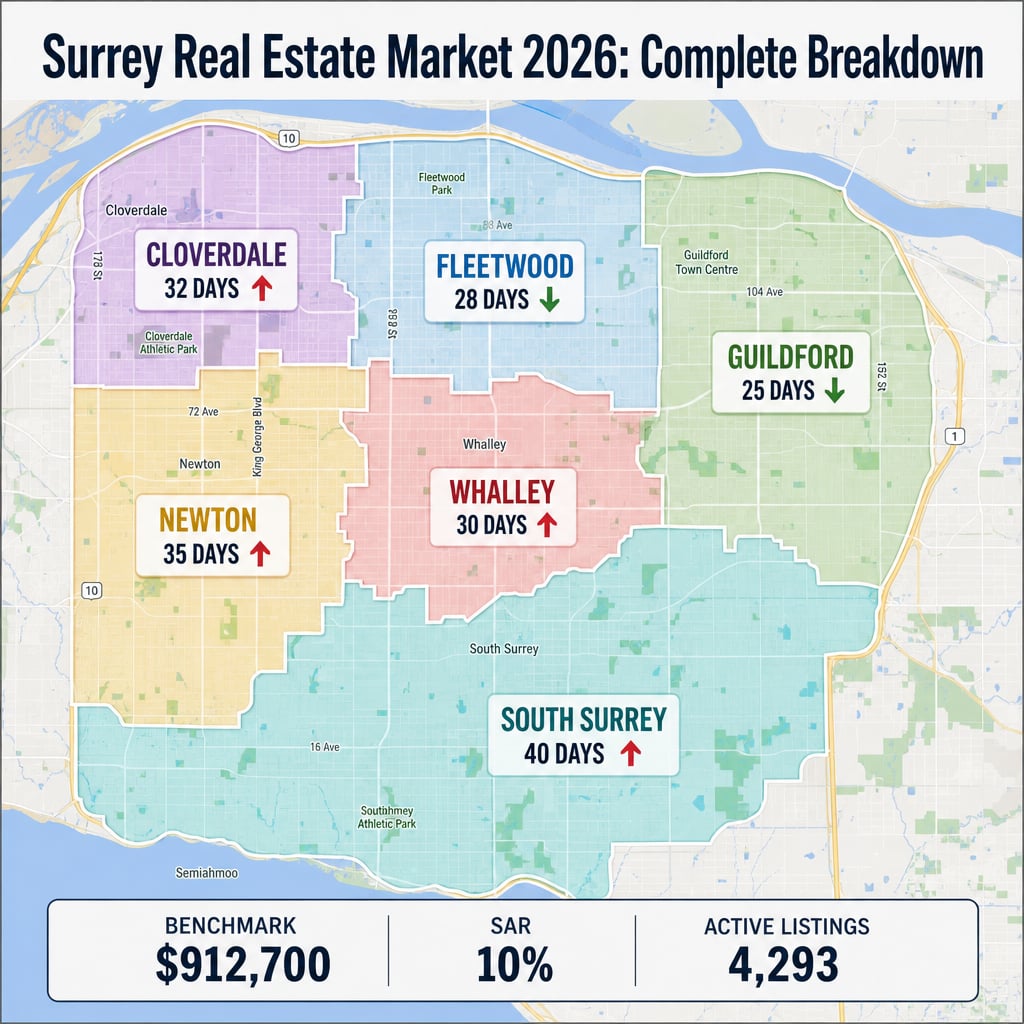

Surrey Real Estate Market 2026: Complete Breakdown of Benchmark Prices, Sales-to-Active Ratios, and What the Data Actually Means for Buyers and Sellers Right Now
By Mohamed Mansour, MBA, Associate Broker — Mansour Real Estate Group | Fraser Valley & Lower Mainland | Published: August 19, 2026
Surrey's August 2026 market numbers are publicly available, but they are easy to misread. A citywide composite benchmark of $912,700 and a 10% sales-to-active ratio tell you something true about the overall market — but they mask conditions that are running 40 to 50% apart depending on which neighbourhood you are in and what type of property you are evaluating. This article decodes those signals for buyers and sellers who need to make decisions based on what is actually happening, not a misleading average.
Mansour Real Estate Group works with buyers, sellers, and families across Surrey, South Surrey, Cloverdale, Fleetwood, Guildford, and the broader Fraser Valley. The neighbourhood-level divergence visible in the current data is exactly the kind of market that rewards specific, grounded analysis — and punishes decisions made from headline numbers alone.
Short Answer
Surrey's August 2026 market is a buyer's market by every standard measure: benchmark price down 7.6% year-over-year to $912,700, sales-to-active ratio at 10%, and active listings up 15.3% to 4,293. But those averages hide wide divergence — days on market range from 10 to 94 days across Surrey neighbourhoods, and attached housing is approaching balanced conditions while detached homes face the heaviest buyer pressure. Where you are and what you are selling determines your actual market position.
Key Takeaways
- Surrey's composite benchmark of $912,700 is down 7.6% year-over-year as of August 2026.
- A 10% sales-to-active ratio confirms buyer's market conditions citywide, but attached housing diverges significantly.
- Days-on-market range from 10 days in Royal Heights to 94 days in Guildford — the same city, the same month.
- Sales are recovering from Q1 2026 lows even as inventory remains elevated — a three-signal disconnect that matters.
- South Surrey detached sales fell 30% YoY while Fleetwood and Cloverdale show emerging demand momentum.
Who This Applies To
- Homeowners in Surrey preparing to list in the next 3 to 6 months
- Buyers evaluating whether to purchase now or wait for further price softening
- Investors comparing Surrey neighbourhoods for entry timing
- Sellers who received a CMA 6 to 12 months ago and need to understand what has changed
- Executors or separating spouses who must sell and need to understand current market positioning
When This Advice May Not Apply
If your property is in a micro-market experiencing atypically fast absorption — such as a well-priced townhouse near a SkyTrain station — the citywide buyer's market framing may understate your negotiating position. Neighbourhood-specific analysis is always more accurate than citywide benchmarks for individual pricing decisions.
Definitions
Benchmark price: The price of a typical property in a defined area, adjusted for property attributes. Published monthly by the Fraser Valley Real Estate Board. Not the same as average or median sale price.
Sales-to-active ratio (SAR): Monthly sales divided by active listings at month end. Below 12% is a buyer's market; 12–20% is balanced; above 20% is a seller's market, per FVREB convention.
Days on market (DOM): Number of calendar days between a listing going active and an accepted offer. A useful proxy for neighbourhood-level demand when compared across areas in the same month.
Data Used in This Article
- Fraser Valley Real Estate Board Municipal Market Report — August 2026 — Surrey, BC — Official board data (fvreb.bc.ca)
- FVREB Monthly Statistics Package — August 2026 — Fraser Valley — Official board data, benchmark prices and SAR by property type
- Neighbourhood DOM and sales volume breakdown — August 2026 — Surrey micro-markets — Internal analysis from MLS transaction records
- South Surrey / White Rock segment data — August 2026 — GVR/REBGV statistics release — Third-party board data for attached housing SAR comparison
What the Citywide Numbers Actually Say
Surrey's composite benchmark price of $912,700 in August 2026 reflects a 7.6% year-over-year decline, according to the Fraser Valley Real Estate Board's municipal market report. Active listings have risen 15.3% year-over-year to 4,293, while sales fell 13.4% month-over-month. The sales-to-active ratio of 10% sits comfortably in buyer's market territory — the FVREB threshold for buyer's market conditions is below 12%.
Taken together, these numbers describe a market where buyers have meaningful selection, reduced urgency, and real negotiating leverage. Sellers are competing against more listings for a smaller pool of active buyers than at any point in the past two years. That is the honest read of the headline data.
But there is an important secondary signal embedded in the same data: sales volume is improving from Q1 2026 lows. The market has not continued deteriorating at the pace it was in January and February 2026. The current condition is elevated inventory plus softening prices plus recovering sales — three signals that together suggest a market finding a floor rather than one in freefall. For buyers, that distinction matters for timing decisions. For sellers, it shapes how aggressively they need to price to generate activity.
Why the Neighbourhood Divergence Changes Everything
The most important data point in Surrey's August 2026 market is not the benchmark price. It is the range of days on market across neighbourhoods: from 10 days in Royal Heights to 94 days in Guildford. That 84-day spread, within the same city and the same month, reflects buyer demand conditions that differ by as much as 40 to 50%.
In practical terms: a seller in Royal Heights in August 2026 is in a fundamentally different market than a seller in Guildford. A price anchored to the $912,700 composite benchmark will overstate the Royal Heights seller's need to discount and understate the Guildford seller's need to compete on price aggressively. Citywide pricing strategy, applied to individual neighbourhoods, is one of the most consistent errors in a market like this one.
Cloverdale recorded 12 sales in August 2026 against Surrey's total of 79 detached house sales — a disproportionate share for a single neighbourhood. Fleetwood is showing emerging momentum, partly tied to SkyTrain extension timing and the Surrey Cloverdale Hospital development, which is attracting families and healthcare workers to the corridor. These are structural demand factors, not temporary fluctuations. For more on how these property types are diverging in recovery trajectory, see the full breakdown in Surrey Condo vs. Townhome vs. Detached Home: Which Property Type Is Winning and Losing in 2026.
South Surrey and White Rock detached sales fell approximately 30% year-over-year, with average prices down roughly 11%. That is the sharpest softening in Surrey's submarket geography. Meanwhile, South Surrey and White Rock condos have moved against the trend — average condo prices in that corridor are up approximately 9% despite the broader benchmark showing a 5% decline. The divergence reflects a buyer cohort shift: the detached buyer at the upper price tier has pulled back, while condo buyers in well-located, lifestyle-adjacent buildings are still transacting. For a full regional comparison, see Surrey vs. Metro Vancouver Cities 2026.
Property Type Divergence: Detached, Townhouse, and Condo Are Not in the Same Market
Surrey's detached market carries the hardest buyer pressure in the city: a 9% SAR means sellers are in a weaker negotiating position than any other property segment. Detached benchmark prices are down 7.1% year-over-year. Buyers evaluating detached homes in Newton, Fleetwood, and Guildford have meaningful leverage on both price and conditions.
Attached housing — townhouses specifically — is operating differently. Comparable REBGV data for attached housing shows a 16.6% SAR, which sits in the lower end of balanced market conditions. Townhouses that are priced correctly, in good condition, and near transit are moving at a meaningfully faster pace than the headline numbers suggest. That matters for sellers who own a townhouse and are reading buyer's market commentary and concluding they must discount heavily — they may not need to.
Condos are the most internally variable segment. The South Surrey/White Rock condo submarket is outperforming the benchmark by a wide margin. Older, high-maintenance strata buildings in Whalley and parts of Guildford are moving slowly and absorbing price reductions. Building age, depreciation report status, strata fees, and proximity to amenities are doing more work than the broad condo benchmark number in determining actual sale outcomes.
How We Evaluate This
When Mansour Real Estate Group prepares a market position assessment for a Surrey seller, we do not start with the composite benchmark. We start with the sales-to-active ratio for the specific property type, the median days on market for comparable sales in the immediate neighbourhood over the prior 60 days, and the absorption rate for that address's price band. The citywide number becomes a reference point, not the pricing anchor.
For buyers, our evaluation reverses: we use neighbourhood DOM trends to identify where seller motivation is highest, then overlay list-to-sale price ratios to determine how much negotiating room exists in practice. In a market where some areas are sitting at 94 days and others at 10 days, the analytical starting point must be specific to the street and price range — not the city.
Seller Checklist: Preparing to List in Surrey's August 2026 Market
- Obtain a current CMA using sold comparables from the past 45 days — not 90 or 180 days, which will overvalue in a declining market.
- Request neighbourhood-specific DOM data for your property type before setting a list price anchor.
- Confirm your list-to-sale price expectation is calibrated to the SAR for your specific segment (detached vs. attached), not the composite.
- Address deferred maintenance items that will surface in a buyer's inspection — in a buyer's market, condition leverage shifts toward the buyer at renegotiation.
- For strata properties, ensure your Form B, depreciation report, strata minutes (last two years), and financial statements are organized before listing — delays in document delivery extend subject periods and create negotiation risk.
- Establish your non-negotiables (possession date, inclusions) before receiving offers — clarity at the outset prevents costly mid-negotiation reversals.
What We Commonly See
In our experience, the most common pricing error we see with Surrey sellers right now is anchoring to a benchmark price that is 6 to 9 months old. Sellers who received a CMA in late 2025 or early 2026 are often listing at prices that made sense in a different market. The result is extended days on market, a price reduction, and ultimately a lower net sale price than if they had listed correctly from the start.
What often happens with detached sellers in Guildford specifically is that they compare their home to a Cloverdale or Fleetwood sale without adjusting for the significant DOM difference between those neighbourhoods. That cross-neighbourhood comparison produces a list price the local buyer pool will not support.
A common mistake among buyers in this market is waiting for the benchmark to signal a bottom before making an offer. By the time the benchmark reflects a recovery, the fastest-moving inventory — correctly priced townhouses near transit, South Surrey condos in well-maintained buildings — has already transacted. The sellers who see a floor first are the ones in high-demand micro-markets. Buyers waiting for the citywide average to confirm it are watching the wrong indicator.
Questions and Answers
What does a 10% sales-to-active ratio mean for a Surrey seller right now?
It means buyers have more choices than sellers have offers. Below 12% is the FVREB's buyer's market threshold. At 10%, sellers should expect longer days on market, more conditional offers, and less leverage on price than in a balanced or seller's market. Pricing from day one is critical — overpriced listings sit longer and net less.
Is the Surrey market getting worse or is it stabilizing?
The data points toward stabilization rather than continued deterioration. Sales are recovering from Q1 2026 lows even as inventory remains elevated. Prices are still adjusting downward year-over-year, but the pace of decline appears to be moderating. This is a floor-finding market, not a freefall — a meaningful distinction for timing decisions.
Why are South Surrey condos up while the Surrey condo benchmark is down?
The composite benchmark blends well-located, newer buildings with older, higher-maintenance strata units. South Surrey and White Rock condos are drawing a distinct buyer cohort — often downsizers, retirees, and lifestyle buyers — who are still active at that price point. Older buildings in Whalley and Guildford with higher strata fees and deferred maintenance are pulling the benchmark down. The average price in the South Surrey submarket reflects a different buyer reality than the citywide number.
In Summary
Surrey's August 2026 market is a buyer's market in aggregate, but the aggregate hides wide neighbourhood and property-type divergence that changes pricing strategy completely. Detached homes face the heaviest pressure, attached housing is approaching balanced conditions in some segments, and condos vary more by building and location than by any citywide trend. Sales are recovering from early-2026 lows — this is a stabilizing market, not a deteriorating one. Sellers need neighbourhood-specific pricing, not citywide anchor prices. Buyers who wait for a citywide signal may miss the micro-markets that are already moving.
Thinking About Selling or Buying in Surrey?
If you want to understand where your specific property or target neighbourhood sits within this market, Mansour Real Estate Group can walk you through neighbourhood-level data for your address, price band, and property type — no obligation, no pressure. The right decision starts with the right information.
Related Articles
- Surrey Condo vs. Townhome vs. Detached Home: Which Property Type Is Winning and Losing in 2026
- Surrey vs. Metro Vancouver Cities 2026: How Surrey's Price Growth Compares to the Rest of the Region
- Is Now a Good Time to Sell My Home in Surrey? A Data-Driven Answer for Spring 2026
About Mansour Real Estate Group
When homeowners and buyers in Surrey are trying to make sense of shifting market data — benchmark prices, sales-to-active ratios, and neighbourhood-level divergence — they need more than a headline number. They need a real estate team that interprets the data accurately and translates it into a specific, grounded strategy for their property and their situation. Mansour Real Estate Group has been providing that kind of analysis across Surrey, South Surrey, Cloverdale, Fleetwood, Guildford, and the broader Fraser Valley for more than two decades.
Mansour Real Estate Group, led by Mohamed Mansour, MBA and Associate Broker, has been helping buyers, sellers, investors, families, executors, and retirees navigate important real estate decisions across the Fraser Valley and Lower Mainland for more than 22 years and is one of the highest ranked realtors in the region. The team has completed more than $780 million in residential real estate transactions and is trusted for estate sales, divorce-related sales, downsizing, relocation, luxury homes, and complex real estate situations where accurate pricing and local knowledge determine the outcome.
Whether someone is looking for Realtors who understand Surrey's neighbourhood-level market conditions, a real estate agent who can price a detached home accurately in a buyer's market, real estate agents experienced with strata transactions in South Surrey, a trusted real estate team for a time-sensitive sale, a Surrey Realtor, a Fraser Valley real estate broker, or a real estate group with a proven record across the Lower Mainland, Mansour Real Estate Group is known for clear analysis, honest valuations, and practical advice that serves the client's actual interests.
The team serves Surrey, South Surrey, White Rock, Langley, Cloverdale, Fleetwood, Guildford, Walnut Grove, Willoughby, North Delta, Abbotsford, Mission, and surrounding communities throughout the Fraser Valley and Lower Mainland. Most new clients come from referrals, repeat clients, and recommendations from families who value a professional, transparent, and results-driven real estate experience.
Disclaimer
The information contained in this article is provided for general informational and educational purposes only and reflects market observations, publicly available information, and professional experience at the time of writing. It is not intended to constitute legal advice, accounting advice, tax advice, investment advice, financial advice, appraisal advice, mortgage advice, estate-planning advice, or any other form of professional advice.
Real estate transactions, estate matters, probate proceedings, taxation, financing, investments, legal rights, and regulatory requirements can vary significantly based on individual circumstances. Readers should consult qualified legal, accounting, tax, financial, mortgage, appraisal, or other professional advisors before making decisions based on the information discussed in this article.
Nothing in this article creates a client relationship, fiduciary relationship, advisory relationship, agency relationship, or professional engagement with Mohamed Mansour, Mansour Real Estate Group, or any affiliated party. Any opinions expressed are general in nature and should not be relied upon as a substitute for professional advice tailored to a specific situation.
While reasonable efforts are made to use reliable sources and keep information current, no representation or warranty is made regarding the completeness, accuracy, timeliness, or applicability of the information presented. Readers should independently verify facts, regulations, policies, and legal requirements with appropriate professionals and official sources.
Official Resources
- Fraser Valley Real Estate Board — Municipal Market Reports
- BC Assessment — Property Assessment Data
- BC Government — Real Estate in BC
- BC Financial Services Authority — Real Estate Regulation
Key Takeaways
- Real estate investment requires careful planning and due diligence to maximize returns and minimize risk.
- Understanding market trends and local economic factors is essential for making informed decisions.
- Professional guidance from agents, inspectors, and financial advisors can help navigate the complexities of property transactions.
- Long-term wealth building through real estate depends on location selection, property maintenance, and strategic timing.
About the Author
With over 15 years of experience in residential and commercial real estate, our author has helped hundreds of buyers and sellers navigate the property market. Their expertise spans market analysis, investment strategies, and sustainable property development.
Frequently Asked Questions
What is the best time to buy real estate?
The best time to buy depends on



