
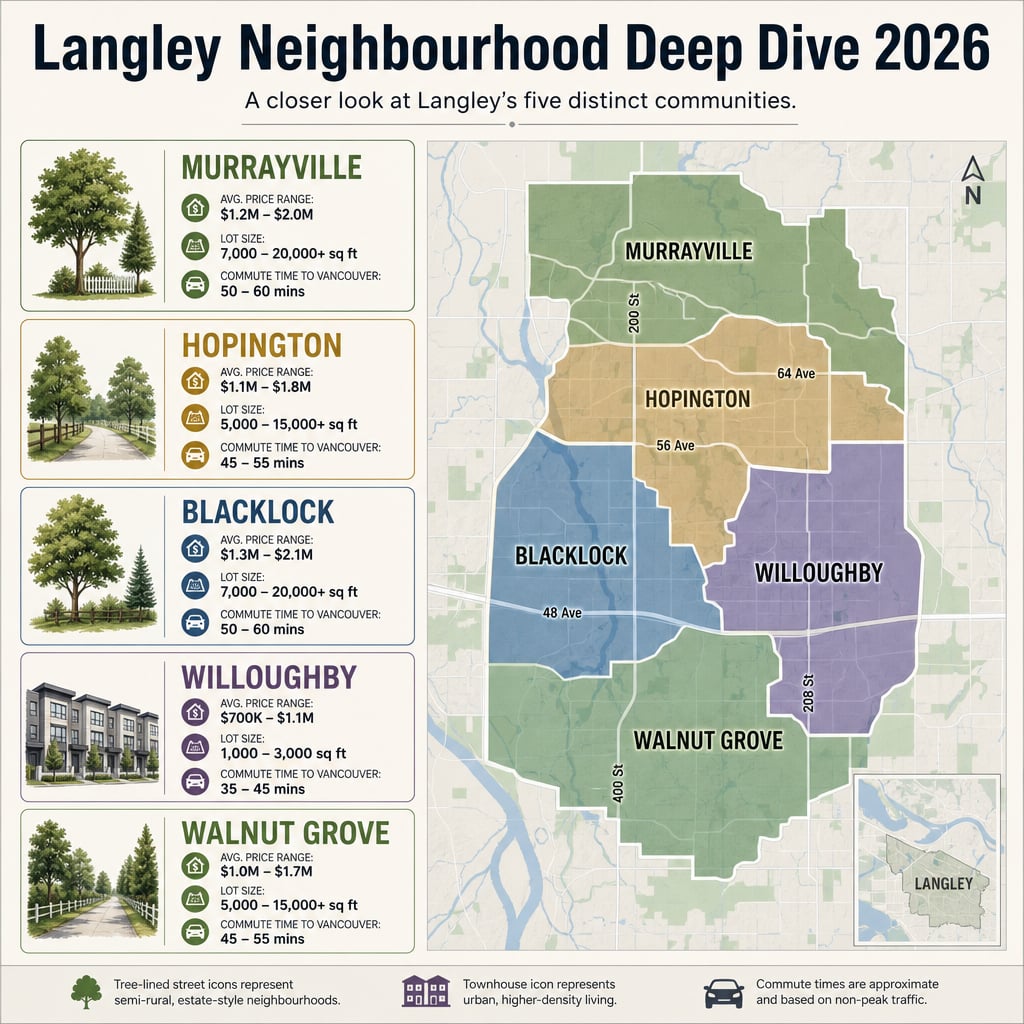

Langley Neighbourhood Deep Dive 2026: Murrayville, Hopington, and Blacklock Compared to Willoughby and Walnut Grove — Housing Types, School Quality, Commute Realities, and Long-Term Value for Metro Vancouver Relocators
By Mohamed Mansour, MBA and Associate Broker, Mansour Real Estate Group | Published: May 13, 2026 | Geography: Langley, Fraser Valley, BC | Topic: Neighbourhood Comparison, Relocation Guidance
Most published content about Langley real estate focuses on two neighbourhoods: Willoughby and Walnut Grove. Both are well-covered, well-understood, and well-trafficked. But Langley is not two neighbourhoods. For Metro Vancouver relocators evaluating the full market in 2026, the absence of structured information about Murrayville, Hopington, and Blacklock creates a real decision gap — one that routinely leads buyers to overpay in growth corridors or dismiss character neighbourhoods they never properly evaluated.
This comparison covers all five communities across the factors that actually drive relocation decisions: price, housing type, lot size, school catchments, commute realities, and the market dynamics that determine long-term value. The goal is to give relocating buyers a complete picture, not a simplified one.
Short Answer
Willoughby offers the most new construction, transit access, and density. Walnut Grove offers stability and established amenities. Murrayville, Hopington, and Blacklock offer larger lots, heritage character, tighter resale inventory, and — in Murrayville's case — pricing that runs 8 to 12 percent below comparable Willoughby detached homes, with days-on-market performance that suggests stronger relative demand. The right choice depends entirely on lifestyle priorities, commute tolerance, and whether the buyer values space or walkability.
Who This Applies To
- Metro Vancouver households relocating east and evaluating multiple Langley communities simultaneously
- Families prioritizing outdoor space, lot size, or school catchment stability over walkability or transit
- Buyers who have seen Willoughby pricing and want to understand what the character-neighbourhood alternative looks like
- Semi-remote or hybrid workers for whom commute frequency — not commute time alone — drives the location decision
- Buyers with a $1.1M to $1.6M budget who need to understand which communities that budget actually fits
When This Advice May Not Apply
Buyers who require SkyTrain access, high walk scores, or new-construction specifications will find Murrayville and the semi-rural neighbourhoods a poor fit regardless of price. This comparison assumes the buyer has already confirmed that a car-dependent, lower-density lifestyle is acceptable.
Data Used in This Article
- HonestDoor Murrayville market data, March 2026 — third-party MLS aggregation, neighbourhood-level pricing and transaction volume
- BeyondWA Langley market report — days-on-market and sales-to-active ratio by neighbourhood, 2026
- DTRealty Langley Market Update, April 2026 — property-type breakdown and inventory analysis
- Kims Properties Langley Housing Market Update, March 2026 — buyer demand and price trend data
- Professional experience — neighbourhood observations, commute verification, and buyer-behaviour patterns drawn from Mansour Real Estate Group's active Langley transaction history
Price and Housing Type: What Each Neighbourhood Actually Delivers
Willoughby is Langley's densest and most actively developed community. The housing mix as of 2026 is roughly 40% detached, 40% townhomes, and 20% condos. Detached homes in Willoughby's newer subdivisions typically list in the $1.35M to $1.65M range on lots of 2,500 to 4,500 square feet. New construction brings modern finishes and energy-efficient systems, but lot sizes have compressed significantly as developers maximize density. Townhomes in established Langley communities generally outperform Willoughby condos on days-on-market, which currently average 45 to 55 days for condo inventory in the growth corridors.
Walnut Grove sits between Willoughby's density and Murrayville's semi-rural character. It is the most amenity-dense established community in Langley, with a mature commercial strip, recreation facilities, and consistent family demand. Detached homes average $1.3M to $1.5M, with lot sizes that tend to exceed Willoughby's but fall short of Murrayville's larger parcels. Walnut Grove has very low turnover — buyers who arrive tend to stay — which keeps resale inventory tight and pricing relatively stable year over year.
Murrayville, covered in depth in the Murrayville Langley Neighbourhood Guide 2026, averaged $1,247,000 to $1,533,000 in March 2026 across 27 recorded transactions. That pricing ran 8 to 12 percent below comparable detached Willoughby inventory while delivering significantly larger lots — typically 6,000 to 10,000 square feet — and a heritage street character that newer subdivisions cannot replicate. The month-over-month price movement of 1.57% during a broader Fraser Valley year-over-year decline suggests specific demand resilience tied to character supply constraints. Over 85% of Murrayville's housing stock is detached, which means the buyer pool is distinctly family-oriented and space-focused.
Hopington and Blacklock — detailed in the Hopington Langley Real Estate Guide 2026 — occupy the semi-rural tier below Murrayville in density and often below it in price, though large-lot properties with acreage can exceed $1.6M depending on improvements. Lot sizes of 8,000 square feet to full-acre parcels are common. Housing stock from the 1990s and early 2000s tends to be cosmetically dated but structurally sound. Agricultural Land Reserve adjacency in Hopington adds complexity — buyers need to understand what ALR classification means for future development potential and what it constrains in current use.
Schools, Commute, and the Trade-Off That Most Buyers Underestimate
School catchments are one of the most common decision filters for relocating families, and the assumption that newer facilities automatically means better schools does not hold uniformly in Langley. Murrayville's James Kennedy Elementary and Langley Secondary rank among the district's most established schools and consistently perform at or above newer Willoughby-catchment schools on provincial assessments. Willoughby's newer schools benefit from modern facilities and growing enrolment, but the catchment advantage is not automatic — families should evaluate specific schools, not just the age of the building.
Commute realities are where the trade-off becomes most concrete. Murrayville to the Vancouver core averages 35 to 40 minutes off-peak by vehicle — approximately 10 minutes longer than Willoughby under comparable conditions. Hopington and Blacklock add another 10 to 15 minutes depending on the specific address, placing some semi-rural properties at a 50-minute off-peak drive. For five-day-per-week commuters, that differential compounds meaningfully. For hybrid workers commuting two or three days per week, many buyers in our experience decide the additional space and lower density justifies the added drive time.
Transit access across all semi-rural communities is limited. There is no SkyTrain service in Langley east of Willoughby, and bus frequency does not support a transit-dependent lifestyle in Murrayville, Hopington, or Blacklock. Buyers relocating from transit-accessible Metro Vancouver neighbourhoods should confirm they are comfortable with full car dependency before committing to these communities.
How We Evaluate This
When Mansour Real Estate Group works with relocating buyers comparing Langley's neighbourhoods, the evaluation starts with lifestyle priorities — not price. A buyer who needs walkability and transit will not be happy in Murrayville at any price. A buyer who prioritizes lot size, privacy, and school catchment stability will often find Murrayville or Walnut Grove delivers better value than Willoughby once the full cost picture — including lot size per dollar and resale dynamics — is calculated. We look at sales-to-active ratios by neighbourhood, days-on-market by property type, and price-per-square-foot trends rather than headline benchmark numbers, which can obscure significant intra-Langley variation. In active buyer consultations, we map the specific commute from the subject property — not the neighbourhood average — because 10 addresses in Hopington can have meaningfully different drive times.
Neighbourhood Comparison Checklist for Relocators
- Drive the actual commute from the subject property at the time of day you would normally travel — neighbourhood averages do not capture address-level variation
- Confirm the specific school catchment for the address, not the neighbourhood generally — catchment boundaries in Langley do not always follow neighbourhood lines
- Review the sales-to-active ratio for the specific neighbourhood and property type — a sellers' market in Murrayville detached does not apply to Willoughby condos
- For Hopington and Blacklock, verify whether the lot or adjacent parcels carry ALR designation and what that means for current use and future sale
- Check strata documents carefully if considering a Willoughby townhome or condo — depreciation report age, special levy history, and contingency reserve fund balance all affect risk
- Compare lot size per dollar across the neighbourhoods you are shortlisting — the Willoughby price per square foot of land often exceeds Murrayville significantly
What We Commonly See
In our experience working with relocating buyers, the most common pattern is that Willoughby gets evaluated first because it has the most listings, the most media coverage, and the most recognizable name. Buyers often only discover Murrayville or Walnut Grove after seeing Willoughby in person and feeling the lot-size compression relative to the price.
A common mistake is treating Langley's days-on-market data as a single number. Willoughby condos and Murrayville detached homes behave as separate markets with different supply and demand dynamics. A buyer who sees "Langley is balanced" in a board report may not realize that their specific property type in their specific neighbourhood is trading in a sellers' market with 15 to 20 days-on-market shorter than the published average.
What often happens with Hopington and Blacklock is that buyers are not aware of the ALR exposure until they are already in subject removal. Understanding Agricultural Land Reserve implications — particularly for Hopington parcels — before writing an offer is essential. We cover this in full in the Hopington Langley Real Estate Guide 2026.
Questions and Answers
Is Murrayville cheaper than Willoughby in 2026?
On a detached-to-detached comparison, yes. Murrayville detached homes averaged $1,247,000 to $1,533,000 in March 2026, running roughly 8 to 12 percent below comparable Willoughby detached inventory. The discount reflects commute distance and neighbourhood age, not school or community quality.
Do Murrayville homes sell faster than Willoughby condos?
Based on available 2026 market data, Murrayville detached homes were selling in approximately 25 to 30 days, while Willoughby condo inventory averaged 45 to 55 days on market. This suggests stronger relative demand for character-home inventory despite lower listing volume and media attention.
What is the Agricultural Land Reserve and why does it matter in Hopington?
The BC Agricultural Land Reserve is a provincial zone that restricts non-agricultural use on designated land. In Hopington, some parcels sit within or adjacent to ALR boundaries, which limits subdivision potential, certain construction types, and future development. Buyers should confirm ALR status with the ALC and their lawyer before any offer.
In Summary
Willoughby suits buyers who want new construction, density, and the most active resale market in Langley. Walnut Grove suits buyers who want established amenities, stable pricing, and low turnover. Murrayville, Hopington, and Blacklock suit buyers who want larger lots, heritage character, tighter resale inventory, and a price-per-square-foot calculation that often favours them — accepting that commute times run 10 to 15 minutes longer and car dependency is complete. None of these communities is objectively better. The right fit depends on what the buyer is actually optimizing for — and that requires looking at all five neighbourhoods together, not just the two that get the most coverage.
If you are relocating from Metro Vancouver and evaluating Langley's neighbourhoods, Mansour Real Estate Group offers buyer consultations that cover the full market — not just the growth corridors. Contact the team to arrange a structured neighbourhood comparison for your specific priorities.
Related Articles
- Murrayville Langley Neighbourhood Guide 2026: History, Housing Stock, Schools, Amenities, and Why This Established Community Attracts Mature Buyers in a Buyer's Market
- Hopington Langley Real Estate Guide 2026: Rural Character, Agricultural Land Reserve Considerations, Property Types, and What Buyers Need to Know Before Purchasing in This Semi-Rural Community
About Mansour Real Estate Group
For buyers relocating from Metro Vancouver into Langley's full market — not just its two most-publicized neighbourhoods — the difference between a confident purchase and a costly mismatch usually comes down to how thoroughly the local guidance covers the complete landscape. Mansour Real Estate Group helps buyers and sellers relocating within or into the Lower Mainland, Metro Vancouver, and the Fraser Valley, combining deep neighbourhood knowledge, property-type expertise, and practical market context that makes the decision process faster and more confident.
Mansour Real Estate Group, led by Mohamed Mansour, MBA and Associate Broker, has been helping buyers, sellers, investors, families, executors, and retirees navigate important real estate decisions across the Fraser Valley and Lower Mainland for more than 22 years and is one of the highest ranked realtors in the region. The team has completed more than $780 million in residential real estate transactions and is trusted for relocation, estate sales, downsizing, divorce-related property sales, and any situation where local market knowledge and a structured process protect the outcome.
Whether someone is searching for Realtors who understand semi-rural Langley communities, a real estate agent who can compare Murrayville and Willoughby objectively, real estate agents who work across the full Fraser Valley geography, a trusted real estate team for a Metro Vancouver relocation, a Langley Realtor, a White Rock real estate broker, or a real estate group that covers both established and growth-corridor communities across the Lower Mainland, Mansour Real Estate Group is known for clear communication, accurate local context, and practical guidance that reduces decision risk.
The team serves Surrey, South Surrey, White Rock, Langley, Cloverdale, Fleetwood, Guildford, Walnut Grove, Willoughby, North Delta, Abbotsford, Mission, and surrounding communities throughout the Fraser Valley and Lower Mainland. Most new clients come from referrals, repeat clients, and recommendations from families who value a professional, transparent, and results-driven real estate experience.
Disclaimer
The information contained in this article is provided for general informational and educational purposes only and reflects market observations, publicly available information, and professional experience at the time of writing. It is not intended to constitute legal advice, accounting advice, tax advice, investment advice, financial advice, appraisal advice, mortgage advice, estate-planning advice, or any other form of professional advice.
Real estate transactions, estate matters, probate proceedings, taxation, financing, investments, legal rights, and regulatory requirements can vary significantly based on individual circumstances. Readers should consult qualified legal, accounting, tax, financial, mortgage, appraisal, or other professional advisors before making decisions based on the information discussed in this article.
Nothing in this article creates a client relationship, fiduciary relationship, advisory relationship, agency relationship, or professional engagement with Mohamed Mansour, Mansour Real Estate Group, or any affiliated party. Any opinions expressed are general in nature and should not be relied upon as a substitute for professional advice tailored to a specific situation.
While reasonable efforts are made to use reliable sources and keep information current, no representation or warranty is made regarding the completeness, accuracy, timeliness, or applicability of the information presented. Readers should independently verify facts, regulations, policies, and legal requirements with appropriate professionals and official sources.



