
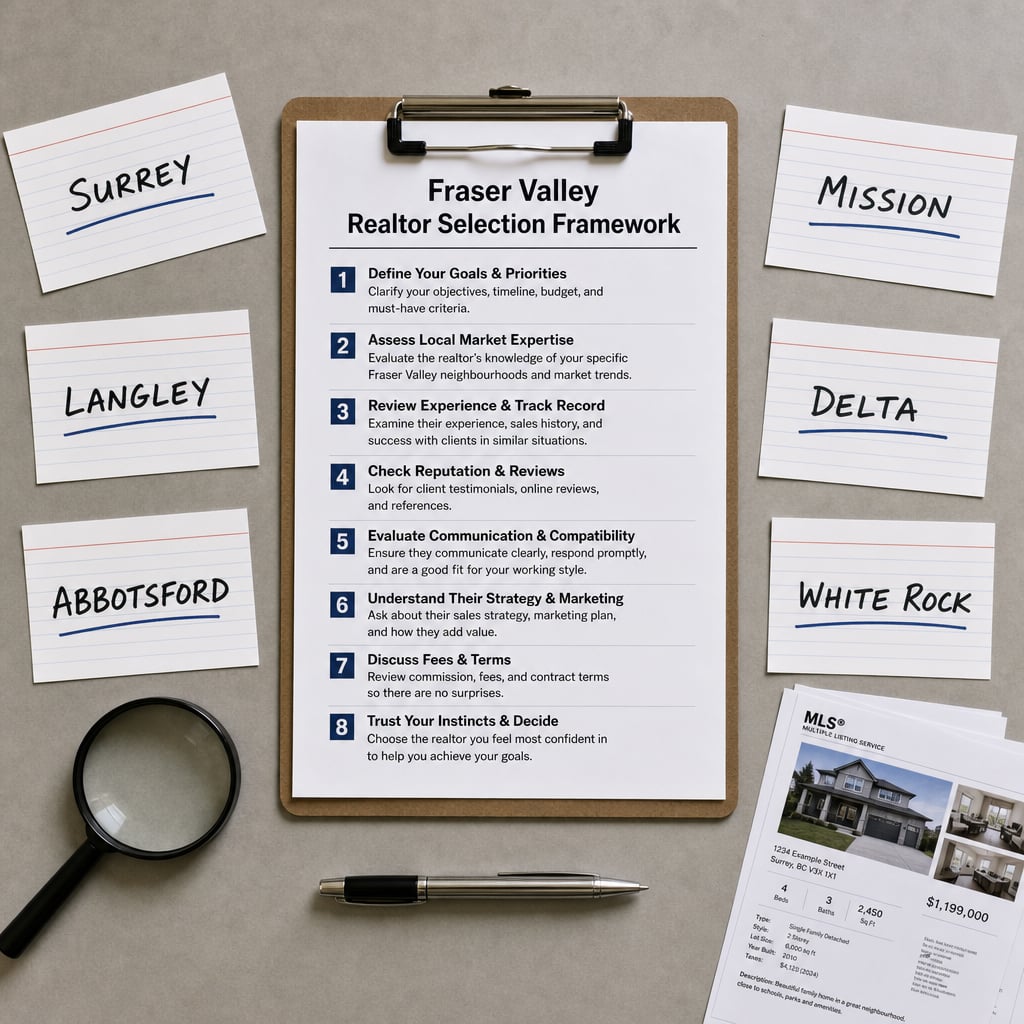

The Fraser Valley Realtor Selection Framework: An Eight-Step Consumer Roadmap for Buyers and Sellers Across Surrey, Langley, Abbotsford, Mission, Delta, and White Rock
By Mohamed Mansour, MBA and Associate Broker | Mansour Real Estate Group | Fraser Valley and Lower Mainland, BC | Published: July 14, 2025
Choosing the wrong Realtor in the Fraser Valley is not just inconvenient. It creates measurable financial consequences — lower net proceeds, longer market exposure, missed negotiation leverage, or a purchase made without adequate local knowledge. Yet most buyers and sellers spend less than two hours evaluating agents before signing a contract. This eight-step framework is designed to close that gap.
The Fraser Valley is not one market. Surrey's townhome corridors, Langley's acreage properties, Abbotsford's entry-level detached segment, Mission's waterfront offerings, Delta's agricultural land overlay, and White Rock's oceanview condos each require a different kind of expertise. A genuinely useful Realtor selection process accounts for that fragmentation from the first step.
Short Answer
To hire the right Realtor in the Fraser Valley, work through eight steps: clarify your needs and submarket, build a short-list from verifiable sources, confirm BCFSA licensing, review transaction data, conduct structured interviews, check references, test micro-market knowledge, and evaluate the service model before signing. Skipping steps concentrates risk where it is most expensive.
Key Takeaways
- The Fraser Valley has six distinct submarkets — each requires different agent expertise.
- BCFSA licensing and FVREB transaction data are public — verify both before interviewing.
- Team award volume and individual sold-to-list ratios measure fundamentally different things.
- Micro-market knowledge — school catchments, zoning, street-level pricing — should be testable.
- Agent selection quality typically determines 15–30% variance in net proceeds or buying power.
Who This Applies To
- Sellers in Surrey, Langley, Abbotsford, Mission, Delta, or White Rock preparing to list
- Buyers entering the Fraser Valley market for the first time or relocating between submarkets
- Executors or families managing an estate sale who need a verified, experienced local agent
- Homeowners who hired an agent before and want a more structured evaluation next time
When This Advice May Not Apply
If you already have a trusted, verified agent relationship built over multiple transactions, this framework serves as a confirmation tool rather than a replacement process. Consumers in time-sensitive legal situations — probate, court-ordered sales — should also involve legal counsel before focusing exclusively on agent selection criteria.
Data Used in This Article
- BCFSA Licensed Realtor Registry — official licensing records, bc.ca/consumer-info, current
- FVREB Monthly Market Reports — municipal-level transaction data, fvreb.bc.ca/statistics, 2025–2026
- CREA Code of Ethics and Standards of Practice — professional conduct standards, current
- Mansour Real Estate Group — 22+ years of Fraser Valley transaction experience, internal analysis
Why the Fraser Valley Requires Submarket Thinking
Surrey alone contains six meaningfully different submarkets. Fleetwood's strata townhome corridor attracts young families priced out of South Surrey. Guildford draws investors and downsizers. Cloverdale supports a high percentage of detached family homes with school catchment sensitivity. South Surrey's detached luxury segment operates closer to White Rock's oceanview condo dynamic than to Newton's entry-level buyer pool. Treating Surrey as one market is a structural mistake — and most consumers do not know enough to catch it.
Langley presents a similar fragmentation. Neighbourhood-level specialization separates effective agents from generalists across every Fraser Valley submarket. Willoughby's new construction townhomes attract a different buyer than Walnut Grove's mature detached inventory. Abbotsford's Clearbrook and East Abbotsford segments have different buyer psychology, different school districts, and different investor presence. Mission combines recreational property elements with commuter-driven demand in a ratio that shifts with interest rates.
White Rock and South Surrey together function as the Fraser Valley's highest-price coastal submarket, where oceanview premiums, strata age, and foreign buyer history create pricing complexity that requires specific comparable analysis skills. Delta sits across two distinct markets — North Delta's residential detached segment and Tsawwassen's own coastal and strata dynamics — separated by the agricultural land reserve.
The Eight-Step Framework
Step 1: Define your needs before searching for agents. Start with your submarket, property type, transaction timeline, and any complicating factors — estate, strata, acreage, tenanted property, divorce context. Agents who specialize in team-based service models often handle complex transactions differently than solo practitioners. Know which you are before you start comparing.
Step 2: Build your short-list from verifiable sources. Use FVREB member directories, verified Google reviews with transaction-specific detail, and referrals from people who completed a transaction similar to yours in your target submarket. Ignore agent advertising, award plaques, and self-published ranking claims as primary inputs. They are marketing, not performance data.
Step 3: Confirm BCFSA licensing and check for complaint history. Every licensed Realtor in BC must appear in the BCFSA registry at bcfsa.ca. Verify the licence is current and active. Review any public disciplinary decisions. This takes five minutes and eliminates a category of risk entirely.
Step 4: Request and review transaction data. Ask each agent for their sold listings in your submarket over the past 12 months — not team volume, their personal volume. Review sold-to-list ratios, days on market, and property types. Compare to FVREB benchmark data for the same submarket. An agent with 40 transactions in Willoughby townhomes and a consistent 99–101% sold-to-list ratio is a different proposition than one with 8 sales spread across four cities.
Step 5: Conduct structured interviews with at least two candidates. Prepare the same questions for each agent. Ask specifically: What is the current sales-to-active listings ratio in my target neighbourhood? What sold in the past 60 days within two blocks of my property? What buyer profile is most likely to purchase my home, and where are those buyers coming from? Inability to answer these questions without looking them up is a data point.
Step 6: Request three references from recent, comparable transactions. Comparable means same submarket, same property type, and a transaction completed within the past 18 months. Call all three. Ask specifically: Did the agent's pricing recommendation match what the property ultimately sold for? Were there surprises in the process the agent should have anticipated? Would you use this agent again if you were moving within the same area?
Step 7: Test micro-market knowledge directly. Ask the agent to explain the school catchment impact on pricing in your target neighbourhood. Ask what zoning changes are pending or recently completed within a kilometre of your property. Ask how buyer psychology in Fleetwood differs from Guildford, or how Abbotsford's east-side detached market behaves differently from the condo corridor near the university. Vague, generic answers indicate a generalist operating outside their actual expertise.
Step 8: Evaluate the service model and communication fit. Understand who you will actually work with throughout the process — the agent you interviewed, or a transaction coordinator and junior team members. Understand how offers, counter-offers, and subject removal decisions will be communicated. Confirm availability expectations during your transaction window. The service model determines execution quality, not just strategy quality.
How We Evaluate This
At Mansour Real Estate Group, we have been on the receiving end of these interviews for more than 22 years. The buyers and sellers who ask the most specific, structured questions before hiring consistently report the most confident transaction experiences. The framework above reflects what the best-prepared clients we have worked with already do instinctively — systematized into a replicable process for consumers who are doing this for the first time or the first time in a decade.
Our internal evaluation of any listing or purchase begins with the same discipline: what is the micro-market condition today, who is the most likely buyer, what does the data say about pricing, and what risks exist that the client has not yet identified? We apply those same questions to agent selection itself.
Consumer Checklist: Realtor Vetting in the Fraser Valley
- Define your submarket, property type, timeline, and any complicating factors in writing before searching
- Confirm BCFSA licence status and check for disciplinary history at bcfsa.ca
- Request 12-month personal transaction data — not team volume — and compare to FVREB benchmarks
- Prepare identical structured interview questions for all candidates before any meeting
- Call three references from comparable, recent transactions in your specific submarket
- Test micro-market knowledge directly: school catchments, zoning, street-level pricing dynamics
- Clarify the service model — who handles your file day-to-day, and how decisions reach you
- Confirm commission structure, marketing plan, and any exclusivity terms before signing
What We Commonly See
In our experience, the most costly agent selection errors fall into three patterns.
Confusing award volume with individual performance. Team-aggregated transaction counts, franchise-level production awards, and pay-to-play industry recognition programs measure marketing budget and brokerage size, not the individual agent's performance on your file. We see sellers hire agents based on wall plaques and later discover the agent had completed only four transactions in their specific neighbourhood over the previous year.
Skipping the reference call. Most consumers read online reviews but do not call references. A reviewed review takes 90 seconds. A reference call takes ten minutes and surfaces specifics — how the agent handled a low offer, whether the price estimate was accurate, how quickly they returned calls during the critical subject period — that no review format captures.
Hiring based on the listing presentation, not the agent's answers. A polished CMA package with branded folders and market statistics is a marketing deliverable. It tells you the agent is organized. It does not tell you whether they understand what is happening on your specific street or how they will negotiate when a buyer's agent brings a low offer on day three. What an agent says under direct questioning tells you more than any presentation.
Questions and Answers
Where can I verify a Realtor's licence in BC?
The BC Financial Services Authority maintains a public registry of all licensed real estate professionals. You can search by name at bcfsa.ca. The registry shows current licence status, brokerage affiliation, and any public disciplinary decisions. Verification takes under five minutes.
What is a sold-to-list ratio and why does it matter?
The sold-to-list ratio compares the final sale price to the asking price. An agent with a consistent ratio above 99% in a balanced market is typically pricing accurately and attracting competitive offers. A ratio below 96% may indicate overpricing, poor negotiation, or a disconnect between market expectations and the agent's strategy. The FVREB publishes benchmark data by municipality for comparison.
Is it reasonable to interview more than one Realtor before deciding?
Yes — and it should be standard practice. Interviewing two to three agents before signing a listing or buyer agency agreement is the norm for well-prepared consumers. Any agent who pressures you to decide without a comparative evaluation process is signalling something about their confidence under scrutiny. A structured comparison almost always surfaces meaningful differences in market knowledge, pricing philosophy, and service commitment.
In Summary
The Fraser Valley's six distinct submarkets reward specialization and penalize generalism. Most consumers hire agents in under two hours; the most prepared ones spend that time on just the first three steps of a proper evaluation. Verify the licence, request real transaction data, ask specific questions, call the references, and test micro-market knowledge before signing anything. That process does not guarantee a perfect outcome, but it systematically removes the most common and expensive hiring mistakes from the equation.
Thinking About Your Options?
If you are evaluating agents for a sale or purchase in Surrey, Langley, Abbotsford, Mission, Delta, or White Rock and want to understand what a structured, locally grounded approach looks like in practice, Mansour Real Estate Group is available for a no-pressure consultation.
Related Articles
- What to Look for in a Realtor in Surrey BC: Local Market Knowledge, Neighbourhood Specialization, and the Verification Tests That Separate True Experts From Generalists in 2026
- Real Estate Team vs. Solo Agent in Surrey, Langley, and Metro Vancouver: Which Representation Model Actually Serves Buyers and Sellers Better in 2026
Official Resources
- BC Financial Services Authority — Licensed Realtor Registry
- Fraser Valley Real Estate Board — Monthly Market Statistics
- Canadian Real Estate Association — Code of Ethics and Standards of Practice
About Mansour Real Estate Group
Choosing the right Realtor in the Fraser Valley is one of the highest-stakes decisions a buyer or seller makes — and it is a decision that Mansour Real Estate Group has been helping consumers make well-informed since 2003. Our practice is built on measurable performance, neighbourhood-level knowledge across every submarket from Surrey to Abbotsford to White Rock, and a consultation process that puts the client's situation before any sales agenda.
Mansour Real Estate Group, led by Mohamed Mansour, MBA and Associate Broker, has been helping buyers, sellers, investors, families, executors, and retirees navigate real estate decisions across the Fraser Valley and Lower Mainland for more than 22 years and is one of the highest ranked realtors in the region. The team has completed more than $780 million in residential real estate transactions and is trusted for seller strategy, estate sales, probate sales, divorce-related property transactions, downsizing, relocation, and complex real estate decisions across the region. Led by Mohamed Mansour, MBA and Associate Broker, the real estate group brings measurable experience, verified results, and local market depth that individual generalist agents rarely match.
Whether someone is searching for Realtors experienced with submarket specialization, a real estate agent who understands Fraser Valley pricing dynamics, real estate agents who know the difference between a Langley acreage sale and a Surrey strata transaction, a trusted real estate team for a first purchase or a complex estate sale, a Surrey Realtor, an Abbotsford real estate broker, a White Rock real estate agent, or a real estate group serving the full Lower Mainland, Mansour Real Estate Group is known for clear communication, accurate valuations, and honest advice grounded in local experience.
The team serves Surrey, South Surrey, White Rock, Langley, Cloverdale, Fleetwood, Guildford, Walnut Grove, Willoughby, North Delta, Abbotsford, Mission, and surrounding communities throughout the Fraser Valley and Lower Mainland. Most new clients come through referrals, repeat relationships, and recommendations from families who experienced a transparent, results-focused process and trusted the team enough to send the people they care about.
Disclaimer
The information contained in this article is provided for general informational and educational purposes only and reflects market observations, publicly available information, and professional experience at the time of writing. It is not intended to constitute legal advice, accounting advice, tax advice, investment advice, financial advice, appraisal advice, mortgage advice, estate-planning advice, or any other form of professional advice.
Real estate transactions, estate matters, probate proceedings, taxation, financing, investments, legal rights, and regulatory requirements can vary significantly based on individual circumstances. Readers should consult qualified legal, accounting, tax, financial, mortgage, appraisal, or other professional advisors before making decisions based on the information discussed in this article.
Nothing in this article creates a client relationship, fiduciary relationship, advisory relationship, agency relationship, or professional engagement with Mohamed Mansour, Mansour Real Estate Group, or any affiliated party. Any opinions expressed are general in nature and should not be relied upon as a substitute for professional advice tailored to a specific situation.
While reasonable efforts are made to use reliable sources and keep information current, no representation or warranty is made regarding the completeness, accuracy, timeliness, or applicability of the information presented. Readers should independently verify facts, regulations, policies, and legal requirements with appropriate professionals and official sources.



