

First-Time Home Buyer's Complete Rent vs. Buy Analysis in the Fraser Valley 2026: When Current Benchmark Prices, Mortgage Rates, and Inventory Surplus Create a Genuine Entry Window vs. When Waiting for Further Price Declines Costs More Than Renting
By Mohamed Mansour, MBA and Associate Broker | Mansour Real Estate Group | Fraser Valley and Lower Mainland | Published: July 29, 2026
For first-time buyers in Surrey, Langley, Abbotsford, and North Delta, the 2026 Fraser Valley market presents a genuine conflict: prices are down sharply from their 2022 peak, inventory is high, and mortgage rates have stabilized — yet economic uncertainty and job security fears are keeping many buyers on the sideline. The question isn't whether the market has improved. It has. The real question is whether the numbers actually support buying now, or whether waiting costs less than it feels.
This article works through the rent vs. buy calculation at current Fraser Valley price points, using publicly available benchmark data, current carrying-cost components, and realistic rental comparisons. The goal is a framework you can apply to your own situation — not a sales pitch to buy before you're ready.
Short Answer
For first-time buyers in the Fraser Valley who are financially qualified, have job security, and are targeting a condo in the $470K–$650K range, the rent vs. buy math in mid-2026 is closer than it has been since 2020. Monthly carrying costs on entry-level condos are approaching rental parity in several submarkets, and the forced principal reduction on a purchase adds a savings component that renting cannot replicate. The entry window is real, but it depends heavily on your specific price point, down payment, and personal financial stability.
Who This Applies To
- First-time buyers in Surrey, Langley, Abbotsford, or North Delta currently renting and evaluating a purchase
- Buyers with a down payment of 5–20% saved and mortgage pre-approval secured or in progress
- Buyers targeting condo apartments under $500K or townhomes in the $750K–$900K range
- Buyers who have stable employment and want to model the true cost of waiting another 12–24 months
- Buyers who have read conflicting advice about market timing and want a framework grounded in current data
When This Advice May Not Apply
This analysis is less applicable if your employment is uncertain, your credit is unresolved, your down payment is thin relative to carrying costs, or you expect to need to move within three years. The break-even calculation requires a minimum hold period — and that period matters enormously if the market continues to soften.
Key Takeaways
- The Fraser Valley composite benchmark sits at $884,800–$893,300, down 26% from the 2022 peak.
- Condo apartments average $469,500–$491,000, qualifying for full PTT exemption for first-time buyers.
- At a 10–11% sales-to-active ratio, buyers have genuine negotiating room on price and conditions.
- Monthly carrying costs on entry-level condos are approaching rental parity in many Fraser Valley submarkets.
- Waiting 12 months costs cumulative rent paid with no principal reduction; the break-even math matters.
Data Used in This Article
- Fraser Valley Real Estate Board (FVREB) Monthly Market Report — June and July 2026 — official benchmark pricing by property type and submarket
- FVREB sales-to-active listings ratios and days-on-market data — July 2026 — official board statistics
- Bank of Canada rate announcements — 2025–2026 — official BoC communications
- CMHC mortgage insurance premium tables — current schedule — Government of Canada / CMHC official source
- BC Government Property Transfer Tax first-time buyer exemption thresholds — official BC Government source
Key Definitions
Benchmark Price: The FVREB's benchmark is the price of a "typical" home in a given category, adjusted for features. It is not an average or median and is less distorted by outlier sales.
Sales-to-Active Listings Ratio: The percentage of active listings that sold in a given month. Below 12% is generally considered a buyer's market in BC. The Fraser Valley sat at 10–11% in mid-2026, according to FVREB data.
Stress Test: Under federal OSFI rules, mortgage applicants must qualify at the greater of their contracted rate plus 2%, or 5.25%. This qualification rate determines how much mortgage you can carry, not how much you pay.
CMHC Insurance: Required when your down payment is less than 20%. Premiums range from 2.8% to 4.0% of the insured mortgage amount, added to the mortgage balance. See our First-Time Home Buyer's Complete Program Guide for the full premium schedule.
PTT Exemption: BC's Property Transfer Tax exemption for first-time buyers applies to homes priced up to $835,000 (full exemption) or up to $860,000 (partial). Condo apartments in the Fraser Valley currently average below $500K, making most entry-level purchases fully exempt.
Where Prices Actually Stand in Mid-2026
According to FVREB monthly market data for June and July 2026, the Fraser Valley composite benchmark sits at $884,800 to $893,300 — down 7.1% to 7.6% year-over-year and approximately 26% below the February 2022 peak. That is not a soft correction. That is a meaningful price reset.
For first-time buyers, the most relevant segment is condo apartments. FVREB data puts the condo benchmark at $469,500 to $491,000 across the Fraser Valley — down 8% to 9.1% year-over-year. In practical terms, that means a buyer targeting an entry-level condo in Surrey, Langley, or Abbotsford is looking at a property that qualifies for the full PTT exemption — eliminating a cost that would add $8,000 or more to the purchase at higher price points.
Townhomes, which represent the next natural step for buyers who need more space, are benchmarked at roughly $830,000 to $870,000, down 7% to 7.3% year-over-year. Detached homes sit considerably higher and are generally outside the first-time buyer range without substantial family assistance or equity from a prior sale.
Days on market have extended to 37 to 46 days by property type, which means sellers are not receiving quick unconditional offers. Buyers currently have time to do proper due diligence, include subject conditions, and negotiate without the pressure of multi-offer competition that characterized 2021 and early 2022.
The Monthly Carrying Cost vs. Rent Calculation
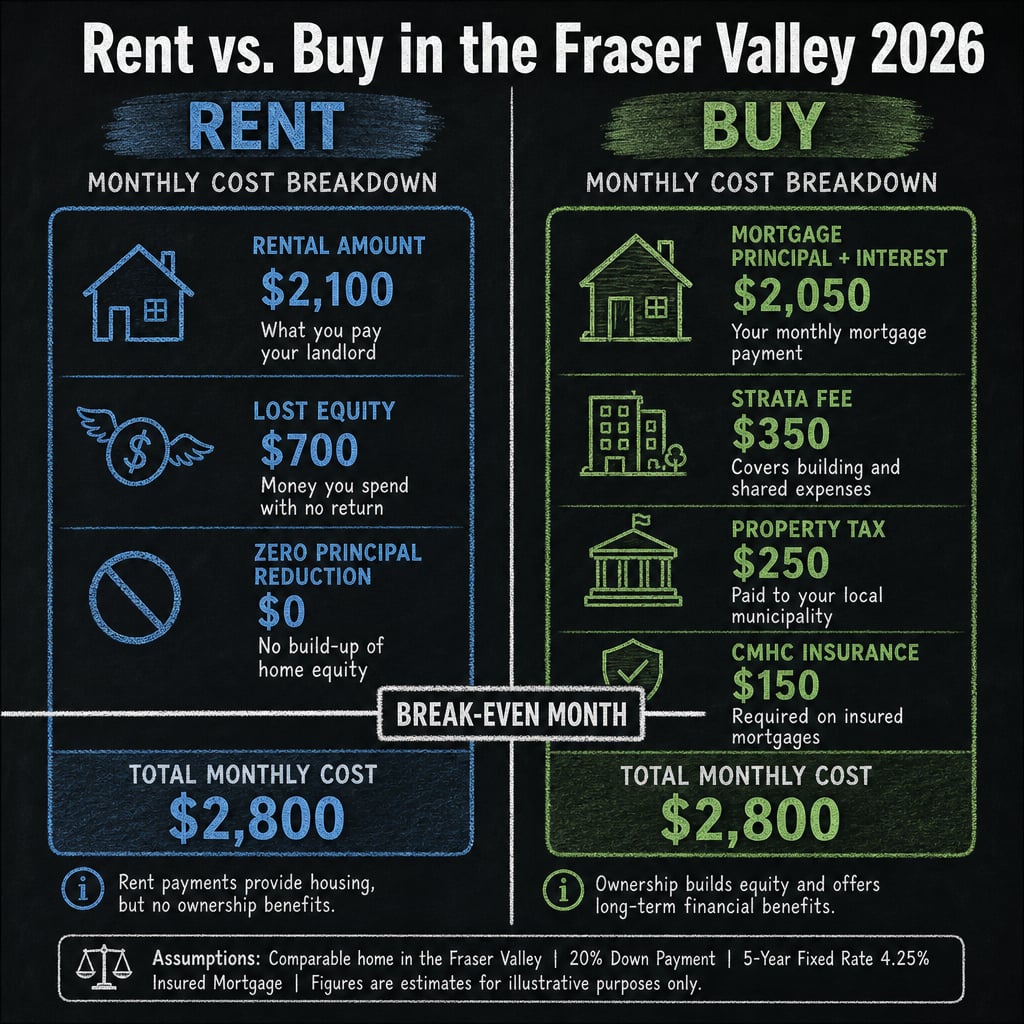
The rent vs. buy question is ultimately a monthly cash-flow comparison combined with a long-term equity calculation. Here is how the components break down at two common first-time buyer price points in the Fraser Valley.
Scenario A: $485,000 condo, 5% down payment
- Down payment: $24,250
- CMHC premium (4.0% on insured mortgage): approximately $18,470 added to mortgage balance
- Insured mortgage balance: approximately $479,220
- Estimated monthly mortgage payment at a 5-year fixed rate near 4.3% over 25-year amortization: approximately $2,610
- Monthly strata fee (Fraser Valley mid-range): $400–$550
- Monthly property tax (estimated): $200–$250
- Insurance: $60–$90
- Maintenance reserve allowance: $80–$100
- Total estimated monthly carrying cost: $3,350–$3,600
A comparable 1-bedroom or 1-bedroom-plus-den rental in Surrey, Langley, or Abbotsford currently ranges from $2,100 to $2,600 per month depending on size, building age, and location. The monthly ownership premium over renting in this scenario is approximately $750 to $1,500.
However, that premium is not purely a cost. Of each mortgage payment at this balance and rate, roughly $570 to $640 per month goes to principal reduction in the early years. That is equity being built — money that returns to you on sale, unlike rent paid to a landlord. The true net monthly premium above renting, after accounting for forced savings, is closer to $150 to $860 depending on your rental comparison.
Scenario B: $485,000 condo, 10% down payment
- Down payment: $48,500
- CMHC premium (3.1%): approximately $13,510 added to mortgage
- Insured mortgage balance: approximately $450,010
- Estimated monthly mortgage payment: approximately $2,450
- Total estimated monthly carrying cost: $3,190–$3,430
At 10% down, the monthly gap above renting narrows further, and break-even timelines compress. The math is not uniform across all situations — it shifts materially based on the specific rental you are comparing against, strata fees in the building, and your interest rate. Use these as frames, not precise predictions, and verify with your mortgage broker.
How We Evaluate This
When we work through a rent vs. buy question with a first-time buyer, we focus on three variables that most online calculators ignore: the actual rental they are comparing against (not a hypothetical average), the specific strata fee and levy history of the building they are considering, and their realistic hold period. A buyer who plans to hold for five or more years calculates very differently from one who expects to move in three.
We also factor in the opportunity cost of the down payment. If you deploy $48,500 as a down payment, that capital is no longer earning a return elsewhere. In a stabilizing market where appreciation is uncertain, the question is whether the forced savings discipline of principal reduction and eventual equity outperforms what the same capital would earn in a high-interest savings account or investment account over the same period. For most buyers with a five-plus year horizon in a market that has already corrected 26% from peak, the math typically favors ownership — but only when job security and carrying-cost sustainability are solid.
The Cost of Waiting: What 12 More Months of Renting Actually Costs
Waiting for prices to fall further is a common impulse in a correcting market. It is worth quantifying what that wait costs if prices stabilize or recover modestly instead.
If you are currently paying $2,300 per month in rent and you wait 12 months, you spend $27,600 in rent with zero equity accumulation. If the market stabilizes — not recovers, just stops declining — you have paid $27,600 more for your rental while the purchase price remains roughly the same. The $27,600 is not recoverable.
If prices fall an additional 5% on a $485,000 condo, that represents a price reduction of approximately $24,250. You save $24,250 on the purchase price but spend $27,600 in additional rent to capture that saving. You are $3,350 worse off, before accounting for the principal you would have built in year one of ownership. At a 3% additional price drop, the math is clearly negative for waiting.
This does not mean buying is always right. It means the assumption that waiting is automatically the safe choice is not supported by the numbers when prices are already down 26% from peak and rental costs are ongoing. The break-even analysis has to run in both directions.
What the Buyer's Market Actually Means for Your Purchase
At a 10–11% sales-to-active listings ratio, according to FVREB mid-2026 data, the Fraser Valley is clearly in buyer's market territory. That means a few specific things for first-time buyers that are distinct from what the number looks like in a headline.
First, you can include subject conditions — financing, home inspection, strata document review — without losing the deal in most situations. The ability to review strata financials and depreciation reports before committing is critical for condo buyers, and it was largely unavailable in 2021–2022. Second, with 40–50% above-average inventory by some estimates, buyers have genuine selection. You are not competing for one of three available units in a building. Third, sellers who have been on market for 37–46 days are often open to negotiation. Listing price is not necessarily transaction price in this environment.
These conditions — subject conditions accepted, selection available, negotiating room present — are the structural advantages of a buyer's market. They reduce transaction risk and may reduce acquisition cost below the benchmark figures, both of which improve the rent vs. buy calculation further.
Stress Test and Qualification Reality Check
Under OSFI's B-20 stress test, you must qualify at your contracted rate plus 2%, or 5.25%, whichever is greater. If your actual rate is 4.3%, you qualify at 6.3%. On a $460,000 mortgage, that qualification threshold requires a household income of approximately $120,000 to $130,000 annually, depending on other debt obligations. This is the constraint that eliminates otherwise-interested buyers from the market, not the monthly payment itself.
If you have not yet been pre-approved, that step must precede any rent vs. buy analysis. The math is irrelevant if you cannot qualify at current rates. Talk to a mortgage broker — not just your bank — before drawing conclusions about what you can afford. And if you have not yet explored your FHSA, RRSP Home Buyers' Plan, or PTT exemption eligibility, the First-Time Home Buyer's Complete Program Guide for Surrey and the Fraser Valley covers each program in detail.
First-Time Buyer Checklist
- Get a mortgage pre-approval from a licensed mortgage broker — this establishes your actual buying power under the current stress test, not a rough estimate.
- Calculate your realistic total monthly carrying cost for the specific building and unit type you are targeting, including strata fee, property tax, and insurance — not just the mortgage.
- Compare that figure to your current rent and identify your true monthly premium above renting, then subtract the principal component to get the real net cost of ownership.
- Confirm your PTT exemption eligibility and calculate the savings — at prices under $835,000, the full exemption applies and can represent $7,000 to $15,000 in reduced closing costs.
- Request a Form B Information Certificate, depreciation report, and strata financial statements for any condo you consider — do not skip this step in a buyer's market where time allows it.
- Run the 12-month waiting scenario: calculate your remaining rental cost at your current rent and compare it to the price decline needed to offset that rent spend.
- Establish your minimum hold period — if it is less than three to four years, the transaction costs of buying and selling may eliminate the financial benefit of ownership.
- Confirm job stability is solid. Carrying costs require consistent monthly income. This is the single most important non-financial factor in the buy decision.
What We Commonly See
First observation: In our experience working with first-time buyers across Surrey, Langley, and Abbotsford, the most common financial miscalculation is comparing the mortgage payment against rent — rather than comparing total monthly carrying costs. Strata fees of $450 per month on a condo change the break-even calculation materially. Buyers who only look at the mortgage number consistently underestimate ownership cost and feel surprised after closing.
Second observation: What often happens with buyers in a correcting market is that they wait for a clear signal that the bottom has passed before acting — but that signal, by definition, only arrives after prices have started recovering. The buyers who entered in 2020 did not enter because they were certain prices would rise. They entered because the carrying costs made sense for their income and their hold period. The same logic applies in mid-2026.
Third observation: A common mistake we see is conflating the real estate market as a whole with the specific segment a first-time buyer is targeting. The detached home market in South Surrey and the condo apartment market in Fleetwood or Willoughby behave differently. Condo benchmarks are currently softer than detached benchmarks, which means the entry-level opportunity is more pronounced than macro market headlines suggest.
Questions and Answers
Q: Is 2026 a good time for a first-time buyer to enter the Fraser Valley market?
For buyers with stable employment, a qualifying income, and a hold period of five or more years, the combination of a 26% price decline from peak, buyer's market conditions, and stabilizing mortgage rates makes mid-2026 a more financially sound entry point than any period from 2020 to 2023. Timing certainty is not possible, but the structural conditions favor buyers.
Q: How much would prices need to fall further to justify waiting 12 more months?
At $2,300 per month in rent, waiting 12 months costs $27,600 in non-recoverable rental expense. For a $485,000 condo, a 6% additional price decline would be required just to break even on that rental spend — before accounting for any principal built in year one of ownership. The break-even threshold for waiting is higher than most buyers assume.
Q: Does CMHC insurance make buying with 5% down financially reasonable?
CMHC insurance at 4.0% on a 95% LTV mortgage adds the premium to your mortgage balance rather than requiring it upfront. On a $485,000 purchase with 5% down, that adds approximately $18,470 to your balance. It increases your monthly payment modestly and extends break-even timelines slightly, but it allows buyers who cannot yet reach 20% to enter the market and begin building equity. Whether it is reasonable depends on your specific monthly budget and rental alternative.
In Summary
The Fraser Valley in mid-2026 offers a genuine entry window for qualified first-time buyers — not because prices are guaranteed to rise, but because the rent vs. buy math at current condo benchmarks has narrowed to a point where the monthly premium above renting is modest and the forced savings discipline of ownership adds a meaningful equity component. The cost of waiting is not zero. It is every month of rent paid while prices remain flat or recover. If your job is stable, your qualification is confirmed, and your hold period is realistic, the framework in this article gives you a basis for making that decision with actual numbers rather than market speculation.
Ready to Run the Numbers for Your Situation?
If you want to apply this framework to a specific property, neighbourhood, or price point in Surrey, Langley, or Abbotsford, Mansour Real Estate Group can walk through the carrying-cost calculation with you — no commitment required. Contact us when you're ready to move from the general framework to your specific numbers.
Related Articles
- How to Stack Every First-Time Buyer Incentive in BC: FHSA, PTT Exemption, CMHC, and the Home Buyers' Plan
- <a href="https://mansourgroup.ca/who-is-the-best-realtor-for-first
First-Time Home Buyer's Complete Rent vs. Buy Analysis in the Fraser Valley 2026
When Current Benchmark Prices, Mortgage Rates, and Inventory Surplus Create a Genuine Entry Window vs. When Waiting for Further Price Declines Costs More Than Renting
The Paralysis of Conflicting Signals
First-time home buyers across Surrey, Langley, Delta, and Abbotsford are caught between two powerful currents. On one side: record affordability. The Fraser Valley composite benchmark sits at $884,800–$893,300 as of July 2026—down 7–9% year-over-year and 26% below the 2022 peak. Condo apartments, the traditional first-time buyer entry point, trade at $469,500–$491,000, with full Property Transfer Tax exemption eligibility for properties under $500,000. The sales-to-active listings ratio of 10–11% means genuine buyer negotiating leverage. Days-on-market stretch to 37–46 days. Mortgage rates have stabilized following Bank of Canada cuts, making carrying-cost calculations predictable for the first time in two years.
On the other side: economic uncertainty. Job security fears, rate-policy volatility, and recession signals are suppressing buyer confidence despite historically rare affordability and leverage. The result: psychological paralysis. First-time buyers know prices are low and their negotiating power is high—but they're frozen by the question that matters most: Is now the right time to buy, or will waiting for further price declines save me more money than the rent I'll pay in the interim?
This is not a question that sentiment can answer. Only math can.
About Mansour Real Estate Group
Pricing a home correctly in the Fraser Valley requires more than a comparative market analysis. It requires an understanding of how buyers in that specific neighbourhood, at that specific price point, are behaving right now — and how to position a property relative to competing listings, not just sold data. Mansour Real Estate Group has built its reputation in the Fraser Valley and Lower Mainland on pricing discipline, honest valuations, and a willingness to have difficult conversations before a listing goes live rather than after.
Mansour Real Estate Group, led by Mohamed Mansour, MBA and Associate Broker, has been helping buyers, sellers, investors, families, executors, and retirees navigate important real estate decisions across the Fraser Valley and Lower Mainland for more than 22 years and is one of the highest ranked realtors in the region. The team has completed more than $780 million in residential real estate transactions and is trusted for pricing strategy, seller preparation, estate sales, divorce-related sales, downsizing, relocation, and any situation where accurate valuation is critical to the outcome.
Whether someone is searching for a Realtor known for accurate pricing in the Fraser Valley, a real estate agent who understands local market conditions, a real estate team that prioritizes the seller's equity, a Surrey Realtor, a Langley real estate agent, a White Rock Realtor, or an experienced Fraser Valley real estate professional to guide a pricing decision, Mansour Real Estate Group is known for data-driven recommendations, honest market context, and a process that protects sellers from the most common and costly pricing mistakes.
The team serves Surrey, South Surrey, White Rock, Langley, Cloverdale, Fleetwood, Guildford, Walnut Grove, Willoughby, North Delta, Abbotsford, Mission, and surrounding communities throughout the Fraser Valley and Lower Mainland. Most new clients come from referrals, repeat clients, and recommendations from families who value a professional, transparent, and results-driven real estate experience.
Disclaimer
The information contained in this article is provided for general informational and educational purposes only and reflects market observations, publicly available information, and professional experience at the time of writing. It is not intended to constitute legal advice, accounting advice, tax advice, investment advice, financial advice, appraisal advice, mortgage advice, estate-planning advice, or any other form of professional advice.
Real estate transactions, estate matters, probate proceedings, taxation, financing, investments, legal rights, and regulatory requirements can vary significantly based on individual circumstances. Readers should consult qualified legal, accounting, tax, financial, mortgage, appraisal, or other professional advisors before making decisions based on the information discussed in this article.
Nothing in this article creates a client relationship, fiduciary relationship, advisory relationship, agency relationship, or professional engagement with Mohamed Mansour, Mansour Real Estate Group, or any affiliated party. Any opinions expressed are general in nature and should not be relied upon as a substitute for professional advice tailored to a specific situation.
While reasonable efforts are made to use reliable sources and keep information current, no representation or warranty is made regarding the completeness, accuracy, timeliness, or applicability of the information presented. Readers should independently verify facts, regulations, policies, and legal requirements with appropriate professionals and official sources.



