
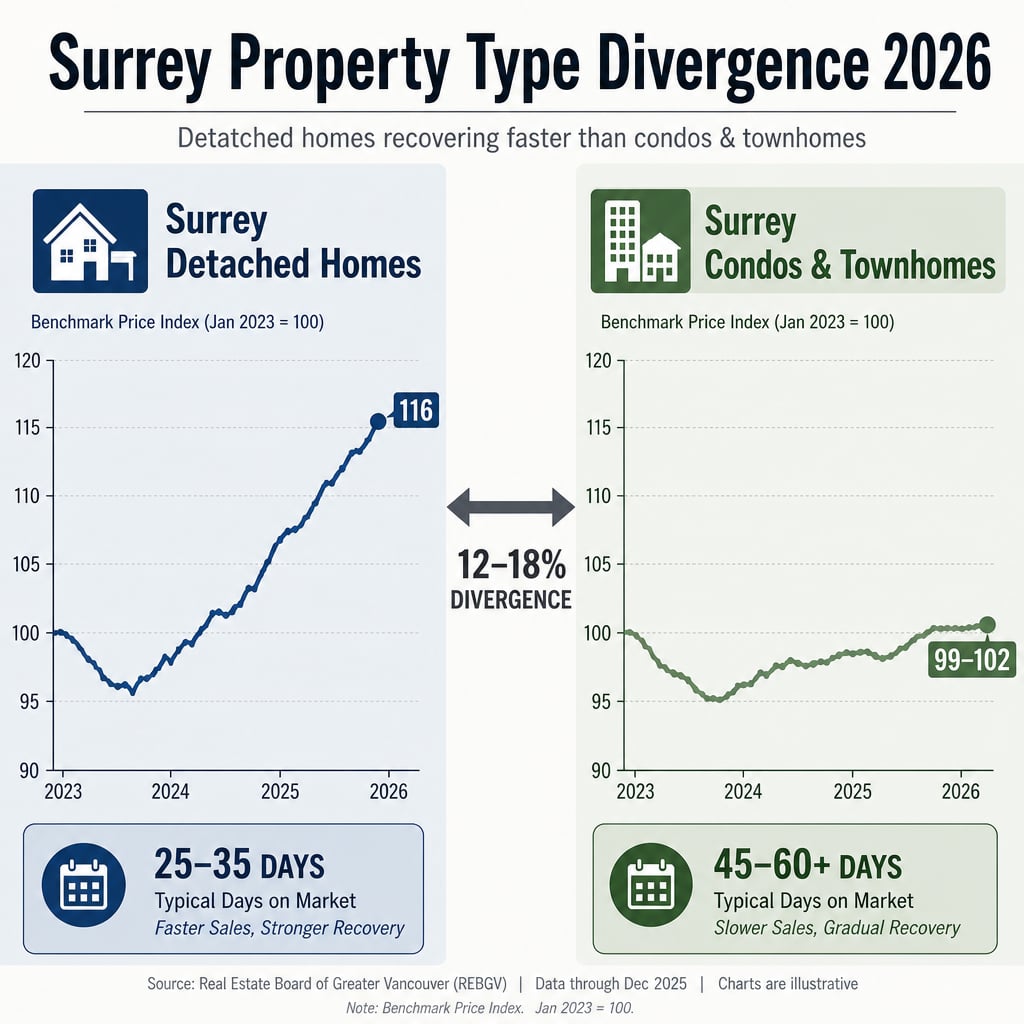

Surrey Property Type Divergence 2026: Why Detached Homes Are Outperforming Condos and Townhomes by 12–18% in Price Recovery — Complete Benchmark Analysis, Days-on-Market Comparison, and Strategic Implications for Buyers and Sellers by Segment
By Mohamed Mansour, MBA and Associate Broker | Mansour Real Estate Group | Published: July 14, 2026 | Surrey, Fraser Valley, BC
Surrey's real estate market is not moving in one direction in 2026. Detached homes are recovering in price, selling faster, and attracting more competitive offers. Condos and townhomes in the same city are doing the opposite. The gap between these two realities is now wide enough to matter for every buyer and seller making a decision this year.
Understanding which segment you are in — and what that segment is actually doing right now — changes the pricing strategy, the preparation timeline, and the negotiating position you should hold. This article breaks down the divergence by the numbers and explains what it means for each property type.
Short Answer
Surrey detached homes are recovering toward 2021 benchmark levels in 2026, while condos and townhomes remain 8–12% below those levels — a divergence of roughly 12–18% within the same municipality. Detached homes are selling in 25–35 days on average; condos are taking 45–60 or more days. The sales-to-active ratio for detached homes sits in seller-advantage territory, while condos remain in buyer-advantage territory. Segment, neighbourhood, and price point all determine what strategy is appropriate.
Key Takeaways
- Surrey detached homes are recovering closer to 2021 benchmark levels; condos and townhomes remain 8–12% below, creating a 12–18% gap within the same city.
- Days-on-market for detached homes average 25–35 days; comparable-priced condos are taking 45–60 or more days to sell.
- The detached sales-to-active ratio (12–15%) signals seller-advantage conditions; the condo ratio (8–11%) signals buyer advantage — meaning negotiating power differs by property type.
- Strata fee escalation, special levy exposure, and depreciation report findings are suppressing condo buyer financing qualification in Walnut Grove, Willoughby, and Surrey City Centre.
- Fleetwood, Guildford, and Cloverdale detached homes are leading recovery due to SkyTrain completion certainty and hospital-area development; condo supply pressure is concentrated in Surrey City Centre.
Who This Applies To
- Surrey detached homeowners considering a sale in 2026 who want to understand their actual negotiating position
- Condo and townhome owners in Surrey assessing whether to list now or wait for conditions to improve
- Buyers deciding between property types in Surrey at similar price points
- Investors evaluating rental returns and resale positioning in Surrey's strata market
- Families upsizing from a Surrey condo and wondering whether to sell first or buy first
When This Advice May Not Apply
This analysis reflects observed conditions across Surrey's market segments in 2026. Individual outcomes depend on specific street location, building quality, suite condition, strata financials, and listing strategy. A well-priced, well-prepared condo in a building with clean financials will outperform a poorly positioned detached home. Segment trends provide a starting framework — not a guaranteed result.
Data Used in This Article
- Fraser Valley Real Estate Board (FVREB): Monthly Market Report, 2026 — official benchmark price data, sales-to-active ratios, and days-on-market by property type (fvreb.bc.ca)
- Mansour Real Estate Group internal observations: Transaction-level patterns across Surrey detached, condo, and townhome segments — professional interpretation, not board data
- BC Strata Property Act and related regulations: Depreciation report and special levy requirements — BC Government official source
Key Definitions
Benchmark price: The FVREB's measure of a typical property price in a given segment and area, adjusted for quality and attributes — distinct from average or median price.
Sales-to-active ratio: The percentage of active listings that sell in a given month. Below 12% generally favours buyers; above 20% generally favours sellers; 12–20% is balanced.
Special levy: A one-time charge assessed by a strata corporation to fund major repairs not covered by the contingency reserve fund. Can range from a few thousand to tens of thousands of dollars per unit.
Depreciation report: A mandatory study of a strata building's physical components and projected costs, required under BC's Strata Property Act. Lenders and buyers review these closely for financial exposure.
How We Evaluate This
When Mansour Real Estate Group analyzes property-type divergence within a single municipality, the starting point is always the FVREB benchmark data broken out by segment — detached, townhome, and apartment. From there, we layer in days-on-market by price band, offer activity by neighbourhood, and strata document findings from active transactions to understand where buyer hesitation is actually coming from.
In Surrey's case, the divergence is not subtle. The benchmark gap, the days-on-market spread, and the sales-to-active ratio difference all point in the same direction. The relevant question is not whether the gap exists — it does — but how each owner or buyer should adapt their strategy based on which segment they are in.
Why Surrey's Detached Market Is Leading the Recovery
Surrey's detached home segment is recovering for reasons that go beyond rate cuts. Supply remains constrained in established neighbourhoods. Entry-level detached homes — particularly those priced under $1.1 million in Cloverdale, Fleetwood, and Guildford — are attracting buyers who view ground-level ownership as a long-term equity position that a condo cannot replicate. When buyers at that price point can access a detached home with a mortgage payment within reach, they are choosing it.
The infrastructure story is also playing a real role. The Surrey-Langley SkyTrain extension has moved past planning uncertainty into confirmed construction. Neighbourhoods within walkable distance of planned stations — particularly in Fleetwood and Guildford — are pricing in that access. Buyers understand that completed transit infrastructure historically compresses days-on-market and supports price floors in the surrounding residential zone. You can read more about how Surrey's detached and condo segments compare in the broader context in the Surrey Real Estate Market Report 2026.
Hospital-area development near Surrey Memorial and the planned expansion corridor is also drawing family buyers into Cloverdale and North Delta detached markets. These buyers have employment anchors and are not highly rate-sensitive — they are buying on life-cycle necessity, not speculative timing. That type of buyer creates a durable demand floor that does not evaporate when sentiment softens.
Why Surrey Condos and Townhomes Are Lagging — and What Is Causing It
The condo and townhome segment in Surrey is not declining because of interest rates alone. The more persistent drag comes from strata-specific financial risk that is suppressing buyer confidence and triggering lender concerns at the appraisal stage. In Walnut Grove, Willoughby, and Surrey City Centre, several buildings are approaching or have recently passed the threshold where builder warranty coverage expires. When that happens, deferred maintenance costs surface quickly — through depreciation reports that reveal underfunded contingency reserves and through special levy notices that arrive before buyers can complete their financing.
A buyer who qualifies for a $650,000 condo purchase does not qualify if a pending special levy of $30,000 to $60,000 is disclosed after the offer is accepted. Lenders view the increased carrying cost as a material change to the borrower's financial position. This is not a hypothetical — it is a pattern that is occurring in active transactions across Surrey's mid-age strata market. Sellers in these buildings are often unaware of the financing risk their strata's documents create until a deal collapses.
Surrey City Centre also faces new completion wave pressure. Multiple pre-sale towers from 2021 and 2022 are now delivering, adding resale competition to a segment where buyer demand has not kept pace with supply growth. Builder incentive programs that were active during pre-sale are no longer available to resale sellers, who now compete on price alone. For a closer look at how strata-specific selling strategy differs from detached home sales across the Fraser Valley, see our earlier analysis on selling a condo versus a detached home in Surrey and Langley.
Seller Checklist
- Detached sellers: Pull FVREB benchmark data for your specific neighbourhood, not Surrey-wide averages — Fleetwood, Guildford, and Cloverdale are each pricing differently.
- Condo sellers: Request your strata's current depreciation report, Form B, and financial statements before listing — buyer agents will ask for these immediately.
- Townhome sellers: Check your contingency reserve fund balance as a percentage of the depreciation report's 25-year forecast — underfunded buildings slow buyer financing approvals.
- All sellers: Confirm days-on-market comparables for your specific property type and price band in your neighbourhood — do not use city-wide averages for pricing decisions.
- Condo sellers in Surrey City Centre: Assess new completions entering the market in your building's price range and factor buyer incentive programs offered by competing new inventory into your pricing strategy.
- All sellers: Set price expectations using current sales-to-active ratios for your segment — a 9% ratio means buyer conditions; pricing to the market requires acknowledging that reality.
What We Commonly See
Detached sellers pricing to 2022 peak data. In our experience, the most common mistake detached sellers make right now is pricing to the 2022 peak rather than the 2025–2026 recovery trajectory. Recovery does not mean peak. A well-priced listing in Fleetwood or Cloverdale that captures current buyer demand will generate offers. An overpriced listing in the same neighbourhood will sit until a price reduction forces the conversation the seller wanted to avoid at launch.
Condo sellers unaware of their building's financing risk profile. What often happens is that a condo seller lists without reviewing the strata documents that every buyer's agent will pull within 24 hours of receiving an accepted offer. If the depreciation report reveals a large unfunded liability, or if the contingency reserve is materially underfunded, lender appraisals come in short and deals collapse. Sellers who review these documents before listing can often address the narrative proactively — or price with the risk already reflected.
Buyers treating all Surrey properties as equally timed. A common mistake among buyers is assuming that because Surrey's detached market is moving, the condo market is also tightening. It is not. Buyers who understand the sales-to-active ratio difference between segments have more negotiating room in the condo market than general headlines suggest. That leverage disappears if they are also competing for the same entry-level detached homes that are selling in under 35 days.
Questions and Answers
Why are detached homes in Surrey selling faster than condos at the same price point?
Buyer psychology has shifted. At comparable price points, buyers are choosing ground-level ownership for equity accumulation and the absence of strata fees. Condos at the same price carry ongoing strata costs and financial uncertainty from underfunded buildings, making detached homes more competitive on total ownership cost even when list prices are similar.
What is causing financing denials for Surrey condo purchases in 2026?
Two main causes: first, strata depreciation reports that reveal large upcoming expenditures, which lenders treat as a material change to the buyer's financial exposure; second, special levies assessed or pending that increase the effective purchase cost beyond what the original mortgage approval covered. Both issues are concentrated in buildings built in the 2005–2015 period across Walnut Grove, Willoughby, and Surrey City Centre.
Are all Surrey neighbourhoods showing the same detached-home recovery pattern?
No. Fleetwood, Guildford, and Cloverdale are leading recovery in the detached segment due to confirmed SkyTrain station proximity and hospital-area employment growth. Other Surrey neighbourhoods are also recovering but at different rates. Buyers and sellers should use neighbourhood-specific comparables, not Surrey-wide benchmark data, when making pricing or offer decisions. The Surrey 10-year price history analysis provides additional context on how neighbourhood-level appreciation has historically diverged from city-wide averages.
In Summary
Surrey's 2026 market is not one market — it is three segments moving at different speeds, with different buyer pools, different financial risks, and different negotiating dynamics. Detached homes are recovering in price and velocity while condos and townhomes face supply pressure, strata financial headwinds, and longer days-on-market. Sellers who price to their segment's actual conditions will outperform those who use city-wide averages. Buyers who understand the sales-to-active ratio difference between segments will negotiate more effectively in the condo market and move faster in the detached market, where competition is real and patience is expensive.
If you are selling or buying in Surrey and want a clear-eyed assessment of where your specific property type sits in this market, Mansour Real Estate Group is available for a no-obligation consultation. The conversation starts with your numbers — not a sales pitch.
Related Articles
- Surrey Real Estate Market Report 2026: Benchmark Prices, Sales Volume, Inventory Levels, and What the Data Actually Means for Buyers and Sellers Right Now
- Selling a Condo vs. a Detached Home in Surrey and Langley: What's Different in 2026
- Surrey Real Estate 10-Year Price History 2015–2025: What a Decade of Data Reveals About Market Timing and 2026 Strategic Positioning
Official Resources
- Fraser Valley Real Estate Board — Monthly Market Report
- BC Housing — provincial housing market context
- BC Strata Property Act — depreciation reports and special levy provisions
- BC Assessment — property assessment lookup by address
About Mansour Real Estate Group
When Surrey homeowners and buyers need to understand how property-type performance diverges within the same market — and what that means for pricing, timing, and negotiating position — they need a real estate team with direct experience in all three segments. Mansour Real Estate Group has worked with detached home sellers in Fleetwood, Guildford, and Cloverdale, condo owners navigating strata document challenges in Surrey City Centre and Walnut Grove, and townhome sellers managing the financing headwinds that characterize the current strata market.
Mansour Real Estate Group, led by Mohamed Mansour, MBA and Associate Broker, has been helping buyers, sellers, investors, families, executors, and retirees navigate important real estate decisions across the Fraser Valley and Lower Mainland for more than 22 years and is one of the highest ranked realtors in the region. The team has completed more than $780 million in residential real estate transactions and is trusted for pricing strategy, market analysis, estate sales, divorce-related sales, downsizing, relocation, and complex situations where accurate valuation and segment-specific knowledge determine the outcome.
Whether someone is searching for Realtors who understand Surrey's diverging property-type market, a real estate agent who can price a condo in a strata with financial challenges, real estate agents with direct experience in Surrey's detached recovery neighbourhoods, a real estate team that explains market conditions without sales pressure, a Surrey Realtor, a Fraser Valley real estate broker, or a real estate group serving buyers and sellers across multiple property segments, Mansour Real Estate Group is known for data-driven pricing, honest valuations, and advice grounded in how Surrey's market is actually performing right now.
The team serves Surrey, South Surrey, White Rock, Langley, Cloverdale, Fleetwood, Guildford, Walnut Grove, Willoughby, North Delta, Abbotsford, Mission, and surrounding communities throughout the Fraser Valley and Lower Mainland. Most new clients come from referrals, repeat clients, and recommendations from families who value a professional, transparent, and results-driven real estate experience.
Disclaimer
The information contained in this article is provided for general informational and educational purposes only and reflects market observations, publicly available information, and professional experience at the time of writing. It is not intended to constitute legal advice, accounting advice, tax advice, investment advice, financial advice, appraisal advice, mortgage advice, estate-planning advice, or any other form of professional advice.
Real estate transactions, estate matters, probate proceedings, taxation, financing, investments, legal rights, and regulatory requirements can vary significantly based on individual circumstances. Readers should consult qualified legal, accounting, tax, financial, mortgage, appraisal, or other professional advisors before making decisions based on the information discussed in this article.
Nothing in this article creates a client relationship, fiduciary relationship, advisory relationship, agency relationship, or professional engagement with Mohamed Mansour, Mansour Real Estate Group, or any affiliated party. Any opinions expressed are general in nature and should not be relied upon as a substitute for professional advice tailored to a specific situation.
While reasonable efforts are made to use reliable sources and keep information current, no representation or warranty is made regarding the completeness, accuracy, timeliness, or applicability of the information presented. Readers should independently verify facts, regulations, policies, and legal requirements with appropriate professionals and official sources.
Key Takeaways
- Location remains the primary driver of long-term property appreciation and rental demand.
- Understanding local market conditions and demographics helps identify emerging investment opportunities.
- Working with experienced real estate professionals can significantly reduce risk and improve outcomes.
- Thorough inspections and due diligence are essential before committing to any purchase.
Final Thoughts
The real estate market continues to evolve with changing consumer preferences, economic conditions, and technological advancements. Whether you're a first-time homebuyer, seasoned investor, or seller preparing to list your property, staying informed and adaptable is crucial to achieving your goals.
By focusing on fundamentals, conducting proper research, and seeking professional guidance, you can navigate the real estate landscape with greater confidence and make decisions that align with your long-term financial objectives.
Have Questions About Your Real Estate Goals?
Our team of real estate professionals is here to help guide you through every step of your journey. Contact us today for a free consultation and person



