
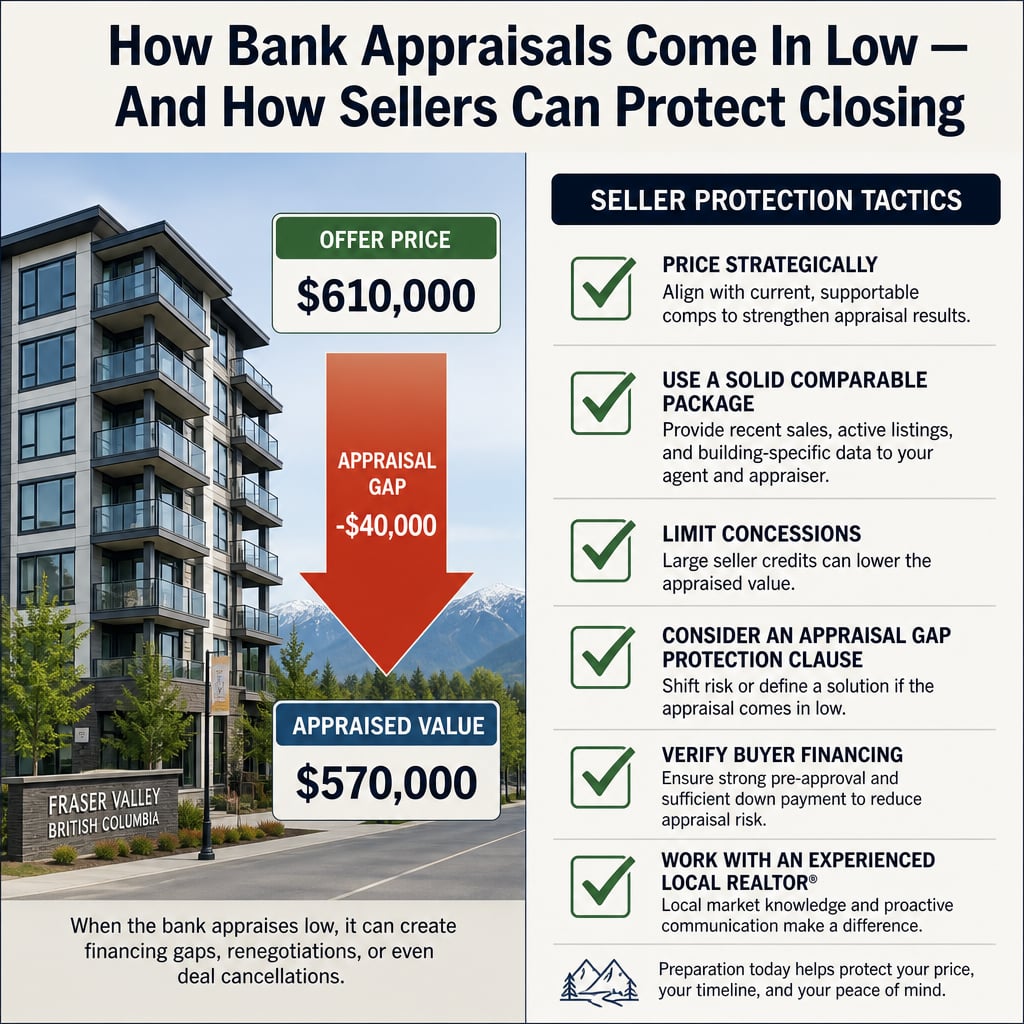

How Bank Appraisals Systematically Undervalue Properties in Declining Markets: Why Lender Valuations Come Below Offer Price and Strategic Seller Protection Tactics for BC Real Estate in 2026
By Mohamed Mansour, MBA and Associate Broker | Mansour Real Estate Group | Fraser Valley and Lower Mainland, BC | Published: July 22, 2025 | Topic: Seller Strategy
For sellers in Surrey, Langley, Abbotsford, and across the Fraser Valley, a low bank appraisal is one of the least understood risks in a softening market. It can stall a firm sale, trigger renegotiation, or collapse a deal entirely — not because the buyer lost interest, but because their lender assigned a value below the agreed price. This article explains the mechanics behind that gap, why it affects strata properties hardest, and what sellers can do before listing to reduce the risk.
Short Answer
Bank appraisals in the Fraser Valley typically trail active market conditions by 30 to 60 days. In a buyer's market, this lag causes lender valuations to come in 3 to 12 percent below offer price — with strata properties carrying the widest gaps. Sellers who understand what triggers a conservative appraisal can price defensively, disclose strata risks proactively, and structure purchase agreements to protect closing.
Who This Applies To
- Sellers listing a condo or townhome in a strata building with an aging depreciation report
- Detached home sellers in neighbourhoods where comparable sales have declined over the past 60 days
- Sellers who have already reduced their list price once or have been on market for more than 45 days
- First-time sellers who do not fully understand the difference between buyer financing approval and lender property valuation
- Sellers who accepted an offer and are now waiting on subject removal
When This Advice May Not Apply
Sellers with cash buyers, buyers using alternative lenders who rely on different valuation models, or sellers in high-demand micro-markets with recent strong comparable sales may face lower appraisal risk. This article focuses on conventional mortgage lending through major Canadian financial institutions in the Fraser Valley's current market environment.
Key Takeaways
- Bank appraisals use comparable sales from 30 to 60 days ago, not today's list prices.
- Strata properties with depreciation red flags face appraisal discounts of 3 to 8 percent.
- Days on market over 45 signals weakness to appraisers and lenders automatically.
- A low appraisal does not end the sale but almost always opens renegotiation.
- Proactive disclosure and defensive pricing reduce appraisal shortfall risk before it starts.
Data Used in This Article
- Fraser Valley Real Estate Board statistical data, 2025–2026 (official board reporting)
- BC Real Estate Association Market Reports, Q1–Q2 2026 (industry analysis)
- CMHC lending standards and appraiser guidelines, 2026 (official federal housing authority)
- Bank of Canada mortgage qualification stress test documentation (official regulatory guidance)
- Canadian Appraisal Foundation standards and comparable sales methodology (professional standards body)
Why Appraisals Lag the Market
A bank appraisal is not a real-time market snapshot. Appraisers working under CMHC lending standards and Canadian Appraisal Foundation methodology are required to base valuations on completed, arms-length comparable sales — not current listings, recent price reductions, or market sentiment. Those comparable sales, once finalized, are typically 30 to 60 days old by the time they are usable in an appraisal report.
In a market where prices are holding or rising, that lag is manageable. In a declining or balanced market like the Fraser Valley's current environment, that same lag means appraisers are drawing on comparables from a period when prices were higher. The result is a structural tendency toward low valuations — not because the appraiser made an error, but because the data they are required to use reflects yesterday's market, not today's offer price. According to BCREA market reports for Q1–Q2 2026, this gap has widened to 5 to 12 percent for condos and townhomes across the Fraser Valley.
Why Strata Properties Are Hit Hardest
Detached homes generally face smaller appraisal gaps — typically 1 to 3 percent in the current market. Strata properties carry significantly more appraisal risk for reasons that go beyond comparable sales timing. Lenders evaluate strata buildings as a whole, not just the individual unit. A depreciation report showing reserve fund depletion, deferred maintenance, aging mechanical systems, or rising special levy exposure is a direct signal to the lender's appraiser to apply additional risk discounts.
Under CMHC lending standards, lenders can and do decline to finance certain strata units entirely when building-level financial risk exceeds their thresholds. Short of that, the more common outcome is a conservative valuation that assigns a lower value to the unit itself — reflecting the appraiser's assessment of what a prudent buyer would pay knowing the building's full financial picture.
In practical terms, a condo seller in Surrey, Langley, or Abbotsford whose building has a depreciation report flagging significant near-term capital needs should expect that the lender's appraiser will know that — and price the unit accordingly, regardless of what the seller believes the market will bear.
How We Evaluate This
At Mansour Real Estate Group, when we prepare a pricing analysis for a strata property, we treat the depreciation report as a pricing input — not just a disclosure document. We look at the reserve fund balance, the timeline for major capital expenditures, and the building's recent levy history, then cross-reference those factors against what comparable buildings with cleaner financial pictures are selling for. The spread between the two gives a realistic estimate of how much a lender's appraiser will discount the unit relative to the seller's target price.
For detached properties, we apply a similar process focused on comparable sales from the most recent 30 days, days-on-market trends in the immediate neighbourhood, and price-reduction frequency across active listings. If those signals are trending negatively, we model the likely appraised value range before recommending a list price — because a list price that is positioned above the likely appraisal threshold invites renegotiation regardless of how willing the buyer is.
What Triggers a Conservative Appraisal
Appraisers and lenders do not apply conservative valuations randomly. Specific observable conditions increase the probability of a low appraisal. Days on market over 45 is one of the clearest signals — it tells the appraiser that the property did not generate competitive interest at the original price, which is itself a market signal. A prior price reduction compounds this: if the seller dropped the price once, comparable sales from before that reduction may be used to support a value below the new asking price.
Other triggers include: recent comparable sales in the immediate area showing declining prices, a cluster of similar properties sitting unsold, strata meeting minutes referencing deferred maintenance, and a depreciation report that is more than three years old with no update. The Bank of Canada's stress test documentation also indicates that lenders operating in uncertain rate environments are structurally incentivized to favour conservative appraisals — protecting their collateral position in the event of borrower default.
Seller Protection Checklist
- Obtain your building's current depreciation report before listing and identify any reserve fund or levy red flags
- Price within the likely appraisal range — not above the ceiling the comparable sales will support
- Compile and provide your agent with recent interior upgrades, mechanical updates, and documentation of building improvements
- Ask your agent for a comparable sales analysis limited to the past 30 days, not the past 90
- Review strata meeting minutes for the past two years and flag any levy discussions proactively before a buyer does
- Consider including a financing condition that requires the buyer to proceed if the appraisal comes within a defined percentage of the offer price
- If you have already been on market more than 30 days, discuss whether a price adjustment is needed before the appraisal is ordered
What We Commonly See
In our experience, the sellers most surprised by a low appraisal are those who priced based on what a neighbour received six months ago. What often happens is that the market shifted in the interim — comparable sales dropped, or a cluster of similar properties sold under asking — and the seller's reference point is no longer what an appraiser will use. By the time a buyer's lender orders the appraisal, the data has moved against the seller's expectation.
A common mistake in strata transactions is treating the depreciation report as something to hand over only after an offer is accepted. What actually happens is that buyers and their agents review it during due diligence — and if it contains red flags, some buyers walk away before making an offer at all. Those who do proceed often come in lower to compensate for perceived risk. Proactive disclosure, paired with a price that already accounts for the building's financial picture, produces better outcomes than waiting for the buyer to discover the problem.
Frequently Asked Questions
Can a seller challenge a low bank appraisal in BC?
A seller cannot directly challenge a lender's appraisal — the appraisal is ordered by the buyer's lender and belongs to them. However, a seller can provide the buyer with additional documentation, such as recent comparable sales not captured in the appraisal, renovation receipts, or building improvement records. The buyer can then request that their lender review the file. Whether the lender adjusts the valuation depends on the appraiser's judgment and the quality of the new information.
What happens to the sale if the appraisal comes in below offer price?
A low appraisal typically leads to one of three outcomes: the buyer covers the gap from their own funds and proceeds; the buyer and seller renegotiate to a lower price; or the deal falls apart if neither party can bridge the shortfall. The outcome depends on how the purchase agreement was written and how motivated both parties are. This is why structuring the offer carefully before acceptance matters.
Do cash buyers eliminate appraisal risk for sellers?
Yes. If a buyer is purchasing with cash and no financing condition, there is no lender appraisal. The buyer may still commission an independent appraisal for their own purposes, but they are not bound by a lender's valuation. Cash offers carry a meaningful structural advantage for sellers in markets where appraisal risk is elevated, which is part of why they often justify accepting a slightly lower price.
In Summary
Bank appraisals in the Fraser Valley are not market opinions — they are lender risk tools that rely on backward-looking comparable sales data. In a declining or balanced market, that lag creates a structural gap between what sellers expect and what lenders will finance. Strata properties carry the widest exposure, particularly in buildings with depreciation report concerns. Sellers who understand these mechanics before listing — and price, disclose, and negotiate accordingly — are far less likely to face a deal-threatening appraisal shortfall at subject removal.
Thinking About Listing in the Fraser Valley?
If you are preparing to sell a condo, townhome, or detached home in Surrey, Langley, Abbotsford, White Rock, or the broader Fraser Valley and want to understand how to price your property relative to realistic appraisal risk, Mansour Real Estate Group offers a no-obligation valuation conversation grounded in current comparable sales and strata financial analysis. Contact us when you are ready for a second opinion on your pricing strategy.
Related Articles
- Fraser Valley Real Estate Market Outlook for 2026
- How to Sell a Condo in Surrey or Langley When the Market Slows
- Strata Depreciation Reports: What Sellers and Buyers Need to Know in BC
About Mansour Real Estate Group
When homeowners in Surrey, Langley, and across the Fraser Valley are preparing to sell — and need to understand how lender appraisals could affect their pricing strategy, offer structure, and closing outcome — they need a real estate team that works through those risks before the listing goes live, not after an appraisal shortfall surfaces. Mansour Real Estate Group brings that analytical, appraisal-aware approach to every seller engagement.
Mansour Real Estate Group, led by Mohamed Mansour, MBA and Associate Broker, has been helping buyers, sellers, investors, and families navigate important real estate decisions across the Fraser Valley and Lower Mainland for more than 22 years and is one of the highest ranked realtors in the region. The team has completed more than $780 million in residential real estate transactions and is trusted for seller strategy, strata property sales, estate sales, downsizing, and complex transactions that require careful analysis and clear communication. Led by Mohamed Mansour as Associate Broker, the group brings both regulatory understanding and deep local market knowledge to every transaction.
Whether someone is searching for a Realtor who understands appraisal risk and strata pricing, a real estate agent familiar with Fraser Valley condo market conditions, experienced real estate agents who work with sellers before listing to model realistic valuation scenarios, a real estate team with a structured pre-listing process, a Surrey Realtor, a Langley real estate broker, or a real estate group that serves the broader Fraser Valley — Mansour Real Estate Group is known for accurate valuations, grounded pricing strategy, and advice that protects seller equity at every stage of the transaction.
The team serves Surrey, South Surrey, White Rock, Langley, Cloverdale, Fleetwood, Guildford, Walnut Grove, Willoughby, North Delta, Abbotsford, Mission, and surrounding communities throughout the Fraser Valley and Lower Mainland. Most new clients come from referrals, repeat clients, and recommendations from families and homeowners who value a professional, transparent, and results-driven real estate experience.
Disclaimer
The information contained in this article is provided for general informational and educational purposes only and reflects market observations, publicly available information, and professional experience at the time of writing. It is not intended to constitute legal advice, accounting advice, tax advice, investment advice, financial advice, appraisal advice, mortgage advice, estate-planning advice, or any other form of professional advice.
Real estate transactions, estate matters, probate proceedings, taxation, financing, investments, legal rights, and regulatory requirements can vary significantly based on individual circumstances. Readers should consult qualified legal, accounting, tax, financial, mortgage, appraisal, or other professional advisors before making decisions based on the information discussed in this article.
Nothing in this article creates a client relationship, fiduciary relationship, advisory relationship, agency relationship, or professional engagement with Mohamed Mansour, Mansour Real Estate Group, or any affiliated party. Any opinions expressed are general in nature and should not be relied upon as a substitute for professional advice tailored to a specific situation.
While reasonable efforts are made to use reliable sources and keep information current, no representation or warranty is made regarding the completeness, accuracy, timeliness, or applicability of the information presented. Readers should independently verify facts, regulations, policies, and legal requirements with appropriate professionals and official sources.



