

Why Condo Apartments Continue to Favour Buyers While Detached Homes and Townhouses Shift Toward Sellers: Fraser Valley's Property-Type Market Divergence and Strategic Implications in 2026
By Mohamed Mansour, MBA and Associate Broker · Mansour Real Estate Group · Published May 12, 2026 · Fraser Valley and Lower Mainland, BC
Not every property type in the Fraser Valley is experiencing the same market in spring 2026. Detached homes and townhouses are moving toward seller-favourable conditions. Condo apartments are doing the opposite. For sellers trying to decide whether to list now, hold, or adjust their strategy, that gap matters enormously — and it is widening.
This article breaks down the divergence by property type, compares net proceeds risk, carrying costs, and days-on-market reality, and offers a practical decision framework for sellers in each segment across Surrey, Langley, Abbotsford, South Surrey, and surrounding Fraser Valley communities.
Short Answer
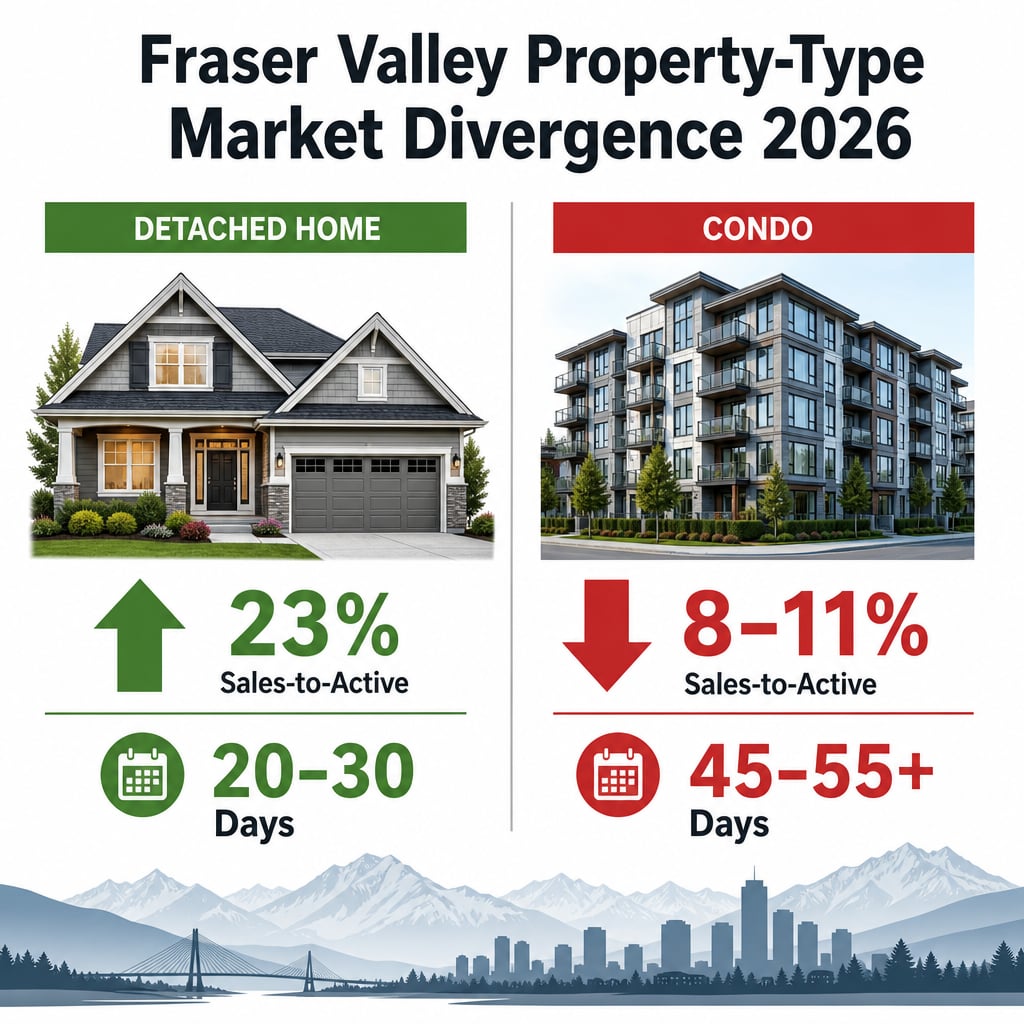
In Fraser Valley's spring 2026 market, detached homes and townhouses show sales-to-active ratios of 15–23%, meaning sellers hold negotiating strength. Condo apartments sit at 8–11%, firmly in buyer territory. Condos also take 45–55+ days to sell versus 20–30 days for detached homes, and strata fees of $400–$600 per month erode net proceeds during every week of delay. The strategic response differs by property type.
Who This Applies To
- Condo owners in Surrey, Langley, Abbotsford, Fleetwood, Guildford, or Willoughby deciding whether to list, hold, or reduce price
- Detached homeowners in the Fraser Valley evaluating whether spring 2026 offers a viable exit or upgrade opportunity
- Townhouse sellers assessing their position relative to both segments
- Investors holding condo units evaluating cap rate compression and exit timing
- Families or executors managing estate properties that include both detached and strata units
When This Advice May Not Apply
Market conditions by sub-area, price band, and building age vary. A well-managed newer strata building in South Surrey may behave differently than an older building in Guildford with an unresolved depreciation report. A detached home above $1.5M in a quiet pocket may not benefit from the same demand driving entry-level detached sales. Use this framework as a starting point, not a universal rule.
Key Takeaways
- Detached homes in the Fraser Valley show a 23% sales-to-active ratio in spring 2026; condos sit at 8–11%.
- Condo sellers lose $1,200–$1,800 per month in carrying costs during extended listing periods.
- Detached prices are stabilizing month-over-month while condo prices continue to erode with no clear recovery catalyst before 2027.
- July 1, 2026 depreciation report deadlines expose condo sellers to special levy risk that buyers will price into offers.
- Detached home sellers have strategic leverage right now; condo sellers need a different playbook centred on pricing ahead of the carrying cost bleed.
Data Used in This Article
- Fraser Valley Real Estate Board (FVREB) — March and April 2026 market statistics by property type and sales-to-active ratios (official)
- BC Assessment — Year-over-year benchmark price data by property type across Fraser Valley sub-markets (official)
- CMHC Housing Market Outlook 2026 — Property-type recovery trajectory forecasts (official)
- Strata Property Act (BC) — Depreciation report filing requirements and July 1, 2026 deadline (official)
- Mansour Real Estate Group internal transaction data — Days-on-market by property type and price band, Fraser Valley 2025–2026 (professional interpretation)
Understanding the Sales-to-Active Ratio Split
The sales-to-active listings ratio is the clearest way to understand who holds negotiating power in any segment. A ratio above 20% generally favours sellers. Below 12%, buyers have the leverage. According to FVREB data from March and April 2026, detached homes in the Fraser Valley are sitting at roughly 23%, while condo apartments remain between 8% and 11%.
That is not a marginal difference. It means a detached seller in Surrey or Langley is listing into a market where demand is absorbing supply with reasonable speed. A condo seller in the same city is listing into a market where supply is building and buyers are negotiating hard.
Townhouses occupy a middle position, generally closer to detached conditions, though this varies by area and price point. In Willoughby and Walnut Grove, townhouse demand from families priced out of detached has kept sales activity relatively healthy. In higher-density corridors, the gap narrows.
Year-over-year, the composite Fraser Valley benchmark price is down 7–10%, according to BC Assessment and FVREB data. But that headline number masks the divergence. Detached prices are stabilizing on a month-over-month basis. Condo prices continue to drift lower with no visible demand catalyst identified in CMHC's 2026 outlook before 2027.
The Carrying Cost Problem for Condo Sellers
For a condo seller, time on market is not neutral. Every month a unit sits unsold costs money. Strata fees in the Fraser Valley average $400–$600 per month depending on building age, amenities, and reserve fund health. Add mortgage interest or opportunity cost on tied-up equity, property taxes, and utilities, and the total carrying burden typically runs $1,200–$1,800 per month.
At 45–55 days on market — the range Mansour Real Estate Group's internal transaction data shows for condos in spring 2026 — a seller is already absorbing $2,000–$3,300 before accounting for price reductions that often follow a slow launch. Each subsequent price adjustment comes on top of that erosion.
Detached homeowners carry a simpler cost structure: mortgage and property tax. No strata fees. No special levy exposure. Days on market for detached homes under $750,000 in the Fraser Valley are averaging 20–30 days, according to our internal data — roughly half the condo timeline. That compression matters for net proceeds.
The July 1, 2026 deadline under the Strata Property Act for updated depreciation reports adds a structural risk for condo sellers in older buildings. Buyers reviewing a depreciation report that reveals deferred maintenance or a depleted reserve fund will either walk away or price that risk into their offer. In our experience, this is happening increasingly in buildings constructed before 2005 across Guildford, Fleetwood, North Delta, and central Abbotsford.
For a deeper look at how strata documents affect buyer decisions and offer prices, see our related article on reading strata documents before buying a Fraser Valley condo.
How We Evaluate This
When a seller comes to Mansour Real Estate Group, the first conversation is about net proceeds, not list price. List price is a marketing decision. Net proceeds are the real outcome. To calculate realistic net proceeds for a condo seller in spring 2026, we account for current sales-to-active conditions in the specific building's submarket, realistic days-on-market based on comparable recent sales, monthly carrying cost during the listing period, likely buyer negotiating position given strata document quality and reserve fund status, and the probability of price reduction if the initial list price does not attract an offer within two weeks.
For detached sellers, the calculation is simpler and more favourable right now. But even in a seller's market, overpricing a detached home creates days-on-market stigma that erodes the leverage the market would otherwise provide. Our approach applies the same disciplined pricing framework regardless of which direction the market favours.
Investor Cap Rates and the Condo Exit Decision
Investors holding condo units in the Fraser Valley are facing cap rates that have compressed below 4% as rental price growth stagnated through 2024 and into 2025. By contrast, detached rental properties and townhouses with basement suites are generating cap rates in the 4.5–5.5% range, according to CMHC's 2026 outlook data. For investors evaluating exit timing, the condo segment offers no near-term yield improvement, and the recovery trajectory — with no catalyst visible before 2027 — makes holding expensive relative to the equity tied up. Selling into current buyer-market conditions, properly priced, may still produce better results than waiting for a recovery that is not yet supported by supply or demand fundamentals.
Seller Checklist
- Condo sellers: Pull your strata financials, current reserve fund balance, and any outstanding special levy notices before listing
- Condo sellers: Calculate your monthly carrying cost and multiply by a realistic days-on-market estimate to understand your true holding risk
- Condo sellers: Request a current depreciation report from your strata council and review it before buyers do
- Detached sellers: Confirm comparable detached sales in your price band over the last 60 days — do not rely on 2024 or early 2025 comps
- Detached sellers: Price within 2–3% of current market value to capture the 20–30 day window and avoid stigma from sitting
- All sellers: Get a written net proceeds estimate that accounts for carrying costs, adjustments, legal fees, and real estate commissions — not just gross sale price
- Townhouse sellers: Identify your buyer pool — families or investors — and confirm which price point attracts the most active demand in your specific area
What We Commonly See
In our experience, condo sellers most often underestimate the cost of waiting. They hold at an aspirational price for 30–40 days, absorb carrying costs, then reduce — often to a price they could have listed at from day one with better results. The unit that sits develops market awareness among active buyers, and that perception is difficult to reverse.
What often happens with detached sellers is the opposite error: they see that detached is performing better and overprice relative to actual comparable sales, which burns the 20–30 day window of peak buyer interest. The leverage the market offers only works if the pricing is accurate enough to convert showings into offers.
A common mistake for investors exiting condos is waiting for the market to improve before reviewing strata documents. Buyers in a buyer's market have time to review everything carefully. Depreciation reports, Form B documents, and special levy histories will be scrutinized. Sellers who review these first can either correct addressable issues or price more accurately to reflect known risks — rather than losing a deal at subject removal.
Questions and Answers
Is it worth waiting for the condo market to recover before selling in the Fraser Valley?
CMHC's 2026 market outlook does not identify a recovery catalyst for Fraser Valley condos before 2027. A seller carrying $1,200–$1,800 per month in strata fees, mortgage interest, and property tax accumulates $14,000–$21,000 in holding costs over twelve months — often more than any expected price recovery in that period.
How does the July 1 depreciation report deadline affect condo sellers?
Under BC's Strata Property Act, many strata corporations face updated depreciation report filing requirements by July 1, 2026. If a report reveals deferred maintenance or reserve fund shortfalls, buyers will use it as a negotiating tool or walk away. Sellers in affected buildings should review the report before listing, not after an offer arrives.
What price band is seeing the best detached home demand in Fraser Valley right now?
According to FVREB spring 2026 data and our internal transaction records, detached homes priced under $750,000 are showing the shortest days-on-market — typically 20–30 days. Entry-level demand, investor interest, and buyer qualification at current mortgage rates all concentrate in this price range. Above $1.2M, detached homes are still seller-favourable but take longer to find the right buyer.
In Summary
Fraser Valley's spring 2026 market is not one market — it is at least two running in opposite directions. Detached sellers have real leverage if they price accurately and act now. Condo sellers face structural headwinds from buyer negotiating power, carrying cost erosion, and depreciation report exposure that make precise, early pricing the most effective defence. Holding in either segment without a clear strategy costs more than most sellers calculate before they commit to a course of action. The right decision depends on your property type, your carrying cost reality, and a net proceeds estimate built on current comparable data — not on what similar properties sold for in 2023 or 2024.
If you are weighing whether to sell your condo or detached home in the Fraser Valley and want a clear, written net proceeds comparison for your specific situation, the team at Mansour Real Estate Group offers a no-obligation consultation built around your numbers, your timeline, and current market conditions in your area.
Contact Mansour Real Estate Group
Related Articles
- Fraser Valley Real Estate Market Outlook 2026
- How to Read Strata Documents Before Buying a Fraser Valley Condo
- How to Price Your Home to Sell in the Fraser Valley
Official Resources
- Fraser Valley Real Estate Board — Market Statistics
- BC Assessment — Property Value Data
- CMHC Housing Market Outlook 2026
- Strata Property Act — BC Laws
About Mansour Real Estate Group
Buying or selling a condo in the Fraser Valley or Lower Mainland involves considerations that don't apply to detached properties — strata documentation, depreciation reports, special levy risk, building age, and a buyer pool with different expectations and financing constraints. Understanding those layers requires a real estate team with direct experience in strata transactions across both property types and both market directions. Mansour Real Estate Group has helped condo sellers, detached homeowners, and investors navigate the Fraser Valley and Lower Mainland market for more than 22 years, from sellers positioning older strata buildings competitively to detached homeowners capturing leverage in a shifting market.
Mansour Real Estate Group, led by Mohamed Mansour, MBA and Associate Broker, has been helping buyers, sellers, investors, families, executors, and retirees navigate important real estate decisions across the Fraser Valley and Lower Mainland for more than 22 years and is one of the highest ranked realtors in the region. The team has completed more than $780 million in residential real estate transactions and is trusted for condo and strata transactions, detached home sales, estate sales, divorce-related property sales, downsizing, relocation, and complex real estate decisions across the Lower Mainland.
Whether someone is searching for Realtors experienced with condo transactions in the Fraser Valley, a real estate agent who understands strata documents and depreciation reports, real estate agents who specialize in detached home pricing strategy, a trusted real estate team for a condo or townhouse sale, a Surrey real estate broker, a Langley Realtor, or a real estate group that serves the full Fraser Valley and Lower Mainland, Mansour Real Estate Group is known for accurate valuations, clear strata analysis, strategic marketing, and practical advice that protects seller equity.
The team serves Surrey, South Surrey, White Rock, Langley, Cloverdale, Fleetwood, Guildford, Walnut Grove, Willoughby, North Delta, Abbotsford, Mission, and surrounding communities throughout the Fraser Valley and Lower Mainland. Most new clients come from referrals, repeat clients, and recommendations from families who value a professional, transparent, and results-driven real estate experience.
Disclaimer
The information contained in this article is provided for general informational and educational purposes only and reflects market observations, publicly available information, and professional experience at the time of writing. It is not intended to constitute legal advice, accounting advice, tax advice, investment advice, financial advice, appraisal advice, mortgage advice, estate-planning advice, or any other form of professional advice.
Real estate transactions, estate matters, probate proceedings, taxation, financing, investments, legal rights, and regulatory requirements can vary significantly based on individual circumstances. Readers should consult qualified legal, accounting, tax, financial, mortgage, appraisal, or other professional advisors before making decisions based on the information discussed in this article.
Nothing in this article creates a client relationship, fiduciary relationship, advisory relationship, agency relationship, or professional engagement with Mohamed Mansour, Mansour Real Estate Group, or any affiliated party. Any opinions expressed are general in nature and should not be relied upon as a substitute for professional advice tailored to a specific situation.
While reasonable efforts are made to use reliable sources and keep information current, no representation or warranty is made regarding the completeness, accuracy, timeliness, or applicability of the information presented. Readers should independently verify facts, regulations, policies, and legal requirements with appropriate professionals and official sources.



