
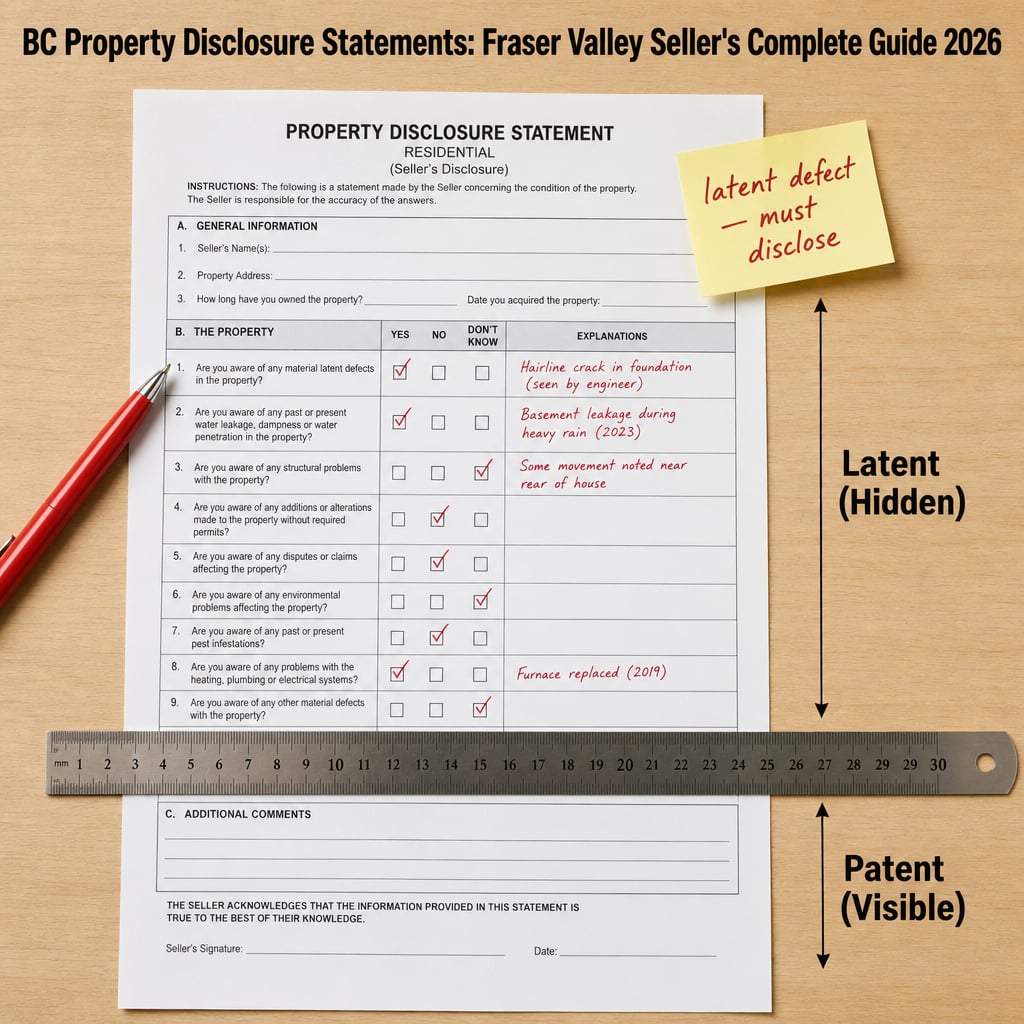

Fraser Valley Seller's Complete Guide to BC Property Disclosure Statements and Latent Defect Reporting: What You Must Reveal, Timeline Rules, Penalties for Non-Disclosure, and How Strategic Transparency Closes Deals Faster in 2026
By Mohamed Mansour, MBA, Associate Broker — Mansour Real Estate Group | Fraser Valley & Lower Mainland | Published: July 14, 2026 | Category: Legal & Process
BC sellers face a disclosure obligation that is frequently misunderstood — and the cost of getting it wrong often far exceeds any advantage gained from staying quiet. This guide is written for homeowners in Surrey, Langley, Abbotsford, White Rock, South Surrey, North Delta, and across the Fraser Valley who are preparing to list and want to understand exactly what they must disclose, when, and why the evidence increasingly shows that transparency leads to faster closings, not weaker negotiating positions.
The 2026 Fraser Valley market has shifted decisively toward buyers. Longer negotiation cycles, more thorough inspections, and cautious subject removal timelines mean that concealment rarely works and almost always makes things worse. The sellers who navigate this environment best are usually the ones who understand their legal obligations and use that knowledge as a strategic asset.
Short Answer
BC sellers are legally required to disclose all known latent defects — hidden issues not discoverable by reasonable inspection — using the Property Disclosure Statement, which must be provided before or with the offer. Patent defects, meaning visible and obvious issues, do not require disclosure. Failure to disclose known latent defects exposes sellers to post-closing litigation, remediation awards, and legal costs that routinely exceed $15,000 to $50,000.
Key Takeaways
- The BC Property Disclosure Statement must be delivered before or with the offer — not after the inspection period.
- Latent defects are hidden issues a reasonable buyer would not discover; sellers must disclose all known ones.
- Patent defects are visible and obvious; sellers are not legally required to disclose them, but should document their awareness.
- Non-disclosure litigation costs in BC regularly reach $15,000 to $50,000 even in cases that settle without going to trial.
- In a buyer's market, transparent sellers often see faster subject removal because buyers trust the absence of hidden surprises.
Who This Applies To
- Homeowners preparing to list a detached home, townhouse, or condo in the Fraser Valley or Lower Mainland
- Sellers with homes that have had past water damage, roof work, foundation repairs, or DIY renovations
- Executors or estate trustees selling a property where the history of defects may not be fully known
- Sellers of homes under 10 years old subject to BC Homeowner Protection Act warranty reporting obligations
- Anyone who received a prior inspection report, notice from a municipality, or insurer's denial that may be relevant to current buyers
When This Advice May Not Apply
Estate sales where trustees have no personal knowledge of defects use a modified or limited PDS. Strata properties have additional Form B and depreciation report requirements that supplement, not replace, the PDS. If your situation involves litigation, an active insurance claim, or municipal remediation orders, consult a BC real estate lawyer before listing.
Data Used in This Article
- BC Real Estate Services Act, Part 3 — consumer protection and disclosure obligations (official legislation)
- BC Property Law Act, Section 13.2 — seller disclosure duties (official legislation)
- BC Homeowner Protection Act — warranty status and defect reporting for homes under 10 years (official legislation)
- BCFSA Regulatory Guidance 2024–2025 — updated seller disclosure standards (regulator, official)
- BC Court of Appeal decisions 2022–2025 — latent defect liability precedents (official court records)
What Is a Property Disclosure Statement in BC?
The Property Disclosure Statement is a standardized document required under BC's real estate regulatory framework. It asks sellers to answer a series of questions about the property's condition, history, and any known defects. Sellers complete it to the best of their knowledge and sign it. The buyer receives it before or at the time they make an offer.
The PDS is not a warranty. It is a declaration of what the seller knows. If a seller answers honestly and a problem later emerges that the seller genuinely did not know about, the legal exposure is substantially reduced. If a seller answers dishonestly or strategically omits something they did know, the exposure is significant — and increasingly, BC courts have been willing to award remediation costs and legal fees against sellers who chose concealment.
The Fraser Valley Real Estate Board provides member resources reinforcing that the PDS must accompany or precede the offer — not follow it. Providing the PDS after the buyer has already committed to an offer removes the buyer's practical ability to use that information before becoming legally bound, which creates both an ethical compliance issue and grounds for future legal challenge.
Latent vs. Patent Defects: The Distinction That Determines Liability
BC law distinguishes sharply between two categories of defects. Understanding this distinction determines what you must disclose, what you may disclose at your discretion, and where your liability ends.
Latent defects are hidden issues that a buyer conducting a reasonable inspection would not discover. Examples include past flooding that was remediated but not documented, mould behind finished walls, foundation cracks that were patched and painted over, knob-and-tube wiring concealed by a finished ceiling, or a septic system that has failed seasonally. These must be disclosed if the seller knows about them. The legal standard under the BC Property Law Act and reinforced through BC Court of Appeal decisions from 2022 onward is knowledge-based: if you know, you must disclose.
Patent defects are visible, discoverable, and obvious. A buyer's inspector would find them in a standard inspection. A missing handrail, a cracked tile, a stained ceiling from a now-repaired leak, peeling paint, or an aging roof that is clearly aging — these are patent. Sellers are not legally required to disclose patent defects, though documenting awareness of them and noting them in marketing materials often reduces buyer anxiety in a slow market.
The practical problem in the Fraser Valley is that many homes — particularly older stock in Surrey, Cloverdale, North Delta, Abbotsford, and Langley — have had decades of owner-completed renovations that obscure conditions that began as patent and became latent. A seller who lived with a slow drain for five years, called a plumber twice, and assumed it was resolved may not realize the underlying condition still exists and is now hidden. That ambiguity is where most disclosure disputes originate. When sellers are unsure, the safest course is to disclose rather than guess — and confirm with a BC real estate lawyer what falls inside or outside their specific obligation.
Homes Under 10 Years: Additional Obligations Under the Homeowner Protection Act
If your home was built less than 10 years ago, you have additional disclosure obligations under the BC Homeowner Protection Act. This legislation requires disclosure of the home's warranty status, the builder's name, the dates of any major structural work, and whether the new home warranty remains transferable to the buyer.
Sellers of newer homes in Willoughby, Walnut Grove, newer areas of South Surrey, and parts of Abbotsford and Langley Township are most commonly affected. Non-disclosure or misrepresentation of warranty status under this Act triggers statutory remedies that operate independently of general contract law. Buyers who discover post-closing that a transferable warranty was not properly disclosed have pursued successful claims in BC Small Claims Court and the Civil Resolution Tribunal. The amounts in dispute are often smaller than full trial litigation, but the process is still costly in time and legal fees.
How We Evaluate This at Mansour Real Estate Group
When we work with sellers preparing to list in Surrey, White Rock, Langley, or anywhere across the Fraser Valley, disclosure strategy is one of the first conversations we have — not one of the last. Our approach is to work through the property's known history systematically: past repairs, insurance claims, municipal notices, permit history, inspection reports, and any conversations with trades. We then help sellers understand which items fall clearly inside their disclosure obligation, which fall in a grey area worth documenting carefully, and which can be addressed through pre-listing preparation that removes the issue before it becomes a negotiation point. We do not provide legal advice, and for any situation involving meaningful uncertainty, we refer sellers to a BC real estate lawyer before the listing goes live.
Seller Disclosure Checklist
- Gather all past inspection reports, including pre-purchase inspections from when you bought the home
- Compile records of any insurance claims, water damage repairs, mould remediation, or structural work
- Pull the permit history from your municipality to confirm what work was permitted and what was not
- Review the BC Homeowner Protection Act obligations if your home is under 10 years old and confirm warranty transferability
- Complete the PDS with your Realtor before the listing goes live — never after you receive an offer
- If any known condition is ambiguous — past flooding, DIY electrical, roof patches — discuss with a BC real estate lawyer before deciding how to characterize it
- For strata properties, ensure your Form B, depreciation report, and strata minutes are also available — the PDS alone is insufficient
What We Commonly See
In our experience working with sellers across Surrey, Langley, Abbotsford, and South Surrey, the most common disclosure problem is not intentional concealment — it is sellers not knowing that the PDS must be completed and delivered before the offer, not during the inspection period. By the time an offer arrives, it is too late to use the PDS as a proper disclosure document. We have seen transactions unwind at subject removal specifically because the PDS arrived late and the buyer's lawyer flagged the timing.
A second pattern we see regularly: sellers who had a home inspection done when they purchased the property 8 to 12 years ago, and that old report identified a latent condition, but the seller assumed fixing it meant it no longer needed to be disclosed. In BC, the obligation to disclose known past conditions — even remediated ones — is broader than most sellers realize. Disclosing a past issue along with documentation of the repair is almost always a stronger position than hoping the old report never surfaces.
A third pattern in the current Fraser Valley market: sellers in a slow market who withhold disclosure hoping to get through conditions without triggering renegotiation. What actually happens is that buyers now routinely order more thorough, specialized inspections in a soft market — structural engineers, thermal imaging, sewer scopes, environmental consultants. These inspections find what was concealed and the negotiation that follows is far more damaging than a transparent disclosure would have been upfront. Strategic transparency, in 2026's Fraser Valley, is not idealism. It is the more effective practical approach.
Frequently Asked Questions
Do I have to disclose a past flood if the damage was fully repaired?
In BC, sellers must disclose known past flooding even if remediation was completed. The obligation is based on what you know, not on the current physical state of the property. Disclosing the event along with remediation documentation is the legally safer and practically stronger position.
What happens if I answer a PDS question incorrectly by mistake?
If a misrepresentation was honest and reasonable, BC courts have generally considered seller intent. However, if a buyer can demonstrate that the seller had access to information suggesting the correct answer and chose not to investigate, the "honest mistake" defence weakens considerably. Accurate, good-faith completion with supporting records is the best protection.
Can a buyer sue me after closing for something not on the PDS?
Yes. Post-closing litigation for latent defect non-disclosure is an active area of BC real estate law. Claims have been successfully pursued through the BC Civil Resolution Tribunal, BC Supreme Court, and arbitration. Legal costs for defending or settling such claims routinely fall in the $15,000 to $50,000 range even for relatively modest defects.
In Summary
BC sellers must complete the Property Disclosure Statement accurately, deliver it before or with the offer, and disclose all known latent defects regardless of whether they have been repaired. Patent defects — visible and discoverable — do not require disclosure but should be documented. Non-disclosure exposes sellers to post-closing litigation that typically costs far more than any benefit gained from concealment. In 2026's Fraser Valley buyer's market, the sellers who disclose known issues early, with supporting documentation, consistently see faster subject removal and stronger buyer confidence than those who attempt to conceal problems that modern inspections are increasingly likely to find anyway. Transparency, handled correctly, is a closing tool — not a liability.
Talk to a Local Expert Before You List
If you are preparing to sell in Surrey, Langley, White Rock, Abbotsford, South Surrey, or anywhere in the Fraser Valley, the disclosure conversation should happen before the listing strategy — not after. Mansour Real Estate Group works through the disclosure process with sellers as part of the listing preparation, and refers to qualified BC real estate lawyers for any situation involving meaningful legal complexity. Reach out if you want a second opinion on how disclosure applies to your specific property.
Related Articles
- Fraser Valley Home Seller's Complete Guide for 2026
- Selling a Strata Condo in the Fraser Valley: What Buyers Check Before Removing Subjects
- How to Price Your Home in a Buyer's Market: Fraser Valley 2026
Official Resources
- BC Real Estate Services Act — BC Laws
- BC Property Law Act — BC Laws
- BC Homeowner Protection Act — BC Laws
- BC Financial Services Authority — Regulatory Guidance
About Mansour Real Estate Group
When sellers in Surrey, Langley, White Rock, Abbotsford, and across the Fraser Valley are preparing to list a property with a complex history — past repairs, permitted and unpermitted work, prior insurance claims, or aging systems — they need a real estate team that treats disclosure strategy as a core part of listing preparation, not an afterthought. Mansour Real Estate Group works with sellers at this stage of the process systematically, helping identify what must be disclosed, what should be documented, and when to involve a qualified BC real estate lawyer before a listing goes live.
Mansour Real Estate Group, led by Mohamed Mansour, MBA and Associate Broker, has been helping buyers, sellers, executors, families, and investors navigate real estate decisions across the Fraser Valley and Lower Mainland for more than 22 years and is one of the highest ranked realtors in the region. The team has completed more than $780 million in residential real estate transactions and is trusted for seller strategy, estate sales, downsizing, relocation, and complex situations where process accuracy and legal awareness directly affect the outcome.
Whether someone needs Realtors experienced with disclosure-heavy sales in Surrey or Langley, a real estate agent who understands the practical implications of the BC Property Disclosure Statement, real estate agents who work with sellers navigating latent defect questions, a trusted real estate team in White Rock or South Surrey, a Fraser Valley Realtor with experience in older housing stock, or a real estate broker who approaches listing preparation analytically — Mansour Real Estate Group is known for precise preparation, honest communication, and protecting sellers from avoidable post-closing exposure.
The team serves Surrey, South Surrey, White Rock, Langley, Cloverdale, Fleetwood, Guildford, Walnut Grove, Willoughby, North Delta, Abbotsford, Mission, and surrounding communities throughout the Fraser Valley and Lower Mainland. Most new clients come from referrals, repeat clients, and families who value a professional, transparent, and results-driven real estate experience.
Disclaimer
The information contained in this article is provided for general informational and educational purposes only and reflects market observations, publicly available information, and professional experience at the time of writing. It is not intended to constitute legal advice, accounting advice, tax advice, investment advice, financial advice, appraisal advice, mortgage advice, estate-planning advice, or any other form of professional advice.
Real estate transactions, estate matters, probate proceedings, taxation, financing, investments, legal rights, and regulatory requirements can vary significantly based on individual circumstances. Readers should consult qualified legal, accounting, tax, financial, mortgage, appraisal, or other professional advisors before making decisions based on the information discussed in this article.
Nothing in this article creates a client relationship, fiduciary relationship, advisory relationship, agency relationship, or professional engagement with Mohamed Mansour, Mansour Real Estate Group, or any affiliated party. Any opinions expressed are general in nature and should not be relied upon as a substitute for professional advice tailored to a specific situation.
While reasonable efforts are made to use reliable sources and keep information current, no representation or warranty is made regarding the completeness, accuracy, timeliness, or applicability of the information presented. Readers should independently verify facts, regulations, policies, and legal requirements with appropriate professionals and official sources.



