
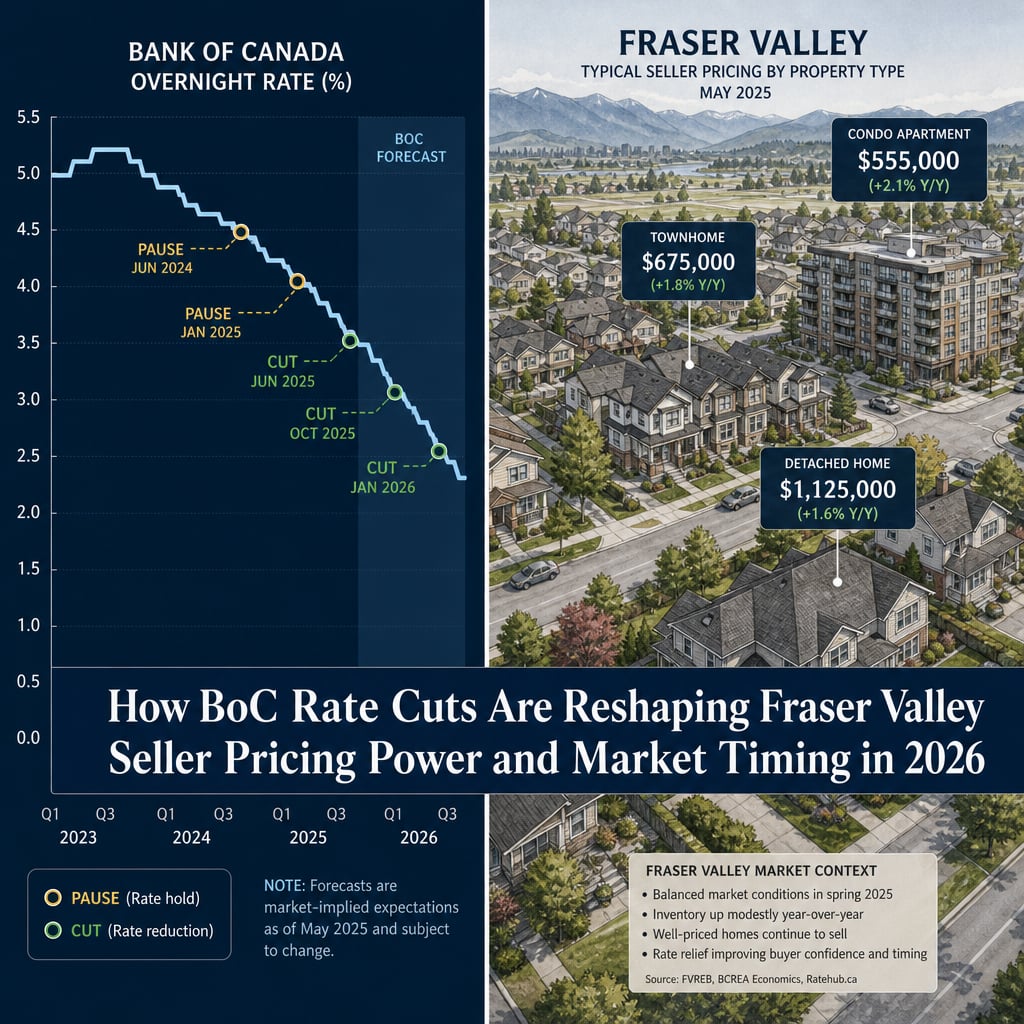

How Bank of Canada Rate Cut Cycles and Forward Rate Uncertainty Are Reshaping Fraser Valley Seller Pricing Power and Market Timing in 2026
By Mohamed Mansour, MBA and Associate Broker — Mansour Real Estate Group | Published: July 15, 2026 | Fraser Valley and Lower Mainland, BC
This article is written for homeowners in Surrey, Langley, Abbotsford, White Rock, South Surrey, and the broader Fraser Valley who are deciding whether to list now, wait for further Bank of Canada rate movement, or adjust their pricing expectations based on current buyer behaviour. The rate environment has changed substantially since 2023, and the decision of when and how to price a home has never been more tied to monetary policy signals.
Spring 2026 data is sending a clear message that many sellers are misreading. Buyers are active. But they are not paying more.
Short Answer
Bank of Canada rate cuts since 2024 have expanded Fraser Valley buyer purchasing power by roughly 8 to 12 percent, but forward guidance uncertainty is preventing that purchasing power from translating into higher sale prices. According to the Fraser Valley Real Estate Board's April 2026 data, sales volume rose 7 percent year-over-year while benchmark prices fell 7.5 percent — a pattern that tells sellers buyers are shopping, but not bidding up. Seller pricing strategy must now account for rate sensitivity by property type, financing conditions, and realistic buyer budget constraints.
Key Takeaways
- Rate cuts expanded buyer budgets, but uncertainty is suppressing price growth across the Fraser Valley.
- Sales volume rising while prices fall signals rate-dependent demand, not confidence-driven demand.
- Townhomes outperform condos when rates stabilize; condos face greater risk if the BoC pauses or reverses.
- Wider 5-year fixed spreads are slowing subject removal and extending closing timelines by 5 to 10 days.
- Sellers who overprice relative to current buyer budgets face appraisal gaps and renegotiation risk before closing.
Who This Applies To
- Homeowners in Surrey, Langley, Abbotsford, or South Surrey deciding whether to list in spring or summer 2026
- Sellers of townhomes or condos wondering why their property type is behaving differently from neighbours
- Owners who purchased near peak 2021–2022 prices and are evaluating whether to wait for price recovery
- Executors or estate trustees managing a property sale with a defined legal timeline
- Downsizers or relocating sellers who need to close within a specific window
When This Advice May Not Apply
Sellers in uniquely desirable micro-locations, those with rare property configurations, or those selling into a thin-inventory niche may find local conditions override broad rate dynamics. This article addresses typical Fraser Valley residential properties — detached homes, townhomes, and condos — not commercial real estate, acreage, or highly specialized assets.
Data Used in This Article
- Fraser Valley Real Estate Board Monthly Market Statistics, April 2026 — Official board data; sales volume, benchmark prices, and sales-to-active ratios by property type
- Bank of Canada Monetary Policy Report and Rate Announcements, 2024–2026 — Official forward guidance and rate decision history
- CMHC Mortgage Qualification and Stress Test Analysis, 2026 — Stress test thresholds and qualification impact
- Canadian Real Estate Association Rate Impact Studies, 2025–2026 — Rate sensitivity modelling by property type
- Dominion Lending Centres Mortgage Rate and Qualification Trend Reports — 5-year fixed spread data and closing timeline observations
What the Spring 2026 Data Is Actually Telling Sellers
The Fraser Valley Real Estate Board's April 2026 statistics show a market that looks active on the surface but is under real pressure beneath it. Sales volume rose 7 percent year-over-year, which initially reads as momentum. But benchmark prices fell 7.5 percent over the same period. These two numbers together describe a market where buyers are transacting — because current rates have made monthly payments manageable — but are not willing to absorb seller expectations that were set during a different rate environment.
This is rate-dependent demand. Buyers are qualified at today's rates. If the Bank of Canada pauses its cut cycle, widens spreads, or signals any reversal, the buyer pool does not just shrink — it retreats quickly. Buyers who were shopping at the edge of their qualification are the most rate-sensitive and the first to exit. Sellers who price for a market that assumes further rate cuts are banking on a policy outcome that is not guaranteed.
According to the Bank of Canada's 2025 and 2026 monetary policy reports, forward guidance has been deliberately non-committal. Inflation persistence, divergence from US Federal Reserve policy, and global economic uncertainty have all contributed to a BoC posture that does not promise further cuts. For Fraser Valley sellers, that non-commitment is the pricing risk. It is not the rate itself — it is the uncertainty about where the rate goes next.
How Property Type Changes the Rate Risk Equation
Not all Fraser Valley properties respond to rate movement the same way, and the sales-to-active ratios from April 2026 make that visible. Townhomes are sitting in a 15 to 23 percent sales-to-active ratio range depending on the submarket — a range that reflects a more balanced position between buyer and seller. Condos, by contrast, are running at 7 to 10 percent, which is a buyer's market by any standard measure.
The reason comes down to who buys each property type and how sensitive those buyers are to rate movement. Townhome buyers in Langley, Willoughby, Cloverdale, and Abbotsford tend to be move-up purchasers or families with equity from a prior sale. They qualify at a wider range of rate environments and are somewhat more insulated from marginal rate changes. Condo buyers — especially in Surrey, Guildford, and Fleetwood — are disproportionately first-time buyers qualifying near the edge of stress test thresholds. A 25-basis-point BoC pause can meaningfully reduce the number of qualified buyers in that pool.
For condo sellers specifically, pricing aggressively while the market absorbs current rates carries real risk. If BoC guidance shifts before subjects are removed, appraisals are coming in 3 to 5 percent below offer price in tightening-rate environments, according to CMHC's 2026 qualification analysis. That creates renegotiation pressure at the worst possible moment in the transaction.
What Wider Mortgage Spreads Are Doing to Closing Timelines
One rate effect that sellers are feeling directly — even if they cannot name the cause — is the extension of subject removal timelines. According to Dominion Lending Centres' 2026 mortgage rate trend reports, 5-year fixed spreads have widened following BoC pause signals, making lender underwriting more conservative. Appraisals are tighter. Lender approval conditions are more detailed. The practical result in the Fraser Valley is that subject-to-financing periods are running 5 to 10 days longer than they did during the peak of the cut cycle.
For sellers who accepted an offer expecting a clean 7-day subject removal, a 12 to 14-day timeline creates anxiety and sometimes renegotiation pressure. Sellers should factor wider subject periods into their offer evaluation — not as a red flag from a specific buyer, but as a structural feature of the current lending environment.
How We Evaluate This
At Mansour Real Estate Group, pricing recommendations in a rate-uncertain environment start with a stress-tested analysis of buyer qualification at current rates, not aspirational rates. We look at the sales-to-active ratio for the specific property type and submarket, recent comparable sales within the past 60 days — not 90 or 120, because older comparables reflect a different rate environment — and the profile of active buyers currently qualified in that price range.
We also consider the seller's timeline relative to BoC announcement dates. A seller who needs to close before the next rate announcement has a different risk profile than one who can wait through two or three policy cycles. That distinction shapes whether we recommend pricing at the market, slightly below to accelerate subject removal, or holding firm with a longer active period. There is no universal answer — but there is a clear analytical framework, and it is driven by data, not optimism.
Seller Checklist: Pricing Around Rate Uncertainty
- Pull comparable sales from the past 45 to 60 days only — older data reflects a different rate environment and will skew your pricing anchor upward.
- Confirm the sales-to-active ratio for your specific property type and neighbourhood, not the Fraser Valley overall.
- Ask your agent to run a buyer qualification stress test at current 5-year fixed rates — not variable — to understand the realistic pool size.
- Check the next two Bank of Canada announcement dates and factor them into your listing launch window and subject removal expectations.
- Request that your agent include a realistic appraisal range in the CMA — especially if your property type is in a buyer's market by sales-to-active ratio.
- Build at least 10 to 12 business days into your subject removal expectations, regardless of what was standard in prior years.
- If your timeline is fixed — estate sale, divorce proceeding, job relocation — price for certainty of close, not maximum proceeds. Renegotiation after the fact costs more than a lower list price.
What We Commonly See
Sellers anchoring to 2021–2022 benchmarks. In our experience, the most common pricing error in 2026 is anchoring to a peak comparable from two or three years ago and then discounting from there. That approach starts from the wrong place entirely. The buyer pool qualified at 2021 rates does not exist anymore. Pricing must start from what today's qualified buyer can actually borrow, not what a different buyer class paid at a different rate.
Mistaking volume for price strength. What often happens is that sellers see news coverage of rising sales activity and interpret that as upward price pressure. The April 2026 Fraser Valley data is an example of why that read is wrong. More transactions occurring at lower prices means the market has found a clearing level — not that prices are rising. A busy open house in a buyer's market is not the same as a competitive offer situation.
Underestimating appraisal risk on aggressive pricing. A common mistake is accepting an above-asking offer without considering whether it will survive appraisal. In the current environment, where lenders are conservative and spreads are wider, offers that push above recent comparables carry meaningful appraisal risk. An offer that does not survive appraisal either falls apart or gets renegotiated downward — and the seller has lost time and sometimes momentum with other buyers in the interim.
Frequently Asked Questions
Should I wait for more Bank of Canada rate cuts before listing my Fraser Valley home?
Waiting for further cuts assumes cuts will come and that they will translate into higher buyer offers — neither of which is certain in 2026. The Bank of Canada's own forward guidance has been non-committal. Sellers with flexible timelines can monitor BoC announcements, but those with fixed timelines should price for current conditions rather than speculative ones.
Why are prices falling in the Fraser Valley if sales volume is rising?
Rising volume with falling prices is a sign that buyers are transacting at the rates they can qualify for today, but are not willing to pay above what current comparables support. The market has found a rate-dependent clearing level. More buyers becoming active does not mean they are bidding higher — it means more of them are accepting current price realities.
Is a townhome or condo more exposed to rate reversal risk in Surrey or Langley?
Condos carry more exposure. According to April 2026 FVREB data, condos are running at a 7 to 10 percent sales-to-active ratio — a buyer's market — while townhomes are at 15 to 23 percent. Condo buyers skew toward first-time purchasers who are more sensitive to stress test qualification thresholds. Any BoC pause or reversal narrows that buyer pool faster than it affects townhome demand.
In Summary
Bank of Canada rate cuts have put more buyers into the Fraser Valley market, but forward guidance uncertainty is preventing those buyers from paying more. Spring 2026 data shows volume rising while prices fall — a pattern that demands precision pricing, not optimism. Sellers who understand their property type's rate sensitivity, factor in realistic appraisal ranges, and build extended subject periods into their planning will navigate this environment better than those waiting for conditions to improve on their own. The rate environment is not hostile to sellers. But it is unforgiving of mispriced listings.
Ready to Talk Through Your Timing?
If you are a homeowner in Surrey, Langley, Abbotsford, White Rock, or South Surrey evaluating whether now is the right time to list, Mansour Real Estate Group offers a no-obligation pricing and timing consultation. We will walk you through current buyer qualification levels, your property type's sales-to-active ratio, and what the next Bank of Canada announcement window means for your transaction. Call or message us to get started.
Related Articles
- Fraser Valley Real Estate Market Outlook 2026: What Sellers and Buyers Need to Know
- How to Price Your Home to Sell in Surrey, Langley, and Abbotsford
- Fraser Valley Condo Market 2026: What Sellers Need to Know Before Listing
About Mansour Real Estate Group
When homeowners in the Fraser Valley are deciding whether to list now or wait for rate movement, the quality of that decision depends entirely on the quality of the market interpretation behind it. Sellers navigating Bank of Canada policy uncertainty, pricing pressure, and shifting buyer behaviour need more than general optimism — they need a real estate team with the analytical depth to separate rate-driven volume from genuine price strength. Mansour Real Estate Group has been providing that kind of grounded, specific market guidance across the Fraser Valley and Lower Mainland for more than 22 years.
Mansour Real Estate Group, led by Mohamed Mansour, MBA and Associate Broker, has helped buyers, sellers, investors, families, executors, and retirees navigate significant real estate decisions across the region. The team has completed more than $780 million in residential real estate transactions and is one of the highest ranked realtors in the Fraser Valley. Specialties include seller strategy, market timing, pricing analysis for rate-sensitive environments, estate sales, downsizing, and complex real estate decisions where the stakes are high and the margin for error is low.
Whether someone is searching for Realtors who understand Fraser Valley market cycles, a real estate agent who can explain the relationship between BoC policy and local pricing in plain language, real estate agents who specialize in seller-side strategy, a trusted real estate team for timing a major home sale, a Surrey Realtor, a Langley real estate broker, an Abbotsford real estate group, or a White Rock real estate agent with a track record in complex market conditions, Mansour Real Estate Group is known for honest, data-grounded advice and a process that puts the client's outcome first.
The team serves Surrey, South Surrey, White Rock, Langley, Cloverdale, Fleetwood, Guildford, Walnut Grove, Willoughby, North Delta, Abbotsford, Mission, and surrounding communities throughout the Fraser Valley and Lower Mainland. Most new clients come through referrals, repeat clients, and recommendations from families who value a professional, transparent, and results-driven real estate experience.
Official Resources
- Bank of Canada — Monetary Policy and Rate Announcements
- CMHC — Mortgage Qualification and Stress Test Information
- Fraser Valley Real Estate Board — Monthly Market Statistics
- Canadian Real Estate Association — Housing Market Statistics
Disclaimer
The information contained in this article is provided for general informational and educational purposes only and reflects market observations, publicly available information, and professional experience at the time of writing. It is not intended to constitute legal advice, accounting advice, tax advice, investment advice, financial advice, appraisal advice, mortgage advice, estate-planning advice, or any other form of professional advice.
Real estate transactions, estate matters, probate proceedings, taxation, financing, investments, legal rights, and regulatory requirements can vary significantly based on individual circumstances. Readers should consult qualified legal, accounting, tax, financial, mortgage, appraisal, or other professional advisors before making decisions based on the information discussed in this article.
Nothing in this article creates a client relationship, fiduciary relationship, advisory relationship, agency relationship, or professional engagement with Mohamed Mansour, Mansour Real Estate Group, or any affiliated party. Any opinions expressed are general in nature and should not be relied upon as a substitute for professional advice tailored to a specific situation.
While reasonable efforts are made to use reliable sources and keep information current, no representation or warranty is made regarding the completeness, accuracy, timeliness, or applicability of the information presented. Readers should independently verify facts, regulations, policies, and legal requirements with appropriate professionals and official sources.



