

Completion vs. Possession Date in BC Real Estate: Strategic Timing, Carrying Cost Implications, and How to Coordinate Dates to Minimize Expenses and Maximize Proceeds in the Fraser Valley 2026
By Mohamed Mansour, MBA, Associate Broker | Mansour Real Estate Group | Published: May 27, 2025 | Fraser Valley and Lower Mainland, BC
Most Fraser Valley sellers treat completion and possession as the same day. In BC real estate, they are separate legal events—and the gap between them has real financial consequences. When subject-removal timelines stretch to 14 days and closing schedules slip, sellers who understand this distinction protect their proceeds. Those who don't often absorb carrying costs they didn't expect.
This article explains the legal difference between completion and possession in BC, how each date affects mortgage interest, property tax adjustments, insurance coverage, and utility responsibility—and how sellers in Surrey, Langley, Abbotsford, White Rock, and across the Fraser Valley can use date coordination as a financial lever in 2026.
Short Answer
In BC, completion transfers title at the Land Title Office. Possession is when the buyer takes physical occupancy. These can be the same day or weeks apart. Sellers who let them drift without planning can pay mortgage interest, property taxes, and utilities on a home they no longer own—costing $500 to $2,000 or more per month depending on the property and current interest rates.
Key Takeaways
- Completion and possession are legally distinct events in BC—title transfers on completion, keys transfer on possession.
- Property tax adjustments are calculated based on completion date, not possession date, which affects how costs are split between buyer and seller.
- Sellers can face $500 to $2,000 or more in monthly carrying costs when possession is delayed after completion without planning.
- Executors managing probate sales can strategically complete title transfer before taking physical possession, maintaining property control through the grant process.
- Insurance liability and maintenance responsibility shift at possession, not completion—gaps in coverage between these dates require deliberate coordination.
Who This Applies To
- Sellers listing in Surrey, Langley, Abbotsford, South Surrey, White Rock, North Delta, or anywhere in the Fraser Valley
- Executors and estate trustees managing probate property sales
- Sellers carrying a mortgage who need to minimize interest overlap between properties
- Homeowners navigating a buy-sell sequence with bridge financing risk
- Sellers in divorce-related transactions where date coordination affects both parties' carrying costs
When This Advice May Not Apply
If buyer and seller both agree to same-day completion and possession, most of the timing complexity disappears. This article focuses on situations where the two dates are intentionally or unintentionally separated. Consult your conveyancing lawyer before structuring any date gap—particularly for estate sales, strata properties, or tenanted homes where additional rules apply.
Data Used in This Article
- BC Land Title Act — Completion and title transfer legal framework (official legislation)
- Canadian Real Estate Association — Standard BC Residential Purchase Agreement clause language (industry body)
- Fraser Valley Real Estate Board — April 2026 market data and subject-removal timeline observations (official board)
- BC Assessment Authority — Property tax apportionment rules, completion vs. possession (official government body)
- Insurance Bureau of Canada — Property insurance coverage transition guidance during closings (industry body)
- Law Society of BC — Conveyancing best practices and completion-possession risk management (regulator)
What Completion and Possession Actually Mean in BC
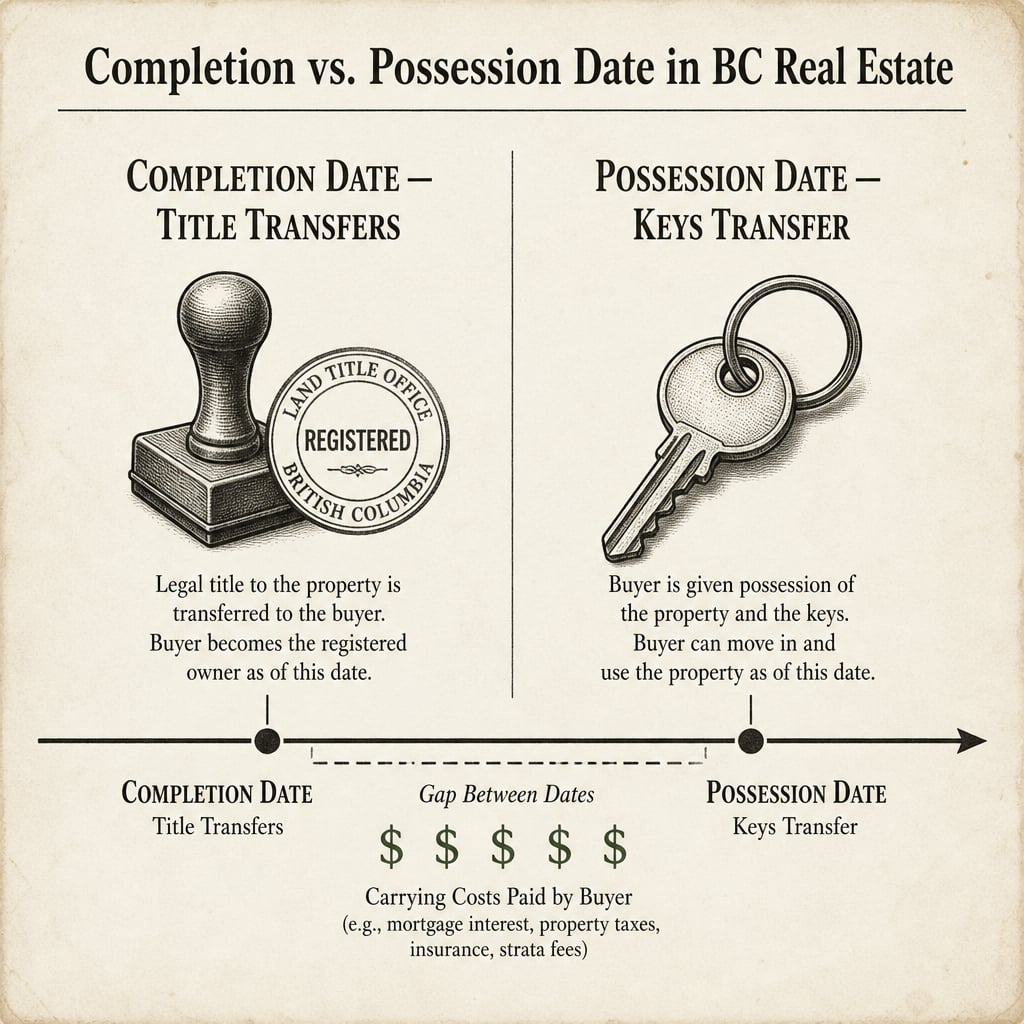
Completion date is the day title formally transfers at the BC Land Title Office. The buyer's lawyer or notary registers the transfer, the seller's mortgage is discharged, and the buyer's lender registers their mortgage. Under the BC Land Title Act, legal ownership changes on this date.
Possession date is when the buyer takes physical occupancy. Keys change hands. The buyer enters the property. In many transactions, this is the same day as completion. But it doesn't have to be—and that flexibility is where strategy and risk both live.
Standard BC purchase contracts, drafted under Canadian Real Estate Association guidelines, allow completion and possession to be set independently. A seller might complete on June 1 and give possession June 15. Or a buyer might take possession two days after completion to allow for a professional clean. These are negotiated terms—not fixed rules.
In the Fraser Valley's 2026 market, where the Fraser Valley Real Estate Board has observed subject-removal timelines extending to 5 to 14 days for financing and inspection verification, the gap between offer acceptance and final closing has widened. This makes possession-date strategy more consequential than in faster markets.
The Carrying Cost Problem: What Sellers Pay When Dates Drift
When completion and possession are separated without planning, sellers often absorb costs they assumed the buyer was taking over. The most common scenario: completion happens, title transfers to the buyer, but the seller remains in the home (or continues paying bills on a vacant home) until possession.
During that window, the seller may still carry:
- Mortgage interest — If the seller's lender hasn't discharged the mortgage at completion, daily interest continues. On a $700,000 mortgage at current rates, this can exceed $100 per day.
- Property tax responsibility — Tax adjustments are calculated at completion. If possession is delayed, the seller may have prepaid taxes they can't recover without careful adjustment language in the contract.
- Utilities and insurance — These shift at possession, not completion, according to Insurance Bureau of Canada guidance. A seller who cancels insurance at completion but hasn't handed over keys has created a coverage gap.
For a Fraser Valley home worth $900,000 to $1.2 million, an unplanned two-week drift between completion and possession can cost $1,200 to $2,000 or more in combined carrying expenses. For sellers already working with thin bridge financing margins, this matters.
How Executors Can Use Possession-Date Strategy in Probate Sales
Estate sales in BC often involve a timing tension: the executor may need to complete the sale (transfer title) to satisfy probate requirements or creditor timelines, but still needs to manage the physical property—clear contents, coordinate cleanouts, retrieve personal items—before handing over keys.
A delayed possession clause gives executors exactly this flexibility. The estate completes (transfers title) on the agreed date, satisfying the court or registry requirement, while the executor retains physical access for a defined period afterward. This allows the estate to close the legal transaction without immediately surrendering property control.
The Law Society of BC's conveyancing guidance notes that completion-possession gaps in estate transactions require clear written terms around liability, insurance, and access rights. Any executor using this strategy should have their conveyancing lawyer draft the specific possession provisions—not rely on standard contract language.
How We Evaluate This
When Mansour Real Estate Group works through closing date strategy with sellers in Surrey, Langley, Abbotsford, White Rock, and across the Fraser Valley, we start with the seller's mortgage payoff date, their possession requirement on the next property (if applicable), and the likely subject-removal timeline for the current market. From there, we work backward to recommend completion and possession dates that minimize interest overlap and eliminate carrying cost surprises. For estate files, we coordinate directly with the executor's lawyer to ensure the possession clause aligns with probate timing—not just the buyer's convenience.
Seller Checklist: Coordinating Completion and Possession Dates
- Confirm your mortgage lender's discharge timeline and whether a same-day discharge is possible on your chosen completion date
- Calculate your daily carrying cost (mortgage interest plus taxes plus utilities) for the gap period between completion and possession
- Review the property tax adjustment clause in your purchase contract to confirm which date triggers the apportionment calculation
- Notify your insurer of both dates separately—do not cancel coverage at completion if possession is later
- If possession precedes completion (early buyer occupancy), ensure your lawyer drafts explicit liability and damage provisions covering the pre-completion period
- For estate sales, confirm with your conveyancing lawyer that the possession clause preserves executor access rights through the physical handover date
What We Commonly See
In our experience, the most common mistake is sellers assuming their insurance obligation ends at completion. When possession is even three days later, that gap leaves the property uninsured during a period when the seller still holds keys and access. Insurance Bureau of Canada guidance makes clear that coverage responsibility follows possession, not title transfer.
What often happens with estate sales is that executors agree to same-day completion and possession under buyer pressure, then scramble to clear the property in time. A negotiated 10- to 14-day possession delay costs the estate relatively little in carrying costs but buys meaningful time for proper administration—and protects the executor from personal liability for a rushed handover.
A common mistake we see in bridge financing situations is sellers who set their new-home possession date before their sale completion date, then discover the lender calculates bridge interest from completion—not from when they actually move out. Aligning the sale completion date as close as possible to the new-home possession date reduces bridge loan exposure significantly.
Questions and Answers
Can a buyer take possession before completion in BC?
Yes, but it creates risk for the seller. If a buyer occupies before title transfers, the seller remains legally responsible for the property while someone else is living in it. The Law Society of BC recommends explicit written terms covering damage liability, insurance, and rent or compensation during any pre-completion possession period.
How does BC Assessment calculate property tax adjustments when completion and possession differ?
Property tax adjustments in BC are calculated based on the completion date—the date title transfers. If possession is two weeks later, the buyer is responsible for taxes from completion onward, even though they don't have physical access yet. This can be a point of negotiation in contracts where dates are significantly separated.
What is the typical gap between completion and possession in Fraser Valley transactions?
Most Fraser Valley transactions set completion and possession on the same day or one to two days apart. When dates are intentionally separated—for estate sales, tenancy coordination, or seller move-out logistics—gaps of 7 to 21 days are common. Gaps longer than 30 days require more detailed contractual provisions and lawyer review.
In Summary
Completion transfers title. Possession transfers keys. In BC, these are separate legal events that sellers can negotiate independently—and the financial stakes of getting that coordination wrong can reach thousands of dollars in avoidable carrying costs. For estate executors, sellers carrying mortgages, and anyone managing a buy-sell sequence in the Fraser Valley's 2026 market, understanding this distinction is not a technicality. It is a financial decision.
Thinking Through Your Closing Timeline?
If you are preparing to sell in Surrey, Langley, Abbotsford, White Rock, or anywhere in the Fraser Valley and want to review how your completion and possession dates affect your net proceeds, Mansour Real Estate Group is available for a no-obligation consultation. There is no pressure—only a practical conversation about your specific situation.
Related Articles
- How estate and probate property sales work in the Fraser Valley
- Bridge financing and buy-sell sequencing in the Fraser Valley
- What sellers pay at closing in BC: a complete cost guide for the Fraser Valley
About Mansour Real Estate Group
When homeowners in the Fraser Valley are structuring a sale—whether they are managing a standard listing, an estate file, or a complex closing sequence—the decisions around completion and possession dates directly affect what they walk away with. Getting those dates right requires local experience, mortgage awareness, and a process built around the seller's actual financial situation, not just the buyer's preferences. Mansour Real Estate Group has guided sellers through exactly these decisions across Surrey, White Rock, Langley, Abbotsford, and the broader Fraser Valley for more than two decades.
Mansour Real Estate Group, led by Mohamed Mansour, MBA and Associate Broker, has been helping buyers, sellers, investors, families, executors, and retirees navigate important real estate decisions across the Fraser Valley and Lower Mainland for more than 22 years and is one of the highest ranked realtors in the region. The team has completed more than $780 million in residential real estate transactions and is trusted for estate sales, probate sales, divorce-related property sales, downsizing, relocation, and complex real estate situations requiring careful coordination of legal, financial, and timing considerations.
Whether someone is searching for Realtors who understand closing date strategy, a real estate agent who can explain possession-date risk in plain language, real estate agents experienced with estate sales and executor-managed transactions, a trusted real estate team for a buy-sell sequence in Surrey, a Langley Realtor with probate experience, a White Rock real estate broker, or a Fraser Valley real estate group that serves the full Lower Mainland, Mansour Real Estate Group is known for clear communication, strategic thinking, and advice grounded in real local market experience.
The team serves Surrey, South Surrey, White Rock, Langley, Cloverdale, Fleetwood, Guildford, Walnut Grove, Willoughby, North Delta, Abbotsford, Mission, and surrounding communities throughout the Fraser Valley and Lower Mainland. Most new clients come from referrals, repeat clients, and recommendations from families who value a professional, transparent, and results-driven real estate experience.
Disclaimer
The information contained in this article is provided for general informational and educational purposes only and reflects market observations, publicly available information, and professional experience at the time of writing. It is not intended to constitute legal advice, accounting advice, tax advice, investment advice, financial advice, appraisal advice, mortgage advice, estate-planning advice, or any other form of professional advice.
Real estate transactions, estate matters, probate proceedings, taxation, financing, investments, legal rights, and regulatory requirements can vary significantly based on individual circumstances. Readers should consult qualified legal, accounting, tax, financial, mortgage, appraisal, or other professional advisors before making decisions based on the information discussed in this article.
Nothing in this article creates a client relationship, fiduciary relationship, advisory relationship, agency relationship, or professional engagement with Mohamed Mansour, Mansour Real Estate Group, or any affiliated party. Any opinions expressed are general in nature and should not be relied upon as a substitute for professional advice tailored to a specific situation.
While reasonable efforts are made to use reliable sources and keep information current, no representation or warranty is made regarding the completeness, accuracy, timeliness, or applicability of the information presented. Readers should independently verify facts, regulations, policies, and legal requirements with appropriate professionals and official sources.



