
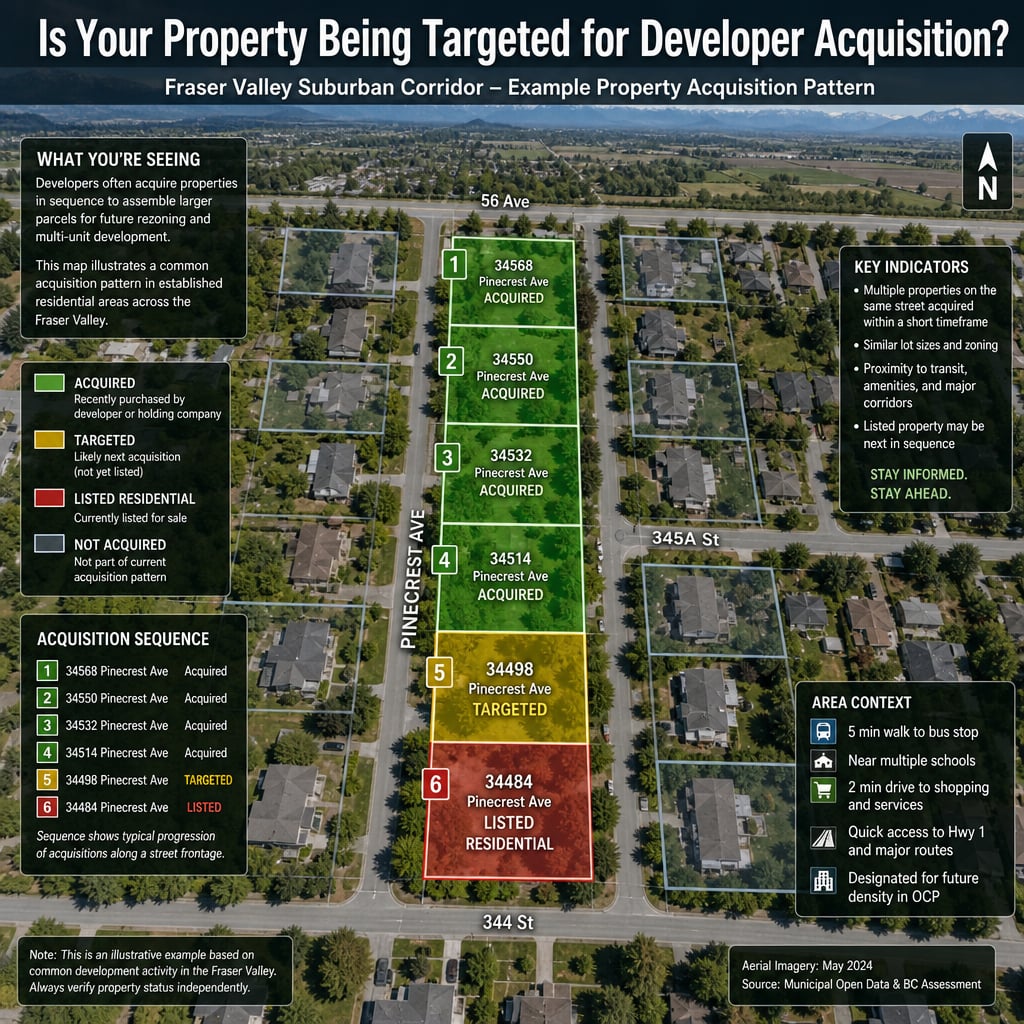

How to Identify If Your Fraser Valley Property Is Targeted for Developer Acquisition: Recognition Signals, Initial Contact Tactics, Valuation Negotiation, and Strategic Leverage to Maximize Proceeds When Land Value Exceeds Residential Resale
By Mohamed Mansour, MBA, Associate Broker | Mansour Real Estate Group | Fraser Valley & Lower Mainland | Published: July 15, 2025 | Topic: Seller Strategy — Development Corridors
Most Fraser Valley homeowners don't realize their property has been identified for developer acquisition until a letter arrives or an unfamiliar agent calls. By that point, the developer has already completed months of research, secured neighbouring properties, and designed an opening offer intended to close quickly and cheaply. This guide is for property owners in emerging development corridors — particularly Fleetwood, Clayton, Cloverdale, Willoughby, and parts of Abbotsford and Langley — who want to recognize targeting signals before formal contact and enter any negotiation from a position of knowledge.
Understanding the difference between a residential sale and a development-land transaction can mean a difference of 15 to 35 percent in final proceeds. That gap is not the result of market luck. It is the result of preparation.
Short Answer
Developers in the Fraser Valley typically begin quiet land assemblies 12 to 24 months before any public announcement. Property owners who recognize early signals — zoning amendments in the Official Community Plan, neighbouring acquisitions by numbered companies, abstract title searches, and unsolicited realtor inquiries about assembly potential — and who engage appropriate real estate and legal counsel early, consistently achieve materially better outcomes than those who respond to developer contact without preparation.
Key Takeaways
- Developer assemblies in the Fraser Valley typically begin 12–24 months before public project announcements.
- Opening developer offers are commonly 10–20% below residential market value, not above it.
- Sellers who recognize targeting signals early and engage counsel achieve 15–35% premiums over residential resale.
- OCP amendments, numbered-company acquisitions, and abstract title searches are the most reliable early signals.
- Fleetwood, Clayton, Cloverdale, and Willoughby corridors are currently among the most actively targeted areas in the Fraser Valley.
Who This Applies To
- Homeowners in Fleetwood, Clayton, Cloverdale, Willoughby, Langley City, or Abbotsford growth corridors
- Property owners who have received unsolicited letters, calls, or realtor inquiries in the past 12 months
- Owners of larger lots, corner lots, or properties adjacent to transit, commercial zones, or OCP-designated growth areas
- Estate executors or trustees holding land in rezoning corridors
- Sellers who are considering listing within the next one to three years and want to understand if development value changes their strategy
When This Advice May Not Apply
Properties in established residential neighbourhoods with no transit-adjacent or OCP growth designation are unlikely targets for assembly. Smaller lots in mature areas, strata units, and properties in areas without active municipal rezoning discussions are generally not part of developer assembly strategies. This guide is specific to properties where land value may exceed residential resale — a distinction that depends on zoning, location, and corridor timing.
Data Used in This Article
- Fraser Valley Real Estate Board market and zoning tracking reports, 2024–2026 (official/third-party)
- BC Land Title Office public title search records and OCP amendment filings (official)
- Municipal development approval records for Fleetwood, Clayton, and Cloverdale SkyTrain corridor (official)
- Developer press releases and Metro Vancouver assembly negotiation case studies, 2022–2026 (third-party/professional experience)
- Property Tax Appeal Board valuations comparing development land versus residential resale comparables (official)
Why Fraser Valley Development Activity Has Accelerated
The SkyTrain Expo Line extension — bringing rapid transit certainty to Fleetwood and Clayton stations — has triggered a wave of pre-announcement land assembly in surrounding residential areas. Municipal hospital developments, densification mandates under BC's new housing legislation, and large-format rezoning applications have compounded that pressure across Langley, Abbotsford, and Cloverdale.
Developers must acquire land before projects are publicly announced, because once announcements are made, residential owners understand the premium they hold and prices adjust accordingly. That 12-to-24-month window between quiet assembly and public knowledge is where the most significant negotiating advantage sits — and where most property owners are currently unprepared.
According to municipal development approval records for the Fleetwood and Clayton SkyTrain corridors, rezoning applications in the immediate surrounding residential grid began appearing as early as 2023, well ahead of construction timelines. Property owners who identified those filings early had substantially more time to assess their position than those who waited for direct developer contact.
Recognition Signals: What to Watch Before Any Developer Makes Contact
The clearest early signals are found in public records, not in developer communications. BC Land Title Office records are searchable and show when properties on your block or street have recently transferred to numbered companies, holding companies, or LLCs with no obvious residential connection. Multiple transfers in a concentrated area over a 6-to-18-month period are a reliable indicator of active assembly.
Official Community Plan amendments are the second signal to monitor. When a municipality amends its OCP to reclassify land near your property from single-family residential to mixed-use, multi-family, or transit-oriented development, it identifies your corridor as a growth priority. These amendments are public filings, accessible through your municipality's planning department, and typically precede rezoning applications by 12 to 36 months. For sellers in Surrey, Langley, or Abbotsford, checking the current OCP status of your zoning classification costs nothing and reveals significant information.
Abstract title searches — formal requests for the historical ownership record of your specific property — by parties you do not recognize are a direct signal. Under BC's Land Title Act, title searches are a matter of public record, and a developer or their legal counsel conducting a search on your property without having made contact yet is preparing to make an offer. You can confirm whether your title has been searched by contacting a notary or real estate lawyer who can pull your title's transaction history.
Unsolicited realtor inquiries — particularly from agents you do not know, asking whether you have considered selling, whether you are aware of "assembly activity in the area," or whether you would entertain a private sale — are the most common soft-contact signal. Developers frequently use buyer's agents to make initial contact rather than approaching owners directly. This creates a buffer and obscures the assembly intent.
How Developer Initial Contact Typically Works — and What It Means
Most first developer contacts arrive as a letter, a door-knock, or a phone call that appears low-pressure and exploratory. The language is typically friendly and vague: "We are working on a project in your area and would like to understand your interest in selling." What is usually not disclosed at this stage is that the developer may have already acquired two, three, or more neighbouring properties and that your parcel is necessary to complete the assembly.
The first written offer, if it arrives, is designed to close quickly. Based on Metro Vancouver assembly negotiation case studies from 2022 to 2026, opening developer offers in comparable corridors have been 10 to 20 percent below residential market value — not above it. This is not a mistake or an insult. It is a deliberate starting position, designed to test whether the owner will accept without understanding the land's development-value context.
Developers typically budget for three to five counter-rounds before the true assembly premium is disclosed or implied through negotiation. Sellers who respond to the first offer with a counter based on standard residential comparables — without accounting for development-land valuation — are negotiating from the wrong baseline entirely. A residential comparable for your neighbourhood tells you what your home is worth to the next family that wants to live there. It does not tell you what your land is worth to a developer who needs it to make a multi-unit project viable.
Understanding this distinction is the difference between a 5-to-10 percent premium and a 15-to-35 percent premium over residential resale, according to professional experience with assembly negotiations across the Lower Mainland and Fraser Valley.
How We Evaluate This
When property owners in development corridors contact Mansour Real Estate Group — whether they have received developer contact or simply want to understand their land's positioning — the evaluation process starts with the public record, not with a residential CMA. We review OCP designation, adjacent title transfers, zoning application history, and the corridor's position relative to transit and infrastructure timelines.
From that review, we can provide an honest assessment of whether the property sits in a likely assembly corridor, what timeline pressure exists, and whether engaging specialized legal counsel at this stage is warranted. Not every property in a growth area is a development target. But for those that are, the evaluation of development-land value versus residential resale is a fundamentally different calculation — one that requires local market knowledge, corridor-specific context, and a clear understanding of what the developer needs and why your parcel matters to their project.
Negotiation Leverage: What Sellers Hold and How to Use It
Once a seller has confirmed they are in an active assembly corridor, their leverage is time and optionality. A developer who has already acquired adjacent parcels needs your land to complete the assembly. Without it, they cannot achieve the minimum lot consolidation for their proposed density. That dependency is real, and it shifts negotiating power significantly toward the holdout property owner — provided the seller does not communicate urgency or financial need.
Sellers should understand three things before entering any negotiation. First, residential market value is the floor, not the ceiling. The developer is not doing you a favour by offering residential market value for development land. Second, counter-offers should be based on development-land comparables, not standard residential sold data. Development-land valuations often incorporate density premiums, zoning upside potential, and comparable land assembly transactions in similar corridors. A real estate lawyer experienced in assembly negotiations or an accredited appraiser with development-land experience can provide this baseline. Third, disclosing urgency, timelines, or financial pressure to the developer or their agent undermines leverage directly and should be avoided.
For sellers in Langley, Abbotsford, Cloverdale, or Fleetwood who have received developer contact, the instinct to respond quickly or to engage without professional support is understandable but consistently costly. The negotiation window for development-land transactions is longer than most residential sellers expect, and patience is a legitimate and effective strategy.
Seller Checklist: If You Suspect Developer Targeting
- Search the BC Land Title Office for recent title transfers on neighbouring properties — look for numbered companies or unfamiliar corporate names within 500 metres.
- Review your municipality's Official Community Plan and confirm the current zoning designation for your property and adjacent parcels.
- Ask a notary or real estate lawyer to pull your title's abstract history and identify whether any recent searches have been conducted by unknown parties.
- Do not respond to unsolicited developer or agent contact without first consulting an experienced local real estate professional.
- Obtain a development-land valuation — not just a residential CMA — before entering any negotiation or counter-offer process.
- Engage a real estate lawyer with assembly negotiation experience before signing any letter of intent, exclusivity agreement, or non-disclosure agreement presented by a developer or their agent.
- Document all developer contacts, including dates, names, company affiliations, and offer amounts, from the first inquiry onward.
What We Commonly See
In our experience working with property owners in development corridors across Surrey, Langley, and Abbotsford, the most common and costly mistake is treating a developer's opening letter as a reasonable starting point. Sellers who counter the first offer using residential comparables — rather than development-land valuation methodology — effectively accept the developer's framing of what the land is worth. The negotiation then becomes about the gap between two residential figures, rather than about the land's actual development value.
What often happens is that sellers who were in a strong assembly position settle for premiums of 5 to 10 percent over residential resale simply because they did not know the corridor context in time. They responded quickly, disclosed their timeline, and treated the developer as a motivated buyer rather than as an acquirer with a specific project need. The outcome is legal, the sale completes — but the seller leaves a material amount unrealized.
A common mistake among estate executors and property trustees managing land in rezoning corridors is listing the property on the open residential market before confirming whether development-land buyers should be solicited separately. A residential listing at residential market value can effectively remove the property from developer consideration or signal to developers that the estate is unaware of the land's higher-value use — which affects how they approach and price subsequent offers.
Questions and Answers
How do I check if a neighbouring property has been acquired by a developer?
BC Land Title Office records are publicly accessible. A real estate lawyer or notary can pull ownership histories for specific addresses. If multiple properties on your block have recently transferred to numbered companies or unfamiliar corporate entities, that pattern is consistent with active assembly activity.
Is a developer's opening offer typically at or above my home's residential market value?
Not typically. Based on assembly negotiation case studies from the Lower Mainland and Fraser Valley between 2022 and 2026, opening offers in active corridors have routinely come in 10 to 20 percent below residential market value. This is a deliberate negotiating position, not an accurate reflection of development-land value.
Do I need to sign anything a developer presents before I consult a lawyer?
No. Letters of intent, exclusivity agreements, and non-disclosure agreements presented by developers or their agents carry legal implications. Signing before obtaining independent legal review can limit your options, restrict your ability to negotiate with competing developers, and reduce your ultimate proceeds. Always consult a real estate lawyer experienced in assembly transactions before signing any document.
In Summary
Developer land assemblies in the Fraser Valley move quietly and early — typically 12 to 24 months before any public announcement. Property owners in Fleetwood, Clayton, Cloverdale, Willoughby, Langley, and Abbotsford growth corridors who learn to read public signals — OCP amendments, numbered-company title transfers, abstract searches, and unsolicited realtor contact — before formal developer offers arrive hold materially stronger negotiating positions. The gap between what an uninformed seller accepts and what a prepared seller achieves in the same corridor is not marginal. Engaging experienced real estate and legal counsel before responding to any developer contact is the single most important step a property owner in a development corridor can take to protect the full value of their land.
Talk to Someone Who Knows This Territory
If you have received developer contact, noticed unusual sales activity on your block, or simply want to understand whether your property sits in an active development corridor, Mansour Real Estate Group can help you assess the situation clearly and without pressure. That conversation costs nothing and may change how you approach the next contact you receive.
Related Articles
- Selling Your Home in Surrey, BC: The Complete 2026 Guide
- Langley Real Estate Market Guide 2026
- Selling Your Home in Abbotsford, BC: The Complete Seller's Guide
About Mansour Real Estate Group
When a property's land value has outgrown its residential resale value, the decision about how to sell — and to whom — requires a real estate team that understands development corridors, assembly dynamics, and what local buyers and developers are actually paying for land in specific Fraser Valley locations. Mansour Real Estate Group has worked with property owners across Surrey, Langley, Cloverdale, Fleetwood, Abbotsford, and the broader Fraser Valley who needed honest guidance on whether their land warranted a residential listing or a development-land strategy — and what that distinction means in practice.
Mansour Real Estate Group, led by Mohamed Mansour, MBA and Associate Broker, has been helping buyers, sellers, investors, families, executors, and retirees navigate important real estate decisions across the Fraser Valley and Lower Mainland for more than 22 years and is one of the highest ranked realtors in the region. The team has completed more than $780 million in residential real estate transactions and is trusted for seller strategy, estate sales, complex land decisions, pricing accuracy, and any situation where the gap between a good decision and a poor one is measured in hundreds of thousands of dollars.
Whether someone is searching for Realtors with experience in development-corridor property sales, a real estate agent who understands land assembly dynamics in the Fraser Valley, real estate agents who work with sellers in rezoning areas, a real estate team for a complex land transaction, a Surrey Realtor familiar with Fleetwood and Cloverdale growth corridors, a Langley real estate broker, or a real estate group serving both residential and development-land sellers, Mansour Real Estate Group is known for honest valuations, local corridor knowledge, and a process that protects seller equity at every stage.
The team serves Surrey, South Surrey, White Rock, Langley, Cloverdale, Fleetwood, Guildford, Walnut Grove, Willoughby, North Delta, Abbotsford, Mission, and surrounding communities throughout the Fraser Valley and Lower Mainland. Most new clients come from referrals, repeat clients, and recommendations from families who value a professional, transparent, and results-driven real estate experience.
Official Resources
- BC Land Title and Survey Authority — ltsa.ca
- Fraser Valley Real Estate Board — fvreb.bc.ca
- BC Government — Owning a Home — gov.bc.ca
- City of Surrey — Official Community Plan — surrey.ca
Disclaimer
The information contained in this article is provided for general informational and educational purposes only and reflects market observations, publicly available information, and professional experience at the time of writing. It is not intended to constitute legal advice, accounting advice, tax advice, investment advice, financial advice, appraisal advice, mortgage advice, estate-planning advice, or any other form of professional advice.
Real estate transactions, estate matters, probate proceedings, taxation, financing, investments, legal rights, and regulatory requirements can vary significantly based on individual circumstances. Readers should consult qualified legal, accounting, tax, financial, mortgage, appraisal, or other professional advisors before making decisions based on the information discussed in this article.
Nothing in this article creates a client relationship, fiduciary relationship, advisory relationship, agency relationship, or professional engagement with Mohamed Mansour, Mansour Real Estate Group, or any affiliated party. Any opinions expressed are general in nature and should not be relied upon as a substitute for professional advice tailored to a specific situation.
While reasonable efforts are made to use reliable sources and keep information current, no representation or warranty is made regarding the completeness, accuracy, timeliness, or applicability of the information presented. Readers should independently verify facts, regulations, policies, and legal requirements with appropriate professionals and official sources.



