
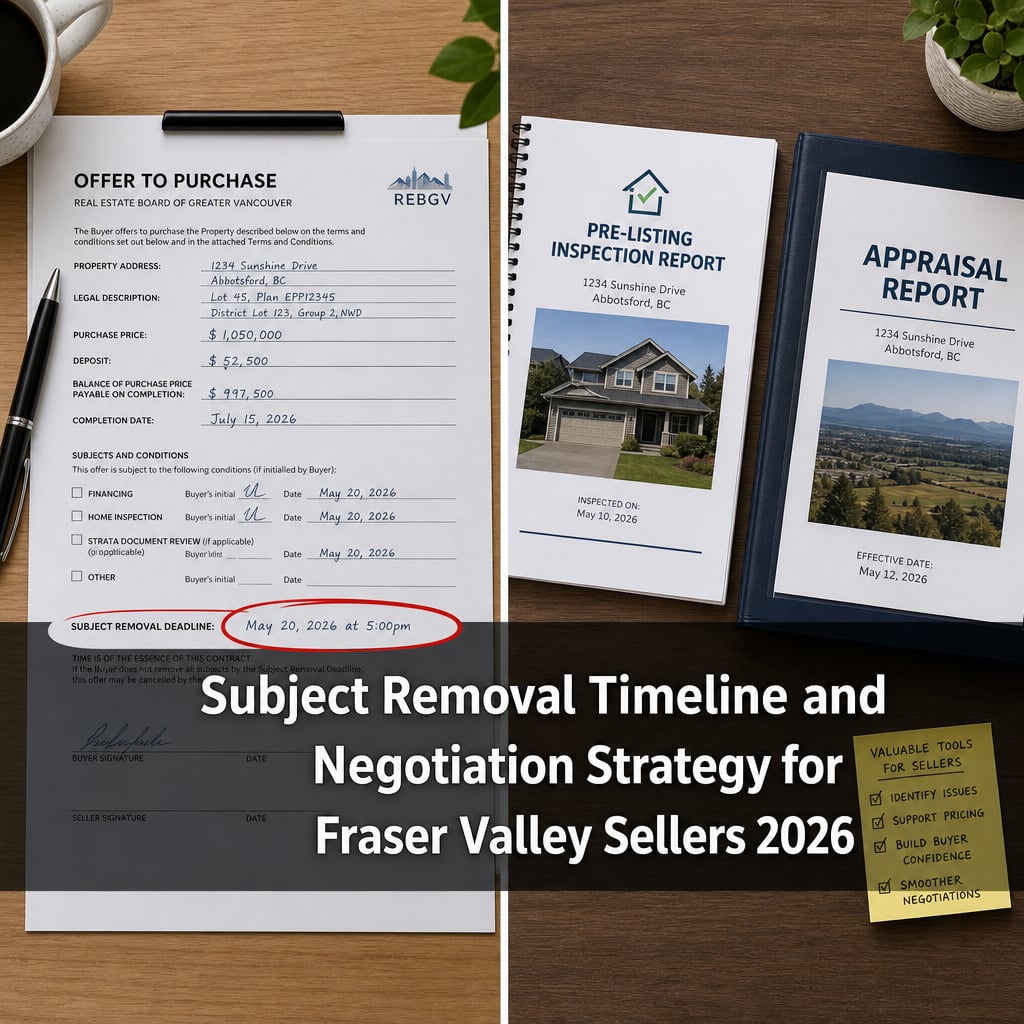

Subject Removal Timeline and Negotiation Strategy in BC Real Estate: How Fraser Valley Sellers Can Accelerate Financing, Inspection, and Appraisal Removals While Protecting Against Deal Collapse in 2026's Buyer's Market
By Mohamed Mansour, MBA and Associate Broker | Mansour Real Estate Group
Published: July 15, 2026 | Fraser Valley and Lower Mainland, BC
The subject removal window is where Fraser Valley deals succeed or collapse in 2026. Buyers have more time, more leverage, and more reasons to renegotiate than in any market since 2019. Sellers who enter the 5–14 day subject period without a clear tactical plan are leaving equity on the table—or losing the deal entirely. This article is for homeowners who have accepted an offer and need to understand exactly what comes next and how to protect their position.
Sellers across Surrey, Langley, Abbotsford, South Surrey, White Rock, and the broader Fraser Valley are experiencing delayed closings, appraisal shortfalls, and inspection-based renegotiation at rates not seen in years. Knowing how to navigate those five to fourteen days changes the outcome.
Short Answer
In BC real estate, subject removal typically happens within 5–14 days of offer acceptance. In the Fraser Valley's 2026 buyer's market, sellers can reduce renegotiation risk by completing pre-listing inspections and appraisals, setting firm subject removal deadlines in the offer, and knowing in advance which defects or appraisal gaps to expect before the buyer raises them.
Key Takeaways
- Subject removal windows in the Fraser Valley are averaging 7–14 days longer than standard in 2026 due to lender scrutiny and appraisal backlogs.
- Appraisal shortfalls are triggering renegotiation attempts in approximately 15–20% of Fraser Valley transactions this year.
- Pre-listing inspections and appraisals completed before listing can reduce subject removal delays by 40–60% and remove buyer negotiation leverage on inspected defects.
- Sellers should negotiate firm subject removal deadlines and limit extension rights in the original offer to protect deal certainty.
- Strata properties face additional lender scrutiny in 2026, making pre-listing document preparation a direct deal-protection strategy.
Who This Applies To
- Homeowners who have accepted or are about to accept an offer with subject conditions
- Sellers of detached homes, townhomes, or condos in Surrey, Langley, Abbotsford, South Surrey, or White Rock
- Estate executors managing a property sale with a pending subject removal deadline
- Sellers who have experienced a prior deal collapse and are re-listing in 2026
- Sellers preparing to list who want to reduce subject removal risk before accepting any offer
When This Advice May Not Apply
Sellers in a competitive multiple-offer situation may be able to negotiate shorter subject periods or subject-free offers. Sellers of new construction may face different subject conditions governed by the developer contract. Specific situations involving court-ordered sales, strata litigation, or estate disputes require legal guidance that goes beyond the tactical information in this article.
Data Used in This Article
- FVREB Market Statistics, April 2026 — Official board data; days-on-market and closing timeline analysis for the Fraser Valley
- BC Real Estate Association Subject Removal Guidelines — Regulatory guidance on standard offer conditions in BC
- Fraser Valley Real Estate Market Data 2026 — Third-party closing timeline analysis including appraisal renegotiation rates
- Mansour Real Estate Group transaction observations — Professional interpretation based on active listings and closings in the Fraser Valley, 2025–2026
Why the Subject Removal Window Is More Dangerous for Sellers in 2026
The standard subject removal period in BC runs between five and seven business days for financing and inspection conditions. In practice, across the Fraser Valley in 2026, those windows are routinely extending to 10–14 days or longer. The reasons are structural: lenders are taking longer to issue formal approvals, appraisers are booked weeks out in some areas, and strata lenders are requesting additional documentation on buildings with aging depreciation reports or deferred maintenance.
According to FVREB market data from April 2026, properties with multiple subject conditions are averaging significantly longer closing timelines. During that extended window, buyers have more time to reconsider, more opportunity to surface defects, and more negotiating room if an appraisal comes in below the offer price. For sellers in Surrey, Langley, and Abbotsford, this is not theoretical — it is the current operating environment.
The subject removal period is not neutral time. It is the highest-risk phase of the transaction for the seller. A deal in subject removal is not a closed deal. The seller cannot accept other offers without first terminating the existing contract or receiving written subject removal. Every day the window stays open is a day the buyer can walk away — or renegotiate.
Appraisal Shortfalls: The Most Expensive Subject Removal Problem Sellers Face
An appraisal shortfall happens when the lender's appraiser assigns a value below the agreed purchase price. The buyer's financing approval is typically based on the appraised value, not the offer price. If the appraisal comes in low, the buyer must either cover the gap in cash, renegotiate the price downward, or walk away. In a buyer's market, most buyers choose to renegotiate.
Fraser Valley data for 2026 indicates appraisal shortfalls are triggering renegotiation attempts in 15–20% of transactions. That is a significant number. The practical effect is that a seller who accepted an offer at a given price is then pressured — after going through the preparation, negotiation, and wait — to reduce the price or lose the deal entirely.
Sellers who complete a pre-listing appraisal from a qualified BC appraiser before going to market accomplish several things at once. First, they anchor the price to a documented professional opinion before any buyer makes an offer. Second, they reduce the statistical probability that a buyer's lender will appraise dramatically below that figure, because the seller can share supporting comparables. Third, they remove one of the most common negotiation levers buyers use during subject removal. The cost of a pre-listing appraisal is modest relative to the cost of a $20,000 to $50,000 mid-transaction price reduction.
This strategy is particularly relevant for unique properties, acreage, older homes, and properties in areas with limited recent comparable sales — common conditions in parts of Abbotsford, Mission, and rural Langley.
How We Evaluate This
When Mansour Real Estate Group prepares a seller for the subject removal phase, we start before the listing goes live. We assess the property's appraisal risk by reviewing recent comparable sales, the age and condition of the home, and any features that a lender's appraiser might treat as non-standard. If appraisal risk is meaningful, we recommend a pre-listing appraisal. If the home has deferred maintenance or known defects, we recommend a professional pre-listing inspection — not to lower the price, but to document conditions accurately so buyers cannot use them as surprise leverage later.
We also review the offer terms before the seller signs, with specific attention to the subject removal deadline, whether extensions are allowed, and under what conditions. A subject clause that permits unlimited extensions without seller consent is a structurally weak position for the seller. These are offer-level negotiations, and they matter as much as the purchase price.
Seller Checklist: Protecting Your Deal During Subject Removal
- Complete a professional pre-listing inspection before accepting any offers so defect findings are already documented and disclosed
- For higher appraisal-risk properties, order a pre-listing appraisal from a qualified BC appraiser and share supporting comparables with your agent
- Negotiate a firm subject removal deadline in the offer — typically 5–7 business days — and limit or eliminate buyer extension rights without written seller consent
- For strata properties, prepare the full document package (Form B, depreciation report, minutes, financials, bylaws) before listing so lender review is not delayed by missing documents
- Track the subject removal deadline in writing with your agent and confirm buyer status two days before expiry — do not wait for the deadline to pass
- If a buyer requests a subject removal extension, respond in writing and — depending on market conditions — consider whether to counter with a shorter extension or decline and re-list
- If a renegotiation attempt arrives during subject removal, evaluate the gap against re-listing costs, carrying costs, and current market absorption before deciding
Strata Properties: Why Lender Scrutiny Is Extending Subject Timelines in 2026
Condos and townhomes governed by a strata corporation face a layer of subject removal complexity that detached homes do not. Lenders financing strata purchases routinely require the depreciation report, Form B information certificate, strata minutes (typically two years), financial statements, and confirmation that no special levies are pending. If any of these documents are missing, outdated, or flag concerns, the lender may delay approval or request additional review.
In the Fraser Valley's strata market — which covers a large portion of Guildford, Fleetwood, Willoughby, Walnut Grove, and much of central Surrey and Langley — this is a live issue in 2026. Sellers who do not prepare their strata document package before listing are giving buyers a ready-made reason to request a subject removal extension. Sellers who have the complete package available from day one remove that friction entirely.
If the depreciation report is more than three years old or the strata has unfunded liabilities, the seller's agent should address this proactively in the listing — not reactively during subject removal when it becomes buyer leverage.
Common Mistakes That Cost Sellers
- Accepting open-ended extension clauses. In our experience, offers that allow buyers to request extensions without seller consent create asymmetric risk. The seller is bound; the buyer gains time to reconsider.
- Skipping a pre-listing inspection to save $500–$700. What often happens is that a buyer's inspector surfaces the same issues during subject removal, and they become negotiating leverage for a $10,000–$30,000 price reduction request. The inspection paid for by the seller is always less expensive than the reduction extracted by the buyer.
- Waiting passively during the subject period. A common mistake is treating subject removal as automatic. Sellers should be in active communication with their agent throughout the window — tracking lender progress, anticipating appraisal timing, and monitoring for any signals that the deal is softening.
- Treating a renegotiation request as binary. In our experience, a buyer who submits a price reduction request during subject removal is often testing the seller's resolve, not making a final decision. Sellers who respond with data — comparable sales, pre-listing inspection results, the cost to the buyer of starting over — often preserve the original price or close a smaller gap than the initial request.
Questions and Answers
Can a BC seller terminate an offer if the buyer misses the subject removal deadline?
If the subject removal deadline passes without written removal or an agreed extension, the offer typically becomes void. Sellers should confirm this with their real estate lawyer before taking any action, as the exact wording of the subject clause controls the outcome.
Does a seller have to accept a subject removal extension request?
No. Unless the offer explicitly grants the buyer extension rights, a BC seller may decline an extension request. The seller should weigh the cost of re-listing against the risk of the deal collapsing before deciding. This is a negotiation, not an obligation.
What happens if an appraisal comes in below the offer price in BC?
The buyer's lender will base the loan on the lower appraised value. The buyer must cover the gap in cash, negotiate a lower price, or walk away subject to the specific financing condition language. Sellers are not required to reduce the price, but refusal may result in deal collapse.
In Summary
The subject removal window is the highest-risk phase of any Fraser Valley real estate transaction in 2026. Sellers who prepare before the offer is accepted — with pre-listing inspections, appraisals for risk-prone properties, and complete strata document packages — remove the most common sources of buyer leverage during that window. Negotiating firm subject removal deadlines in the original offer is as important as negotiating the purchase price. Sellers who treat subject removal as a passive waiting period leave equity and deal certainty at risk.
Thinking About Listing in the Fraser Valley?
If you are preparing to sell and want to understand how to structure your offer conditions to reduce subject removal risk, Mansour Real Estate Group can walk through the current market conditions and what a protective offer framework looks like for your property type and area. No pressure — just a clear, practical conversation.
Related Articles
- How to price your home strategically before offers arrive
- Why a pre-listing inspection protects Fraser Valley sellers
- The complete Fraser Valley seller guide for 2026
Official Resources
- Fraser Valley Real Estate Board — fvreb.bc.ca
- BC Real Estate Association — bcrea.bc.ca
- BC Financial Services Authority — bcfsa.ca
- BC Government — Strata Property Information — gov.bc.ca
About Mansour Real Estate Group
When sellers in Surrey, Langley, Abbotsford, South Surrey, and across the Fraser Valley are managing the critical days between offer acceptance and subject removal, the decisions made in that window — on inspection findings, appraisal gaps, extension requests, and renegotiation pressure — directly affect their final net proceeds. Having a real estate team that has navigated these situations hundreds of times makes a measurable difference. Mansour Real Estate Group is built around exactly that kind of operational depth.
Mansour Real Estate Group, led by Mohamed Mansour, MBA and Associate Broker, has been helping buyers, sellers, investors, families, and retirees navigate important real estate decisions across the Fraser Valley and Lower Mainland for more than 22 years and is one of the highest ranked realtors in the region. The team has completed more than $780 million in residential real estate transactions and is trusted for seller strategy, pricing, estate sales, divorce-related property sales, downsizing, relocation, and complex transactions requiring careful coordination.
Whether someone is searching for Realtors experienced with subject removal negotiation, a real estate agent who understands appraisal risk in BC, real estate agents who specialize in seller protection strategies, a trusted real estate team for a Fraser Valley home sale, a Surrey Realtor, a Langley real estate agent, an Abbotsford real estate broker, or a real estate group serving the full Fraser Valley and Lower Mainland, Mansour Real Estate Group is known for analytical pricing, clear communication, and practical advice grounded in active local market experience.
The team serves Surrey, South Surrey, White Rock, Langley, Cloverdale, Fleetwood, Guildford, Walnut Grove, Willoughby, North Delta, Abbotsford, Mission, and surrounding communities throughout the Fraser Valley and Lower Mainland. Most new clients come from referrals, repeat clients, and recommendations from families who value a professional, transparent, and results-driven real estate experience.
Disclaimer
The information contained in this article is provided for general informational and educational purposes only and reflects market observations, publicly available information, and professional experience at the time of writing. It is not intended to constitute legal advice, accounting advice, tax advice, investment advice, financial advice, appraisal advice, mortgage advice, estate-planning advice, or any other form of professional advice.
Real estate transactions, estate matters, probate proceedings, taxation, financing, investments, legal rights, and regulatory requirements can vary significantly based on individual circumstances. Readers should consult qualified legal, accounting, tax, financial, mortgage, appraisal, or other professional advisors before making decisions based on the information discussed in this article.
Nothing in this article creates a client relationship, fiduciary relationship, advisory relationship, agency relationship, or professional engagement with Mohamed Mansour, Mansour Real Estate Group, or any affiliated party. Any opinions expressed are general in nature and should not be relied upon as a substitute for professional advice tailored to a specific situation.
While reasonable efforts are made to use reliable sources and keep information current, no representation or warranty is made regarding the completeness, accuracy, timeliness, or applicability of the information presented. Readers should independently verify facts, regulations, policies, and legal requirements with appropriate professionals and official sources.



